From Real Exams Quiz
Secondary 2 Mathematics Geometry Trigonometry Quiz
Free Sec 2 Maths Geometry Trigonometry quiz, Exam version, with questions, answers, and syllabus-aligned practice for Singapore students.
These static practice materials are generated from the site's syllabus and paper-generation workflow, with source and model context shown so students and parents can evaluate the material before use.
Questions
Free quiz and exam paper access
Enter your details to view this paper
Your access is remembered on this device.
Answers
Secondary 2 Mathematics Quiz - Geometry Trigonometry: Answer Key
Total Marks: 40
Section A: Angle Properties and Polygons (Questions 1–5)
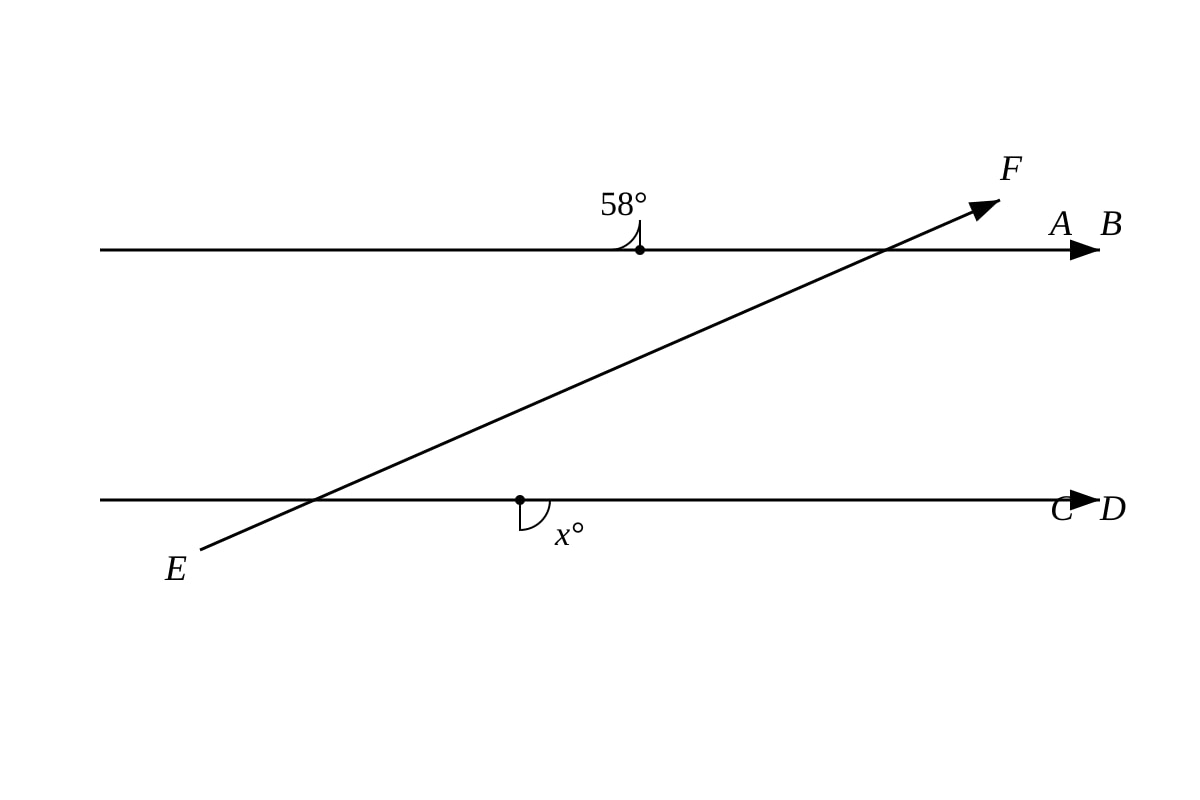
Question 1
Answer:
Marks: 2 (M1 for identifying angle relationship, A1 for correct answer)
Explanation: When a transversal cuts two parallel lines, alternate angles are equal. The angle marked and angle are alternate interior angles (they are on opposite sides of the transversal and inside the parallel lines). Therefore, .
Common mistake: Students may confuse alternate angles with corresponding angles or interior angles on the same side of the transversal. Remember: alternate angles form a "Z" shape and are equal.
Question 2
Answer: 15 sides
Marks: 2 (M1 for using correct formula, A1 for correct answer)
Explanation: For a regular polygon with sides:
- Interior angle
Given interior angle :
The polygon has 15 sides.
Alternative method: Use exterior angle . Since exterior angle , we have .
Question 3
Answer:
Marks: 2 (M1 for using angle sum of triangle, A1 for correct answer)
Explanation: The sum of interior angles in any triangle is .
Question 4
Answer:
Marks: 2 (M1 for finding number of sides, A1 for correct sum)
Explanation: For a regular polygon, exterior angle , where is the number of sides.
Given exterior angle :
The polygon has 15 sides.
Sum of interior angles
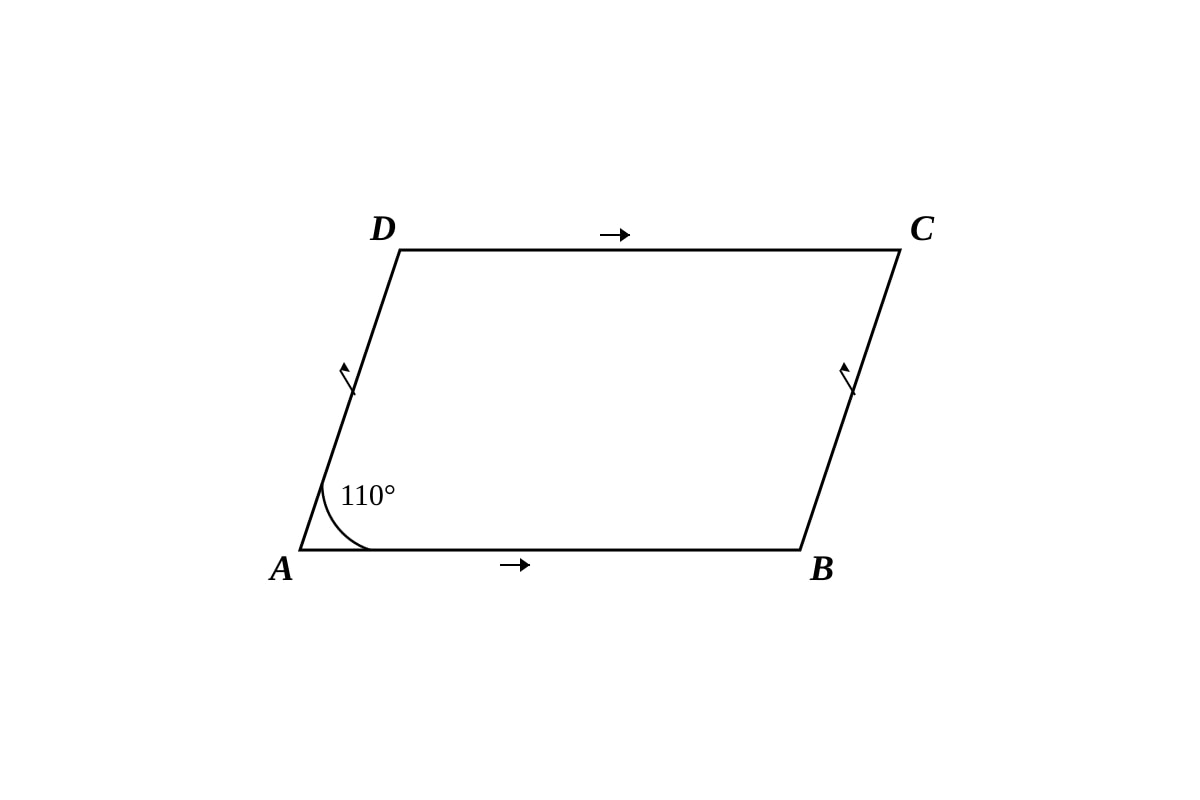
Question 5
Answer:
Marks: 2 (M1 for using parallelogram properties, A1 for correct answer)
Explanation: In a parallelogram, adjacent angles are supplementary (sum to ).
Key property: In a parallelogram, opposite angles are equal, and adjacent angles are supplementary.
Section B: Congruence and Similarity (Questions 6–10)
Question 6
Answer: SAS (Side-Angle-Side)
Marks: 1
Explanation: The SAS (Side-Angle-Side) congruence condition states that if two sides and the included angle of one triangle are equal to two sides and the included angle of another triangle, then the triangles are congruent.
Here, , , and . The angle is the included angle between sides and , and is the included angle between sides and . Therefore, SAS applies.
Common mistake: Students may confuse SAS with SSA (which is not a valid congruence condition). Ensure the angle is between the two given sides.
Question 7
Answer: Scale factor (or )
Marks: 2 (M1 for correct ratio, A1 for correct scale factor)
Explanation: The scale factor from to is the ratio of corresponding side lengths. We can verify with the other pair: .
The scale factor is 1.5, meaning is 1.5 times larger than .
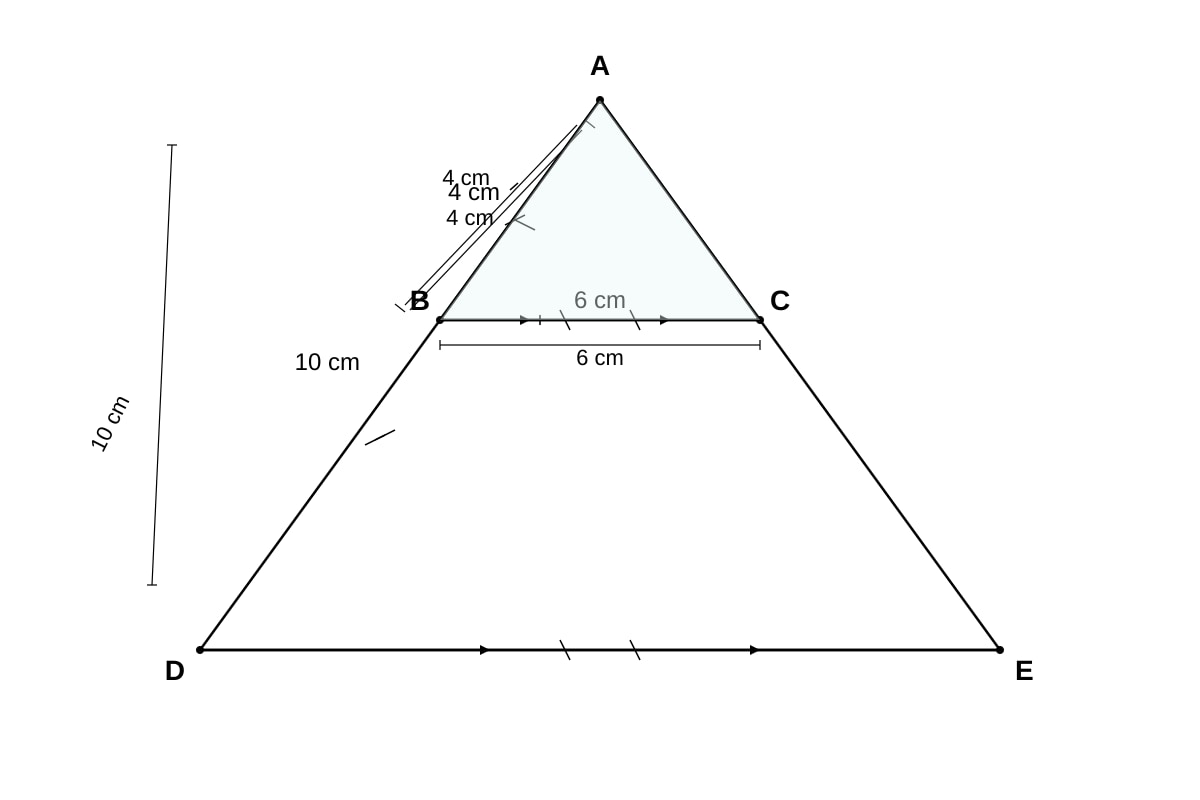
Question 8
Answer: cm
Marks: 3 (M1 for identifying similarity, M1 for correct ratio, A1 for correct answer)
Explanation: Since , corresponding sides are in proportion.
The scale factor from to is:
Therefore:
Alternative approach: Using the ratio directly:
Question 9
Answer: cm
Reason: Corresponding sides of congruent triangles are equal.
Marks: 2 (A1 for correct length, A1 for correct reason)
Explanation: When two triangles are congruent, all corresponding sides and angles are equal. Since , side corresponds to side (both are between the second and third vertices in the naming order). Therefore, cm.
Marking note: Accept any reasonable statement about corresponding sides being equal in congruent triangles.
Question 10
Answer: 12 cm
Marks: 2 (M1 for using area ratio, A1 for correct answer)
Explanation: For similar figures, the ratio of areas equals the square of the linear scale factor.
Ratio of areas
Linear scale factor
Length of corresponding side in larger triangle cm
Key concept: Area scales by where is the linear scale factor. If the area is 4 times larger, the side length is times larger.
Section C: Pythagoras' Theorem (Questions 11–15)
Question 11
Answer: 15 cm
Marks: 2 (M1 for correct substitution into Pythagoras' theorem, A1 for correct answer)
Explanation: Pythagoras' theorem: , where is the hypotenuse.
Let cm and cm.
The hypotenuse is 15 cm.
Common mistake: Students may forget to take the square root at the end.
Question 12
Answer: 12 cm
Marks: 2 (M1 for correct substitution, A1 for correct answer)
Explanation: In a rectangle, the diagonal forms a right-angled triangle with the length and width.
Let the length be cm. Using Pythagoras' theorem:
The length of the rectangle is 12 cm.
Question 13
Answer: 4.77 m
Marks: 2 (M1 for correct substitution, A1 for correct answer to 2 d.p.)
Explanation: The ladder, wall, and ground form a right-angled triangle. The ladder is the hypotenuse (5 m), the distance from the wall is one leg (1.5 m), and the height up the wall is the other leg.
Let be the height up the wall.
Question 14
Answer: 17 km
Marks: 2 (M1 for correct substitution, A1 for correct answer)
Explanation: The ship's path forms a right-angled triangle. The eastward distance (15 km) and northward distance (8 km) are the two legs. The shortest distance back to the start is the hypotenuse.
Let be the shortest distance.
The shortest distance is 17 km.
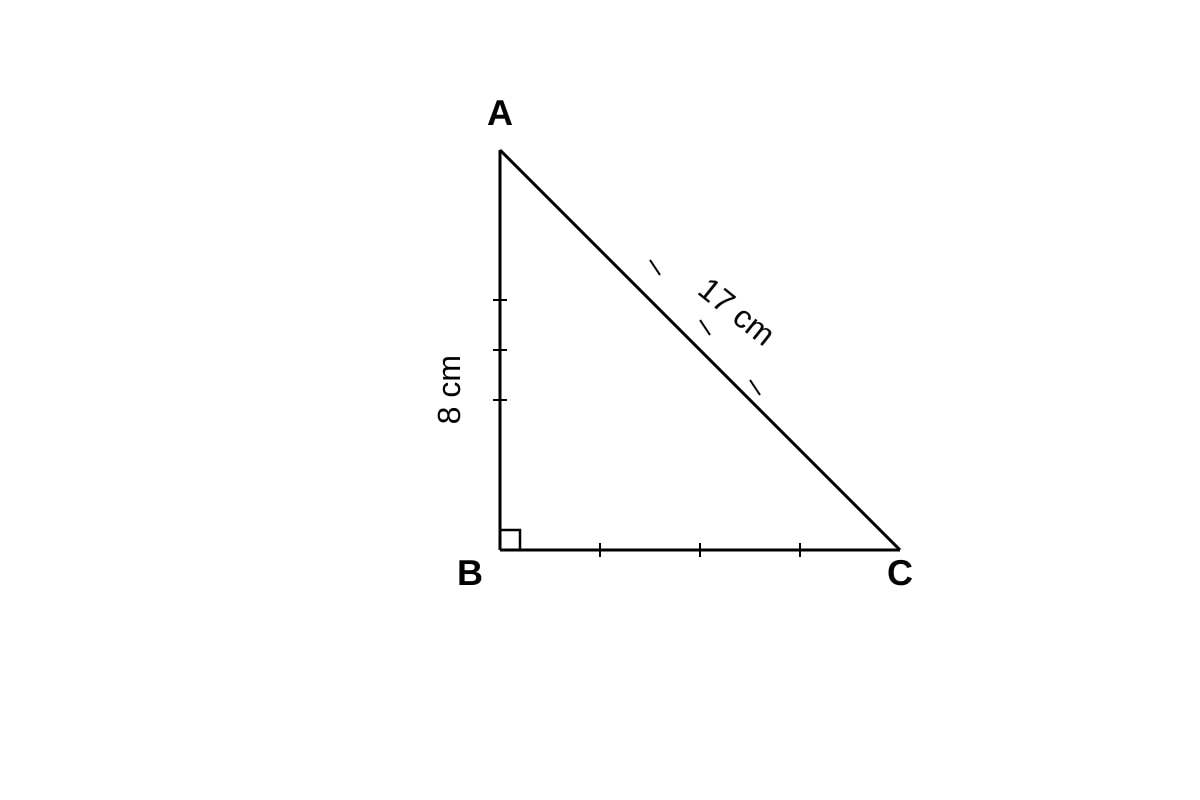
Question 15
Answer: cm
Marks: 2 (M1 for correct substitution, A1 for correct answer)
Explanation: In right-angled triangle with right angle at , is the hypotenuse.
Using Pythagoras' theorem:
Section D: Trigonometry (Questions 16–20)
Question 16
Answer: 10 cm
Marks: 2 (M1 for using , A1 for correct answer)
Explanation: In a right-angled triangle, .
Given and opposite cm:
Key fact: is a standard trigonometric value worth memorising.
Question 17
Answer:
Marks: 2 (M1 for finding YZ using Pythagoras, A1 for correct tan ratio)
Explanation: First, find using Pythagoras' theorem:
Now,
Note: The answer can be left as a fraction. Do not convert to a decimal unless asked.
Question 18
Answer: 8.40 m
Marks: 2 (M1 for using , A1 for correct answer to 2 d.p.)
Explanation: The flagpole, its shadow, and the sun's rays form a right-angled triangle. The angle of elevation of the sun is the angle between the ground and the sun's rays.
Let be the height of the flagpole.
Calculator tip: Ensure your calculator is in degree mode before calculating .
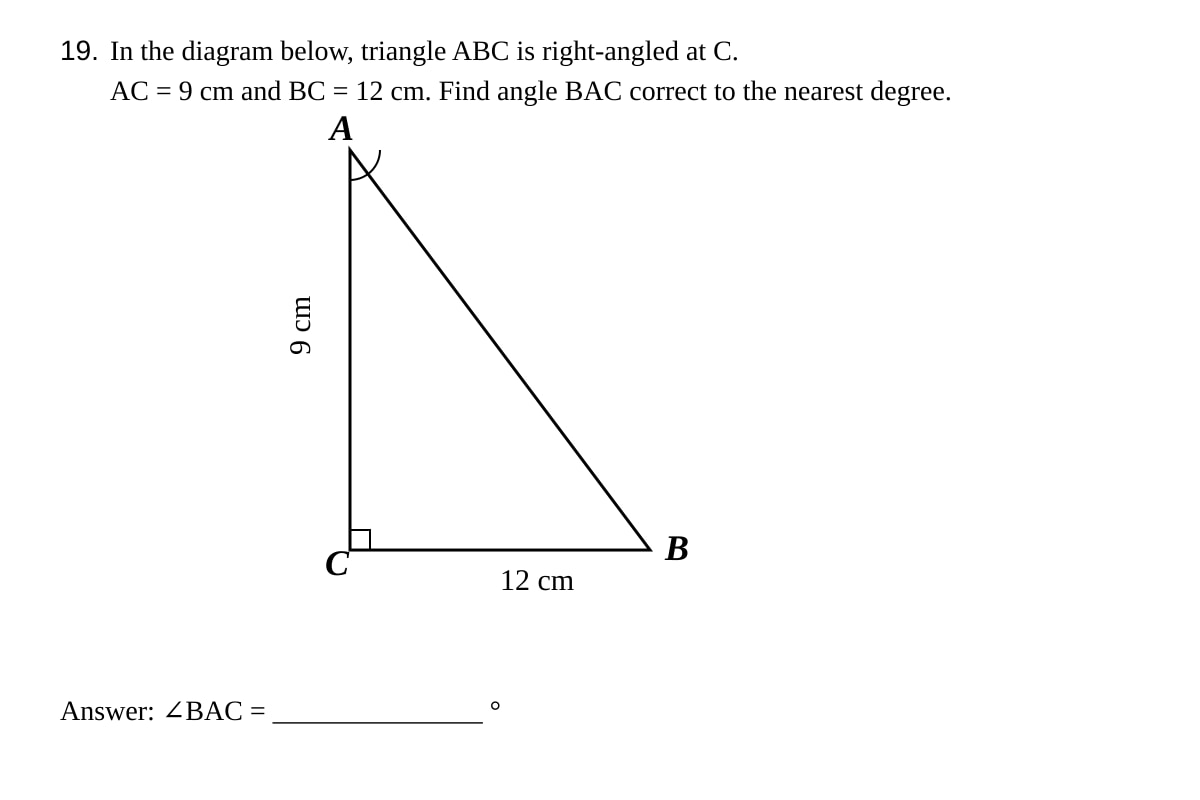
Question 19
Answer:
Marks: 2 (M1 for using correct trigonometric ratio, A1 for correct answer to nearest degree)
Explanation: In right-angled triangle with right angle at :
- With respect to , the opposite side is cm and the adjacent side is cm.
Common mistake: Students may use the wrong trigonometric ratio. Always identify opposite and adjacent sides relative to the angle you are finding.
Question 20
Answer: 173.21 m
Marks: 2 (M1 for using , A1 for correct answer to 2 d.p.)
Explanation: A bearing of means the direction is clockwise from north. The eastward distance is the component perpendicular to the north direction.
In the right-angled triangle formed:
- The distance walked (200 m) is the hypotenuse.
- The eastward distance is opposite the angle (since the angle from north is , the angle from east is ).
Using :
Alternative method: Using (since the angle from east is ): eastward distance m.
END OF ANSWER KEY