From Real Exams Quiz
Secondary 2 Mathematics Algebra Functions Quiz
Free Sec 2 Maths Algebra Functions quiz, Exam version, with questions, answers, and syllabus-aligned practice for Singapore students.
These static practice materials are generated from the site's syllabus and paper-generation workflow, with source and model context shown so students and parents can evaluate the material before use.
Questions
Free quiz and exam paper access
Enter your details to view this paper
Your access is remembered on this device.
Answers
Secondary 2 Mathematics Quiz - Algebra Functions: Answer Key
Total Marks: 50
Section A: Multiple-Choice Questions (4 marks)
1. (A) [1]
- Explanation: "Seven times a number " is . "The sum of ... and five" means add 5. So the expression is .
- Common mistake: Choosing (C) which means "seven times the sum of and five", a different operation order.
2. (B) 3 [1]
- Method: Substitute into .
- .
- Common mistake: Forgetting to square the 2 before multiplying by 2 (doing as ).
3. (A) [1]
- Method: .
- Key step: Remember to distribute the negative sign: .
- Common mistake: Writing (sign error).
4. (B) [1]
- Method:
- Key concept: Bring variable terms to one side and constant terms to the other.
Section B: Short-Answer Questions (20 marks)
5. [2]
- Step 1: Expand brackets: .
- Step 2: Bring terms to LHS, constants to RHS: .
- Step 3: Simplify: .
- Marking: M1 for correct expansion or rearrangement, A1 for correct answer.
- Common mistake: Forgetting to multiply the -4 inside the bracket by 3.
6. where , , [2]
- Step 1: Substitute: .
- Step 2: Evaluate: .
- Marking: M1 for correct substitution, A1 for correct evaluation.
- Teaching note: , NOT . Also note , not .
7. [2]
- Step 1: Find LCM of denominators (LCM of 3 and 4 is 12).
- Step 2: Convert each fraction: , .
- Step 3: Add: .
- Marking: M1 for correct common denominator, A1 for correct simplified answer.
8. Factorise completely. [2]
- Step 1: Find the highest common factor (HCF) of and . The HCF is .
- Step 2: Factor out : .
- Marking: M1 for identifying a common factor, A1 for fully factorised form.
- Common mistake: Only factoring out or only factoring out , giving or . These are not completely factorised.
9. Expand and simplify . [2]
- Step 1: Use FOIL or distributive property:
- Step 2: Expand: .
- Step 3: Simplify: .
- Marking: M1 for correct expansion (allow one sign error), A1 for fully simplified expression.
- Common mistake: , not (combining signs incorrectly).
10. , make the subject. [2]
- Step 1: Divide both sides by 2: .
- Step 2: Subtract from both sides: .
- Final: .
- Marking: M1 for dividing by 2, A1 for final answer with isolated.
- Common mistake: Trying to subtract before dividing by 2.
11. Cost , find cost when , . [2]
- Step 1: Substitute: .
- Step 2: Evaluate: .
- Final: Total cost is $76.
- Marking: M1 for correct substitution, A1 for correct answer with unit.
12. [2]
- Step 1: Add 3 to both sides: .
- Step 2: Multiply both sides by 5: .
- Step 3: Divide by 2: .
- Marking: M1 for correct first step (either adding 3 or multiplying by 5), A1 for correct answer.
- Common mistake: Forgetting to multiply the 10 by 5 (thinking ).
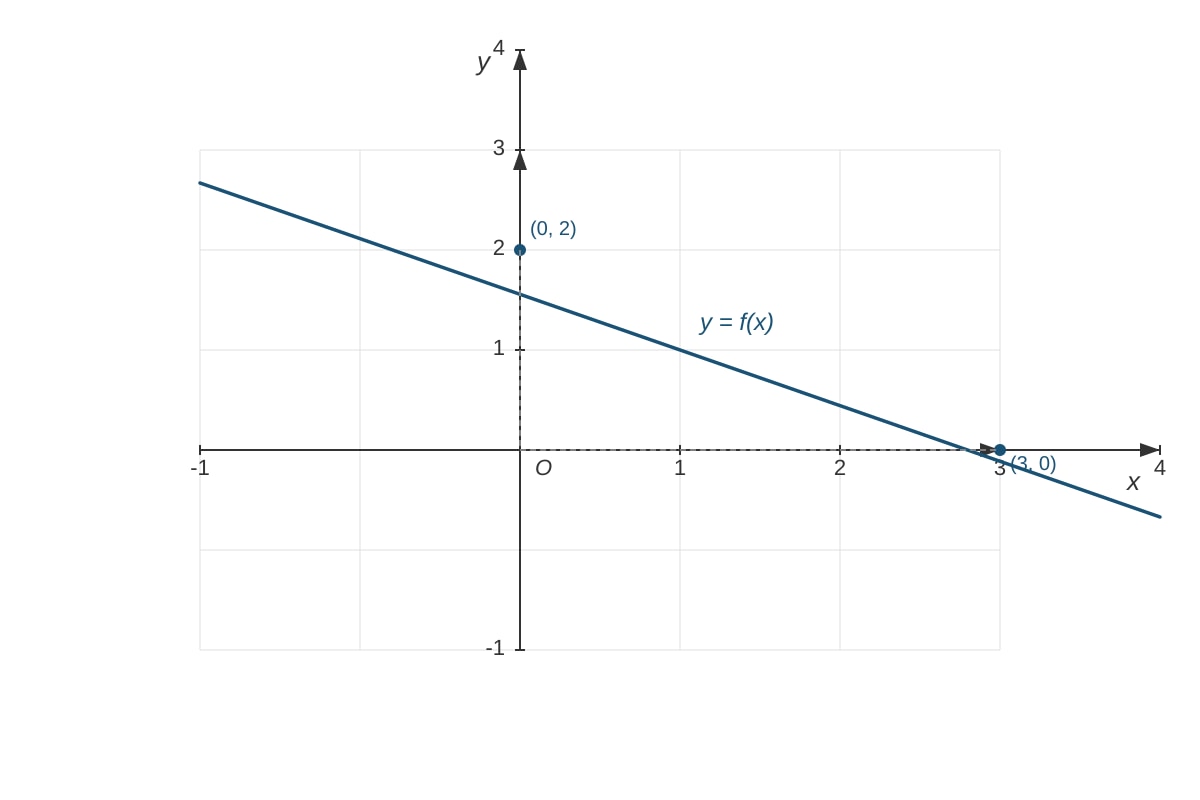
13. Find gradient of line through (0, 2) and (3, 0). [2]
- Method: Gradient .
- Marking: M1 for correct formula/substitution, A1 for correct value.
- Teaching note: A line sloping downwards (left to right) has a negative gradient. The gradient is the rate at which changes per unit change in .
14. , so . When , , so . [2]
- . When , .
- Marking: M1 for finding constant , A1 for correct answer 48.
- Common mistake: Writing but calculating (inverting the relationship).
Section C: Structured-Response Questions (26 marks)
15. (a) [2]
- Step 1: Find factor pairs of -14 that sum to 5: , and .
- Step 2: Factorise: .
- Step 3: Solve: or or .
- Marking: M1 for correct factorisation, A1 for both solutions.
(b) [2]
- Method: Let . Then the equation becomes .
- From part (a): or .
- Solve: . .
- Final: or .
- Marking: M1 for substitution method or expanding and factorising, A1 for correct solutions.
- Teaching note: This is a "quadratic in disguise" — recognising the structure as a single variable simplifies the problem.
16. (1), (2) [3]
- Method 1 (Elimination): Multiply (2) by 2: . Add to (1): .
- Substitute into (1): .
- Method 2 (Substitution): From (1): . Substitute into (2): . Then .
- Marking: M1 for correct elimination or substitution setup, M1 for solving for first variable, A1 for both correct values.
- Common mistake: Sign errors when adding/subtracting equations.
17. (a) Width (since length is 5 m longer than width). [1]
- Marking: A1 for correct expression.
(b) Area . [2]
- Expand: .
- Rearrange: . (Shown)
- Marking: M1 for forming correct equation , A1 for showing the required form.
(c) [2]
- Step 1: Factor pairs of -84 summing to -5: , and .
- Step 2: Factorise: .
- Step 3: Solve: or .
- Step 4: Since length must be positive, .
- Final: Length of field is 12 m.
- Marking: M1 for correct factorisation, A1 for correct positive solution with context check.
- Teaching note: Always check solutions against the problem context. A negative length is impossible, so we reject .
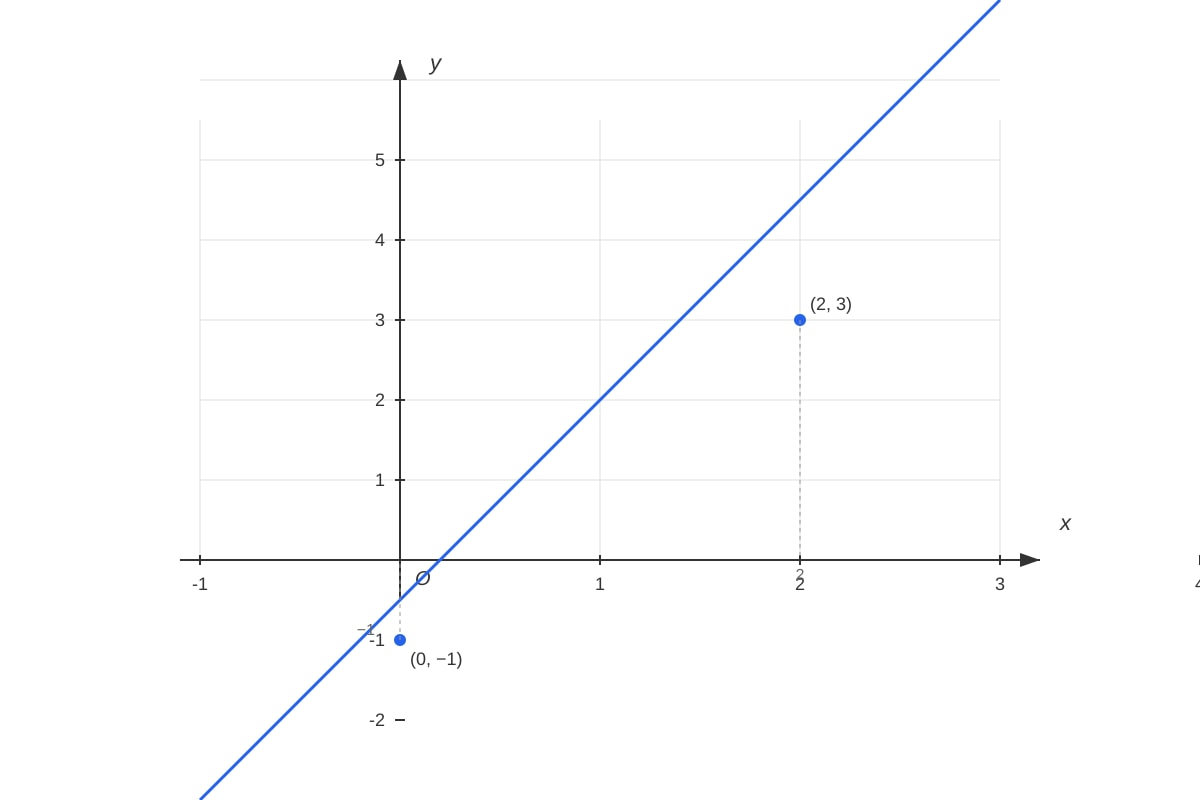
18. (a) Gradient . [2]
- Marking: M1 for correct formula/substitution, A1 for correct value 2.
- Teaching note: The gradient is the "rise over run". From (0, -1) to (2, 3), the rise is and the run is .
(b) Equation: , where (gradient) and (y-intercept, where line crosses y-axis at ). [2]
- So .
- Marking: M1 for correct gradient used in equation, A1 for correct y-intercept and final equation.
- Check: When , ✓. When , ✓.
19. (a) , so . [2]
- When , : .
- Equation: .
- Marking: M1 for correct form , A1 for correct constant .
(b) When : or 0.75. [1]
- Marking: A1 for correct value.
- Teaching note: Inverse proportionality means as increases, decreases (and vice versa). Doubling from 2 to 4 makes one-quarter of its original value (since is squared in the relationship).
20. (a) Total amount . [1]
- Marking: A1 for correct expression.
(b) Total items: (1) [4] Total cost: (2)
- Method: From (1): . Substitute into (2): .
- Then .
- Final: John bought 7 pens and 3 notebooks.
- Check: 7 pens cost 7 \times \2 = $143 \times $5 = $15. Total: \14 + $15 = $29 ✓. Total items: ✓.
- Marking: M1 for forming two correct equations, M1 for correct elimination/substitution, M1 for solving for first variable, A1 for both correct values with units.
Total Marks: 50
Common marking principles applied throughout:
- Method marks (M) are awarded for correct mathematical procedures even if the final answer has an arithmetic error.
- Accuracy marks (A) require the correct final answer.
- For multi-part questions, answers from earlier parts can be used in later parts even if incorrect (error carried forward).
- Units must be stated where required for full marks.