From Real Exams Quiz
Secondary 2 Mathematics Algebra Functions Quiz
Free Sec 2 Maths Algebra Functions quiz, Exam version, with questions, answers, and syllabus-aligned practice for Singapore students.
These static practice materials are generated from the site's syllabus and paper-generation workflow, with source and model context shown so students and parents can evaluate the material before use.
Questions
Free quiz and exam paper access
Enter your details to view this paper
Your access is remembered on this device.
Answers
Answer Key: Secondary 2 Mathematics Quiz - Algebra Functions
Total Marks: 50
Section A: Multiple-Choice Questions (5 marks)
1. (C) - Marks: 1 - Explanation: A linear function is of the form , where and are constants, and the highest power of is 1. Only option (C) fits this form. Option (A) is quadratic, (B) is a reciprocal function, and (D) is a square root function.
2. (A) - Marks: 1 - Explanation: To evaluate , substitute into : .
3. (A) A straight line passing through the origin with a positive gradient. - Marks: 1 - Explanation: Direct proportionality means , where is a non-zero constant. The graph of is always a straight line that passes through the origin .
4. (D) - Marks: 1 - Explanation: The line has gradient . In , is the coefficient of , so the gradient is .
5. (B) - Marks: 1 - Explanation: Substitute into : .
Section B: Short-Answer Questions (20 marks)
6. (a) Direct proportion means , so where is a constant. Substitute , : . Therefore, equation: (or ). - Marks: 1 for finding , 1 for correct equation.
(b) Substitute $x = 6$ into $y = 2.5x$: $y = 2.5 \times 6 = 15$.
     **Answer:** $y = 15$.
     - **Marks:** 1 mark for correct answer.
7. = (Expand brackets carefully. The minus sign before 2 applies to both terms inside the second bracket.) = (Group like terms.) = - Marks: M1 for correct expansion (both terms correct), A1 for . - Common Mistake: Forgetting to multiply the by correctly, giving instead of .
8. = (Use FOIL method: First, Outer, Inner, Last.) = = - Marks: M1 for expanding to 4 terms or correct and constant term, A1 for . - Common Mistake: Sign error in the constant term (e.g., instead of ).
9. Find two numbers that multiply to and add to . The numbers are and . Therefore, . - Marks: M1 for identifying correct factor pair, A1 for . - Common Mistake: Using factor pairs that multiply to 15 but do not sum to 8 (e.g., and ).
10. Subtract from both sides: Add to both sides: Divide by : - Marks: M1 for collecting terms on one side and numbers on the other, A1 for .
11. and Set them equal: Add 1 to both sides: Divide by 3: - Marks: M1 for setting up the equation , A1 for .
12. Since the function is linear with gradient 3, its equation is . The point lies on the line, so substitute , : . Therefore, the equation of is . - Marks: M1 for correct form and substitution, A1 for .
13. . Substitute , : . So, . When : . - Marks: M1 for finding , M1 for final answer .
14. The -intercept is the point where the line crosses the -axis, which occurs when . In the equation , the -intercept is . For , the -intercept is . - Marks: 1 for correct coordinate form, 1 for correct value.
15. Substitute into the equation : . Since the calculated -value equals the -coordinate of the point , the point does lie on the line. - Marks: M1 for correct substitution, A1 for correct conclusion with justification.
Section C: Structured/Long-Answer Questions (25 marks)
16. (a) When , : (Equation 1) When , : (Equation 2) - Marks: 1 mark for each correct equation. - Common Mistake: Swapping and in the equations.
(b) Subtract Equation 1 from Equation 2 to eliminate $b$:
    $(5a + b) - (3a + b) = 30 - 22$
    $2a = 8 \Rightarrow a = 4$
    Substitute $a = 4$ into Equation 1: $22 = 3(4) + b \Rightarrow 22 = 12 + b \Rightarrow b = 10$.
    - **Marks:** M1 for correct elimination or substitution method, A1 for both $a=4$ and $b=10$.

(c) The equation is $C = 4h + 10$.
    For $h = 2$: $C = 4(2) + 10 = 8 + 10 = 18$.
    The cost is $\$18$.
    - **Marks:** 1 for correct answer.
17. (a) When : When : When : When : When :
     Completed table:
     | $x$ | $-2$ | $-1$ | $0$ | $1$ | $2$ |
     |---|---|---|---|---|---|
     | $f(x)$ | $-1$ | $1$ | $3
<stage3_quiz_answers_md>
Answer Key: Secondary 2 Mathematics Quiz - Algebra Functions
Total Marks: 50
Section A: Multiple-Choice Questions (5 marks)
1. (C) - Marks: 1 - Explanation: A linear function is of the form , where and are constants, and the highest power of is 1. Only option (C) fits this form. Option (A) is quadratic, (B) is a reciprocal function, and (D) is a square root function.
2. (A) - Marks: 1 - Explanation: To evaluate , substitute into : .
3. (A) A straight line passing through the origin with a positive gradient. - Marks: 1 - Explanation: Direct proportionality means , where is a non-zero constant. The graph of is always a straight line that passes through the origin .
4. (D) - Marks: 1 - Explanation: The line has gradient . In , is the coefficient of , so the gradient is .
5. (B) - Marks: 1 - Explanation: Substitute into : .
Section B: Short-Answer Questions (20 marks)
6. (a) Direct proportion means , so where is a constant. Substitute , : . Therefore, equation: (or ). - Marks: 1 for finding , 1 for correct equation.
(b) Substitute $x = 6$ into $y = 2.5x$: $y = 2.5 \times 6 = 15$.
     **Answer:** $y = 15$.
     - **Marks:** 1 mark for correct answer.
7. = (Expand brackets carefully) = (Collect like terms) - Marks: 1 for correct expansion, 1 for correct simplification.
8. = = = - Marks: 1 for correct expansion, 1 for correct simplification.
9. = (Since and ) - Marks: 1 for correct factors, 1 for correct factorisation.
10. (Collect like terms) - Marks: 1 for correct rearrangement, 1 for correct solution.
11. and - Marks: 1 for setting up equation, 1 for correct solution.
12. A linear function has gradient , so . The point lies on the graph, so . Therefore, equation: . - Marks: 1 for using gradient, 1 for finding and correct equation.
13. , so . Substitute , : . Therefore, . When : . - Marks: 1 for finding , 1 for correct final answer.
14. The -intercept occurs when . Substitute into : . Coordinates: . - Marks: 1 for correct method, 1 for correct coordinates.
15. Substitute into : . Since the calculated -value equals the given -coordinate, the point lies on the line. - Marks: 1 for correct substitution, 1 for correct conclusion.
Section C: Structured/Long-Answer Questions (25 marks)
16. (a) Using : For , : (Equation 1) For , : (Equation 2) - Marks: 1 for each correct equation.
(b) Subtract Equation 1 from Equation 2: $(5a + b) - (3a + b) = 30 - 22 \Rightarrow 2a = 8 \Rightarrow a = 4$.
     Substitute $a = 4$ into Equation 1: $22 = 3(4) + b \Rightarrow 22 = 12 + b \Rightarrow b = 10$.
     - **Marks:** 1 for correct method, 1 for correct values.

(c) Cost for 2 hours: $C = 4(2) + 10 = 8 + 10 = 18$.
     **Answer:** $\$18$.
     - **Marks:** 1 for correct answer.
17. (a) : : : : : : - Marks: 1 for correct method, 1 for all correct values.
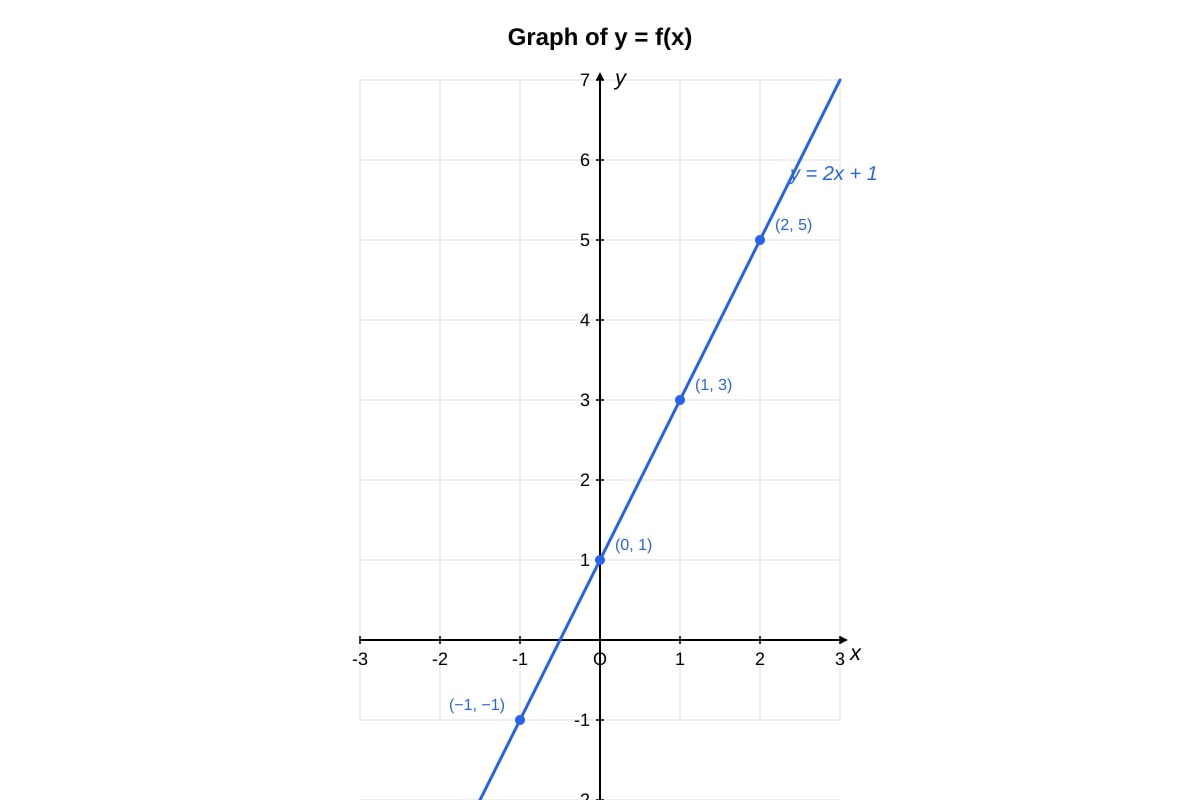
(b) Graph: A straight line passing through the points $(-2, -1)$, $(-1, 1)$, $(0, 3)$, $(1, 5)$, $(2, 7)$.
     - **Marks:** 1 for correct plotting, 1 for correct straight line.

(c) From the graph, $f(x) = 0$ when the line crosses the $x$-axis. This occurs at $x = -1.5$.
     - **Marks:** 1 for correct answer.
18. Solve (1) and (2). Multiply (1) by 3: (3) Multiply (2) by 2: (4) Add (3) and (4): . Substitute into (1): . Answer: , . - Marks: 1 for correct elimination method, 1 for correct , 1 for correct , 2 for clear working.
19. (a) Area = length breadth: . - Marks: 1 for correct equation.
(b) Expand: $x(x + 5) = x^2 + 5x = 36 \Rightarrow x^2 + 5x - 36 = 0$.
     - **Marks:** 1 for correct expansion and rearrangement.

(c) Factorise $x^2 + 5x - 36 = 0$: $(x + 9)(x - 4) = 0$.
     Therefore, $x + 9 = 0$ or $x - 4 = 0$, so $x = -9$ or $x = 4$.
     Since length cannot be negative, $x = 4$.
     - **Marks:** 1 for correct factorisation, 1 for correct positive solution.

(d) Length = $x + 5 = 4 + 5 = 9$ cm, Breadth = $x = 4$ cm.
     Perimeter = $2(\text{length} + \text{breadth}) = 2(9 + 4) = 2(13) = 26$ cm.
     - **Marks:** 1 for correct answer.
20. (a) Gradient . - Marks: 1 for correct formula, 1 for correct calculation.
(b) Equation of line: $y - y_1 = m(x - x_1)$.
     Using point $(1, 4)$: $y - 4 = -3(x - 1) \Rightarrow y - 4 = -3x + 3 \Rightarrow y = -3x + 7$.
     - **Marks:** 1 for correct method, 1 for correct equation.

(c) Substitute $x = 0$ into $y = -3x + 7$: $y = -3(0) + 7 = 7$.
     Since the calculated $y$-value equals the given $y$-coordinate, the point $(0, 7)$ lies on line $L$.
     - **Marks:** 1 for correct justification.