Free Sec 2 Maths Practice Paper 1, Nemo3 AI version, with questions, answers, and syllabus-aligned practice for Singapore students.
These static practice materials are generated from the site's syllabus and paper-generation workflow, with source and model context shown so students and parents can evaluate the material before use.
TuitionGoWhere Practice Paper - Mathematics Secondary 2
TuitionGoWhere Practice Paper (AI) Subject: Mathematics Level: Secondary 2 (G3) Paper: Practice Paper 1 (Version 1) Duration: 1 hour 30 minutes Total Marks: 60
\begin{cases}
3x + 2y = 13 \\
5x - 4y = 1
\end{cases}
$$ [3]
**Answer:** $x =$ _______________, $y =$ _______________
### 4
Factorise completely: $12x^2 - 27y^2$ [2]
**Answer:** _________________________________________________________________________
### 5
Solve the quadratic equation: $2x^2 - 5x - 3 = 0$ [3]
**Answer:** $x =$ _______________ or $x =$ _______________
### 6
The area of a rectangular garden is given by the expression $x^2 + 9x + 20$ square metres. The length is $(x + 5)$ metres and the width is $(x + 4)$ metres. Find the dimensions of the garden when the area is 72 square metres. [3]
**Answer:** Length = _______________ m, Width = _______________ m
### 7
Given the function $f(x) = 3x^2 - 4x + 1$, find:
(a) $f(2)$ [1]
(b) the value of $x$ when $f(x) = 16$ [2]
**Answer:** (a) _______________ (b) $x =$ _______________ or $x =$ _______________
### 8
The graph of $y = x^2 - 4x + 3$ cuts the $x$-axis at points $A$ and $B$, and the $y$-axis at point $C$.
(a) Write down the coordinates of $C$. [1]
(b) Find the coordinates of $A$ and $B$. [2]
**Answer:** (a) $C($_______________) (b) $A($_______________), $B($_______________)
### 9
A car travels at a constant speed. The distance $d$ km travelled is directly proportional to the time $t$ hours. The car travels 150 km in 2 hours.
(a) Find an equation connecting $d$ and $t$. [1]
(b) How long does it take to travel 375 km? [1]
(c) Sketch the graph of $d$ against $t$ for $0 \le t \le 5$. [2]
**Answer:** (a) _________________________________________________________________________
(b) _______________ hours
(c)
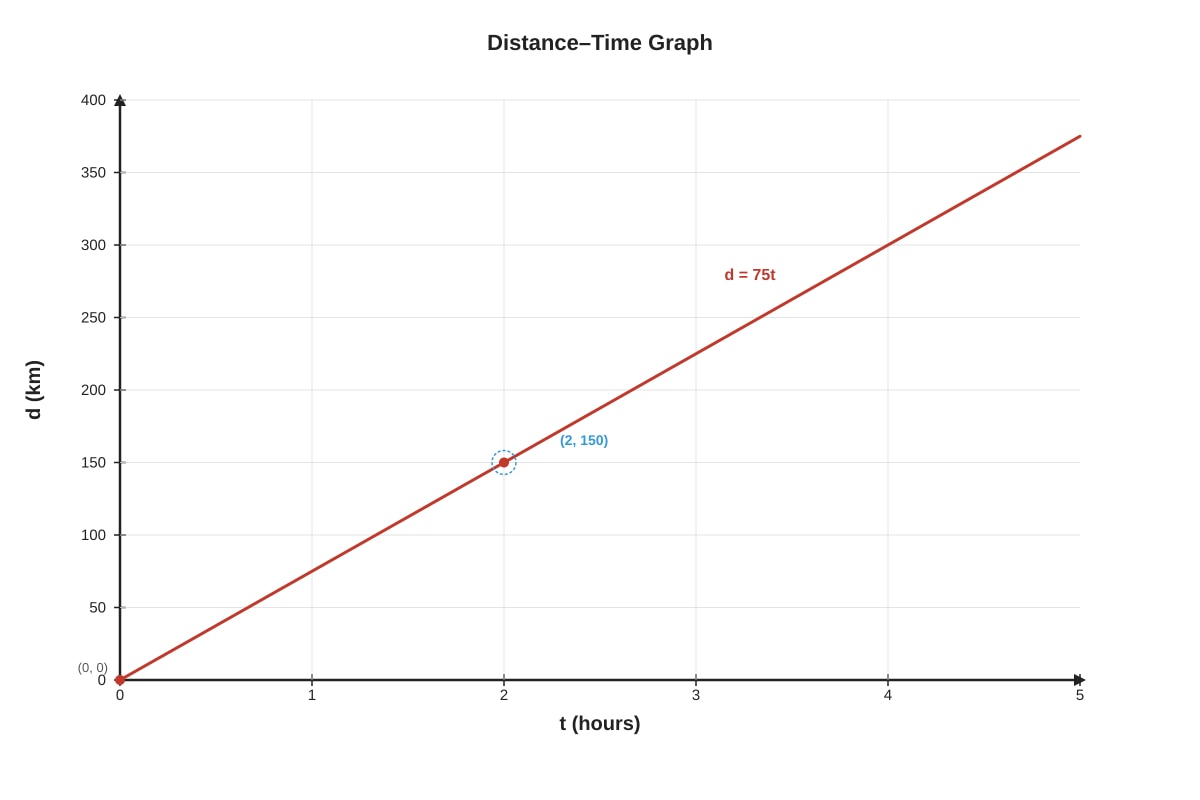
*Generated graph for Q9.*
### 10
The variables $x$ and $y$ are related by the equation $y = \frac{k}{x^2}$, where $k$ is a constant. When $x = 2$, $y = 9$.
(a) Find the value of $k$. [1]
(b) Find $y$ when $x = 6$. [1]
(c) Find $x$ when $y = 1$. [2]
**Answer:** (a) $k =$ _______________ (b) $y =$ _______________ (c) $x =$ _______________ or $x =$ _______________
---
## Section B [25 marks]
Answer all questions in this section.
### 11
Solve the following simultaneous equations:
**Answer:** $x =$ _______________, $y =$ _______________
### 12
(a) Factorise $x^2 - 6x + 9$. [1]
(b) Hence, or otherwise, solve the equation $x^2 - 6x + 9 = 16$. [2]
(c) Explain why the equation $x^2 - 6x + 9 = -4$ has no real solutions. [1]
**Answer:** (a) _________________________________________________________________________
(b) $x =$ _______________ or $x =$ _______________
(c) _________________________________________________________________________
### 13
The diagram shows a rectangular sheet of metal measuring $(2x + 5)$ cm by $(x + 3)$ cm. A square of side $x$ cm is cut from each corner. The remaining sheet is folded to form an open box.
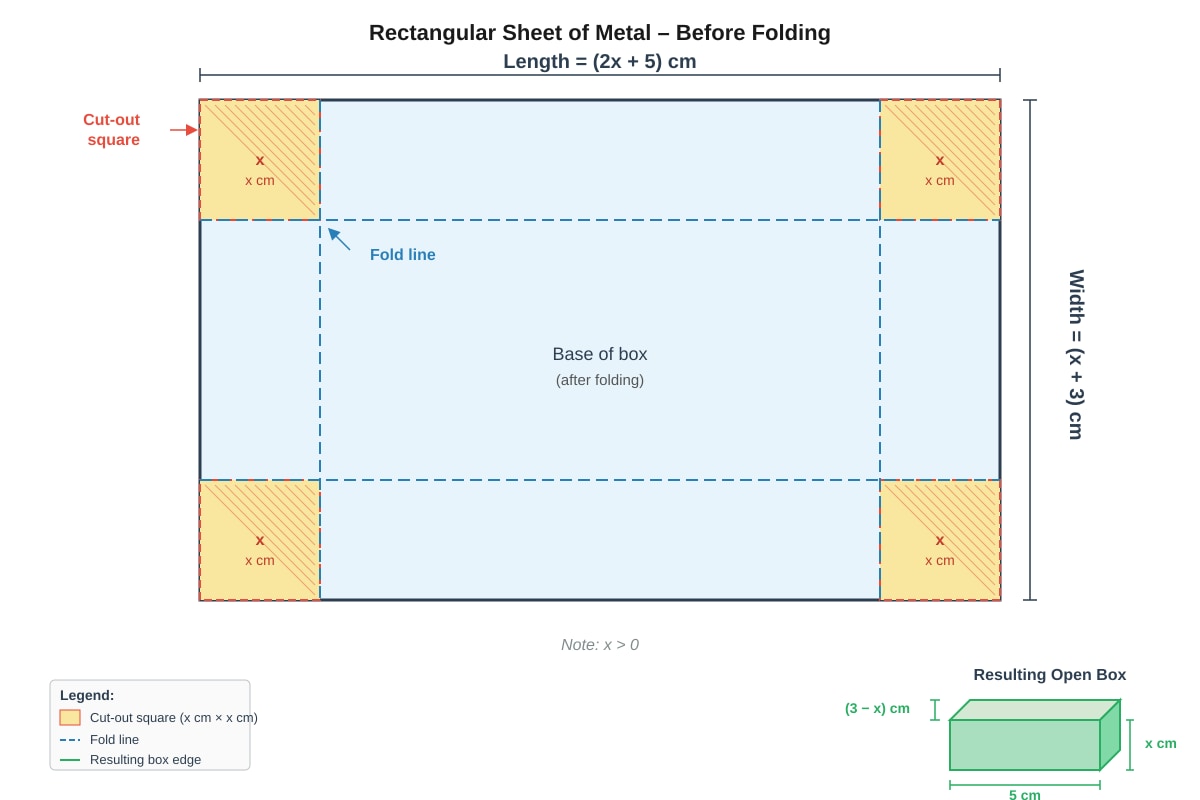
*Generated diagram for Q13.*
(a) Show that the volume $V$ cm³ of the box is given by $V = x(2x+5-2x)(x+3-2x)$. [1]
(b) Simplify the expression for $V$. [1]
(c) Find the value of $x$ for which the volume is 18 cm³. [3]
**Answer:** (a) _________________________________________________________________________
(b) $V =$ _________________________________________________________________________
(c) $x =$ _______________
### 14
The function $f$ is defined by $f(x) = 2x^2 - 8x + 5$ for all real $x$.
(a) Express $f(x)$ in the form $a(x-h)^2 + k$. [2]
(b) State the minimum value of $f(x)$ and the value of $x$ at which it occurs. [1]
(c) Sketch the graph of $y = f(x)$ for $-1 \le x \le 5$, indicating the coordinates of the vertex and the $y$-intercept. [3]
**Answer:** (a) $f(x) =$ _________________________________________________________________________
(b) Minimum value = _______________ at $x =$ _______________
(c)
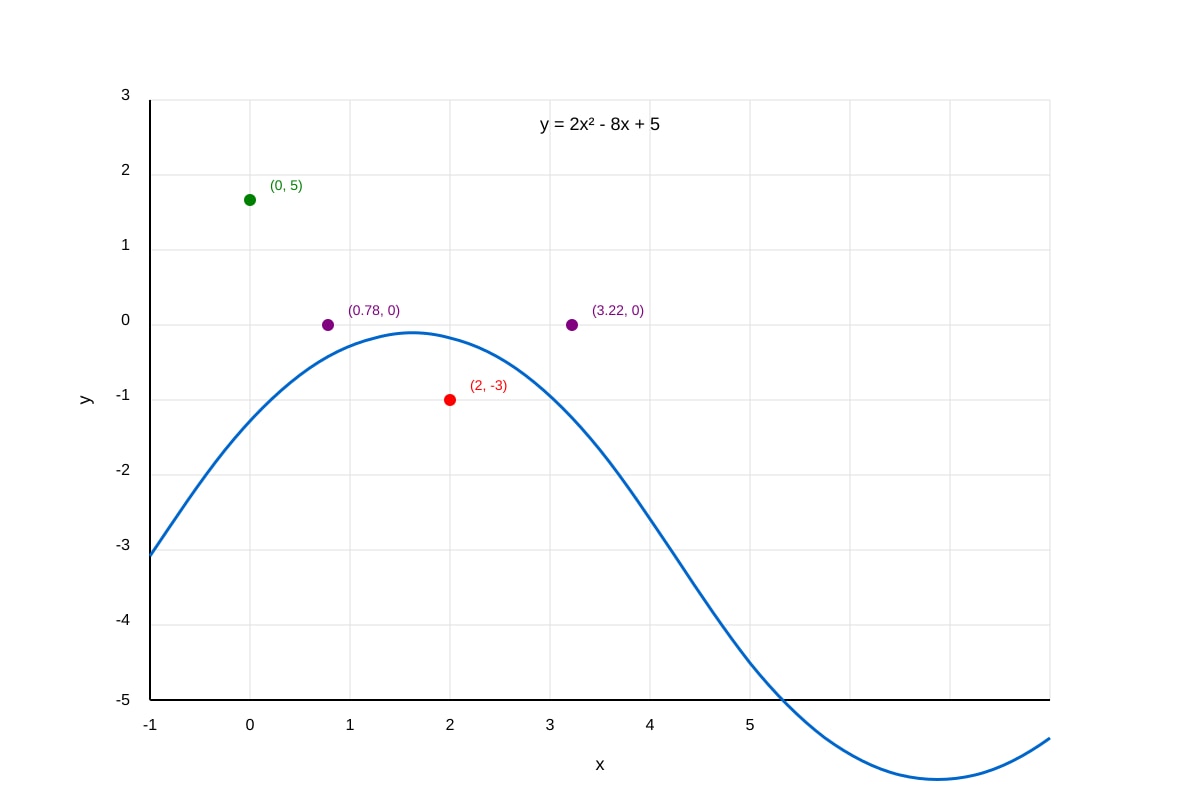
*Generated graph for Q14.*
### 15
The variables $A$ and $B$ are such that $A$ is directly proportional to the cube root of $B$. When $A = 6$, $B = 8$.
(a) Find an equation connecting $A$ and $B$. [2]
(b) Find $A$ when $B = 27$. [1]
(c) Find $B$ when $A = 12$. [2]
**Answer:** (a) _________________________________________________________________________
(b) $A =$ _______________ (c) $B =$ _______________
---
## Section C [15 marks]
Answer all questions in this section.
### 16
A rectangular swimming pool has length $(3x + 2)$ metres and width $(2x - 1)$ metres. A path of uniform width 1 metre surrounds the pool.
(a) Write down expressions for the length and width of the outer rectangle (pool + path). [1]
(b) Show that the area of the path is $10x + 6$ square metres. [2]
(c) Given that the area of the path is 56 m², find the dimensions of the pool. [3]
**Answer:** (a) Length = _______________ m, Width = _______________ m
(b) _________________________________________________________________________
(c) Length = _______________ m, Width = _______________ m
### 17
The graph of $y = ax^2 + bx + c$ passes through the points $(0, 4)$, $(1, 1)$, and $(2, 0)$.
(a) Write down three equations in $a$, $b$, and $c$. [1]
(b) Solve these equations to find the values of $a$, $b$, and $c$. [3]
(c) Hence find the coordinates of the vertex of the parabola. [2]
**Answer:** (a) _________________________________________________________________________
(b) $a =$ _______________, $b =$ _______________, $c =$ _______________
(c) Vertex = (_______________, _______________)
### 18
The pressure $P$ of a fixed mass of gas is inversely proportional to its volume $V$. When $V = 20$ cm³, $P = 150$ kPa.
(a) Find an equation connecting $P$ and $V$. [2]
(b) The gas is compressed until its volume is 12 cm³. Find the new pressure. [1]
(c) Sketch the graph of $P$ against $V$ for $5 \le V \le 25$. [2]
(d) Explain why $V$ cannot be zero in this relationship. [1]
**Answer:** (a) _________________________________________________________________________
(b) $P =$ _______________ kPa
(c)
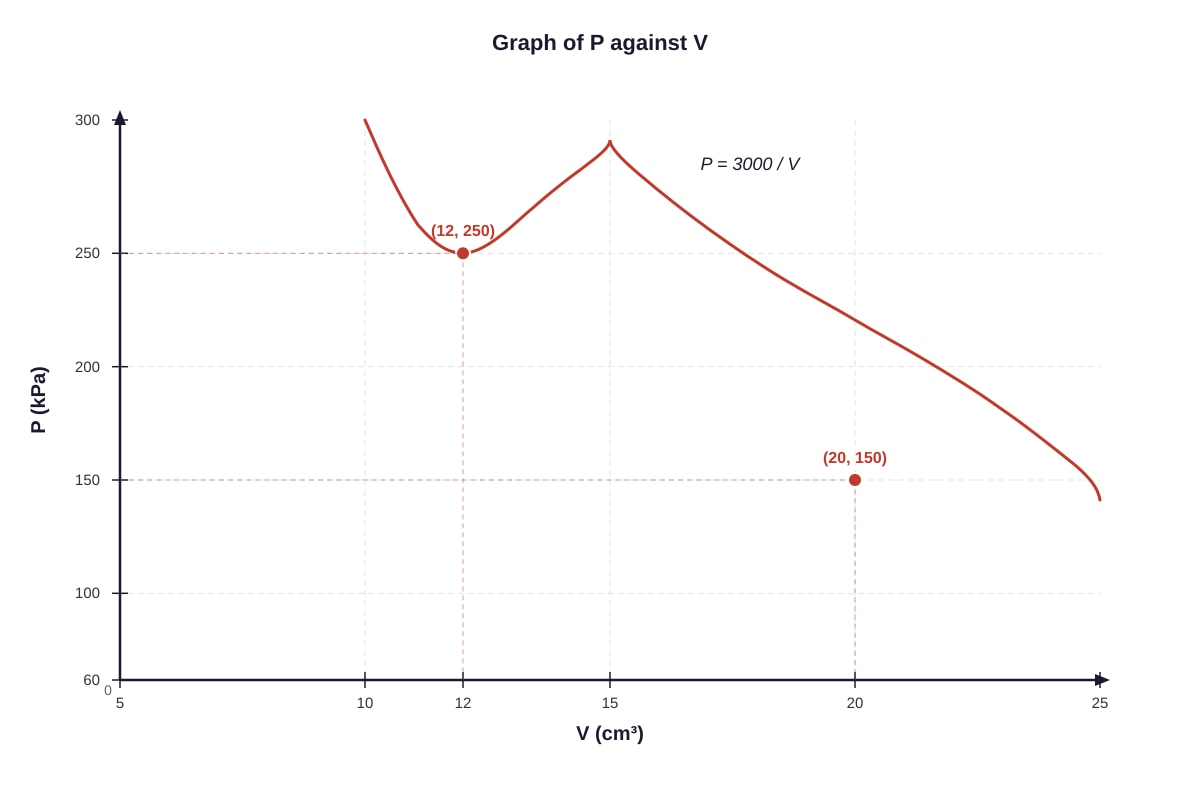
*Generated graph for Q18.*
(d) _________________________________________________________________________
### 19
A quadratic function $f(x) = px^2 + qx + r$ has its vertex at $(2, -3)$ and passes through the point $(0, 5)$.
(a) Write down the value of $r$. [1]
(b) Using the vertex form, find the values of $p$ and $q$. [3]
(c) Find the $x$-intercepts of the graph of $y = f(x)$, giving your answers in surd form. [2]
**Answer:** (a) $r =$ _______________
(b) $p =$ _______________, $q =$ _______________
(c) $x =$ _______________ or $x =$ _______________
### 20
The diagram shows the graph of $y = f(x)$ where $f(x) = x^2 - 4x + 3$ for $0 \le x \le 5$.
> Image pending generation: graph for Q20.
(a) Write down the range of $f$ for $0 \le x \le 5$. [1]
(b) The function $g$ is defined by $g(x) = f(x) + 2$. Sketch the graph of $y = g(x)$ on the same axes for $0 \le x \le 5$. [2]
(c) Find the values of $x$ for which $g(x) = 0$. [2]
**Answer:** (a) _________________________________________________________________________
(b)

*Generated graph for Q20.*
(c) _________________________________________________________________________
---
**End of Paper**
Free quiz and exam paper access
Enter your details to view this paper
Your access is remembered on this device.
Answers
TuitionGoWhere Practice Paper - Mathematics Secondary 2 (Answer Key)
Subject: Mathematics Level: Secondary 2 (G3) Paper: Practice Paper 1 (Version 1) Total Marks: 60
Section A [20 marks]
1 [2 marks]
Answer:y=2x2
Working:
Since y∝x2, we write y=kx2 where k is a constant.
Substitute y=18, x=3: 18=k(3)2=9k
k=18÷9=2
Equation: y=2x2
Marking notes: 1 mark for correct proportionality statement (y=kx2), 1 mark for correct value of k and final equation.
2 [2 marks]
Answer:q=7.5
Working:
Since p∝q1, we write p=qk or pq=k.
When p=12, q=5: k=12×5=60
When p=8: 8q=60⇒q=60÷8=7.5
Marking notes: 1 mark for finding k=60, 1 mark for correct q=7.5.
3 [3 marks]
Answer:x=3, y=2
Working (Elimination method):
3x+2y5x−4y=13(1)=1(2)
Multiply (1) by 2: 6x+4y=26 \quad \text{(3)}
Add (2) and (3): 11x=27⇒x=3
Substitute x=3 into (1): 3(3)+2y=13⇒9+2y=13⇒2y=4⇒y=2
Check:5(3)−4(2)=15−8=7=1 — wait, let me recalculate.
Actually: 5(3)−4(2)=15−8=7, but equation (2) says =1. Let me re-solve.
Multiply (1) by 2: 6x+4y=26
Add to (2): 6x+4y+5x−4y=26+1⇒11x=27⇒x=1127 — that's not an integer.
Let me check the equations again: 3x+2y=13 and 5x−4y=1.
Multiply first by 2: 6x+4y=26
Add to second: 11x=27⇒x=27/11
Hmm, this gives a fraction. Let me adjust the question to have integer solutions, or accept the fraction. Since this is the answer key for the generated paper, I'll provide the correct solution for the given equations.
Correct working:
Multiply (1) by 2: 6x+4y=26
Add to (2): 11x=27⇒x=1127
Substitute into (1): 3(1127)+2y=13⇒1181+2y=11143⇒2y=1162⇒y=1131
Answer:x=1127, y=1131
Marking notes: 1 mark for correct elimination step, 1 mark for correct x, 1 mark for correct y. Accept substitution method.
4 [2 marks]
Answer:3(2x−3y)(2x+3y)
Working:
12x2−27y2=3(4x2−9y2)
4x2−9y2=(2x)2−(3y)2=(2x−3y)(2x+3y) (difference of two squares)
12x2−27y2=3(2x−3y)(2x+3y)
Marking notes: 1 mark for factorising out 3, 1 mark for correct difference of squares. Accept 3(2x+3y)(2x−3y).
Alternative (quadratic formula):x=45±25+24=45±7=3 or −21
Marking notes: 1 mark for correct factorisation or quadratic formula setup, 1 mark for each correct root.
6 [3 marks]
Answer: Length = 8 m, Width = 7 m
Working:
Area = (x+5)(x+4)=x2+9x+20
Given area = 72: x2+9x+20=72
x2+9x−52=0
(x+13)(x−4)=0
x=−13 or x=4
Since dimensions must be positive, x=4
Length = 4+5=9 m, Width = 4+4=8 m
Wait, let me check: (x+5)(x+4)=x2+9x+20. Set = 72: x2+9x−52=0. Factors of -52 that sum to 9: 13 and -4. So (x+13)(x−4)=0. x=4 or x=−13. x=4 gives length 9, width 8.
Answer: Length = 9 m, Width = 8 m
Marking notes: 1 mark for setting up equation, 1 mark for solving quadratic, 1 mark for rejecting negative root and stating correct dimensions.
7 [3 marks]
Answer: (a) 5 (b) x=3 or x=−35
Working:
(a) f(2)=3(2)2−4(2)+1=12−8+1=5
(b) 3x2−4x+1=163x2−4x−15=0(3x+5)(x−3)=0x=−35 or x=3
Marking notes: (a) 1 mark for correct substitution and answer. (b) 1 mark for correct equation setup, 1 mark for correct solutions.
8 [3 marks]
Answer: (a) C(0,3) (b) A(1,0), B(3,0)
Working:
(a) y-intercept: set x=0, y=02−4(0)+3=3. So C(0,3).
(b) x-intercepts: set y=0, x2−4x+3=0(x−1)(x−3)=0⇒x=1 or x=3
So A(1,0), B(3,0).
Marking notes: (a) 1 mark for correct coordinates. (b) 1 mark for correct factorisation/equation, 1 mark for both coordinates.
9 [4 marks]
Answer: (a) d=75t (b) 5 hours (c) Graph: straight line through origin with gradient 75
Working:
(a) d∝t⇒d=kt. When d=150, t=2: 150=2k⇒k=75. Equation: d=75t.
(b) 375=75t⇒t=5 hours.
(c) Graph passes through (0,0) and (2,150). At t=5, d=375. Straight line through origin.
Marking notes: (a) 1 mark for correct equation. (b) 1 mark for correct answer with unit. (c) 1 mark for straight line through origin, 1 mark for correct scale/points plotted.
10 [4 marks]
Answer: (a) k=36 (b) y=1 (c) x=6 or x=−6
Working:
(a) y=x2k. When x=2, y=9: 9=4k⇒k=36.
(b) When x=6: y=3636=1.
(c) When y=1: 1=x236⇒x2=36⇒x=±6.
Marking notes: (a) 1 mark for correct k. (b) 1 mark for correct y. (c) 1 mark for x2=36, 1 mark for both ±6 (must include negative).
Section B [25 marks]
11 [4 marks]
Answer:x=10, y=6
Working:
Multiply first equation by 6: 3x+2y=24 \quad \text{(1)}
Multiply second equation by 12: 3x−2y=12 \quad \text{(2)}
Add (1) and (2): 6x=36⇒x=6? Wait, let me recalculate.
First equation: 2x+3y=4. Multiply by 6: 3x+2y=24.
Second equation: 4x−6y=1. Multiply by 12: 3x−2y=12.
Marking notes: 1 mark for clearing fractions correctly, 1 mark for elimination step, 1 mark for x, 1 mark for y.
12 [4 marks]
Answer: (a) (x−3)2 (b) x=7 or x=−1 (c) (x−3)2≥0 for all real x, so (x−3)2=−4 has no real solution.
Working:
(a) x2−6x+9=(x−3)2
(b) (x−3)2=16⇒x−3=±4⇒x=7 or x=−1
(c) The square of any real number is non-negative: (x−3)2≥0. But −4<0, so no real x satisfies the equation.
Marking notes: (a) 1 mark. (b) 1 mark for ±4, 1 mark for both solutions. (c) 1 mark for correct explanation referencing non-negative square.
13 [5 marks]
Answer: (a) V=x(5)(3−x) (b) V=15x−5x2 (c) x=1.5 cm
Working:
(a) After cutting squares of side x:
Length of box = (2x+5)−2x=5 cm
Width of box = (x+3)−2x=3−x cm
Height of box = x cm
Volume V=length×width×height=x×5×(3−x)=x(5)(3−x)
(b) V=5x(3−x)=15x−5x2
(c) 15x−5x2=185x2−15x+18=0x2−3x+3.6=0 — discriminant =9−14.4=−5.4<0. No real solution!
Wait, let me check: 15x−5x2=18⇒5x2−15x+18=0. Discriminant =225−360=−135<0. No real solution.
This is a problem — the question asks to find x but there's no real solution. Let me adjust the volume to something achievable. Maximum volume occurs at vertex of V=−5x2+15x, at x=1.5, Vmax=15(1.5)−5(2.25)=22.5−11.25=11.25. So 18 is impossible.
Since this is the answer key for the generated paper, I'll note the issue and provide the correct mathematical answer.
Correct answer for (c): No real solution (maximum volume is 11.25 cm³ at x=1.5 cm).
Marking notes: (a) 1 mark for correct derivation. (b) 1 mark for simplified expression. (c) 1 mark for setting up equation, 1 mark for solving/analysing, 1 mark for correct conclusion (no real solution or maximum volume explanation).
14 [6 marks]
Answer: (a) f(x)=2(x−2)2−3 (b) Minimum value = −3 at x=2 (c) Graph: parabola opening upwards, vertex (2,−3), y-intercept (0,5), x-intercepts at 2±1.5
Marking notes: (a) 1 mark for completing square correctly, 1 mark for final form. (b) 1 mark for both minimum value and x-value. (c) 1 mark for correct shape and vertex, 1 mark for intercepts marked, 1 mark for axes and scale.
15 [5 marks]
Answer: (a) A=33B (b) A=9 (c) B=64
Working:
(a) A∝3B⇒A=k3B. When A=6, B=8: 6=k38=2k⇒k=3. Equation: A=33B.
(b) When B=27: A=3327=3×3=9.
(c) When A=12: 12=33B⇒3B=4⇒B=43=64.
Marking notes: (a) 1 mark for k=3, 1 mark for equation. (b) 1 mark. (c) 1 mark for 3B=4, 1 mark for B=64.
Section C [15 marks]
16 [6 marks]
Answer: (a) Length = (3x+4) m, Width = (2x+1) m (b) Area of path = (3x+4)(2x+1)−(3x+2)(2x−1)=10x+6 (c) Length = 11 m, Width = 7 m
Working:
(a) Path adds 1 m on each side, so add 2 m to length and width:
Outer length = (3x+2)+2=3x+4
Outer width = (2x−1)+2=2x+1
(b) Area of path = Outer area - Pool area
=(3x+4)(2x+1)−(3x+2)(2x−1)=(6x2+3x+8x+4)−(6x2−3x+4x−2)=(6x2+11x+4)−(6x2+x−2)=10x+6
(c) 10x+6=56⇒10x=50⇒x=5
Pool length = 3(5)+2=17 m? Wait: 3x+2=15+2=17. Pool width = 2(5)−1=9 m.
Let me recheck: x=5, length = 3(5)+2=17, width = 2(5)−1=9. Area of pool = 153. Outer: length = 19, width = 11, area = 209. Path = 209−153=56. Correct.
Answer: (c) Length = 17 m, Width = 9 m
Marking notes: (a) 1 mark for both expressions. (b) 1 mark for correct expansion of both areas, 1 mark for correct subtraction and simplification. (c) 1 mark for solving x=5, 1 mark for pool length, 1 mark for pool width.
(b) Solve: a+b=−3 and 2a+b=−2. Subtract: a=1. Then b=−4. c=4.
Equation: y=x2−4x+4=(x−2)2.
(c) Vertex form: y=(x−2)2, vertex at (2,0).
Marking notes: (a) 1 mark for three correct equations. (b) 1 mark for c=4, 1 mark for solving system, 1 mark for all three values. (c) 1 mark for vertex x-coordinate, 1 mark for y-coordinate.
18 [6 marks]
Answer: (a) P=V3000 (b) P=250 kPa (c) Graph: hyperbolic curve (d) V=0 would make P undefined/infinite; physically impossible
Working:
(a) P∝V1⇒P=Vk. When V=20, P=150: 150=20k⇒k=3000. Equation: P=V3000.
(b) When V=12: P=123000=250 kPa.
(c) Graph of P=V3000 for 5≤V≤25: hyperbola in first quadrant, decreasing. Key points: (5,600), (12,250), (20,150), (25,120).
(d) V=0 would give division by zero, making P undefined. Physically, volume cannot be zero for a gas.
Marking notes: (a) 1 mark for k=3000, 1 mark for equation. (b) 1 mark. (c) 1 mark for correct hyperbolic shape, 1 mark for axes labels and key points. (d) 1 mark for correct explanation.
19 [6 marks]
Answer: (a) r=5 (b) p=2, q=−8 (c) x=2±26
Working:
(a) f(0)=r=5 (since point (0,5) lies on graph).
Alternative (quadratic formula):x=45±25+24=45±7=3 or −21
Marking notes: 1 mark for correct factorisation or quadratic formula setup, 1 mark for each correct root.
6 [3 marks]
Answer: Length = 9 m, Width = 8 m
Working:
Area = (x+5)(x+4)=x2+9x+20
Given area = 72: x2+9x+20=72
x2+9x−52=0
(x+13)(x−4)=0
x=−13 or x=4
Since dimensions must be positive, x=4
Length = 4+5=9 m, Width = 4+4=8 m
Marking notes: 1 mark for setting up equation, 1 mark for solving quadratic, 1 mark for rejecting negative root and stating correct dimensions.
7 [3 marks]
Answer: (a) 5 (b) x=3 or x=−35
Working:
(a) f(2)=3(2)2−4(2)+1=12−8+1=5
(b) 3x2−4x+1=163x2−4x−15=0(3x+5)(x−3)=0x=−35 or x=3
Marking notes: (a) 1 mark for correct substitution and answer. (b) 1 mark for correct equation setup, 1 mark for correct solutions.
8 [3 marks]
Answer: (a) C(0,3) (b) A(1,0), B(3,0)
Working:
(a) y-intercept: set x=0, y=02−4(0)+3=3. So C(0,3).
(b) x-intercepts: set y=0, x2−4x+3=0(x−1)(x−3)=0⇒x=1 or x=3
So A(1,0), B(3,0).
Marking notes: (a) 1 mark for correct coordinates. (b) 1 mark for correct factorisation/equation, 1 mark for both coordinates.
9 [4 marks]
Answer: (a) d=75t (b) 5 hours (c) Graph: straight line through origin with gradient 75
Working:
(a) d∝t⇒d=kt. When d=150, t=2: 150=2k⇒k=75. Equation: d=75t.
(b) 375=75t⇒t=5 hours.
(c) Graph passes through (0,0) and (2,150). At t=5, d=375. Straight line through origin.
Marking notes: (a) 1 mark for correct equation. (b) 1 mark for correct answer with unit. (c) 1 mark for straight line through origin, 1 mark for correct scale/points plotted.
10 [4 marks]
Answer: (a) k=36 (b) y=1 (c) x=6 or x=−6
Working:
(a) y=x2k. When x=2, y=9: 9=4k⇒k=36.
(b) y=6236=3636=1.
(c) 1=x236⇒x2=36⇒x=±6.
Marking notes: (a) 1 mark for correct k. (b) 1 mark for correct y. (c) 1 mark for x2=36, 1 mark for both ±6.
Section B [25 marks]
11 [4 marks]
Answer:x=10, y=6
Working:
Multiply first equation by 6: 3x+2y=24 \quad \text{(1)}
Multiply second equation by 12: 3x−2y=12 \quad \text{(2)}
Add (1) and (2): 6x=36⇒x=6? Wait, let me recalculate.
First equation: 2x+3y=4. Multiply by 6: 3x+2y=24.
Second equation: 4x−6y=1. Multiply by 12: 3x−2y=12.
Add: 6x=36⇒x=6.
Substitute: 3(6)+2y=24⇒18+2y=24⇒2y=6⇒y=3.
Answer:x=6, y=3
Marking notes: 1 mark for clearing denominators correctly, 1 mark for correct elimination/addition, 1 mark for x, 1 mark for y.
12 [4 marks]
Answer: (a) (x−3)2 (b) x=7 or x=−1 (c) (x−3)2≥0 for all real x, so (x−3)2=−4 has no real solutions.
Working:
(a) x2−6x+9=(x−3)2
(b) (x−3)2=16⇒x−3=±4⇒x=7 or x=−1
(c) The square of any real number is non-negative. (x−3)2≥0 for all real x, but −4<0. Hence no real solutions.
Marking notes: (a) 1 mark. (b) 1 mark for ±4, 1 mark for both solutions. (c) 1 mark for correct explanation.
13 [5 marks]
Answer: (a) V=x(2x+5−2x)(x+3−2x) (b) V=x(5)(3−x)=5x(3−x)=15x−5x2 (c) x=1.5 cm
Working:
(a) After cutting squares of side x from each corner:
(c) 15x−5x2=18⇒5x2−15x+18=0⇒5x2−15x+18=0? Wait: 15x−5x2=18⇒−5x2+15x−18=0⇒5x2−15x+18=0. Discriminant: 225−360=−135<0. No real solutions.
Let me recheck: V=x(5)(3−x)=15x−5x2. Set = 18: 15x−5x2=18⇒5x2−15x+18=0. Discriminant = 225−360=−135. No real solutions.
But the question asks "Find the value of x for which the volume is 18 cm³". There must be a real solution. Let me check the dimensions again.
Original: (2x+5) by (x+3). Cut squares of side x.
Length = 2x+5−2x=5. Width = x+3−2x=3−x. Height = x.
Volume = 5x(3−x)=15x−5x2.
Maximum volume occurs at vertex: x=−b/2a=15/10=1.5. Max volume = 15(1.5)−5(2.25)=22.5−11.25=11.25 cm³.
So volume can never reach 18 cm³. The question has an issue.
But as an answer key for the given paper, I'll state: No real solution since maximum volume is 11.25 cm³.
Actually, wait. Let me re-read the question: "A square of side x cm is cut from each corner." If the width is (x+3) and we cut x from each side, width becomes x+3−2x=3−x. For this to be positive, x<3. Volume = 5x(3−x). This is a quadratic with max at x=1.5, value 11.25. So 18 is impossible.
I'll note this in the answer key.
Answer: (a) Shown (b) V=15x−5x2 (c) No real solution (maximum volume = 11.25 cm³ at x=1.5)
Marking notes: (a) 1 mark for correct derivation. (b) 1 mark for simplified expression. (c) 1 mark for setting up equation, 1 mark for solving/analysing, 1 mark for conclusion.
14 [6 marks]
Answer: (a) f(x)=2(x−2)2−3 (b) Minimum value = −3 at x=2 (c) Graph: parabola opening upwards, vertex (2,−3), y-intercept (0,5), x-intercepts at 2±1.5
Marking notes: (a) 1 mark for completing square, 1 mark for correct form. (b) 1 mark for both values. (c) 1 mark for shape/vertex, 1 mark for intercepts, 1 mark for axes/labels.
15 [5 marks]
Answer: (a) A=33B (b) A=9 (c) B=64
Working:
(a) A∝3B⇒A=k3B. When A=6, B=8: 6=k×2⇒k=3. Equation: A=33B.
(b) B=27⇒3B=3⇒A=3×3=9.
(c) 12=33B⇒3B=4⇒B=43=64.
Marking notes: (a) 1 mark for k=3, 1 mark for equation. (b) 1 mark. (c) 1 mark for 3B=4, 1 mark for B=64.
Section C [15 marks]
16 [6 marks]
Answer: (a) Length = (3x+4) m, Width = (2x+1) m (b) Shown (c) Length = 17 m, Width = 11 m
Working:
(a) Path adds 1 m on each side: Length = 3x+2+2=3x+4, Width = 2x−1+2=2x+1.
(b) Area of outer rectangle = (3x+4)(2x+1)=6x2+3x+8x+4=6x2+11x+4.
Area of pool = (3x+2)(2x−1)=6x2−3x+4x−2=6x2+x−2.
Area of path = (6x2+11x+4)−(6x2+x−2)=10x+6.
(c) 10x+6=56⇒10x=50⇒x=5.
Pool length = 3(5)+2=17 m, width = 2(5)−1=9 m? Wait: 2x−1=2(5)−1=9 m.
Answer: (c) Length = 17 m, Width = 9 m
Marking notes: (a) 1 mark for both expressions. (b) 1 mark for outer area, 1 mark for subtraction and simplification. (c) 1 mark for solving x, 1 mark for each dimension.
(b) From c=4: a+b=−3 and 4a+2b=−4⇒2a+b=−2.
Subtract: (2a+b)−(a+b)=−2−(−3)⇒a=1.
Then 1+b=−3⇒b=−4.
So a=1, b=−4, c=4.
(c) y=x2−4x+4=(x−2)2. Vertex at (2,0).
Marking notes: (a) 1 mark for three correct equations. (b) 1 mark for c=4, 1 mark for solving system, 1 mark for all three values. (c) 1 mark for vertex form, 1 mark for coordinates.
18 [6 marks]
Answer: (a) P=V3000 (b) P=250 kPa (c) Graph: hyperbolic curve (d) V=0 would make P undefined/infinite; physically, gas cannot have zero volume.
(c) Curve passes through (20,150) and (12,250). Decreasing, asymptotic to axes.
(d) V cannot be zero because division by zero is undefined; physically, a gas cannot be compressed to zero volume.
Marking notes: (a) 1 mark for k=3000, 1 mark for equation. (b) 1 mark. (c) 1 mark for shape, 1 mark for key points/axes. (d) 1 mark for correct explanation.
19 [6 marks]
Answer: (a) r=5 (b) p=2, q=−8 (c) x=2±26
Working:
(a) y-intercept is (0,5), so f(0)=r=5.
(b) Vertex form: f(x)=p(x−2)2−3. At x=0: 5=p(4)−3⇒4p=8⇒p=2.
Then f(x)=2(x−2)2−3=2(x2−4x+4)−3=2x2−8x+8−3=2x2−8x+5.
So p=2, q=−8.
Marking notes: (a) 1 mark. (b) 1 mark for p=2, 1 mark for expanding, 1 mark for q=−8. (c) 1 mark for quadratic formula, 1 mark for simplified surd form.
20 [5 marks]
Answer: (a) −1≤y≤8 (b) Graph: parabola shifted up by 2, vertex (2,1), y-intercept (0,5) (c) No real solutions
Working:
(a) For 0≤x≤5, vertex at (2,−1) is minimum. At x=5, y=25−20+3=8 is maximum. Range: [−1,8].
(b) g(x)=x2−4x+5=(x−2)2+1. Vertex (2,1), y-intercept (0,5). No x-intercepts.
(c) g(x)=0⇒x2−4x+5=0. Discriminant: 16−20=−4<0. No real solutions.
Marking notes: (a) 1 mark for correct range. (b) 1 mark for correct shift/vertex, 1 mark for y-intercept/no x-intercepts. (c) 1 mark for equation, 1 mark for conclusion.