From Real Exams Exam Paper
Secondary 2 Mathematics Semestral Assessment 2 (End of Year) Paper 1
Free Sec 2 Maths SA2 Paper 1, Nemo3 Exam version, with questions, answers, and syllabus-aligned practice for Singapore students.
These static practice materials are generated from the site's syllabus and paper-generation workflow, with source and model context shown so students and parents can evaluate the material before use.
Questions
TuitionGoWhere Practice Paper - Mathematics Secondary 2
TuitionGoWhere Secondary School (AI)
Subject: Mathematics
Level: Secondary 2 (G3)
Paper: SA2 Version 1
Duration: 1 hour 30 minutes
Total Marks: 60
Name: ________________________
Class: ________________________
Date: ________________________
INSTRUCTIONS TO CANDIDATES
- Write your name, class, and date in the spaces provided above.
- Answer all questions.
- Write your answers and working in the spaces provided.
- Omission of essential working will result in loss of marks.
- Calculators may be used where appropriate.
- If the degree of accuracy is not specified, give answers to 3 significant figures.
- The number of marks is given in brackets [ ] at the end of each question or part question.
- The total number of marks for this paper is 60.
Section A [20 marks]
Answer all questions in this section.
1
is directly proportional to the square of . When , .
(a) Find an equation connecting and . [2]
(b) Find the value of when . [1]
2
is inversely proportional to the cube root of . When , .
(a) Find an equation connecting and . [2]
(b) Find the value of when . [1]
3
Given that , find the value of . [2]
4
The function is defined as for all real .
(a) Find . [1]
(b) Find the value of such that . [2]
5
Solve the equation . [3]
6
Solve the simultaneous equations:
\begin{cases} 3x + 2y = 13 \\ 5x - 4y = 3 \end{cases} $$ [3] --- ### 7 Factorise completely: $12x^2 - 27y^2$. [2] --- ### 8 Simplify the algebraic fraction:\frac{x^2 - 9}{x^2 - 4x - 21}
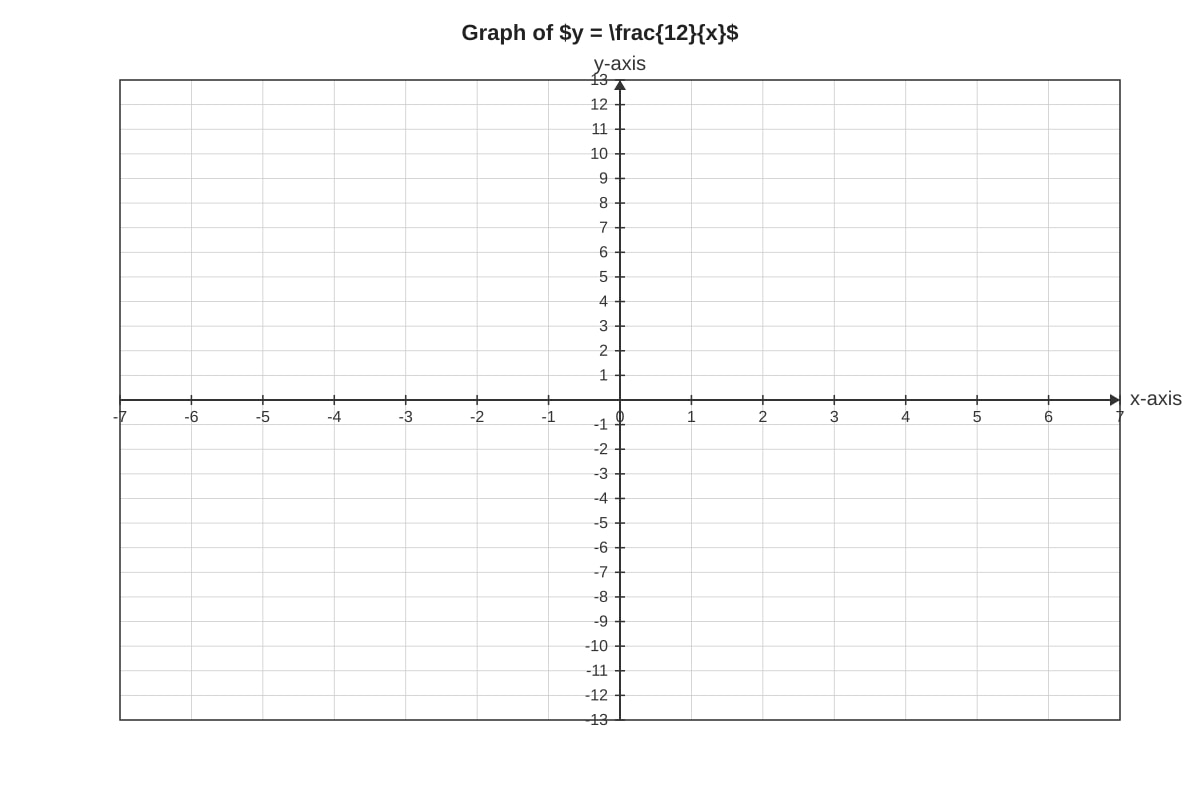
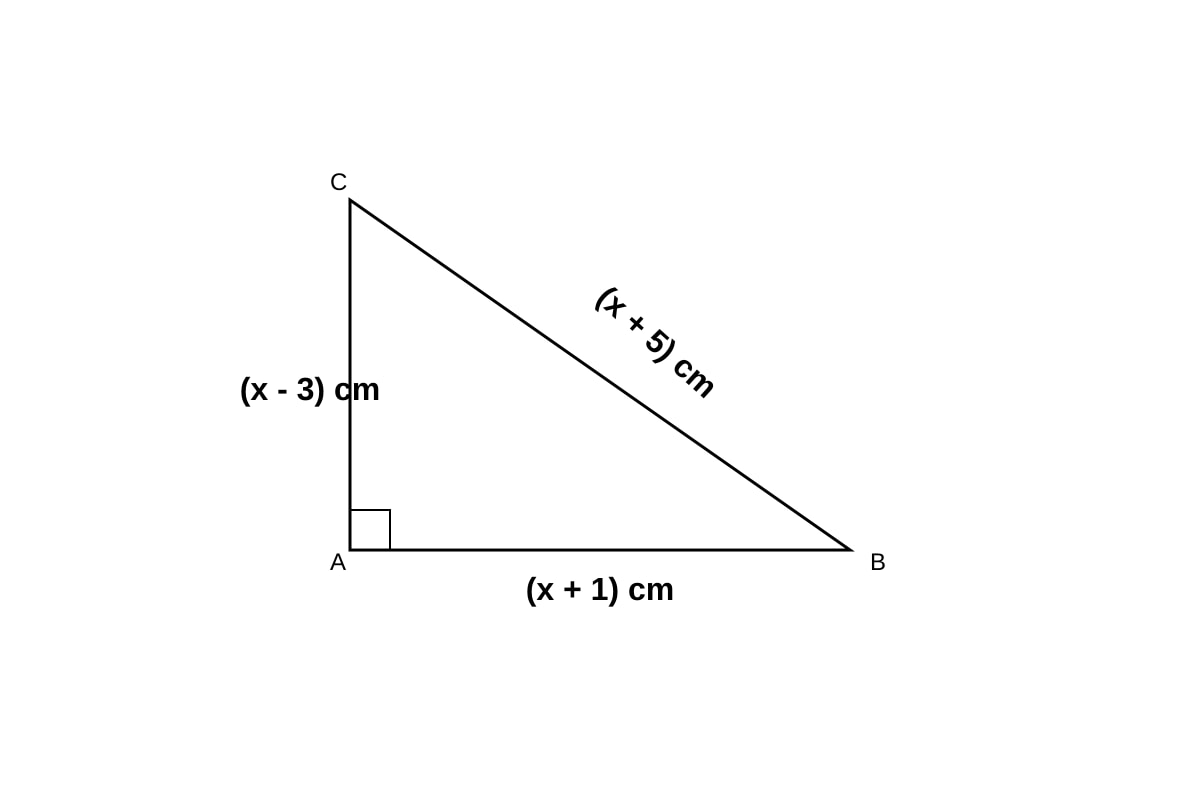
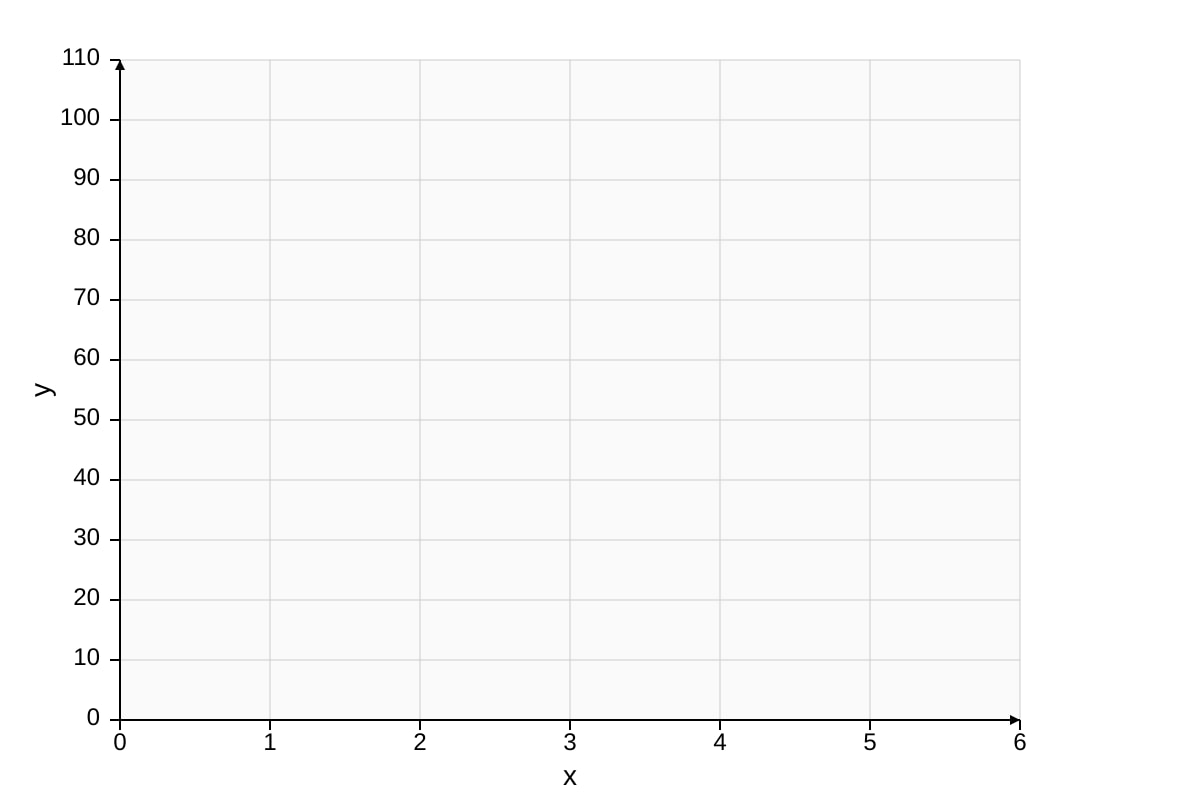
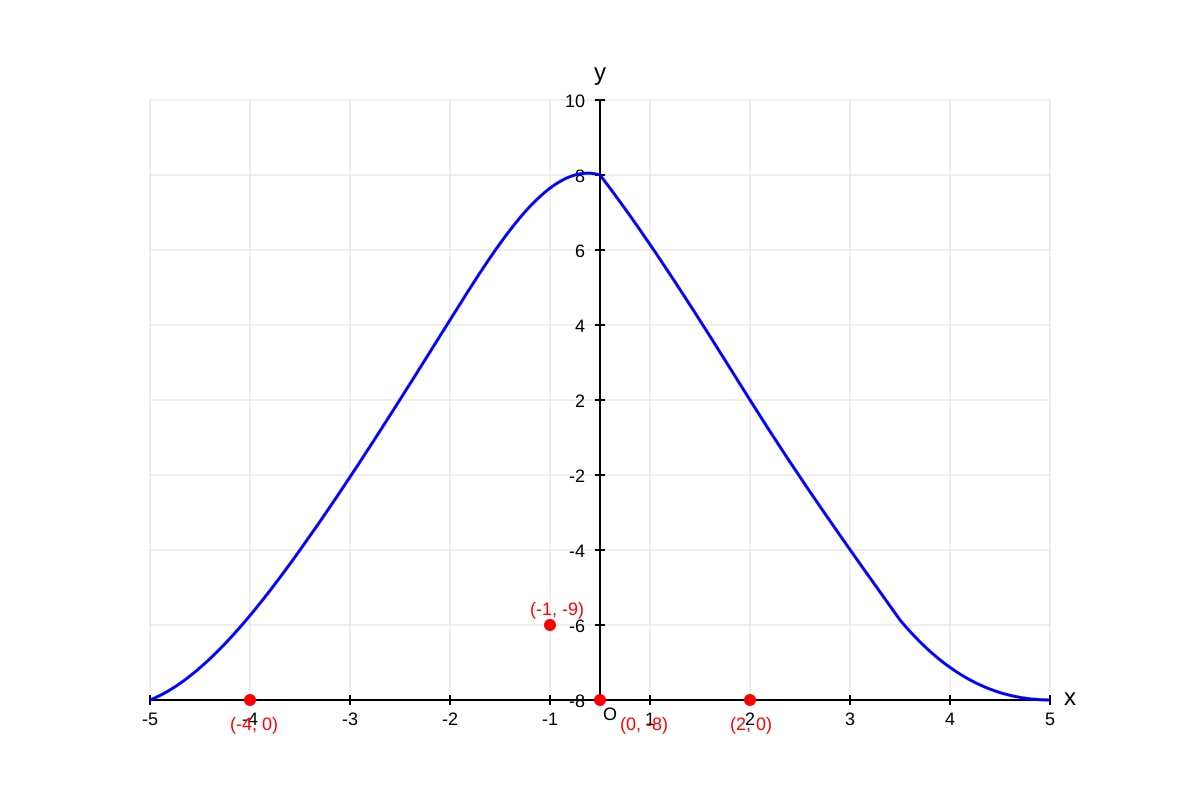
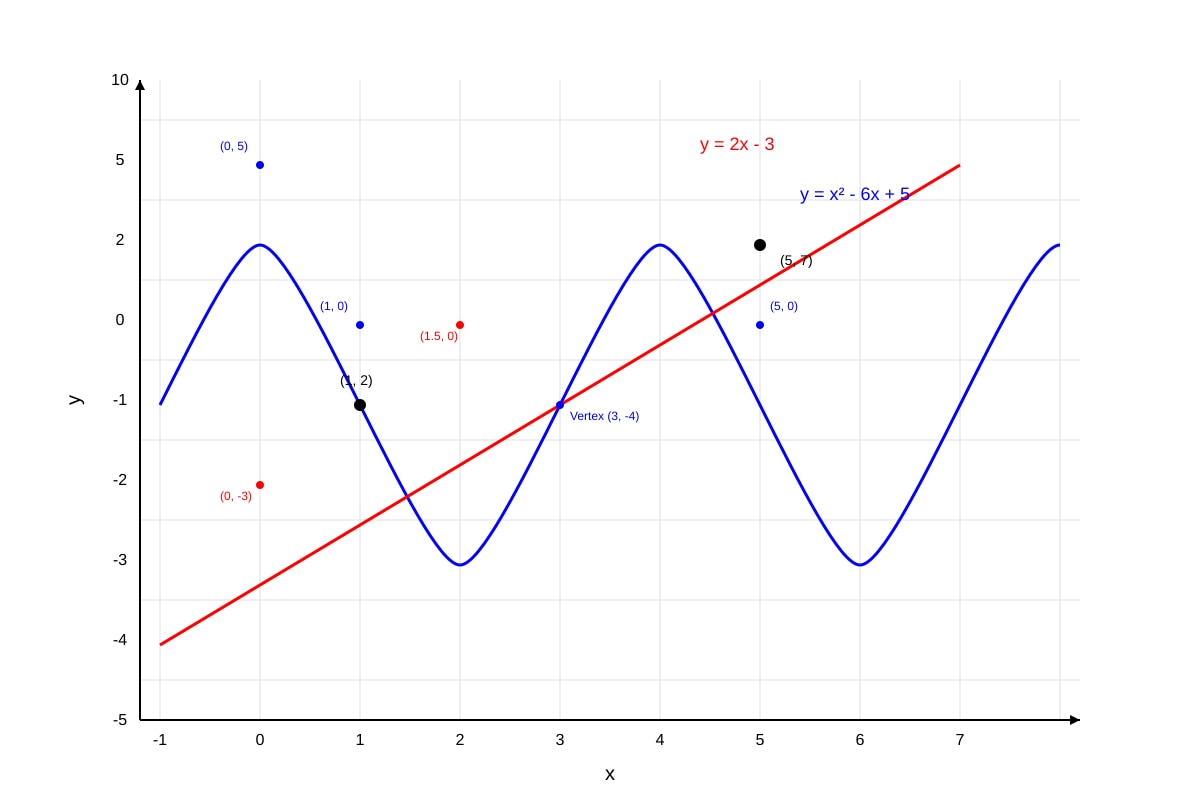
--- ### 9 The diagram shows the graph of $y = x^2 - 4x - 5$ for $-2 \le x \le 6$. <image_placeholder> id: Q9-fig1 type: graph linked_question: Q9 description: Graph of quadratic function y = x^2 - 4x - 5 with x-axis from -2 to 6, y-axis from -10 to 10. Parabola opening upwards with vertex at (2, -9), x-intercepts at (-1, 0) and (5, 0), y-intercept at (0, -5). Grid lines at integer intervals. labels: x-axis, y-axis, vertex (2, -9), x-intercepts (-1, 0) and (5, 0), y-intercept (0, -5) values: x from -2 to 6, y from -10 to 10 must_show: Parabola shape, vertex, intercepts, grid lines, axis labels </image_placeholder> (a) Write down the coordinates of the minimum point of the graph. [1] (b) Write down the equation of the line of symmetry of the graph. [1] (c) Use the graph to find the solutions of $x^2 - 4x - 5 = 0$. [1] --- ### 10 The table below shows values of $x$ and the corresponding values of $y$ for the function $y = \frac{12}{x}$, $x \neq 0$. | $x$ | -6 | -4 | -3 | -2 | -1 | 1 | 2 | 3 | 4 | 6 | |-----|----|----|----|----|----|---|---|---|---|---| | $y$ | -2 | -3 | -4 | -6 | -12 | 12 | 6 | 4 | 3 | 2 | (a) On the grid, plot the points from the table and draw the graph of $y = \frac{12}{x}$ for $-6 \le x \le -1$ and $1 \le x \le 6$. [2] <image_placeholder> id: Q10-fig1 type: graph linked_question: Q10 description: Blank coordinate grid for reciprocal function y = 12/x. x-axis from -7 to 7, y-axis from -13 to 13. Grid lines at integer intervals. Two separate branches for negative and positive x. labels: x-axis, y-axis, grid lines values: x from -7 to 7, y from -13 to 13 must_show: Empty grid with labelled axes and scale </image_placeholder> (b) Write down the equations of the two asymptotes of the graph. [1] --- ## Section B [25 marks] Answer all questions in this section. ### 11 A rectangular piece of paper has length $(2x + 5)$ cm and width $(x - 2)$ cm. (a) Write down an expression, in terms of $x$, for the area of the paper. [1] (b) Given that the area of the paper is $72 \text{ cm}^2$, form an equation in $x$ and show that it reduces to $2x^2 + x - 82 = 0$. [2] (c) Solve the equation $2x^2 + x - 82 = 0$, giving your answers correct to 2 decimal places. [2] (d) Hence, find the perimeter of the paper. [2] --- ### 12 The diagram shows a right-angled triangle with sides $(x - 3)$ cm, $(x + 1)$ cm, and $(x + 5)$ cm, where $(x + 5)$ cm is the hypotenuse. <image_placeholder> id: Q12-fig1 type: diagram linked_question: Q12 description: Right-angled triangle with sides labelled (x-3) cm, (x+1) cm, and (x+5) cm as hypotenuse. Right angle between the two shorter sides. labels: Side lengths (x-3) cm, (x+1) cm, (x+5) cm, right angle symbol values: Algebraic expressions for side lengths must_show: Right-angled triangle with algebraic side labels and right angle marker </image_placeholder> (a) Form an equation in $x$ using Pythagoras' theorem. [1] (b) Show that the equation reduces to $x^2 - 14x - 15 = 0$. [2] (c) Solve this equation to find the value of $x$. [2] (d) Hence, find the area of the triangle. [2] --- ### 13 The variables $x$ and $y$ are connected by the equation $y = \frac{k}{x^2}$, where $k$ is a constant. The table below shows some values of $x$ and $y$. | $x$ | 1 | 2 | 3 | 4 | 5 | |-----|---|---|---|---|---| | $y$ | 100 | 25 | $p$ | 6.25 | 4 | (a) Find the value of $k$. [1] (b) Find the value of $p$. [1] (c) On the grid, plot the points and draw the graph of $y = \frac{100}{x^2}$ for $1 \le x \le 5$. [2] <image_placeholder> id: Q13-fig1 type: graph linked_question: Q13 description: Blank coordinate grid for y = 100/x^2. x-axis from 0 to 6, y-axis from 0 to 110. Grid lines at integer intervals. Curve decreasing in first quadrant only. labels: x-axis, y-axis, grid lines values: x from 0 to 6, y from 0 to 110 must_show: Empty grid with labelled axes and scale </image_placeholder> (d) Use your graph to estimate the value of $x$ when $y = 15$. [1] (e) The equation $y = \frac{100}{x^2}$ can be written as $x^2 = \frac{100}{y}$. On the same axes, draw the line $y = 15$ and use it to find the value of $x$ when $y = 15$. [1] --- ### 14 A function $h$ is defined by $h(x) = ax^2 + bx + c$, where $a$, $b$, and $c$ are constants. The graph of $y = h(x)$ passes through the points $(1, 6)$, $(2, 11)$, and $(3, 18)$. (a) Form three equations in $a$, $b$, and $c$. [2] (b) Solve these equations to find the values of $a$, $b$, and $c$. [3] (c) Hence, find the minimum value of $h(x)$. [2] --- ### 15 The diagram shows the graph of $y = (x - 2)(x + 4)$ for $-5 \le x \le 5$. <image_placeholder> id: Q15-fig1 type: graph linked_question: Q15 description: Graph of quadratic function y = (x-2)(x+4) = x^2 + 2x - 8. x-axis from -5 to 5, y-axis from -10 to 10. Parabola opening upwards with vertex at (-1, -9), x-intercepts at (-4, 0) and (2, 0), y-intercept at (0, -8). labels: x-axis, y-axis, vertex (-1, -9), x-intercepts (-4, 0) and (2, 0), y-intercept (0, -8) values: x from -5 to 5, y from -10 to 10 must_show: Parabola shape, vertex, intercepts, grid lines, axis labels </image_placeholder> (a) Write down the coordinates of the points where the graph cuts the $x$-axis. [1] (b) Write down the equation of the line of symmetry. [1] (c) The line $y = k$ cuts the graph at two points. Find the range of values of $k$ for which this happens. [1] (d) The graph of $y = (x - 2)(x + 4)$ is translated 3 units to the right. Write down the equation of the new graph. [2] --- ## Section C [15 marks] Answer all questions in this section. ### 16 The cost $C$ dollars of producing $n$ items is given by the formula $C = an^2 + bn$, where $a$ and $b$ are constants. When 10 items are produced, the cost is $120. When 20 items are produced, the cost is $400. (a) Form two equations in $a$ and $b$. [2] (b) Solve these equations to find the values of $a$ and $b$. [2] (c) Find the cost of producing 15 items. [1] (d) The selling price of each item is $10. Find the minimum number of items that must be produced and sold to make a profit. [3] --- ### 17 The diagram shows a rectangular garden with a path of uniform width $x$ metres around it. The garden measures $12$ m by $8$ m. The total area of the garden and path is $192 \text{ m}^2$. <image_placeholder> id: Q17-fig1 type: diagram linked_question: Q17 description: Rectangle 12m by 8m with a uniform border of width x m around it. Outer rectangle dimensions (12+2x) by (8+2x). Shaded path area between inner and outer rectangles. labels: Inner rectangle 12m × 8m, path width x m, outer dimensions (12+2x) m × (8+2x) m values: 12 m, 8 m, x m, total area 192 m² must_show: Nested rectangles with dimensions labelled, path shaded </image_placeholder> (a) Show that $x$ satisfies the equation $x^2 + 10x - 24 = 0$. [3] (b) Solve this equation to find the width of the path. [2] (c) Find the perimeter of the outer edge of the path. [2] --- ### 18 A ball is thrown vertically upwards from a height of $2$ m above the ground. Its height $h$ metres above the ground after $t$ seconds is given by $h = -5t^2 + 20t + 2$. (a) Find the height of the ball after $1$ second. [1] (b) Find the maximum height reached by the ball. [3] (c) Find the time when the ball hits the ground, giving your answer correct to 2 decimal places. [3] --- ### 19 The function $f$ is defined by $f(x) = x^2 - 6x + 11$ for $x \in \mathbb{R}$. (a) Express $f(x)$ in the form $(x - a)^2 + b$, where $a$ and $b$ are constants. [2] (b) Write down the minimum value of $f(x)$ and the value of $x$ at which it occurs. [1] (c) The function $g$ is defined by $g(x) = f(x) + 4$ for $x \in \mathbb{R}$. Describe fully the transformation that maps the graph of $y = f(x)$ onto the graph of $y = g(x)$. [2] (d) The function $h$ is defined by $h(x) = f(x + 2)$ for $x \in \mathbb{R}$. Find the minimum value of $h(x)$. [1] --- ### 20 The diagram shows the graph of $y = x^2 - 6x + 5$ and the line $y = 2x - 3$. <image_placeholder> id: Q20-fig1 type: graph linked_question: Q20 description: Graph showing parabola y = x^2 - 6x + 5 (vertex at (3, -4), x-intercepts at (1,0) and (5,0), y-intercept at (0,5)) and straight line y = 2x - 3 (y-intercept at (0,-3), x-intercept at (1.5,0)). Two intersection points visible. labels: Parabola y = x^2 - 6x + 5, line y = 2x - 3, intersection points, axes values: x from -1 to 7, y from -5 to 10 must_show: Both curves clearly drawn with intersection points, axes labelled </image_placeholder> (a) Find the $x$-coordinates of the points of intersection of the curve and the line. [3] (b) Hence, solve the inequality $x^2 - 6x + 5 > 2x - 3$. [2] --- **END OF PAPER**Answers
TuitionGoWhere Practice Paper - Mathematics Secondary 2
SA2 Version 1 - Answer Key and Marking Scheme
Total Marks: 60
Section A [20 marks]
1
(a)
When , :
Equation:
Marks: [1] for , [1] for and final equation
(b) When :
Marks: [1] for correct substitution and answer
Answer: (a) (b)
2
(a)
When , :
Equation:
Marks: [1] for , [1] for and final equation
(b) When :
Marks: [1] for correct working and answer
Answer: (a) (b)
3
Marks: [1] for correct substitution, [1] for correct evaluation
Answer:
4
(a)
Marks: [1] for correct answer
(b)
Marks: [1] for setting up equation, [1] for solving correctly
Answer: (a) (b) or
5
Factorise:
or
or
Marks: [1] for correct factorisation, [1] for setting each factor to zero, [1] for both solutions
Answer: or
6
Multiply (1) by 2: \quad \text{(3)}
Add (2) and (3):
Substitute into (1):
Marks: [1] for elimination step, [1] for finding , [1] for finding
Answer: ,
7
Marks: [1] for factorising out 3, [1] for difference of squares factorisation
Answer:
8
Marks: [1] for factorising numerator and denominator, [1] for cancelling common factor and stating restriction
Answer:
9
(a) From the graph, the minimum point (vertex) is at .
Marks: [1] for correct coordinates
(b) Line of symmetry passes through the vertex:
Marks: [1] for correct equation
(c) The graph cuts the -axis at and .
Solutions: or
Marks: [1] for both solutions
Answer: (a) (b) (c) or
10
(a) Points plotted correctly and smooth curve drawn through them for both branches ( and ).
Marks: [1] for correct plotting of all points, [1] for smooth curves with correct shape (two separate branches)
(b) The asymptotes are the -axis and -axis.
Equations: and
Marks: [1] for both equations
Answer: (a) Graph drawn (b) and
Section B [25 marks]
11
(a) Area
Marks: [1] for correct expression
(b) Given area :
(shown)
Marks: [1] for equating to 72, [1] for correct rearrangement
(c)
Using quadratic formula:
, ,
or (2 d.p.)
Since represents a length, , so (2 d.p.)
Marks: [1] for correct quadratic formula substitution, [1] for both values to 2 d.p.
(d) Length cm
Width cm
Perimeter cm
Marks: [1] for finding length and width, [1] for correct perimeter
Answer: (a) (b) Shown (c) or (d) cm
12
(a) By Pythagoras' theorem:
Marks: [1] for correct equation
(b) Expand:
(shown)
Marks: [1] for correct expansion, [1] for correct simplification
(c)
or
Since side lengths must be positive: , so
Marks: [1] for solving, [1] for rejecting with reason
(d) Sides: cm, cm
Area
Marks: [1] for finding side lengths, [1] for correct area
Answer: (a) (b) Shown (c) (d)
13
(a)
When , :
Marks: [1] for correct value
(b) When :
(or )
Marks: [1] for correct value
(c) Points plotted correctly and smooth curve drawn.
Marks: [1] for correct plotting, [1] for smooth curve
(d) From graph, when ,
Marks: [1] for reasonable estimate (accept )
(e) Line drawn horizontally. Intersection with curve gives
Marks: [1] for line drawn and intersection used
Answer: (a) (b) or (c) Graph drawn (d) (e)
14
(a) :
:
:
Marks: [1] for first two equations, [1] for third equation
(b) Subtract first from second: \quad \text{(4)}
Subtract second from third: \quad \text{(5)}
Subtract (4) from (5):
Substitute into (4):
Substitute into first:
Marks: [1] for eliminating , [1] for finding and , [1] for finding
(c)
Complete the square:
Minimum value (when )
Marks: [1] for completing the square, [1] for minimum value
Answer: (a) , , (b) , , (c) Minimum value
15
(a) Graph cuts -axis at and .
Marks: [1] for both coordinates
(b) Line of symmetry:
Marks: [1] for correct equation
(c) The minimum value is (at vertex). The line cuts the graph at two points when .
Range:
Marks: [1] for correct inequality
(d) Translation 3 units right: replace with
New equation:
Or expanded:
Marks: [1] for correct substitution, [1] for simplified equation
Answer: (a) and (b) (c) (d) or
Section C [15 marks]
16
(a) When , :
When , :
Marks: [1] for each equation
(b) Simplify:
\quad \text{(1)}
\quad \text{(2)}
Subtract (1) from (2):
Substitute into (1):
Marks: [1] for simplification, [1] for solving
(c) When :
Marks: [1] for correct substitution and answer
(d) Revenue
Profit when Revenue :
Since must be an integer and profit requires , minimum
Marks: [1] for setting up inequality, [1] for solving inequality, [1] for correct integer answer
Answer: (a) , (b) , (c) (d) items
17
(a) Outer dimensions: by
Total area
Divide by 4: (shown)
Marks: [1] for outer dimensions, [1] for area equation, [1] for correct simplification
(b)
or
Width must be positive, so m
Marks: [1] for solving, [1] for rejecting negative root with reason
(c) Outer dimensions: m, m
Perimeter m
Marks: [1] for outer dimensions, [1] for perimeter
Answer: (a) Shown (b) m (c) m
18
(a) m
Marks: [1] for correct answer
(b)
Complete the square:
Maximum height m (when s)
Marks: [1] for completing the square, [1] for identifying vertex form, [1] for maximum height
(c) Ball hits ground when :
or (2 d.p.)
Time must be positive, so s
Marks: [1] for setting , [1] for quadratic formula, [1] for correct positive root to 2 d.p.
Answer: (a) m (b) m (c) s
19
(a)
Marks: [1] for completing the square, [1] for correct form
(b) Minimum value , occurs at
Marks: [1] for both
(c)
This is a translation of the graph of by 4 units upwards (in the positive -direction).
Marks: [1] for "
<stage3_exam_answers_md>
TuitionGoWhere Practice Paper - Mathematics Secondary 2
SA2 Version 1 - Answer Key and Marking Scheme
Total Marks: 60
Section A [20 marks]
1
(a)
When , :
Equation:
Marks: [1] for , [1] for and final equation
(b) When :
Marks: [1] for correct substitution and answer
Answer: (a) (b)
2
(a)
When , :
Equation:
Marks: [1] for , [1] for and final equation
(b) When :
Marks: [1] for correct working and answer
Answer: (a) (b)
3
Marks: [1] for correct substitution, [1] for correct evaluation
Answer:
4
(a)
Marks: [1] for correct answer
(b)
Marks: [1] for setting up equation, [1] for solving correctly
Answer: (a) (b) or
5
Factorise:
or
or
Marks: [1] for correct factorisation, [1] for setting each factor to zero, [1] for both solutions
Answer: or
6
Multiply (1) by 2: \quad \text{(3)}
Add (2) and (3):
Substitute into (1):
Marks: [1] for elimination step, [1] for finding , [1] for finding
Answer: ,
7
Marks: [1] for factorising out 3, [1] for difference of squares factorisation
Answer:
8
Marks: [1] for factorising numerator and denominator, [1] for cancelling common factor and stating restriction
Answer:
9
(a) From the graph, the minimum point (vertex) is at .
Marks: [1] for correct coordinates
(b) Line of symmetry passes through the vertex:
Marks: [1] for correct equation
(c) The graph cuts the -axis at and .
Solutions: or
Marks: [1] for both solutions
Answer: (a) (b) (c) or
10
(a) Points plotted correctly and smooth curve drawn through them for both branches ( and ).
Marks: [1] for correct plotting of all points, [1] for smooth curves with correct shape (two separate branches)
(b) The asymptotes are the -axis and -axis.
Equations: and
Marks: [1] for both equations
Answer: (a) Graph drawn (b) and
Section B [25 marks]
11
(a) Area
Marks: [1] for correct expression
(b) Given area :
(shown)
Marks: [1] for equating to 72, [1] for correct rearrangement
(c)
Using quadratic formula:
, ,
or (2 d.p.)
Since represents a length, , so (2 d.p.)
Marks: [1] for correct quadratic formula substitution, [1] for both values to 2 d.p.
(d) Length cm
Width cm
Perimeter cm
Marks: [1] for finding length and width, [1] for correct perimeter
Answer: (a) (b) Shown (c) or (d) cm
12
(a) By Pythagoras' theorem:
Marks: [1] for correct equation
(b) Expand:
(shown)
Marks: [1] for correct expansion, [1] for correct simplification
(c)
or
Since side lengths must be positive: , so
Marks: [1] for solving, [1] for rejecting with reason
(d) Sides: cm, cm
Area
Marks: [1] for finding side lengths, [1] for correct area
Answer: (a) (b) Shown (c) (d)
13
(a)
When , :
Marks: [1] for correct value
(b) When :
or (3 s.f.)
Marks: [1] for correct value
(c) Points plotted correctly and smooth curve drawn through them for .
Marks: [1] for correct plotting, [1] for smooth curve
(d) From graph, when , (accept )
Marks: [1] for reasonable estimate
(e) Line drawn horizontally. Intersection with curve gives
Marks: [1] for correct use of line and reading
Answer: (a) (b) or (c) Graph drawn (d) (e)
14
(a) :
:
:
Marks: [1] for first two equations, [1] for third equation
(b) Subtract first from second: \quad (1)
Subtract second from third: \quad (2)
Subtract (1) from (2):
Substitute into (1):
Substitute into first:
Marks: [1] for eliminating , [1] for finding and , [1] for finding
(c)
Complete the square:
Minimum value (when )
Marks: [1] for completing square or using vertex formula, [1] for minimum value
Answer: (a) , , (b) , , (c) Minimum value
15
(a) Graph cuts -axis at and .
Marks: [1] for both coordinates
(b) Line of symmetry: (midpoint of and )
Marks: [1] for correct equation
(c) Vertex is at , so minimum .
Line cuts graph at two points when .
Marks: [1] for correct range
(d) Translate 3 units right: replace with
Or expanded:
Marks: [1] for correct substitution, [1] for final equation
Answer: (a) and (b) (c) (d) or
Section C [15 marks]
16
(a) When , :
When , :
Marks: [1] for each equation
(b) Simplify:
\quad (1)
\quad (2)
Subtract (1) from (2):
Substitute into (1):
Marks: [1] for solving for , [1] for solving for
(c)
When :
Marks: [1] for correct cost
(d) Revenue
Profit when
Since is integer, minimum (but check: for , cost , revenue , profit )
Wait:
So for , profit is made. Minimum .
Marks: [1] for setting up inequality, [1] for solving inequality, [1] for correct minimum integer
Answer: (a) , (b) , (c) \2401$ item
17
(a) Outer dimensions: by
Total area
Divide by 4: (shown)
Marks: [1] for outer dimensions, [1] for area equation, [1] for correct simplification
(b)
or
Width must be positive, so m
Marks: [1] for solving, [1] for rejecting negative and stating answer
(c) Outer dimensions: m, m
Perimeter m
Marks: [1] for outer dimensions, [1] for perimeter
Answer: (a) Shown (b) m (c) m
18
(a) m
Marks: [1] for correct answer
(b)
Complete the square:
Maximum height m (at s)
Marks: [1] for completing square or vertex formula, [1] for maximum height, [1] for time (optional)
(c) Ball hits ground when :
s (reject negative)
Marks: [1] for setting , [1] for quadratic formula, [1] for correct positive root to 2 d.p.
Answer: (a) m (b) m (c) s
19
(a)
Marks: [1] for completing square, [1] for correct form
(b) Minimum value at
Marks: [1] for both
(c)
Translation of units upwards (in the positive -direction).
Marks: [1] for "translation", [1] for "4 units upwards"
(d)
Minimum value
Marks: [1] for correct minimum
Answer: (a) (b) Min at (c) Translation 4 units upwards (d)
20
(a) Intersection:
Marks: [1] for equating, [1] for correct quadratic, [1] for solving
(b)
Roots: and
Parabola opens upwards, so inequality holds for or
Marks: [1] for correct inequality setup, [1] for correct solution set
Answer: (a) (b) or
END OF ANSWER KEY