AI Generated Quiz
Secondary 2 History Source Based Skills Quiz
Free Sec 2 History Source Based Skills quiz, LongCat AI version, with questions, answers, and syllabus-aligned practice for Singapore students.
These static practice materials are generated from the site's syllabus and paper-generation workflow, with source and model context shown so students and parents can evaluate the material before use.
Questions
Free quiz and exam paper access
Enter your details to view this paper
Your access is remembered on this device.
Answers
Secondary 2 History Quiz - Source Based Skills
Answer Key
Section A: Source Comprehension (Questions 1–5)
1. What is the date of Source A? [1]
Answer: 1946 [1]
2. According to Source A, what were TWO problems faced by people in Singapore after the war? [2]
Answer: (a) Food shortages / lack of food [1] (b) Lack of clean water / unemployment / damaged infrastructure / disrupted trade [1]
Accept any TWO of the above or other valid problems mentioned in the source.
Marking note: Award 1 mark per correct problem. Answers must be drawn from the source. Do not accept vague answers like "people suffered" without specifying what the problem was.
3. What does Source A tell us about the attitude of the British colonial official towards the people of Singapore? [2]
Answer: The British colonial official was sympathetic / concerned about the people's suffering [1]. He acknowledged the difficulties they faced and recognised the need for rebuilding, but also showed awareness of rising demands for self-government [1].
Alternative: The official was understanding but also cautious about political change.
Marking note: Award 2 marks for a well-explained answer that references the source. Award 1 mark for a general description without source reference.
4. What type of source is Source A? [1]
Answer: Speech [1]
5. Is Source A a primary or secondary source? Explain your answer. [2]
Answer: Source A is a primary source [1] because it was created in 1946 by someone who was directly involved in events at that time / it is a first-hand account from the period being studied [1].
Marking note: Award 1 mark for correctly identifying it as a primary source. Award 1 mark for a valid explanation. Do not accept "because it is old" as a valid explanation.
Section B: Source Comparison (Questions 6–10)
6. What is the provenance of Source C? Give TWO details. [2]
Answer: (a) It is a diary entry / personal diary [1] (b) Written by a Chinese resident in Singapore in 1943 [1]
Alternative for (b): Written during the Japanese Occupation.
Marking note: Award 1 mark per correct detail. The answer must address who created it, what type of source it is, when it was created, or where.
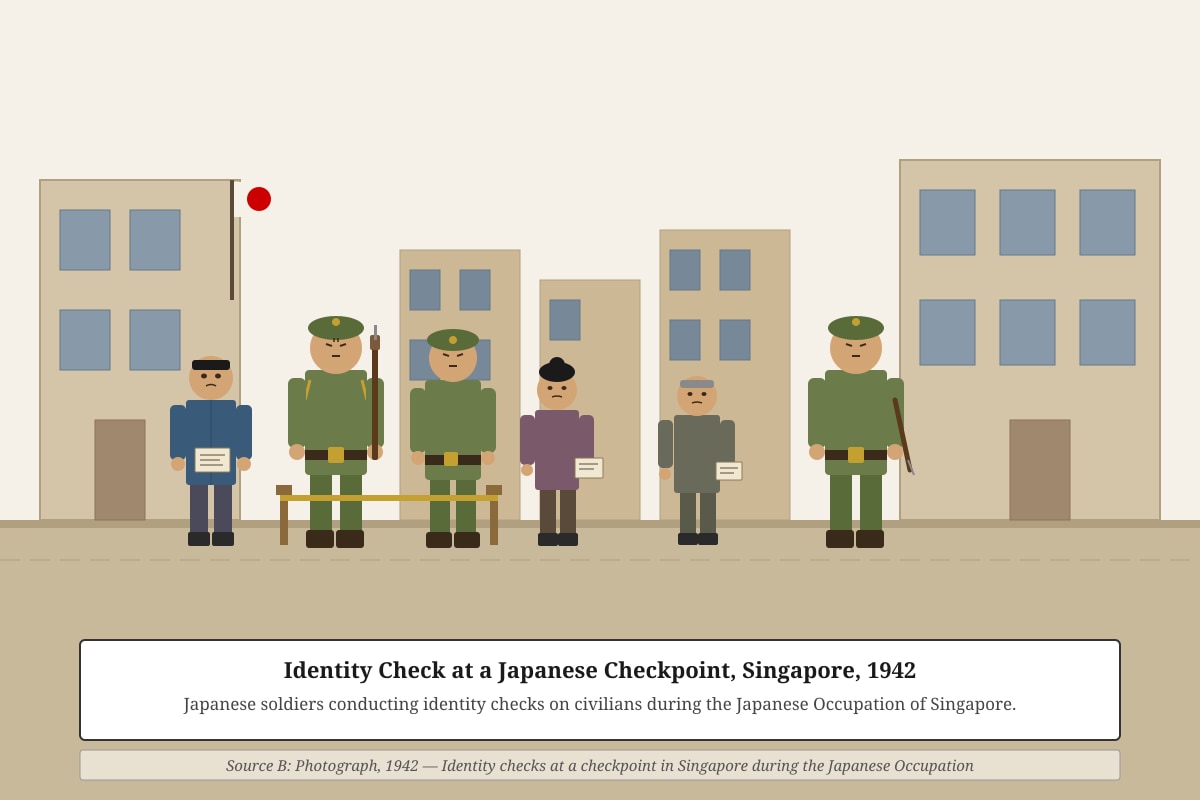
7. How are Sources B and C similar in what they show about life during the Japanese Occupation? Explain your answer using details from both sources. [3]
Answer: Both sources show that the Japanese imposed strict controls on civilians through identity checks [1]. Source B shows Japanese soldiers stopping civilians and checking their papers at a checkpoint [1]. Similarly, Source C describes how soldiers stopped people on the streets and demanded to see identity papers, and that those who failed to comply were beaten or taken away [1].
Marking note: Award 1 mark for identifying the similarity. Award 1 mark for detail from Source B. Award 1 mark for detail from Source C. Answers must reference BOTH sources to receive full marks.
8. How is Source B different from Source C in terms of the information each provides? [3]
Answer: Source B is a photograph that shows what a checkpoint looked like visually but does not tell us how people felt about the experience [1]. Source C is a diary entry that provides personal feelings and emotions, such as fear and the danger of being taken away by the Kempeitai, which a photograph cannot show [1]. Source B shows the physical scene while Source C provides the inner thoughts and experiences of a civilian [1].
Marking note: Award 1 mark for identifying a valid difference. Award 1 mark for detail from Source B. Award 1 mark for detail from Source C. The difference must be explained, not just stated.
9. Which source, B or C, is more useful for understanding how civilians felt during the Japanese Occupation? Explain your answer. [3]
Answer: Source C is more useful for understanding how civilians felt [1]. This is because Source C is a diary entry written by a Chinese resident who directly experienced the Occupation, and it describes emotions such as fear and the need to be careful about what they said and did [1]. Source B is a photograph that shows the physical scene of identity checks but does not reveal the feelings or emotions of the people involved [1].
Marking note: Award 1 mark for choosing Source C. Award up to 2 marks for explanation. Accept Source B with a valid explanation (e.g., facial expressions in the photograph), but this is harder to justify at this level.
10. Can Source C be trusted as an accurate account of life during the Japanese Occupation? Explain your answer. [3]
Answer: Source C can be partially trusted because it is a first-hand account written by someone who experienced the Japanese Occupation in 1943, so it reflects real experiences [1]. However, it represents only one person's perspective — a Chinese resident who may have had particularly negative experiences, especially given the Sook Ching operations targeting Chinese males [1]. To get a more complete and balanced picture, a historian should cross-reference Source C with other sources from different communities and perspectives [1].
Marking note: Award 1 mark for acknowledging it is a first-hand/primary account. Award 1 mark for identifying the limitation (single perspective/potential bias). Award 1 mark for suggesting cross-referencing with other sources. Answers that simply say "yes" or "no" without explanation receive a maximum of 1 mark.
Section C: Source Utility and Reliability (Questions 11–15)
11. What was the purpose of Source E? [2]
Answer: The purpose of Source E was to persuade / convince the local population to cooperate with the Japanese government [1] and to promote Japan's message that they had liberated Singapore from British colonial rule for the benefit of Asia [1].
Alternative: To justify Japanese rule / to spread propaganda.
Marking note: Award 2 marks for a clear explanation of purpose. Award 1 mark for identifying it as propaganda/persuasion without further explanation.
12. Why might Source E not be a reliable source about the true conditions in Singapore during the Japanese Occupation? Explain your answer. [3]
Answer: Source E may not be reliable because it was a speech by a Japanese military commander whose purpose was to promote Japanese rule and gain cooperation from the local population [1]. He would have had a reason to present a positive image of the Occupation and would not have mentioned the hardships, suffering, and harsh treatment experienced by civilians [1]. The source reflects only the Japanese government's perspective and does not show the reality of life for ordinary people during the Occupation [1].
Marking note: Award 1 mark for identifying bias/purpose. Award 1 mark for explaining what information would be omitted. Award 1 mark for identifying it as one-sided/a single perspective.
13. How does the information in Source D differ from the claims made in Source E? [3]
Answer: Source E claims that Japan liberated Singapore and brought order and prosperity to Asia [1]. However, Source D states that the Japanese Occupation was a period of great hardship, with strict controls, food rationing, hunger, fear, and the killing of thousands of Chinese males during the Sook Ching operation [1]. Source D directly contradicts Source E's positive portrayal by describing the suffering and violence experienced by the people [1].
Marking note: Award 1 mark for summarising Source E's claims. Award 1 mark for summarising Source D's information. Award 1 mark for explaining the contradiction/difference.
14. Which source, D or E, would a historian find more useful for understanding what life was really like for people in Singapore during the Japanese Occupation? Explain your answer. [3]
Answer: Source D would be more useful [1]. Source D is a textbook that has been written using evidence from multiple sources and research, and it describes the hardships, strict controls, hunger, and violence experienced by civilians during the Occupation [1]. Source E is a propaganda speech by a Japanese commander that presents only a positive view of Japanese rule and does not reflect the true conditions experienced by the people [1].
Marking note: Award 1 mark for choosing Source D. Award up to 2 marks for explanation. Accept Source E only if the student argues it is useful for understanding Japanese propaganda/perspective, with clear reasoning.
15. Is Source D a primary or secondary source? Give ONE reason for your answer. [2]
Answer: Source D is a secondary source [1] because it was published in 2020, long after the events of the Japanese Occupation (1942–1945), and was written by someone who did not directly experience the events [1].
Alternative reason: It is a textbook that was written based on research and other sources, not from first-hand experience.
Marking note: Award 1 mark for correctly identifying it as a secondary source. Award 1 mark for a valid reason.
Section D: Cross-Referencing and Inference (Questions 16–20)
16. According to Source F, by how much did the price of rice increase from 1941 to 1945? Show your working. [2]
Answer: Price in 1941: 15.00 Increase = 0.10 = $14.90 [1]
The price of rice increased by $14.90 per kilogram [1].
Marking note: Award 1 mark for correct working. Award 1 mark for the correct final answer. If the student only writes the final answer without working, award 1 mark only.
17. What can you infer about the standard of living in Singapore during the Japanese Occupation from Source F? [2]
Answer: The standard of living was very low / poor during the Japanese Occupation [1]. The price of rice increased dramatically (from 15.00 per kg), which means most people could not afford basic food and many would have suffered from hunger [1].
Marking note: Award 1 mark for inferring a low/poor standard of living. Award 1 mark for explaining using evidence from the source (the price increase).
18. How does Source G support the information shown in Source F? Explain your answer. [3]
Answer: Source F shows that the price of rice increased dramatically during the Japanese Occupation, reaching $15.00 per kg by 1945 [1]. Source G supports this by describing how rice became so expensive that the woman's family had to mix rice with sweet potato to have enough to eat, and how her mother queued for hours but still came home with very little [1]. Together, both sources show that food was extremely expensive and scarce during the Occupation, making life very difficult for ordinary people [1].
Marking note: Award 1 mark for referencing Source F's data. Award 1 mark for referencing Source G's details. Award 1 mark for explaining how the two sources support each other.
19. Source G was recorded in 1995, more than 50 years after the Japanese Occupation. Does this make Source G less reliable? Explain your answer. [3]
Answer: Source G may be slightly less reliable because it was recorded more than 50 years after the events, and memories can fade or become distorted over time [1]. The woman may not remember exact details clearly after so many years [1]. However, the strong emotions and traumatic experiences of the Occupation are likely to have left a lasting impression, so the core experiences described are likely to be accurate, even if some specific details may have been affected by the passage of time [1].
Marking note: Award 1 mark for identifying the time gap as a potential issue. Award 1 mark for explaining how memory can fade/distort. Award 1 mark for balancing the argument by acknowledging that significant experiences are often remembered clearly. Answers that simply say "yes" or "no" without balanced explanation receive a maximum of 2 marks.
20. Using details from BOTH Sources F and G, explain what life was like for ordinary people in Singapore during the Japanese Occupation. [4]
Answer: Life for ordinary people in Singapore during the Japanese Occupation was extremely difficult [1]. Source F shows that the price of rice rose dramatically from 15.00 per kg in 1945, meaning that basic food became unaffordable for most people [1]. Source G supports this by describing how the woman's family could barely afford to eat and had to mix rice with sweet potato to make it last, and how some days they only had one meal [1]. Together, the sources show that ordinary people suffered from severe food shortages and had to struggle to survive during the Occupation [1].
Marking note: Award 1 mark for an overall description of life being difficult. Award 1 mark for using detail from Source F. Award 1 mark for using detail from Source G. Award 1 mark for synthesising both sources into a coherent explanation. Answers that only use one source receive a maximum of 2 marks.
Summary of Marks
| Section | Questions | Marks |
|---|---|---|
| A: Source Comprehension | 1–5 | 8 |
| B: Source Comparison | 6–10 | 14 |
| C: Source Utility and Reliability | 11–15 | 13 |
| D: Cross-Referencing and Inference | 16–20 | 15 |
| Total | 1–20 | 50 |
Common Mistakes to Note
- Question 7/8: Students often list content from each source separately without explicitly comparing them. Remind students to use comparative language ("similarly," "in contrast," "both sources show").
- Question 10/12: Students tend to give one-sided answers (e.g., "yes, it can be trusted" or "no, it cannot"). Encourage balanced evaluation — consider both strengths and limitations.
- Question 16: Students may forget to show working. Remind them that "show your working" means the calculation must be visible.
- Question 20: Students may only reference one source. Remind them that the question explicitly asks for details from BOTH sources.