AI Generated Quiz
Secondary 2 History Source Based Skills Quiz
Free Sec 2 History Source Based Skills quiz, Nemo3 AI version, with questions, answers, and syllabus-aligned practice for Singapore students.
These static practice materials are generated from the site's syllabus and paper-generation workflow, with source and model context shown so students and parents can evaluate the material before use.
Questions

Free quiz and exam paper access
Enter your details to view this paper
Your access is remembered on this device.
Answers
Secondary 2 History Quiz - Source Based Skills (Answer Key)
Total Marks: 50
Section A: Source Analysis and Inference (Questions 1–5)
1. Study Source A. What can you infer about the impact of the Japanese Occupation on the daily life of civilians in Singapore? Support your inference with evidence from the source. [4]
Answer:
- Inference 1: The Japanese Occupation caused severe disruption to basic necessities and daily routines. [1]
- Evidence: "Rice is rationed at 200 grams per person per week. We eat tapioca and sweet potato leaves now." [1]
- Inference 2: The Occupation created fear and uncertainty, especially for Chinese families. [1]
- Evidence: "My elder brother left this morning. We have not seen him since." and "The Kempeitai have put up notices everywhere — 'Sook Ching' they call it." [1]
Marking Notes:
- 1 mark per valid inference (max 2 inferences)
- 1 mark per piece of supporting evidence from the source
- Inferences must be about daily life impact (food, fear, education, language, family separation)
- Do not accept inferences not supported by the source (e.g., "Japanese were cruel" without evidence from text)
Common Mistakes:
- Quoting the source without making an inference
- Making inferences about Japanese policy rather than civilian daily life
- Using own knowledge instead of the source
2. Study Source B. How useful is Source B as evidence of the hardships faced by civilians during the Japanese Occupation? Explain your answer using the source and your knowledge. [5]
Answer: Yes, it is useful because: [3 marks max]
- It provides specific details about multiple hardships: Sook Ching executions (5,000–25,000 deaths), food shortages ("Grow More Food" campaign), hyperinflation (rice 100× pre-war price), and education restructuring. [1–2 marks for specific details]
- As a 1946 British government report, it was based on official investigations and records compiled soon after the Occupation, giving it factual credibility. [1 mark for provenance/reliability reasoning]
But it has limitations: [2 marks max]
- It is a British official report, which may emphasise Japanese brutality to justify British return or war crimes trials — possible bias. [1 mark]
- It gives aggregate statistics but lacks personal, lived experiences of ordinary civilians (e.g., emotional trauma, day-to-day survival strategies). [1 mark]
- It does not cover experiences of all communities equally (focuses on Chinese in Sook Ching; less on Malays, Indians, Eurasians). [1 mark]
Marking Notes:
- Must address BOTH usefulness AND limitations for full marks
- "Useful" does not mean "perfectly reliable" — a biased source can still be useful for understanding official perspectives
- Own knowledge should contextualise (e.g., mention banana money, forced labour, Kempeitai terror)
- Max 3 marks for one-sided answer (only usefulness or only limitations)
3. Study Source C. What is the message of this propaganda poster? Explain your answer using details from the source. [4]
Answer: Message: The Japanese Occupation brings peace, prosperity, and unity to Asia under Japanese leadership. / The Japanese are benevolent protectors leading Asia to a bright future in the "Co-Prosperity Sphere". [2 marks for accurate message]
Supporting details from source: [2 marks]
- The smiling Asian family working harmoniously in a rice paddy suggests prosperity and cooperation. [1]
- The rising sun flag and Japanese soldier watching "benevolently" portrays Japanese rule as protective and positive. [1]
- The slogans "Asia for Asians" and "Co-Prosperity Sphere" promote the idea of Asian liberation from Western colonialism under Japanese guidance. [1]
Marking Notes:
- Message must be the intended message of the poster (what the creator wants viewers to believe), not what the student thinks is true
- Must link visual details to the message
- Do not accept "The poster shows a happy family" — that is description, not message
4. Study Sources A and D. How similar are Sources A and D in their portrayal of the Sook Ching operation? Explain your answer using details from both sources. [6]
Answer: Similarities: [3 marks max]
- Both sources portray Sook Ching as a terrifying, arbitrary process targeting Chinese males. [1]
- Source A: "All Chinese males aged 18 to 50 must report to screening centres. My elder brother left this morning. We have not seen him since." [1]
- Source D: "They made us line up for hours. A hooded informant pointed at some men — they were taken away in lorries... My cousin was taken. We never found his body." [1]
- Both show the climate of fear it created. [1]
- Source A: Family anxiety over missing brother. [1]
- Source D: "After that, everyone was terrified. We wore 'peace living' certificates around our necks..." [1]
Differences: [3 marks max]
- Perspective/Provenance: Source A is a contemporary diary (1942) by a teenage girl — immediate, personal, emotional, limited knowledge. Source D is a retrospective oral history (1985) by an adult male — reflective, detailed, includes hindsight. [1–2 marks]
- Details: Source D provides specific procedural details (Hong Lim Complex, hooded informant, "peace living" certificates, bowing to sentries) absent in Source A. [1]
- Scope: Source A focuses on family impact; Source D describes the screening process itself and broader repression (bowing, worthless currency). [1]
Marking Notes:
- Must explicitly compare BOTH sources — do not just describe each separately
- Similarities and differences must be about portrayal of Sook Ching, not general Occupation life
- Provenance comparison (contemporary vs. retrospective) is a high-level difference
- Max 4 marks if only similarities OR only differences covered
5. Study Sources B and C. How different are Sources B and C in their portrayal of life under the Japanese? Explain your answer using details from both sources. [6]
Answer: Differences: [5 marks max]
- Overall portrayal: Source B portrays life as brutal, harsh, and desperate (executions, starvation, hyperinflation, terror). Source C portrays life as peaceful, prosperous, and harmonious under Japanese benevolence. [2 marks for clear contrast]
- Food: Source B — "food supplies critically disrupted", "black market price of rice 100 times pre-war price". Source C — abundant rice paddy harvest, smiling well-fed family. [1]
- Japanese role: Source B — Kempeitai "maintained control through fear, informants, arbitrary arrests". Source C — Japanese soldier watches "benevolently" as protector. [1]
- Purpose/Provenance: Source B is a 1946 British official report aiming to document atrocities for historical/legal record. Source C is a 1943 Japanese propaganda poster aiming to win hearts and minds / legitimise rule. [1–2 marks for provenance-purpose link]
Similarity (if noted): Both acknowledge Japanese authority/presence (flags, soldier, administration). [1 mark — optional, not required for full marks]
Marking Notes:
- The core difference is reality vs. propaganda — students should articulate this
- Must use specific details from BOTH sources
- Provenance/purpose analysis earns higher marks
- Do not accept "Source B is true, Source C is false" — both are portrayals with different purposes
Section B: Source Reliability and Utility (Questions 6–10)
6. Study Source E. What can you infer about Lim Yew Hock's view of the 1956 constitutional proposals? Support your inference with evidence from the source. [4]
Answer:
- Inference 1: Lim Yew Hock viewed the proposals as inadequate and not true self-government. [1]
- Evidence: "This is not true independence... We are being asked to accept a constitution that keeps us as a colony in all but name." [1]
- Inference 2: He believed Singapore should have control over defence and foreign affairs. [1]
- Evidence: "We demand full internal self-government with the right to determine our own defence and foreign policy." [1]
Marking Notes:
- Inferences must be about Lim's view (opinion/stance), not just facts from the text
- Evidence must be direct quotes or close paraphrases
- Do not accept "He didn't like the British" without textual support
7. Study Source F. Why would the British Colonial Office have produced this memorandum? Explain your answer using the source and your knowledge. [5]
Answer: Purpose/Reason: [3 marks max]
- To justify and defend the British constitutional proposals to internal audiences (Cabinet, Parliament, officials) by presenting them as a "fair balance" between local aspirations and imperial responsibilities. [1–2 marks]
- To record the official British rationale for retaining control over defence, external affairs, and internal security — creating a documentary record for posterity and legal justification. [1–2 marks]
- The "Secret" classification shows it was for internal decision-making, not public consumption — candid assessment of communist threat and strategic value of Singapore base. [1 mark]
Contextual Knowledge: [2 marks max]
- 1956: Malayan Emergency ongoing; British feared communist takeover if they withdrew too fast. [1]
- Singapore base vital to British "East of Suez" defence strategy and Commonwealth defence. [1]
- British wanted to decolonise gradually while protecting strategic interests and preventing communist subversion. [1]
Marking Notes:
- "Why produced" = purpose + audience + context
- Must link source content (communist threat, base, reserve powers) to purpose
- Do not accept "to inform the public" — it was marked "Secret"
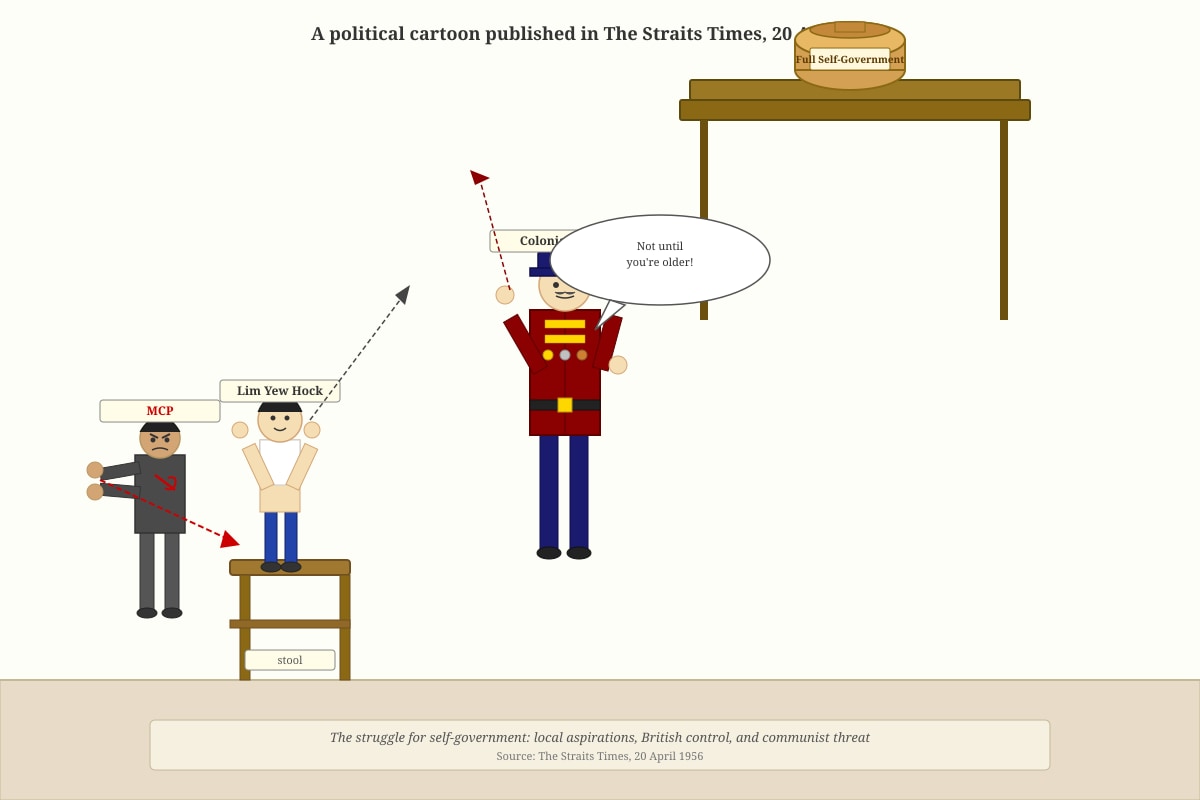
8. Study Source G. What is the cartoonist's view of the constitutional situation in Singapore in 1956? Explain your answer using details from the source. [4]
Answer: View: The cartoonist believes Singapore (Lim Yew Hock) is not yet ready for full self-government, and that the British (Colonial Office) are right to withhold it because of the communist threat (MCP). [2 marks for accurate view]
Supporting details: [2 marks]
- Lim Yew Hock depicted as a small boy — immature, not ready for the "cookie jar" of full self-government. [1]
- British officer holds the jar "just out of reach" saying "Not until you're older!" — British see themselves as responsible gatekeepers. [1]
- Communist figure (MCP) trying to push the boy off the stool — communists are a destabilising threat exploiting the situation. [1]
Marking Notes:
- View must be the cartoonist's perspective, not Lim's or the British's
- Visual metaphors (boy, cookie jar, stool) must be interpreted
- Do not just describe the cartoon — explain what it means
9. Study Sources E and F. How different are Sources E and F in their views on the 1956 constitutional proposals? Explain your answer using details from both sources. [6]
Answer: Differences: [5 marks max]
- Overall stance: Source E (Lim Yew Hock) rejects the proposals as "not true independence" and "colony in all but name". Source F (Colonial Office) defends them as a "significant advance" and "fair balance". [2 marks]
- Defence/External Affairs: Source E demands "right to determine our own defence and foreign policy". Source F insists Britain "must retain responsibility" due to "strategic importance of the Singapore base". [1]
- Internal Security: Source E implies full internal control wanted. Source F argues internal security must remain under "British oversight" due to "Communist threat". [1]
- High Commissioner's Powers: Source E sees veto as proof of colonial status. Source F calls reserve powers a "necessary safeguard against subversion". [1]
Provenance/Purpose Difference: [1 mark]
- Source E: Public speech to rally support / pressure British — political rhetoric.
- Source F: Secret memorandum for internal policy justification — candid strategic reasoning.
Marking Notes:
- Must compare views on the proposals, not just list content
- Provenance/purpose analysis strengthens answer
- Max 4 marks if only content differences without provenance
10. Study Sources G and H. Does Source G make Source H more believable as evidence of the political situation in 1956? Explain your answer using both sources and your knowledge. [5]
Answer: Yes, to some extent: [3 marks max]
- Source G (cartoon) shows the three-way tension (Lim Yew Hock, British, Communists) that Source H (news report) describes in action — student protests exploited by communists, police clash, government crackdown. [1–2 marks]
- Both sources reflect the instability of 1956: Source G predicts/illustrates the dynamic; Source H reports a concrete instance. [1 mark]
- Source H's detail about "communist elements exploiting student grievances" aligns with Source G's depiction of MCP pushing the boy. [1 mark]
But limitations: [2 marks max]
- Source G is a cartoon — exaggerated, simplified, reflects cartoonist's/editor's view, not objective fact. It cannot "prove" a news report. [1 mark]
- Source H is a contemporary newspaper report — may have its own bias (pro-government, anti-communist framing). [1 mark]
- Source G was published after the riots (20 April vs 18 April) — it comments on events, doesn't corroborate them independently. [1 mark]
Marking Notes:
- "Make more believable" = corroboration / cross-referencing
- Must evaluate both sources' nature (cartoon vs. news report)
- No simple "Yes/No" — nuanced judgement required
- Own knowledge: 1956 Chinese middle school riots, Lim Yew Hock's tough stance, MCP influence
Section C: Cross-Referencing and Historical Judgement (Questions 11–15)
11. Study Source I. What can you infer about Lee Kuan Yew's reasons for supporting merger? Support your inference with evidence from the source. [4]
Answer:
- Inference 1: Economic survival — Singapore needs a hinterland and common market to solve unemployment. [1]
- Evidence: "We cannot survive as a small island without a hinterland. Merger with Malaya gives us a common market of 10 million people. It solves our unemployment problem." [1]
- Inference 2: Political security — merger prevents continued colonial rule or communist takeover. [1]
- Evidence: "The alternative is to remain a British colony forever, or worse, to fall into communist hands." [1]
Marking Notes:
- Two distinct reasons: economic and political/security
- Evidence must match inference
- Do not accept "He wanted power" — not in source
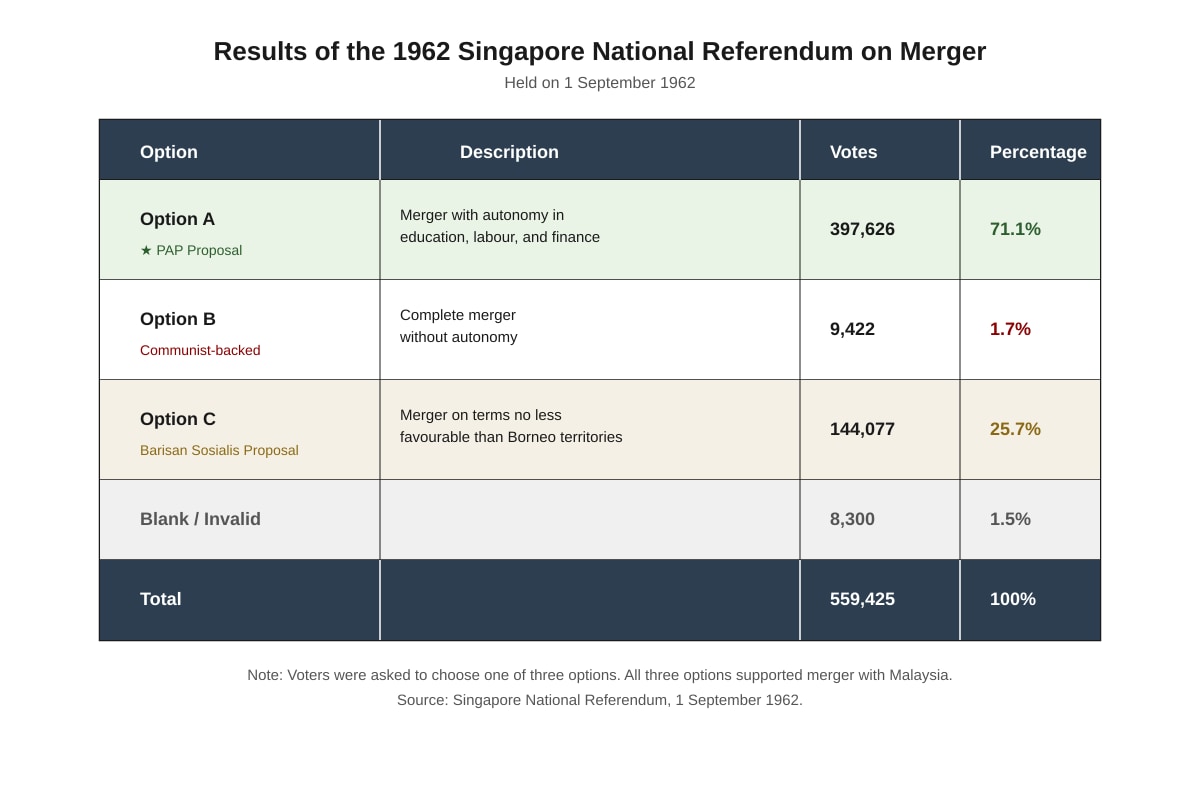
12. Study Source L. What does the referendum result tell you about Singaporeans' views on merger in 1962? Explain your answer using the source. [4]
Answer:
- Overwhelming support for merger on PAP's terms: 71.1% voted for Option A (PAP's proposal with autonomy). [1]
- Very low support for complete merger without autonomy: Only 1.7% for Option B. [1]
- Significant minority wanted better terms (Borneo-style): 25.7% for Option C (Barisan's position). [1]
- The referendum design funnelled votes toward merger: All three options led to merger; no "No merger" option. [1]
Marking Notes:
- Must use data from the table (percentages/votes)
- Interpretation of the "no 'No' option" is a key insight
- Do not just list numbers — explain what they tell you about views
13. Study Sources J and K. How similar are Sources J and K in their description of the terms of merger? Explain your answer using details from both sources. [6]
Answer: Similarities: [3 marks max]
- Both state Singapore contributes 40% of its revenue to the Federal Government. [1]
- Source J: "Singapore gives up 40% of its revenue to the Federal Government."
- Source K: "Singapore will contribute 40% of its revenue to the Federal Government."
- Both indicate Singapore's limited representation in federal parliament. [1]
- Source J: "15 seats in a federal parliament of 144 — we will always be outvoted."
- Source K: "Singapore citizens will become Malaysian citizens but will not automatically enjoy the same rights as citizens in the Federation." (implies unequal status)
- Both note defence/external affairs remain federal. [1]
- Source J implies this by criticising lack of autonomy.
- Source K: "Defence, external affairs, and internal security remain federal responsibilities."
Differences: [3 marks max]
- Tone/Perspective: Source J (Lim Chin Siong) criticises the terms as a "sell-out", "colonial-style arrangement". Source K (British White Paper) presents them neutrally as a "historic step towards decolonisation". [1–2 marks]
- Autonomy details: Source K specifies autonomy in "education, labour, and finance (subject to federal oversight)". Source J claims "We get only 15 seats... we will always be outvoted" — focuses on political powerlessness. [1]
- Citizenship rights: Source K mentions special position of Malays and sovereignty of Malay Rulers; Source J accuses UMNO of "racial politics". [1]
Marking Notes:
- Similarities are factual agreements on terms; differences are interpretation/emphasis
- Must cite specific details from both sources
- Provenance matters: Opposition leader vs. British government document
14. Study Sources I and M. Does Source M prove that the 1962 referendum was fair? Explain your answer using both sources and your knowledge. [6]
Answer: No, Source M does not prove the referendum was fair. [1 mark for clear stance]
Reasons from Source M itself: [3 marks max]
- Source M is Lee Kuan Yew's own memoir (1998) — written 36 years later by the architect of the referendum. He has a vested interest in justifying his strategy. [1–2 marks]
- He admits the design was a "masterstroke" — all three options led to merger; there was no genuine "No merger" choice. This suggests the referendum was manipulated, not fair. [1–2 marks]
- He dismisses the 25% who voted Option C as Barisan supporters, ignoring that they may have genuinely wanted better terms. [1 mark]
Reasons from Source I / Knowledge: [2 marks max]
- Source I shows Lee campaigning for Option A — he was a participant, not a neutral arbiter. [1 mark]
- Own knowledge: Barisan Sosialis leaders were detained (Operation Coldstore, 1963) after the referendum; media coverage favoured PAP; blank votes were counted as "Option A" in some interpretations. [1–2 marks]
Marking Notes:
- "Prove" is a high bar — a single biased memoir cannot prove fairness
- Strong answers note that Source M undermines the claim of fairness by revealing the rigged design
- Must use both sources + knowledge
15. "The merger with Malaya was the best option for Singapore in 1963." How far do Sources I to M support this view? Explain your answer using the sources and your knowledge. [8]
Answer: Sources SUPPORTING the view: [4 marks max]
- Source I (Lee Kuan Yew): Merger solves economic survival (common market, unemployment) and prevents communist takeover. [1]
- Source K (British White Paper): Merger is a "historic step towards decolonisation"; Singapore retains autonomy in key areas. [1]
- Source L (Referendum Result): 71.1% voted for Option A — clear popular mandate for merger on PAP terms. [1]
- **
<stage5_quiz_answers_md>
Secondary 2 History Quiz - Source Based Skills (Answer Key)
Total Marks: 50
Section A: Source Analysis and Inference (Questions 1–5)
1. Study Source A. What can you infer about the impact of the Japanese Occupation on the daily life of civilians in Singapore? Support your inference with evidence from the source. [4]
Answer:
Inference 1: The Japanese Occupation caused severe disruption to basic necessities and food security.
Evidence: "Rice is rationed at 200 grams per person per week. We eat tapioca and sweet potato leaves now."
Inference 2: The Occupation created an atmosphere of fear and uncertainty, especially for Chinese males.
Evidence: "All Chinese males aged 18 to 50 must report to screening centres. My elder brother left this morning. We have not seen him since."
Inference 3: Daily routines and institutions were forcibly changed to impose Japanese culture and control.
Evidence: "School has stopped. We are told to learn Nippon-go." and "Japanese flags fly from the Cathay Building and the Supreme Court."
Marking Guide:
- 1 mark per valid inference (max 2 inferences)
- 1 mark per supporting evidence from source (max 2 evidence)
- Total: 4 marks
2. Study Source B. How useful is Source B as evidence of the hardships faced by civilians during the Japanese Occupation? Explain your answer using the source and your knowledge. [5]
Answer:
Yes, Source B is useful.
Content/Provenance: It is a British government report published in 1946, shortly after the Occupation, giving it access to official records and investigations. It provides specific details on multiple hardships: Sook Ching executions (5,000–25,000 deaths), food shortages ("Grow More Food" campaign), hyperinflation (rice 100x pre-war price), and education restructuring.
Cross-reference/Knowledge: These details align with historical knowledge — Sook Ching massacres, banana money hyperinflation, forced Japanese-language education, and Kempeitai terror are well-documented.
Limitation: As a British post-war report, it may emphasise Japanese brutality to justify British return or war crimes trials. It lacks civilian voices/perspectives.
Conclusion: Useful for factual overview of hardships, but should be cross-referenced with civilian accounts (e.g., Sources A/D) for lived experience.
Marking Guide:
- L1 (1m): General assertion (useful/not useful) without support
- L2 (2–3m): Supported by source content OR provenance OR cross-reference only
- L3 (4–5m): Balanced evaluation using source content, provenance, AND cross-reference/knowledge with clear conclusion
3. Study Source C. What is the message of this propaganda poster? Explain your answer using details from the source. [4]
Answer: Message: The Japanese Occupation brings peace, prosperity, and unity to Asia under Japanese leadership ("Asia for Asians", "Co-Prosperity Sphere").
Evidence from source:
- Visual: Smiling Asian family working harmoniously in a rice paddy → portrays idealised agricultural abundance and racial harmony.
- Rising sun flag and Japanese soldier watching "benevolently" → symbolises Japanese protection and guidance.
- Text "Asia for Asians" and "Co-Prosperity Sphere" → promotes anti-Western colonial narrative and Japanese-led regional order.
Purpose: To legitimise Japanese rule and mask exploitation/forced labour by presenting an idealised image of cooperation.
Marking Guide:
- 1 mark: Correct message identified
- 3 marks: Explanation supported by 3 distinct details from source (visual + text)
4. Study Sources A and D. How similar are Sources A and D in their portrayal of the Sook Ching operation? Explain your answer using details from both sources. [6]
Answer: Similarities (3):
- Fear and arbitrariness: Source A: "Kempeitai have put up notices everywhere — 'Sook Ching' they call it." Source D: "Everyone was terrified... hooded informant pointed at some men — they were taken away."
- Targeting Chinese males: Source A: "All Chinese males aged 18 to 50 must report to screening centres." Source D: Screening at Hong Lim Complex, cousin taken.
- Disappearances/deaths: Source A: "My elder brother left... We have not seen him since." Source D: "My cousin was taken. We never found his body."
Difference (1):
- Source A shows anticipation/uncertainty (brother just left, outcome unknown).
- Source D shows aftermath/trauma (cousin confirmed taken, body never found, "peace living" certificates worn).
Conclusion: Largely similar in portraying Sook Ching as arbitrary, terrifying, and targeting Chinese males with fatal consequences; differ in temporal perspective (during vs. after screening).
Marking Guide:
- L1 (1–2m): Identifies similarities/differences without source evidence
- L2 (3–4m): Supported similarities OR differences only
- L3 (5–6m): Supported similarities AND differences with clear conclusion
5. Study Sources B and C. How different are Sources B and C in their portrayal of life under the Japanese? Explain your answer using details from both sources. [6]
Answer: Differences (3):
- Food situation: Source B: "Food supplies critically disrupted... black market price of rice 100 times pre-war price." Source C: Poster shows abundant rice paddy harvest → portrays prosperity.
- Japanese rule: Source B: "Kempeitai maintained control through fear, informants, arbitrary arrests." Source C: Japanese soldier watches "benevolently" → portrays protection.
- Civilian experience: Source B: "Civilian population endured severe hardship... inflation spiralled." Source C: Smiling family → portrays happiness and cooperation.
Similarity (1):
- Both acknowledge Japanese authority/presence (Source B: "Japanese military administration"; Source C: Rising sun flag, Japanese soldier).
Conclusion: Fundamentally different — Source B portrays brutal exploitation and suffering; Source C portrays idealised harmony and prosperity. Source C is propaganda masking realities described in Source B.
Marking Guide:
- L1 (1–2m): General comparison without evidence
- L2 (3–4m): Supported differences OR similarities only
- L3 (5–6m): Supported differences AND similarity with clear conclusion on extent of difference
Section B: Source Reliability and Utility (Questions 6–10)
6. Study Source E. What can you infer about Lim Yew Hock's view of the 1956 constitutional proposals? Support your inference with evidence from the source. [4]
Answer:
Inference 1: Lim Yew Hock viewed the proposals as not true independence but a continuation of colonial control.
Evidence: "This is not true independence... We are being asked to accept a constitution that keeps us as a colony in all but name."
Inference 2: He believed the British retained critical powers that undermined self-government.
Evidence: "They retain control over defence and foreign affairs... British military bases remain... British High Commissioner can still veto our legislation."
Inference 3: He demanded full internal self-government including defence and foreign policy.
Evidence: "We demand full internal self-government with the right to determine our own defence and foreign policy."
Marking Guide:
- 1 mark per valid inference (max 2)
- 1 mark per supporting evidence (max 2)
- Total: 4 marks
7. Study Source F. Why would the British Colonial Office have produced this memorandum? Explain your answer using the source and your knowledge. [5]
Answer: Purpose: To justify and defend the 1956 constitutional proposals to British officials/policymakers.
Reasons (from source + knowledge):
- Strategic interests: "Strategic importance of the Singapore base to the defence of the Commonwealth and the Free World" — Cold War context, need to retain military base against communism.
- Security concerns: "Communist threat in Malaya and Singapore makes it essential that internal security remains under British oversight" — Malayan Emergency (1948–60), fear of communist subversion (MCP).
- Manage local aspirations: "Fair balance between local aspirations and imperial responsibilities" — respond to anti-colonial pressure (Labour Front, PAP) while retaining control.
- Internal document ("Secret"): Candid assessment for decision-makers, not public consumption.
Marking Guide:
- L1 (1m): General purpose (e.g., "to explain proposals")
- L2 (2–3m): Supported by source content OR knowledge only
- L3 (4–5m): Supported by source content AND knowledge, explaining strategic/security/political motives
8. Study Source G. What is the cartoonist's view of the constitutional situation in Singapore in 1956? Explain your answer using details from the source. [4]
Answer: View: The constitutional situation is unfair and manipulated — Singapore (Lim Yew Hock) is denied full self-government by British control, while communist threat complicates the struggle.
Evidence:
- Lim Yew Hock as small boy → portrays Singapore as immature/dependent in British eyes.
- Cookie jar "Full Self-Government" on high shelf → goal is visible but inaccessible.
- British officer ("Colonial Office") holds jar just out of reach, saying "Not until you're older!" → British deliberately withhold power, patronising local leaders.
- Communist figure ("MCP") tries to push boy off stool → communists exploit the situation to destabilise.
Marking Guide:
- 1 mark: Correct view identified
- 3 marks: Explanation supported by 3 distinct visual/textual details
9. Study Sources E and F. How different are Sources E and F in their views on the 1956 constitutional proposals? Explain your answer using details from both sources. [6]
Answer: Differences (3):
- Nature of proposals: Source E: "Not true independence... colony in all but name." Source F: "Significant advance towards self-government... fair balance."
- British retention of powers: Source E: Condemns British control of defence/foreign affairs/bases/veto as unacceptable. Source F: Defends retention as essential for "strategic importance... defence of the Commonwealth" and "Communist threat."
- High Commissioner's powers: Source E: Implies veto is undemocratic. Source F: Calls reserve powers "necessary safeguard against subversion."
Similarity (1):
- Both acknowledge the proposals grant internal self-government (Source E: "internal self-government"; Source F: "elected Chief Minister and Council of Ministers will control all internal affairs").
Conclusion: Fundamentally opposed — Source E (local nationalist) sees proposals as colonial retention; Source F (British) sees them as reasonable compromise.
Marking Guide:
- L1 (1–2m): General comparison without evidence
- L2 (3–4m): Supported differences OR similarities only
- L3 (5–6m): Supported differences AND similarity with clear conclusion on extent of difference
10. Study Sources G and H. Does Source G make Source H more believable as evidence of the political situation in 1956? Explain your answer using both sources and your knowledge. [5]
Answer: Yes, Source G makes Source H more believable.
Corroboration:
- Source G shows communist threat (MCP) actively undermining Lim Yew Hock → supports Source H's claim that "communist elements are exploiting student grievances."
- Source G shows British withholding self-government → explains Source H's student anger: "students claim the ordinance is a British plot."
- Source G depicts Lim Yew Hock as weak/dependent → aligns with Source H's "government warns" (reactive, not in control).
Knowledge: 1956 Chinese middle school riots were led by pro-communist students opposing National Service; British/Lim Yew Hock cracked down. Cartoon (Source G) reflects contemporary political narrative.
Limitation: Source G is a cartoonist's interpretation (exaggerated, subjective), not factual report. Source H is a newspaper report (may have pro-government bias).
Conclusion: Source G corroborates the political dynamics in Source H (British-local-communist triangle), making H's account of student protests more plausible, but both need cross-referencing.
Marking Guide:
- L1 (1m): Yes/No without support
- L2 (2–3m): Supported by source comparison only
- L3 (4–5m): Supported by source comparison AND knowledge, with balanced evaluation of reliability
Section C: Cross-Referencing and Historical Judgement (Questions 11–15)
11. Study Source I. What can you infer about Lee Kuan Yew's reasons for supporting merger? Support your inference with evidence from the source. [4]
Answer:
Inference 1: Economic survival — Singapore needs a hinterland and common market.
Evidence: "We cannot survive as a small island without a hinterland. Merger with Malaya gives us a common market of 10 million people. It solves our unemployment problem."
Inference 2: Political necessity — Merger prevents continued colonialism or communist takeover.
Evidence: "The alternative is to remain a British colony forever, or worse, to fall into communist hands."
Inference 3: Autonomy safeguards — Negotiated terms protect Singapore's interests.
Evidence: "The Tunku has agreed to a common market, to Singapore's autonomy in education and labour, and to our own revenue collection."
Marking Guide:
- 1 mark per valid inference (max 2)
- 1 mark per supporting evidence (max 2)
- Total: 4 marks
12. Study Source L. What does the referendum result tell you about Singaporeans' views on merger in 1962? Explain your answer using the source. [4]
Answer: View: Overwhelming support for merger on PAP's terms (Option A), but significant minority wanted different terms.
Evidence:
- Option A (PAP): 71.1% (397,626 votes) → clear mandate for merger with autonomy in education, labour, finance.
- Option C (Barisan/Borneo terms): 25.7% (144,077 votes) → substantial opposition wanting better terms.
- Option B (Complete merger): Only 1.7% → minimal support for unconditional merger.
- Blank/Invalid: 1.5% → some boycott/protest (Barisan called for blank votes).
Conclusion: Majority backed Lee Kuan Yew's negotiated terms; Barisan's alternative had notable but minority support.
Marking Guide:
- 1 mark: Correct overall view
- 3 marks: Explanation with specific vote percentages for at least 2 options
13. Study Sources J and K. How different are Sources J and K in their portrayal of the terms of merger? Explain your answer using details from both sources. [6]
Answer: Differences (3):
- Revenue contribution: Source J: "Singapore gives up 40% of its revenue... sell-out." Source K: States factually "Singapore will contribute 40% of its revenue to the Federal Government" — no judgement.
- Political representation: Source J: "We get only 15 seats in a federal parliament of 144 — we will always be outvoted." Source K: Omits seat allocation; focuses on "Singapore citizens will become Malaysian citizens but will not automatically enjoy the same rights."
- Nature of arrangement: Source J: "Colonial-style arrangement... racial politics by UMNO." Source K: "Historic step towards decolonisation... special position of Malays safeguarded."
Similarity (1):
- Both acknowledge Singapore's autonomy in education, labour, finance (Source J: implied criticism of terms; Source K: "retain autonomy in education, labour, and finance (subject to federal oversight)").
Conclusion: Source J (opposition) portrays terms as exploitative and undemocratic; Source K (British) portrays them as structured decolonisation with safeguards.
Marking Guide:
- L1 (1–2m): General comparison without evidence
- L2 (3–4m): Supported differences OR similarities only
- L3 (5–6m): Supported differences AND similarity with clear conclusion
14. Study Sources I, J, and M. Does Source M prove that Lee Kuan Yew was honest about the referendum options? Explain your answer using all three sources and your knowledge. [7]
Answer: No, Source M does not prove honesty; it reveals strategic manipulation.
Source M (Lee's memoir): Admits "masterstroke" — all three options led to merger. Option B (complete merger) was "which nobody wanted"; Option C (Borneo terms) "Tunku had already rejected." The referendum was designed to guarantee a merger outcome.
Source I (Lee's 1961 speech): Presents merger as necessary for survival, frames Option A as "fair deal" — omits that other options were non-viable.
Source J (Lim Chin Siong): Criticises terms as "sell-out" — 40% revenue, 15/144 seats, unequal citizenship. Confirms Option C reflected Barisan's genuine demand for better terms, not a "nobody wanted" straw man.
Knowledge: British records confirm Tunku rejected Borneo-style terms for Singapore. Barisan called for blank votes; 25.7% voted Option C despite boycott call.
Conclusion: Source M undermines Lee's honesty — he admits engineering a "choice" with no real alternatives. Sources I and J show the political contestation he obscures.
Marking Guide:
- L1 (1–2m): General assertion (proves/doesn't prove)
- L2 (3–4m): Uses sources to support claim but limited cross-referencing
- L3 (5–6m): Cross-references all three sources + knowledge, evaluates honesty
- L4 (7m): Nuanced judgement — Source M reveals manipulation, not honesty; Sources I/J show contested narratives
15. "The merger with Malaya was the best possible option for Singapore in 1962." How far do you agree? Explain your answer using Sources I, J, K, L, M and your knowledge. [8]
Answer: Balanced judgement: Merger was the most viable option given constraints, but terms were flawed and imposed.
Agree (Sources I, K, L, knowledge):
- Economic necessity: Source I — "cannot survive as a small island without a hinterland... solves unemployment." Knowledge: Singapore had no natural resources, entrepôt trade declining, high unemployment.
- Decolonisation path: Source K — "historic step towards decolonisation." British supported merger as exit strategy.
- Popular mandate: Source L — 71.1% voted for Option A (merger with autonomy).
- Security: Merger offered protection against communist insurgency (Malayan Emergency).
Disagree (Sources J, M, knowledge):
- Unequal terms: Source J — 40% revenue, 15/144 seats, second-class citizenship. Source K confirms revenue contribution and unequal rights.
- No genuine choice: Source M — "all three options led to merger"; Option C (Borneo terms) rejected by Tunku before referendum.
- Racial politics: Source J — "UMNO practices racial politics"; Source K — "special position of Malays safeguarded" — entrenched communalism.
- Outcome: Singapore expelled 1965 — merger failed.
Synthesis: Given Cold War context, British withdrawal, communist threat, and economic non-viability, merger was the least bad option — but the terms were negotiated from weakness, and the referendum was engineered. "Best possible" reflects constraints, not ideal outcome.
Marking Guide:
- L1 (1–2m): One-sided, general assertions
- L2 (3–4m): One-sided with source support
- L3 (5–6m): Balanced with source support, limited synthesis
- L4 (7–8m): Nuanced, well-supported judgement using all sources + knowledge, addressing "best possible" vs. "flawed" tension
Marking Summary
| Question | Marks | Key Skills Tested |
|---|---|---|
| 1 | 4 | Inference + Evidence |
| 2 | 5 | Utility + Provenance + Cross-reference |
| 3 | 4 | Message + Visual/Textual Analysis |
| 4 | 6 | Cross-referencing (Similarity/Difference) |
| 5 | 6 | Cross-referencing (Similarity/Difference) |
| 6 | 4 | Inference + Evidence |
| 7 | 5 | Purpose + Provenance + Context |
| 8 | 4 | Cartoon Analysis (View + Details) |
| 9 | 6 | Cross-referencing (Similarity/Difference) |
| 10 | 5 | Corroboration + Reliability |
| 11 | 4 | Inference + Evidence |
| 12 | 4 | Data Interpretation |
| 13 | 6 | Cross-referencing (Similarity/Difference) |
| 14 | 7 | Cross-referencing + Judgement (Honesty) |
| 15 | 8 | Historical Judgement + Synthesis |
| Total | 50 |
End of Answer Key