AI Generated Quiz
Secondary 2 History Essay Explanation Quiz
Free Sec 2 History Essay Explanation quiz, AI version, with questions, answers, and syllabus-aligned practice for Singapore students.
These static practice materials are generated from the site's syllabus and paper-generation workflow, with source and model context shown so students and parents can evaluate the material before use.
Questions
Free quiz and exam paper access
Enter your details to view this paper
Your access is remembered on this device.
Answers
Secondary 2 History Quiz - Essay Explanation: Answer Key
Total Marks: 50
Section A: Understanding Historical Explanations (Questions 1–5)
Question 1
Marks: 2
Answer: Causation in history refers to the study of why events happened – the causes and reasons that led to a particular historical outcome. It is important for historians to study causation because:
- It helps them understand not just what happened, but why it happened, providing a deeper understanding of the past.
- It allows historians to identify patterns and connections between events, which can help explain broader historical developments.
Marking Notes:
- 1 mark for a clear definition of causation (e.g., "the reasons why events happen" or "the study of cause and effect").
- 1 mark for explaining why it is important (e.g., "to understand the past more deeply" or "to see connections between events").
Common Mistakes:
- Confusing causation with chronology (the order of events).
- Giving a vague answer like "it's important" without explaining why.
Question 2
Marks: 2
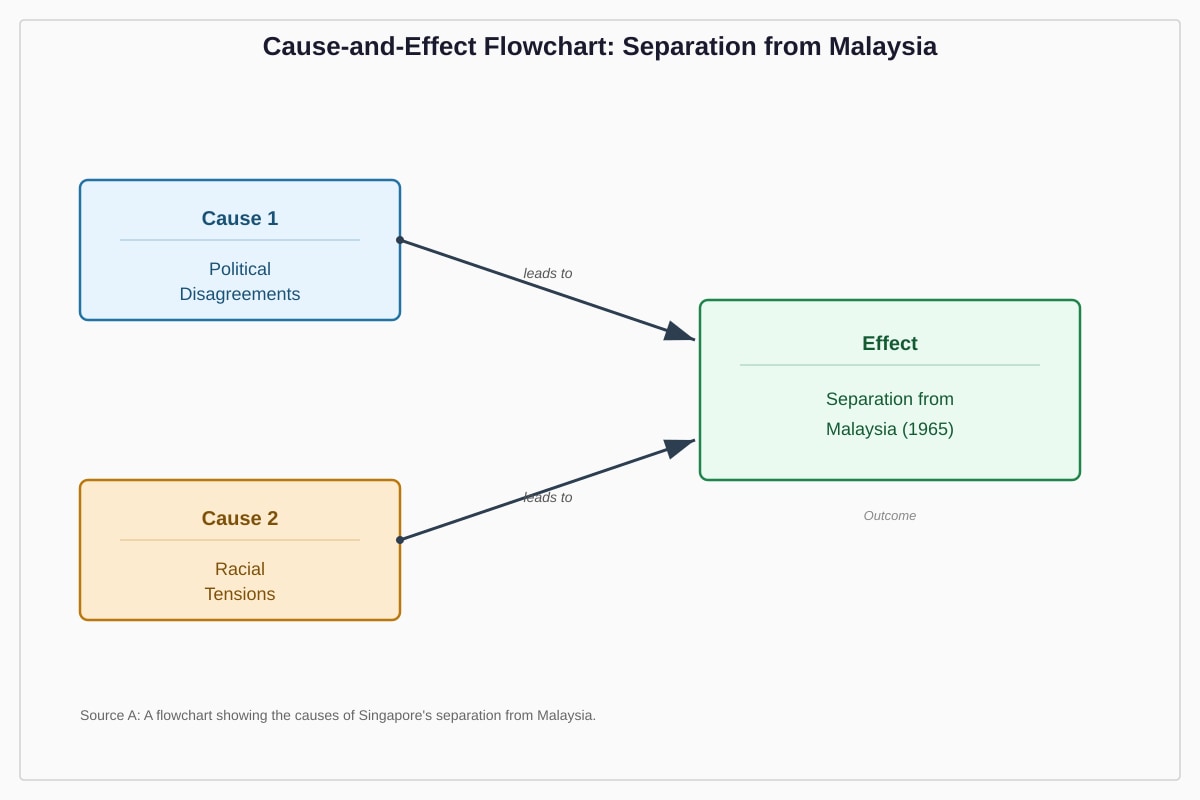
Answer: The flowchart helps historians understand the relationship between causes and effects by visually showing that multiple causes can lead to a single effect. In this case, both "Political Disagreements" and "Racial Tensions" are shown as separate causes that both led to the "Separation from Malaysia (1965)". The arrows show the direction of influence, making it clear that the separation was not caused by just one factor but by a combination of factors working together.
Marking Notes:
- 1 mark for explaining that the flowchart shows multiple causes leading to one effect.
- 1 mark for using the specific example from the diagram (political disagreements and racial tensions leading to separation).
Common Mistakes:
- Simply describing what the flowchart looks like without explaining its purpose.
- Not mentioning that the flowchart shows multiple causes.
Question 3
Marks: 2
Answer: Event: The Separation of Singapore from Malaysia (1965)
Two causes:
- Political disagreements – The PAP and UMNO had different visions for Malaysia. The PAP wanted a "Malaysian Malaysia" where all races were equal, while UMNO wanted Malay dominance.
- Racial tensions – The 1964 racial riots in Singapore showed that communal harmony was breaking down, making it difficult for Singapore and Malaysia to remain together.
(Accept other valid events and causes, such as the Japanese Occupation or the 1959 election.)
Marking Notes:
- 1 mark for naming a correct historical event from 1942–1965.
- 1 mark for stating two valid causes (½ mark each if partially correct).
Common Mistakes:
- Naming an event outside the 1942–1965 period.
- Stating only one cause or giving vague causes like "they disagreed".
Question 4
Marks: 2
Answer: It is important for historians to consider context because events do not happen in a vacuum. The time and place in which an event occurs shape the decisions people make and the options available to them. For example, the Japanese Occupation of Singapore (1942–1945) happened during World War II, a time of global conflict. Understanding this context helps explain why the British were unable to defend Singapore effectively – they were fighting a war on multiple fronts. Without considering context, historians might judge past actions unfairly or miss important factors that influenced events.
Marking Notes:
- 1 mark for explaining why context matters (e.g., "events are shaped by their time and place").
- 1 mark for providing a relevant example from Singapore's history.
Common Mistakes:
- Giving a generic answer without a specific example.
- Confusing context with cause.
Question 5
Marks: 2
Answer: A cause is a reason or factor that makes something happen, while a consequence is the result or outcome of that event.
Example: The cause of Singapore's separation from Malaysia in 1965 was the political disagreements between the PAP and UMNO. The consequence was that Singapore became an independent nation and had to build its own economy, military, and national identity.
Marking Notes:
- 1 mark for clearly distinguishing between cause and consequence.
- 1 mark for using a correct example from Singapore's history.
Common Mistakes:
- Confusing cause and consequence (e.g., saying separation caused the disagreements).
- Giving an example without explaining which part is the cause and which is the consequence.
Section B: Explaining Causes of Key Events (Questions 6–12)
Question 6
Marks: 3
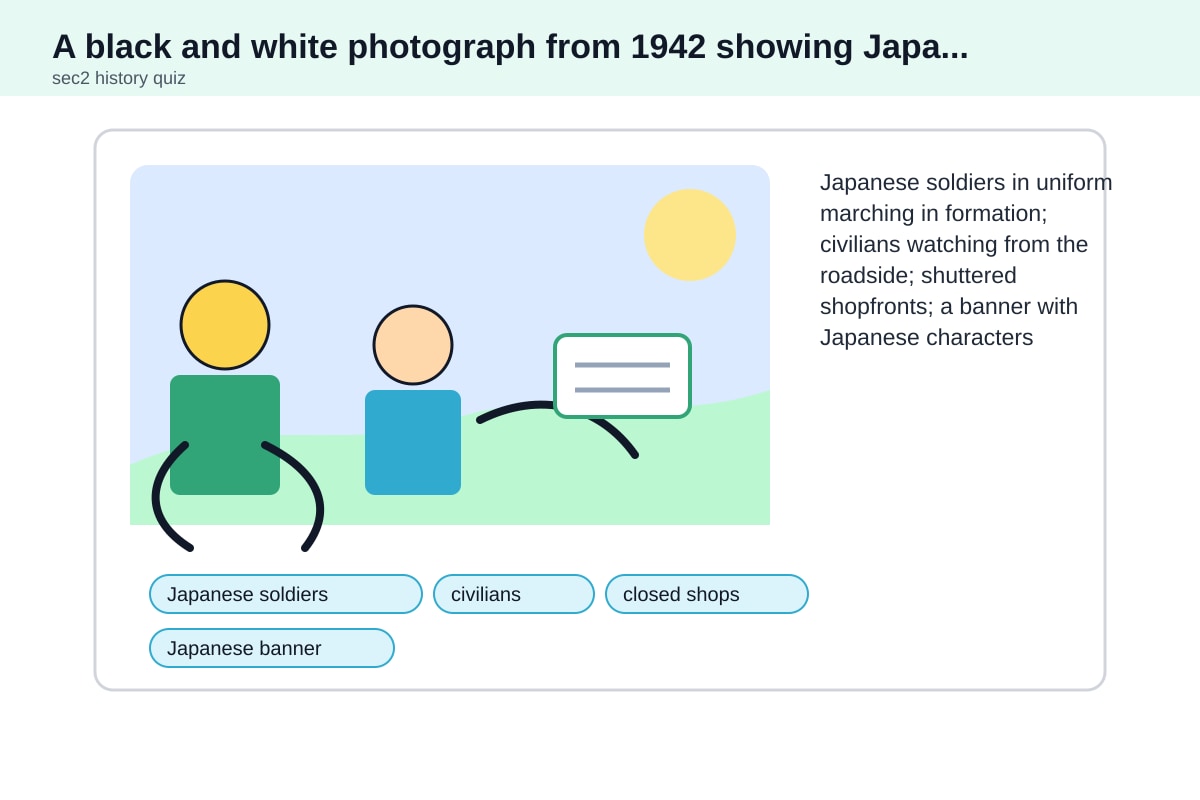
Answer: The photograph suggests that the Japanese were able to control Singapore through a show of military force. The image shows Japanese soldiers marching in formation through the streets, which demonstrates their military strength and discipline. The civilians watching from the roadside look subdued and passive, suggesting that the visible presence of armed Japanese soldiers intimidated the local population and discouraged resistance. The closed shops also suggest that people were afraid to go about their normal activities, showing that fear of the Japanese military helped them maintain control.
Marking Notes:
- 1 mark for identifying a valid reason (e.g., military force/intimidation).
- 1 mark for using specific details from the source (e.g., "soldiers marching", "civilians looking subdued", "closed shops").
- 1 mark for explaining how the detail supports the reason (e.g., "the visible military presence intimidated people").
Common Mistakes:
- Describing the source without connecting it to the reason for control.
- Making unsupported claims not visible in the source.
Question 7
Marks: 3
Answer: One reason why the British decided to surrender Singapore to the Japanese in 1942 was that they were militarily outmatched. The Japanese attacked from the north (through Malaya), which was unexpected because the British had prepared for a sea-based attack. The Japanese had superior air power and more experienced troops, while British forces were poorly prepared and lacked adequate equipment. General Percival, the British commander, decided to surrender to avoid further loss of civilian lives, as the Japanese had already captured the island's water supply and were advancing rapidly.
Marking Notes:
- 1 mark for identifying a valid reason (e.g., military weakness, unexpected attack direction, water supply captured).
- 1 mark for providing specific details (e.g., "attacked from the north", "superior air power").
- 1 mark for explaining how the reason led to surrender.
Common Mistakes:
- Giving a vague answer like "the Japanese were too strong" without specific details.
- Confusing the surrender with other events in World War II.
Question 8
Marks: 3
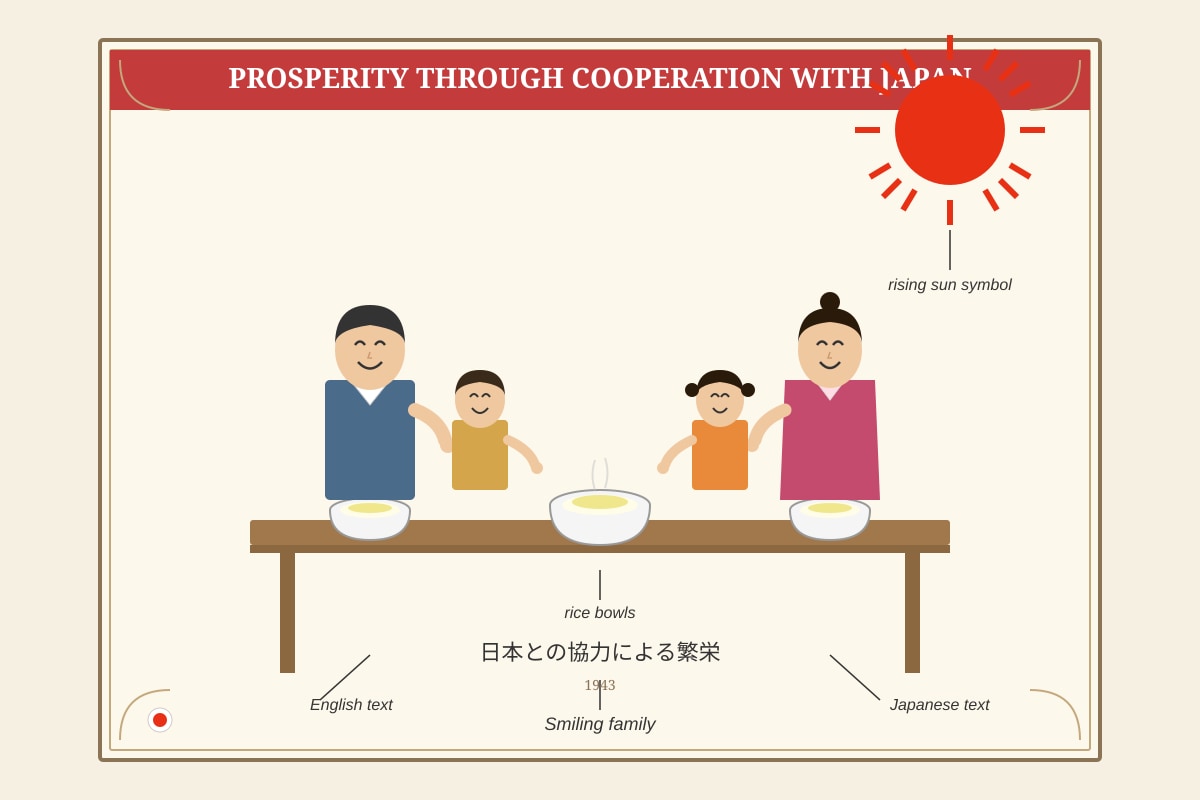
Answer: The purpose of this Japanese propaganda poster was to convince the local population in Singapore to cooperate with the Japanese occupation. The poster shows a smiling family eating rice together, which suggests that cooperation with Japan would lead to prosperity and happiness. The text "Prosperity through Cooperation with Japan" directly states this message. The rising sun symbol reminds viewers of Japanese authority. The poster was trying to create a positive image of Japanese rule to reduce resistance and encourage people to accept the occupation willingly.
Marking Notes:
- 1 mark for identifying the purpose (e.g., "to encourage cooperation" or "to persuade people to accept Japanese rule").
- 1 mark for using specific details from the source (e.g., "smiling family", "Prosperity through Cooperation" text, "rising sun symbol").
- 1 mark for explaining how the details support the purpose.
Common Mistakes:
- Taking the poster at face value without recognizing it as propaganda.
- Not connecting the visual elements to the intended message.
Question 9
Marks: 3
Answer: One reason why many people in Singapore suffered from food shortages during the Japanese Occupation was that the Japanese military confiscated food supplies for their own use. The Japanese army took control of Singapore's rice stocks and other food resources to feed their soldiers. They also disrupted trade routes, which meant that Singapore could not import food from other countries as it had done before the war. Additionally, the Japanese introduced a rationing system that gave very small portions to civilians. As a result, many people faced hunger and malnutrition, and some even starved to death.
Marking Notes:
- 1 mark for identifying a valid reason (e.g., "Japanese confiscated food", "trade disruption", "rationing").
- 1 mark for providing specific details (e.g., "confiscated rice stocks", "disrupted trade routes").
- 1 mark for explaining the impact on people (e.g., "hunger", "malnutrition", "starvation").
Common Mistakes:
- Giving a general answer about war without specific reference to Singapore.
- Confusing food shortages with other hardships like forced labour.
Question 10
Marks: 3
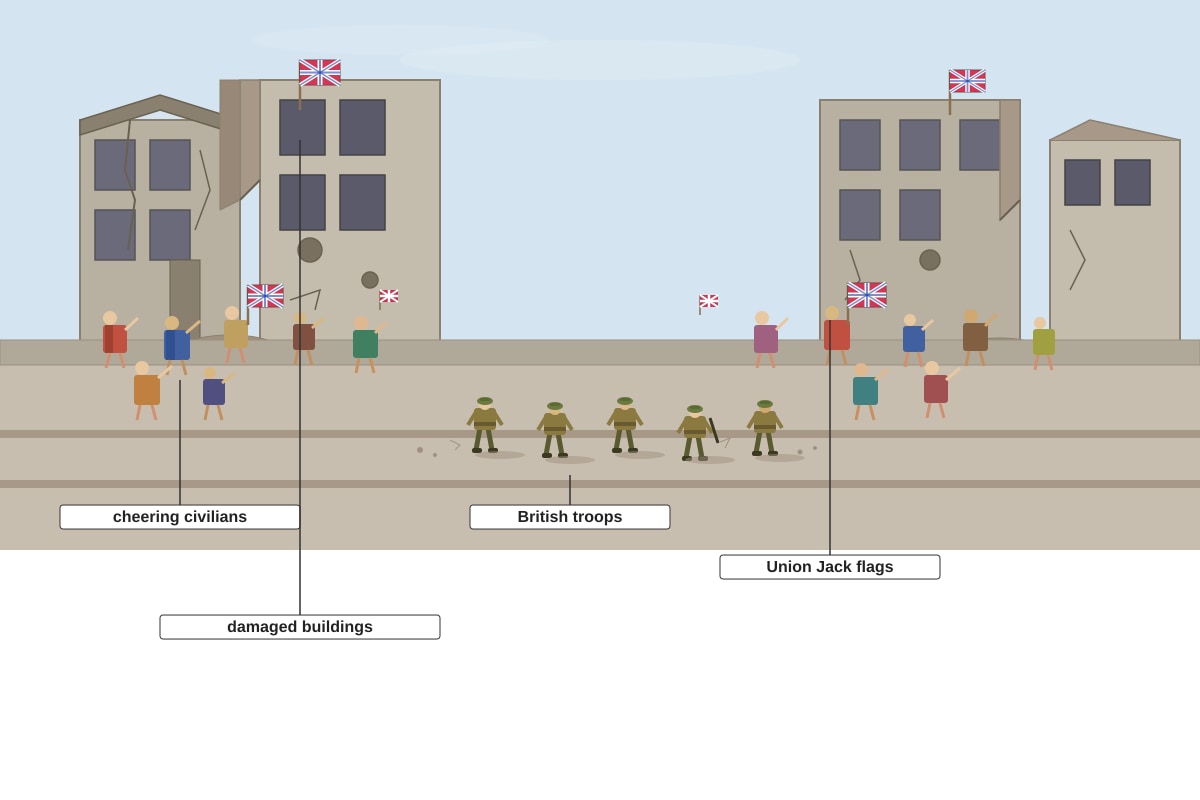
Answer: The photograph suggests that Singaporeans felt joy and relief when the British returned after the Japanese Occupation ended. The image shows civilians cheering and waving Union Jack flags, which indicates that they welcomed the British back. The damaged buildings in the background remind us of the destruction caused by the war and occupation, making the celebration even more significant. The large number of people lining the streets suggests that the return of the British was a widely celebrated event, as people were happy to be freed from Japanese rule.
Marking Notes:
- 1 mark for identifying the feeling (e.g., "joy", "relief", "happiness").
- 1 mark for using specific details from the source (e.g., "cheering civilians", "waving Union Jack flags", "damaged buildings").
- 1 mark for explaining how the details support the feeling.
Common Mistakes:
- Assuming all Singaporeans felt the same way without considering different perspectives.
- Not using specific details from the source to support the answer.
Question 11
Marks: 3
Answer: One reason why the British returned to Singapore after World War II instead of granting independence immediately was that they wanted to rebuild their empire and restore their economic interests in Southeast Asia. Before the war, Singapore was a valuable British colony because of its strategic location and its role as a trading port. The British also believed that Singapore was not ready for self-government, as the local population lacked political experience. Additionally, the British needed to deal with post-war challenges such as rebuilding the economy and maintaining security against the threat of communism.
Marking Notes:
- 1 mark for identifying a valid reason (e.g., "economic interests", "belief that Singapore was not ready", "Cold War/communist threat").
- 1 mark for providing specific details (e.g., "valuable trading port", "lack of political experience").
- 1 mark for explaining how the reason led to the British returning.
Common Mistakes:
- Saying the British returned "to help Singapore" without recognizing their own interests.
- Confusing this with the post-war period in other countries.
Question 12
Marks: 3
Answer: One reason why the British introduced the Rendel Constitution in 1955 was to give Singaporeans more say in their own government while still maintaining British control. The constitution created a Legislative Assembly with 32 elected seats, allowing local political parties to participate in government. This was partly a response to growing demands for self-government from Singaporeans, who had become more politically aware after the war. The British hoped that by giving some power to local leaders, they could reduce political unrest and maintain stability in Singapore.
Marking Notes:
- 1 mark for identifying a valid reason (e.g., "to give more say to Singaporeans", "response to demands for self-government").
- 1 mark for providing specific details (e.g., "32 elected seats", "Legislative Assembly").
- 1 mark for explaining the British motivation (e.g., "reduce unrest", "maintain stability").
Common Mistakes:
- Confusing the Rendel Constitution with other constitutional changes.
- Not explaining why the British made this decision.
Section C: Extended Explanations (Questions 13–20)
Question 13
Marks: 3
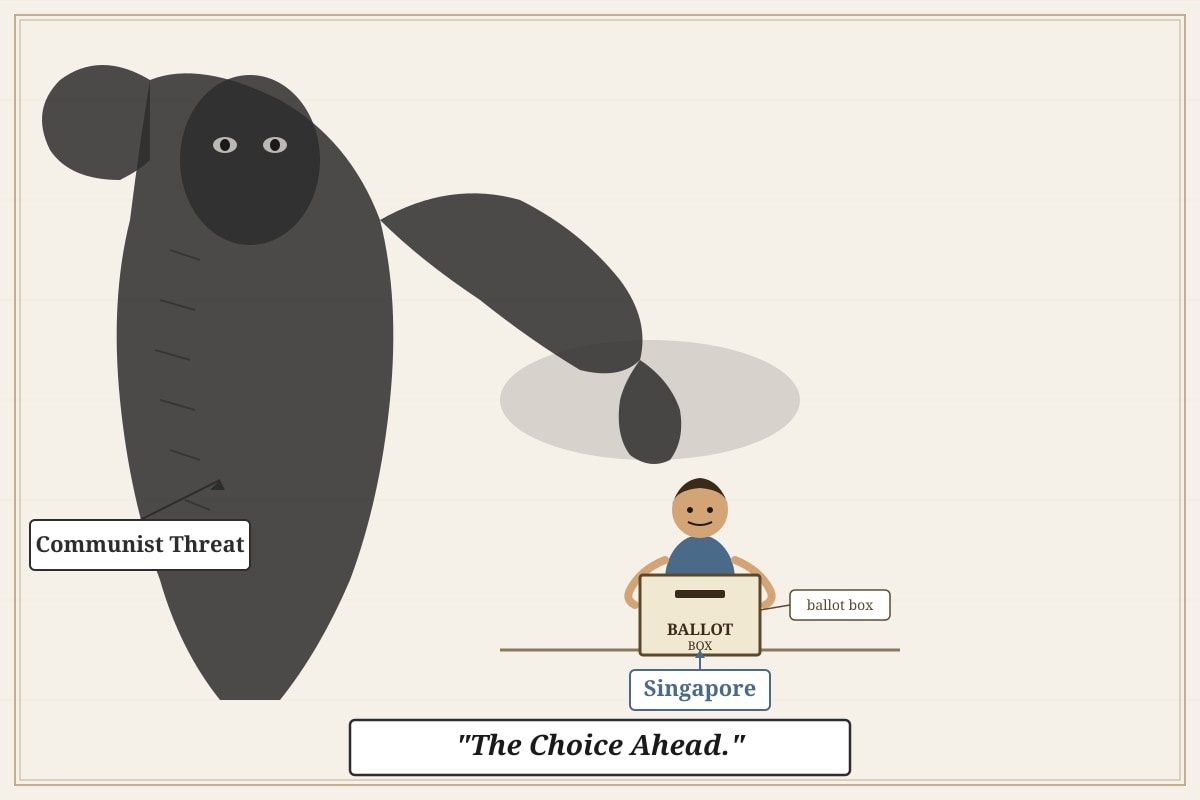
Answer: The cartoonist is trying to convey that Singapore faced a serious threat from communism in 1959, and that the upcoming election was a crucial choice for the future. The large figure labelled "Communist Threat" looming over the smaller figure labelled "Singapore" suggests that communism was a powerful and intimidating force that could overwhelm the country. The small figure holding a ballot box represents the people of Singapore who had the power to choose their government through elections. The caption "The Choice Ahead" emphasizes that the election was not just about choosing a government, but about deciding whether to resist or succumb to the communist threat.
Marking Notes:
- 1 mark for identifying the message (e.g., "communism was a threat to Singapore").
- 1 mark for using specific details from the source (e.g., "large Communist Threat figure", "small Singapore figure", "ballot box", "caption").
- 1 mark for explaining how the details convey the message.
Common Mistakes:
- Describing the cartoon without interpreting its message.
- Not recognizing the symbolism of the figures.
Question 14
Marks: 2
Answer: One reason why the PAP won the 1959 general election was that they promised to improve the lives of ordinary people. The PAP's election manifesto focused on issues that mattered to Singaporeans, such as better housing, education, and jobs. The party was led by well-educated and charismatic leaders like Lee Kuan Yew, who could connect with the people. Additionally, the PAP was seen as a party that could stand up to both the British and the communists, offering a middle path that appealed to many voters.
Marking Notes:
- 1 mark for identifying a valid reason (e.g., "promises to improve lives", "charismatic leaders", "middle path").
- 1 mark for providing specific details (e.g., "better housing, education, jobs", "Lee Kuan Yew").
Common Mistakes:
- Giving a vague answer like "people liked them" without specific reasons.
- Confusing the 1959 election with later elections.
Question 15
Marks: 2
Answer: One reason why Singapore decided to merge with Malaysia in 1963 was for economic survival. Singapore had a small domestic market and needed access to a larger market to support its industries and create jobs. By joining Malaysia, Singapore hoped to gain access to the Malaysian market and benefit from a common market. Additionally, merger was seen as a way to achieve political independence from British colonial rule, as the British had indicated that they would not grant full independence to Singapore on its own.
Marking Notes:
- 1 mark for identifying a valid reason (e.g., "economic survival", "access to larger market", "independence from British").
- 1 mark for providing specific details (e.g., "small domestic market", "common market", "British would not grant independence").
Common Mistakes:
- Giving only one aspect of the reason without explanation.
- Confusing merger with other events like separation.
Question 16
Marks: 3
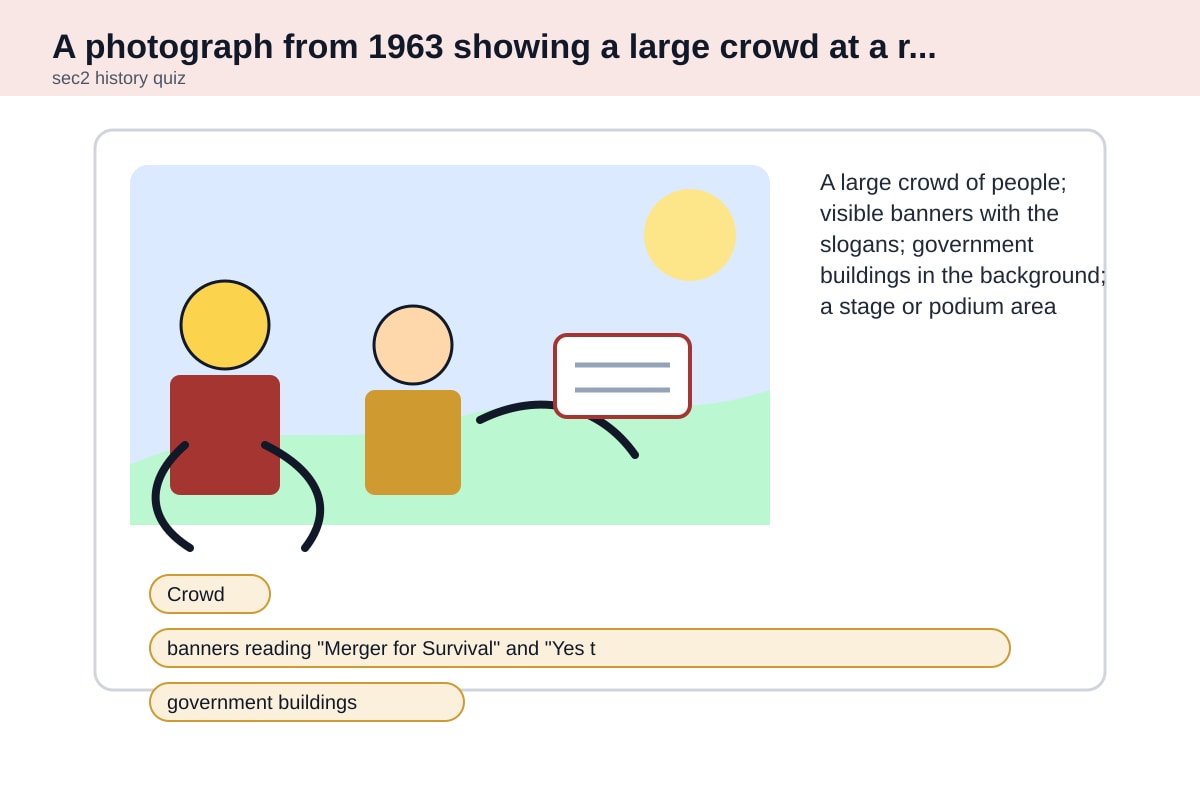
Answer: The photograph suggests that there was strong public support for merger with Malaysia in 1963. The image shows a large crowd gathered at a rally, which indicates that many people were interested in and supportive of the merger. The banners reading "Merger for Survival" and "Yes to Malaysia" show that people were actively campaigning for merger. The fact that the rally was held at a public square with government buildings in the background suggests that this was an officially supported event, and the large turnout shows that the message of merger resonated with many Singaporeans.
Marking Notes:
- 1 mark for identifying the level of support (e.g., "strong public support").
- 1 mark for using specific details from the source (e.g., "large crowd", "banners", "public square").
- 1 mark for explaining how the details support the conclusion.
Common Mistakes:
- Assuming the photograph represents the views of all Singaporeans.
- Not considering that the rally might have been organized by the government.
Question 17
Marks: 2
Answer: One political reason why the merger between Singapore and Malaysia failed was the disagreement over the concept of "Malaysian Malaysia". The PAP, led by Lee Kuan Yew, believed that all Malaysians should be treated equally regardless of race. However, UMNO, the dominant party in Malaysia, wanted to maintain special rights for the Malay population. This fundamental disagreement led to constant political conflicts between the Singapore and federal governments. The situation worsened when the PAP decided to contest the 1964 Malaysian federal elections, which UMNO saw as a direct challenge to their political dominance.
Marking Notes:
- 1 mark for identifying a valid political reason (e.g., "disagreement over Malaysian Malaysia", "PAP contesting federal elections").
- 1 mark for explaining how the reason led to the failure of merger.
Common Mistakes:
- Giving a general reason like "they disagreed" without specific details.
- Confusing political reasons with economic or social reasons.
Question 18
Marks: 2
Answer: One economic reason why the merger between Singapore and Malaysia failed was the disagreement over the common market and financial arrangements. Singapore had agreed to join Malaysia on the understanding that there would be a common market, allowing Singapore's goods to be sold freely in Malaysia. However, the Malaysian federal government was slow to implement the common market because they were worried that Singapore's more developed economy would dominate. Additionally, there were disagreements over how much tax revenue Singapore should contribute to the federal government. These economic disputes created tension and made the merger less attractive to both sides.
Marking Notes:
- 1 mark for identifying a valid economic reason (e.g., "common market not implemented", "tax disputes").
- 1 mark for explaining how the reason led to the failure of merger.
Common Mistakes:
- Confusing economic reasons with political reasons.
- Not explaining why the economic issue mattered.
Question 19
Marks: 3
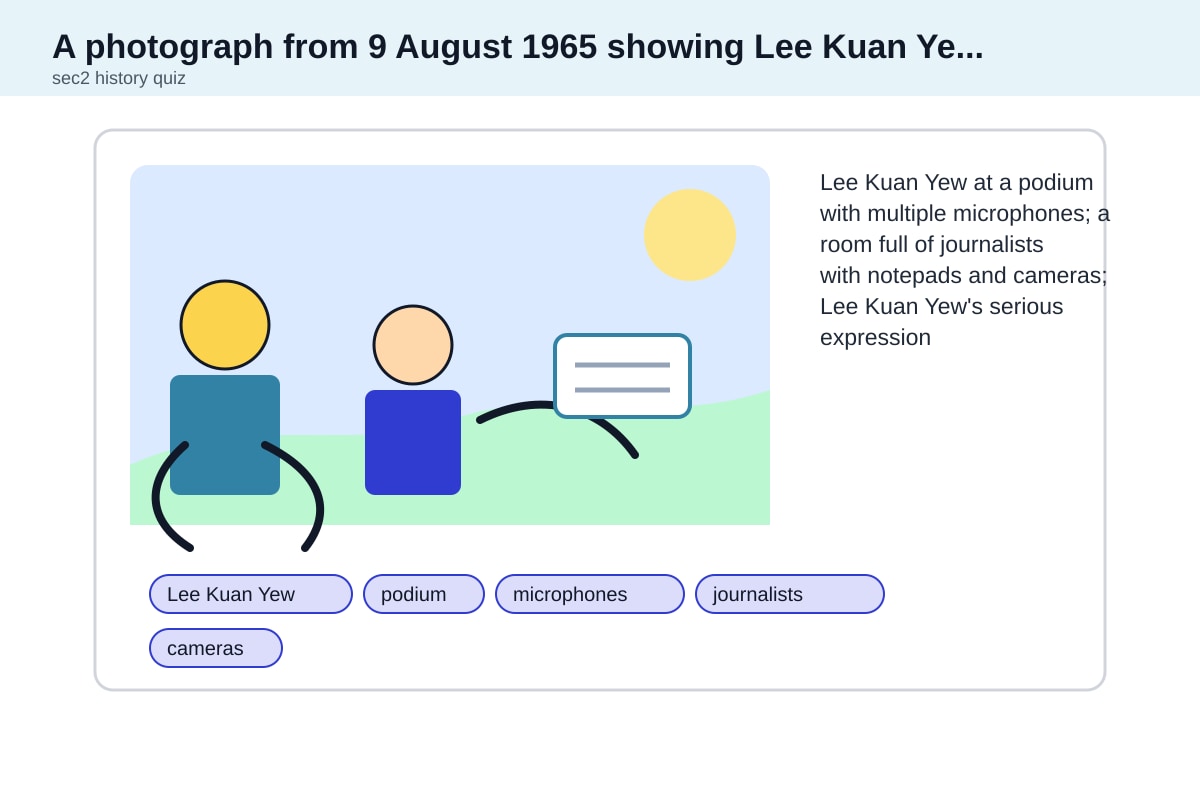
Answer: The photograph suggests that Lee Kuan Yew felt deeply emotional and perhaps sad about Singapore's separation from Malaysia. His serious and emotional expression indicates that this was not a decision he made lightly or happily. The fact that he is at a podium with many microphones and journalists shows that this was an important public announcement. The room filled with journalists and cameras suggests that this was a historic moment that attracted significant attention. Lee Kuan Yew's emotional expression can be interpreted as showing that he viewed separation as a painful but necessary decision for Singapore's survival.
Marking Notes:
- 1 mark for identifying the feeling (e.g., "emotional", "sad", "serious").
- 1 mark for using specific details from the source (e.g., "serious expression", "podium with microphones", "journalists").
- 1 mark for explaining how the details support the feeling.
Common Mistakes:
- Assuming Lee Kuan Yew was happy about separation without considering the context.
- Not using specific visual details from the source.
Question 20
Marks: 2
Answer: Singapore's separation from Malaysia in 1965 was a significant turning point because:
-
Singapore became an independent nation – For the first time, Singapore was a fully independent country responsible for its own defence, economy, and foreign policy. This forced Singapore to build its own military (the Singapore Armed Forces) and develop its own national identity.
-
Singapore had to build its own economy – Without access to the Malaysian market, Singapore had to find new ways to survive economically. This led to the development of export-oriented industries, the attraction of foreign investment, and the creation of key economic institutions like the Economic Development Board (EDB).
Marking Notes:
- 1 mark for each valid reason with explanation (2 marks total).
- Accept other valid reasons such as "development of a unique Singaporean identity" or "focus on survival and self-reliance".
Common Mistakes:
- Stating only one reason or giving vague reasons without explanation.
- Confusing separation with other events like independence in 1965.
End of Answer Key