AI Generated Quiz
Secondary 2 History Essay Explanation Quiz
Free Sec 2 History Essay Explanation quiz, Claude AI version, with questions, answers, and syllabus-aligned practice for Singapore students.
These static practice materials are generated from the site's syllabus and paper-generation workflow, with source and model context shown so students and parents can evaluate the material before use.
Questions
Free quiz and exam paper access
Enter your details to view this paper
Your access is remembered on this device.
Answers
Secondary 2 History Quiz - Essay Explanation (Answer Key)
Section A: Source-Based Questions [25 marks]
Question 1 [4 marks]
What can you tell from this source about the daily experiences of civilians during the Japanese Occupation?
Sample Answer: From Source A, I can tell that civilians faced severe hardship and lived in constant fear during the Japanese Occupation. The diary entry shows that food was extremely scarce - people had to queue for three hours just to get "a small portion of rice," indicating widespread hunger and food shortages. The source also reveals that Japanese soldiers treated civilians harshly, as they were "shouting at everyone and hit an old man who complained," showing that people faced violence and intimidation. The disappearance of Mrs. Lim suggests that people were regularly arrested or taken away by the Japanese, creating an atmosphere of terror.
Marking Notes:
- 1 mark for each valid inference with supporting detail from source
- Must cite specific details from the source
Question 2 [5 marks]
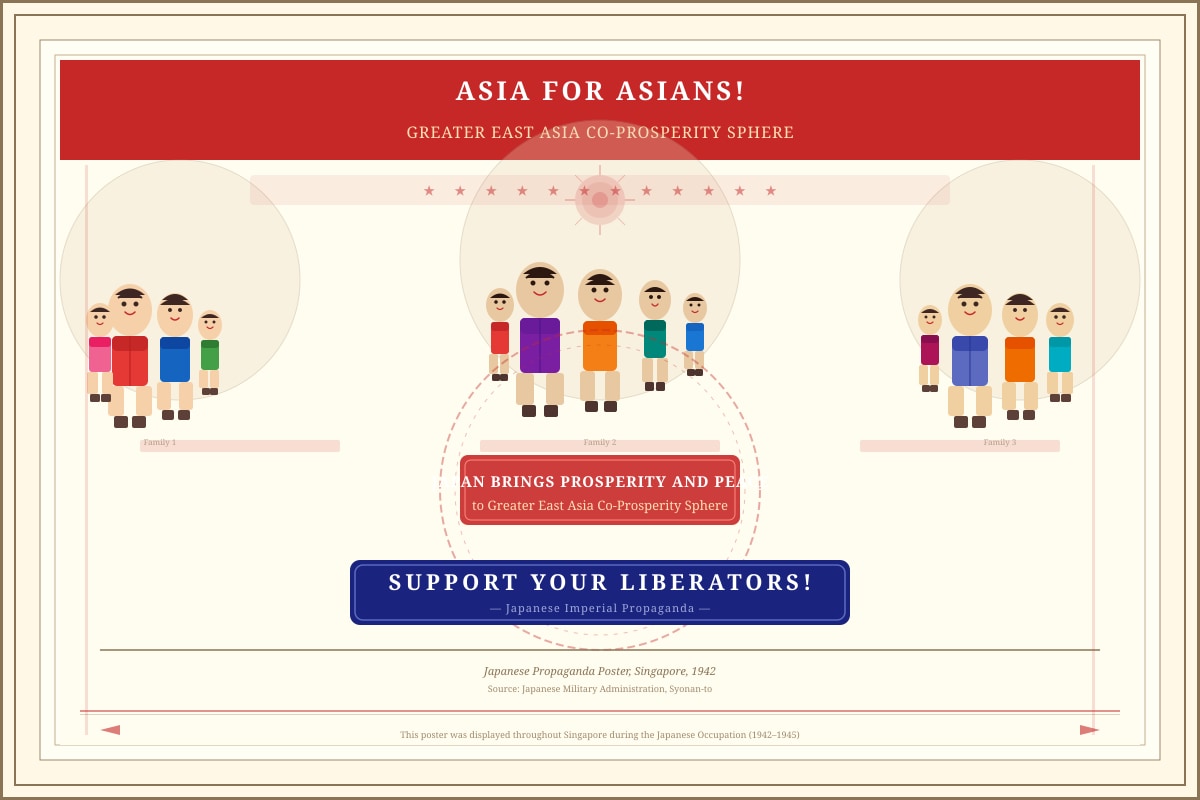
Why was this poster made?
Sample Answer: This poster was made to win support for Japanese rule and convince people that the Japanese were liberators rather than conquerors. The Japanese needed to justify their invasion and occupation of Singapore to reduce resistance from the local population. By promoting the idea of "Asia for Asians," the poster tried to present Japanese rule as freeing Asians from Western colonial control. The promise of "prosperity and peace" was designed to make people believe that Japanese rule would improve their lives. The poster was also part of the Greater East Asia Co-Prosperity Sphere propaganda campaign.
Marking Notes:
- 1 mark each for: propaganda purpose, justifying occupation, anti-Western message, promises of benefits, broader strategy
Question 3 [6 marks]
How different are these two sources about life during the Japanese Occupation?
Sample Answer: Sources A and B present completely different pictures of life during the Japanese Occupation. Source A shows the harsh reality - people suffering from food shortages, violence from Japanese soldiers, and living in fear of arrest. In contrast, Source B presents an idealized version where Japanese rule brings "prosperity and peace" with happy families. These sources differ because they serve different purposes - Source A is a private diary reflecting actual suffering, while Source B is Japanese propaganda designed to win support by hiding harsh realities.
Marking Notes:
- 2 marks for identifying key differences in content
- 2 marks for explaining why sources differ (purpose, perspective)
- 2 marks for using specific details from both sources
Question 4 [5 marks]
How reliable is this source for understanding the impact of Japanese rule on Singapore's population?
Sample Answer: Source A is partially reliable for understanding the impact of Japanese rule. The source is reliable because it is a contemporary account written by someone who actually lived through the occupation, providing genuine firsthand experience of hardships. However, it has limitations because it only represents one person's experience and may not reflect what happened to everyone in Singapore. As a personal diary, it might exaggerate some aspects of suffering. The source is most reliable for understanding general hardships civilians experienced.
Marking Notes:
- 2 marks for explaining reliability (contemporary, firsthand account)
- 2 marks for explaining limitations (personal perspective, may not represent everyone)
- 1 mark for balanced conclusion
Question 5 [5 marks]
"The Japanese Occupation brought only suffering to the people of Singapore." How far do you agree with this statement?
Sample Answer: I largely agree that the Japanese Occupation brought mainly suffering to Singapore's people. Source A shows daily hardships - severe food shortages, violence from soldiers, and constant fear of arrest. The Sook Ching massacre and harsh economic controls caused widespread suffering. However, some limited benefits existed - the "Asia for Asians" ideology in Source B appealed to those who resented Western colonial rule, and some locals gained positions of authority. Nevertheless, these minor benefits were far outweighed by the overwhelming suffering experienced by the vast majority of the population.
Marking Notes:
- Award marks for balanced argument using sources and own knowledge
- Higher marks for specific examples and clear conclusion
Section B: Post-War Singapore [25 marks]
Question 6 [5 marks]
Explain two reasons that led to Singapore's separation from Malaysia in 1965.
Sample Answer: One reason was racial tensions and disagreements over racial policies. The PAP advocated for a "Malaysian Malaysia" with equal treatment for all races, while UMNO wanted Malay political dominance. This led to the 1964 racial riots in Singapore, showing that racial harmony was difficult to achieve within Malaysia.
Another reason was political disagreements between the PAP and the Malaysian federal government. Lee Kuan Yew's criticism of federal policies and his attempts to expand PAP influence beyond Singapore created tensions with Prime Minister Tunku Abdul Rahman, who saw the PAP as a threat to UMNO's political control.
Question 7 [5 marks]
Explain how the Japanese controlled the people of Singapore during the Japanese Occupation.
Sample Answer: The Japanese used terror and violence to control the population, including the Sook Ching massacre which killed thousands of Chinese men to eliminate potential resistance. They imposed strict military rule with harsh punishments for disobedience. The Japanese also used propaganda and forced people to learn Japanese customs, including bowing to Japanese soldiers and learning the Japanese language. They controlled the economy by introducing Japanese military currency and rationing essential goods. Additionally, they used local collaborators and informants to monitor the population and report any signs of resistance.
Question 8 [5 marks]
Explain how Singapore dealt with security threats after independence in 1965.
Sample Answer: Singapore introduced National Service in 1967 to build up its military capabilities and ensure all young men received military training. The government established the Singapore Armed Forces (SAF) with help from Israeli military advisors to develop professional armed forces. Singapore also pursued a policy of deterrence by investing heavily in modern military equipment and technology. The government built strong intelligence capabilities to monitor potential threats and maintained good diplomatic relations with neighboring countries to reduce the likelihood of conflict.
Question 9 [5 marks]
Explain the developments that led to constitutional changes in Singapore after World War Two.
Sample Answer: The Japanese Occupation weakened British prestige and showed that Britain could not protect Singapore, leading to demands for greater self-government. The rise of nationalism and anti-colonial movements across Asia pressured Britain to grant more political rights. The 1948 constitutional changes gave Singapore limited self-government with a Legislative Council that included elected members. Growing political parties like the PAP demanded further constitutional progress. The 1955 Rendel Constitution introduced a Chief Minister and expanded elected representation, leading eventually to full internal self-government in 1959.
Question 10 [5 marks]
Explain why Chinese Middle School students were dissatisfied with the British colonial government after the war.
Sample Answer: Chinese Middle School students felt that the British colonial government discriminated against Chinese education by providing more funding and recognition to English-medium schools while neglecting Chinese schools. They were frustrated that Chinese school qualifications were not recognized for government jobs or university entrance, limiting their future opportunities. Many students were influenced by communist ideology and opposed British colonial rule as a form of foreign oppression. They also felt that the government was trying to suppress Chinese culture and language through education policies that favored English over Chinese.
Section C: Independence and Nation Building [25 marks]
Question 11 [5 marks]
Explain how Singapore would benefit from merger with Malaya in 1963.
Sample Answer: Merger would provide Singapore with a larger domestic market for its industries and trade, helping economic growth. Singapore would gain access to Malaya's natural resources, particularly rubber and tin, which could be processed in Singapore's factories. The merger would provide better security against communist threats, as Singapore would be part of a larger, more defensible territory. Singapore's port would benefit from serving the entire Malaysian market, increasing trade and shipping activities. Additionally, merger would help resolve Singapore's unemployment problems by allowing workers to move freely within the larger Malaysian territory.
Question 12 [5 marks]
Explain two post-war problems the British faced when they returned to Singapore after World War Two.
Sample Answer: One major problem was the rise of anti-colonial nationalism. The Japanese Occupation had weakened British prestige and many people no longer accepted British rule as legitimate. Political parties like the PAP demanded independence, and there were strikes and demonstrations against colonial policies.
Another problem was economic reconstruction. Singapore's infrastructure had been damaged during the war, and the economy needed rebuilding. The British had to restore essential services, rebuild the port facilities, and deal with high unemployment and inflation. They also faced competition from other ports in the region as trade patterns had changed during the war.
Question 13 [5 marks]
Explain how the HDB housing programme changed people's lives in Singapore after independence.
Sample Answer: The HDB programme provided affordable public housing for ordinary Singaporeans, allowing many families to move out of overcrowded shophouses and slums into modern flats with proper sanitation and utilities. The programme promoted racial integration by ensuring that different ethnic groups lived together in the same housing estates, helping to build racial harmony. HDB flats gave people a sense of ownership and belonging to Singapore, as they could purchase their flats and build up assets. The programme also improved living standards significantly, with families having more space, better facilities, and access to amenities like schools and markets within housing estates.
Question 14 [5 marks]
Describe the challenges Singapore faced in building racial harmony after independence.
Sample Answer: Singapore had to overcome the legacy of the 1964 racial riots, which had created tensions and mistrust between different ethnic communities. The government needed to ensure equal treatment and opportunities for all races while respecting cultural differences and religious practices. Language policy was challenging, as the government had to balance the use of English as a common language while preserving mother tongues. Economic inequality between different racial groups created potential for resentment and conflict. The government also had to prevent the influence of racial politics from neighboring countries and build a shared Singaporean identity that transcended ethnic divisions.
Question 15 [5 marks]
Explain why the introduction of National Service was important for Singapore's security.
Sample Answer: National Service was essential because Singapore was a small, newly independent nation surrounded by larger neighbors and needed to build credible defense capabilities. It ensured that Singapore had a large pool of trained reservists who could be mobilized quickly in case of threats. National Service also promoted national unity by bringing together young men from different racial and social backgrounds to serve together. It helped build a sense of national identity and commitment to defending Singapore. Additionally, National Service provided military training and discipline that contributed to Singapore's overall development and social cohesion.
Section D: Economic and Social Development [25 marks]
Question 16 [5 marks]
Describe the economic problems Singapore faced immediately after independence.
Sample Answer: Singapore faced high unemployment, with many people lacking jobs and skills needed for economic development. The country had limited natural resources and depended heavily on entrepot trade, making it vulnerable to changes in regional trade patterns. Singapore lost its natural hinterland when it separated from Malaysia, reducing its role as a trading center for the region. The withdrawal of British military forces meant the loss of a major source of employment and economic activity. Additionally, Singapore had to build new industries and attract foreign investment to create jobs and reduce dependence on traditional trading activities.
Question 17 [5 marks]
Explain how the PAP government promoted national identity in the early years of independence.
Sample Answer: The government promoted multiracialism as a core value, emphasizing that Singapore belonged to all races equally and rejecting racial dominance by any group. It established English as the working language while preserving mother tongues, creating a common means of communication across ethnic groups. The government created national symbols like the flag, anthem, and pledge that represented all Singaporeans regardless of race or religion. It promoted the concept of meritocracy, where advancement was based on ability rather than race or connections. The government also emphasized Singapore's unique identity as a modern, multiracial society different from its neighbors.
Question 18 [5 marks]
Explain why the 1964 racial riots were significant for Singapore's political development.
Sample Answer: The riots demonstrated the dangers of racial politics and convinced leaders that Singapore needed strong policies to prevent racial conflict. They showed that Singapore's multiracial society was fragile and required careful management to maintain harmony. The riots contributed to tensions between Singapore and the Malaysian federal government, as they highlighted the difficulties of integrating Singapore into Malaysia's Malay-dominated political system. They influenced the PAP's decision to pursue separation from Malaysia, as it became clear that racial harmony would be difficult to achieve within the Malaysian framework. The riots also shaped Singapore's post-independence policies on racial integration and national unity.
Question 19 [5 marks]
Explain how Britain's decision to withdraw military forces affected Singapore's defence planning.
Sample Answer: Britain's withdrawal meant Singapore lost a major security guarantee and had to develop its own defense capabilities quickly. The government had to establish the Singapore Armed Forces and invest heavily in military equipment and training to replace British protection. Singapore sought help from other countries, particularly Israel, to train its military forces and develop defense strategies. The withdrawal also meant economic challenges, as British military spending had provided jobs and income for many Singaporeans. Singapore had to diversify its economy to reduce dependence on military-related activities and find new sources of employment and economic growth.
Question 20 [5 marks]
Explain two ways the Japanese Occupation changed people's attitudes towards British colonial rule.
Sample Answer: The occupation shattered the myth of British invincibility and superiority. When the British surrendered Singapore so quickly to the Japanese, many people lost faith in British ability to protect and govern effectively. This weakened the legitimacy of colonial rule and made people more willing to challenge British authority after the war.
The occupation also awakened nationalist consciousness among many Singaporeans. Having experienced rule by another Asian power, people began to believe that Asians could govern themselves without European colonial masters. The Japanese propaganda about "Asia for Asians," despite its failures, planted ideas about self-determination and independence that influenced post-war political movements demanding an end to colonial rule.