AI Generated Quiz
Secondary 2 History Conflict International Relations Quiz
Free Sec 2 History Conflict IR quiz, Qwen3.7 AI version, with questions, answers, and syllabus-aligned practice for Singapore students.
These static practice materials are generated from the site's syllabus and paper-generation workflow, with source and model context shown so students and parents can evaluate the material before use.
Questions
Free quiz and exam paper access
Enter your details to view this paper
Your access is remembered on this device.
Answers
Secondary 2 History Quiz - Conflict International Relations (Answer Key)
Section A: Knowledge and Understanding
1. Define the term 'Cold War'. [2]
- Answer: A state of political tension and military rivalry between the USA and the USSR (1 mark) that did not involve direct large-scale fighting between the two superpowers (1 mark).
- Teaching Note: Emphasize that it was "cold" because they never fought each other directly, but used proxy wars and propaganda.
2. Identify the two superpowers that emerged after World War II. [2]
- Answer: The United States of America (USA) (1 mark) and the Union of Soviet Socialist Republics (USSR/Soviet Union) (1 mark).
3. What was the main ideological difference between the USA and the USSR? [2]
- Answer:
- USA: Capitalism / Democracy (1 mark).
- USSR: Communism / Totalitarianism (1 mark).
4. State one reason why the USA was concerned about the spread of Communism in Asia. [1]
- Answer: Any one of the following: * Fear of the Domino Theory (countries falling to communism one by one). * Loss of economic markets/trade partners. * Strategic military concerns (containment policy).
5. Which international organization did the USA lead to contain the spread of Communism in Europe? [1]
- Answer: NATO (North Atlantic Treaty Organization).
6. What was the 'Domino Theory'? [2]
- Answer: The belief that if one country in a region fell to Communism (1 mark), the surrounding countries would also fall to Communism like a row of dominoes (1 mark).
7. Name the parallel that divided Korea into North and South after World War II. [1]
- Answer: The 38th Parallel.
8. Identify the leader of North Korea at the start of the Korean War in 1950. [1]
- Answer: Kim Il Sung.
9. What term is used to describe a war where superpowers support opposing sides without fighting each other directly? [1]
- Answer: Proxy War.
10. Which country provided significant military support to North Korea during the Korean War, aside from the USSR? [1]
- Answer: China (or People's Republic of China).
Section B: Source-Based Questions
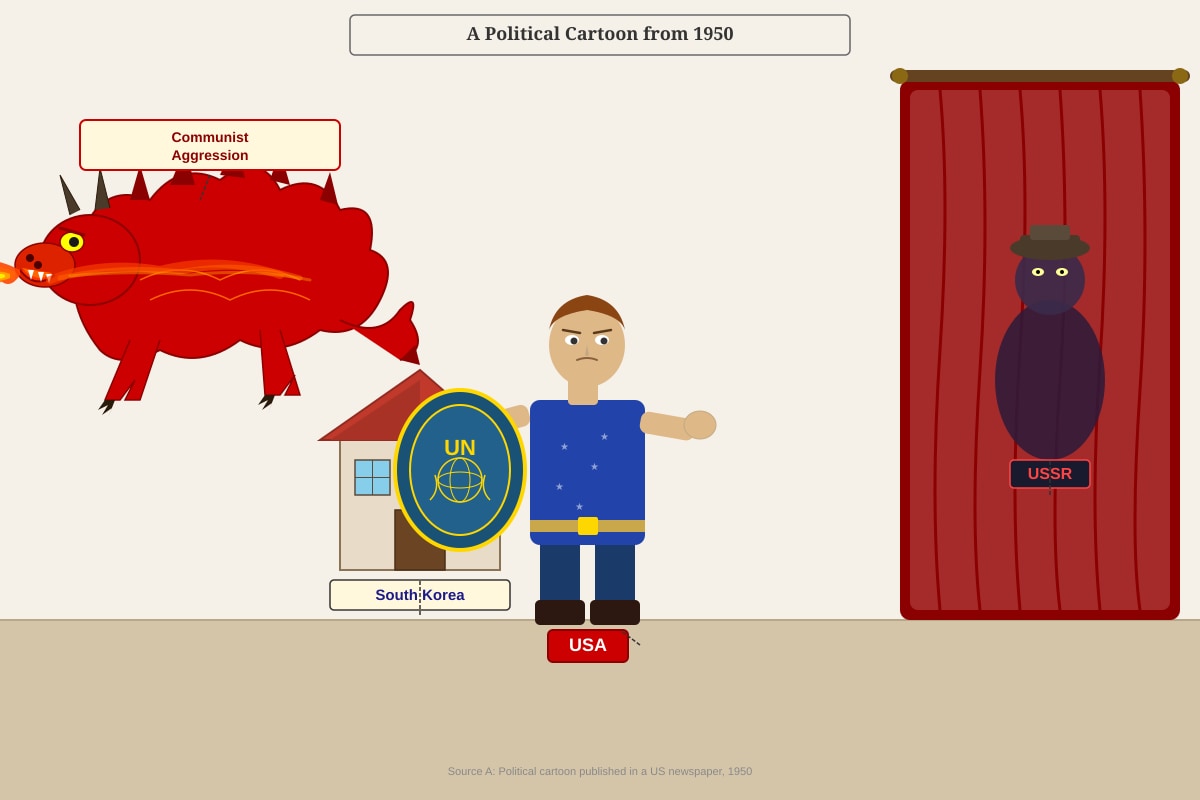
11. What is the message of Source A about the role of the USA in Korea? [3]
- Answer:
- The cartoon suggests that the USA is acting as a protector/defender of South Korea (1 mark).
- It portrays the USA as using the United Nations (UN) as a shield/tool to legitimize its actions (1 mark).
- It implies that the USSR is secretly behind the Communist aggression but is avoiding direct responsibility (hiding behind the curtain) (1 mark).
- Marking Note: Students must interpret the symbols (Shield=UN, Dragon=Aggression, Curtain=Secrecy).
12. How useful is Source A to a historian studying the causes of the Korean War? Explain your answer. [4]
- Answer:
- Useful: It shows the American perspective that the war was caused by "Communist Aggression" and that the USSR was indirectly responsible (1 mark). It reflects the US justification for intervention (1 mark).
- Limitations: It is a political cartoon, so it is biased and simplified (1 mark). It does not provide factual details about the actual border clashes or the internal Korean civil war context (1 mark).
- Teaching Note: Usefulness questions require evaluating both what it tells us and its limitations (bias/purpose).
13. Study Source A and Source B. How similar are these two sources about the threat of Communism? Explain your answer. [4]
- Answer:
- Similarity: Both sources portray Communism as an aggressive threat that uses force. Source A shows a "dragon" breathing fire (armed invasion), and Source B states communism will now use "armed invasion and war" (1 mark + 1 mark for explanation).
- Similarity: Both imply that the West/USA must respond. Source A shows the USA stepping in with a shield, and Source B states the US will "uphold the rule of law" (1 mark + 1 mark for explanation).
- Note: If students identify differences (e.g., Source A blames USSR secretly, Source B blames communism generally), award marks for valid comparison, but the prompt asks for similarity.
14. Based on Source B, what action did President Truman believe the United States must take in response to the attack on Korea? [2]
- Answer:
- Truman believed the US must uphold the rule of law (1 mark).
- This implies military or diplomatic intervention to stop the "armed invasion" (1 mark).
15. What does Source C suggest about the scale of human cost in the Korean War? [2]
- Answer:
- It suggests the war resulted in massive casualties, particularly for Asian nations involved (1 mark).
- It highlights that China and the Koreas suffered significantly higher military deaths than the USA, indicating the heavy burden borne by the local and regional participants (1 mark).
Section C: Structured Response Questions
16. Explain two reasons why the Korean War broke out in 1950. [6]
- Answer:
- Reason 1: Division of Korea. After WWII, Korea was divided at the 38th parallel into North (Communist, supported by USSR) and South (Capitalist, supported by USA). Both leaders (Kim Il Sung and Syngman Rhee) wanted to reunify Korea under their own system, leading to tension (1 mark for reason, 2 marks for explanation).
- Reason 2: Withdrawal of Superpower Troops. The USA and USSR withdrew their troops in 1948/1949, leaving a power vacuum. Kim Il Sung believed the South was weak and that the USA would not intervene, so he sought Stalin’s permission to invade (1 mark for reason, 2 marks for explanation).
- Marking Note: 3 marks per reason (1 for identification, 2 for detailed explanation).
17. "The Korean War was a significant event in the Cold War." Do you agree? Explain your answer with reference to two consequences of the war. [6]
- Answer:
- Agreement: Yes, it was significant.
- Consequence 1: Militarization of the Cold War. Before Korea, the Cold War was mostly political/economic. After Korea, both sides increased military spending and formed alliances (e.g., SEATO, Warsaw Pact). It showed the Cold War could turn "hot" (1 mark for point, 2 marks for explanation).
- Consequence 2: Globalization of the Cold War. The war spread the conflict from Europe to Asia. It reinforced the Domino Theory, leading the USA to get involved in Vietnam later (1 mark for point, 2 marks for explanation).
- Marking Note: Students must link the consequence to why it makes the war significant.
18. Why was the Soviet Union unable to veto the United Nations' decision to intervene in the Korean War? [3]
- Answer:
- The USSR was boycotting the UN Security Council meetings at the time (1 mark).
- They were protesting the UN's refusal to admit the People's Republic of China (Communist China) as a member (1 mark).
- Because they were absent, they could not cast a veto vote against the resolution authorizing force (1 mark).
19. How did the outcome of the Korean War affect the relationship between the USA and China? [3]
- Answer:
- The relationship became hostile and adversarial (1 mark).
- The USA imposed trade embargoes and refused to recognize the Communist government of China for many years (1 mark).
- China viewed the USA as an imperialist threat, leading to decades of diplomatic isolation between the two nations (1 mark).
20. In what way did the Korean War change the nature of the Cold War from a European conflict to a global one? [3]
- Answer:
- Prior to 1950, Cold War tensions were primarily focused on Europe (e.g., Berlin Blockade) (1 mark).
- The Korean War demonstrated that the superpowers were willing to compete for influence in Asia and other regions (1 mark).
- It led to the US extending its containment policy globally, resulting in future interventions in places like Vietnam and Latin America (1 mark).