AI Generated Quiz
Secondary 2 History Conflict International Relations Quiz
Free Sec 2 History Conflict IR quiz, AI version, with questions, answers, and syllabus-aligned practice for Singapore students.
These static practice materials are generated from the site's syllabus and paper-generation workflow, with source and model context shown so students and parents can evaluate the material before use.
Questions
Free quiz and exam paper access
Enter your details to view this paper
Your access is remembered on this device.
Answers
Answer Key: Secondary 2 History Quiz - Conflict International Relations
Total Marks: 40
Section A: Short Answer Questions (Questions 1–5, 2 marks each)
1. Define the term "Cold War" in your own words. [2]
Answer: The Cold War was a period of intense rivalry and tension between the United States and the Soviet Union (and their respective allies) after World War II. It was not fought through direct military conflict between the two superpowers, but through political, economic, ideological, and proxy wars in other countries.
Marking Notes:
- 1 mark for identifying it as a rivalry/tension between the USA and USSR.
- 1 mark for explaining that it was fought through indirect means (ideology, proxy wars, political/economic influence) rather than direct war.
Teaching Note: Emphasise the word "cold" – it means the superpowers never fought each other directly, but the tension was very real and often played out in other countries.
2. State two reasons why Singapore's location made it strategically important during the Cold War. [2]
Answer: (a) Singapore is located at the crossroads of major sea trade routes, including the Strait of Melaka, which connects the Indian Ocean and the Pacific Ocean. This made it a vital naval and commercial hub. (b) Its deep-water harbour and position in the heart of Southeast Asia made it a useful base for military operations and intelligence gathering for both superpowers seeking influence in the region.
Marking Notes:
- 1 mark for each valid reason (maximum 2 marks).
- Accept other valid reasons, such as its proximity to conflict zones like Vietnam and Indonesia, or its role as a British military base.
Teaching Note: Singapore's strategic value was not new – it had been important for trade for centuries. During the Cold War, this location also became important for military and ideological reasons.
3. Name the two superpowers that emerged after World War II and competed for global influence. [2]
Answer: (a) The United States of America (USA) (b) The Soviet Union (USSR)
Marking Notes:
- 1 mark for each correct answer.
Teaching Note: These two countries had very different political and economic systems – the USA promoted capitalism and democracy, while the USSR promoted communism. Their rivalry shaped global politics for decades.
4. What was the purpose of the Southeast Asia Treaty Organization (SEATO), formed in 1954? [2]
Answer: SEATO was a military alliance formed to prevent the spread of communism in Southeast Asia. Its purpose was to provide collective defence and mutual support among member countries (including the USA, Britain, France, Australia, New Zealand, Pakistan, the Philippines, and Thailand) against communist aggression or subversion in the region.
Marking Notes:
- 1 mark for identifying it as a military alliance/collective defence organisation.
- 1 mark for explaining its purpose was to contain/stop the spread of communism in Southeast Asia.
Teaching Note: SEATO was part of the American policy of containment. Unlike NATO, SEATO did not have a standing combined force and was less effective, but it showed America's commitment to stopping communism in Asia.
5. State two ways the Cold War affected countries in Southeast Asia. [2]
Answer: (a) Some countries experienced direct military conflict, such as the Vietnam War, as the superpowers fought proxy wars in the region. (b) Countries were pressured to choose sides – either aligning with the USA (anti-communist) or with the USSR/China (communist) – which sometimes led to internal political divisions and instability.
Marking Notes:
- 1 mark for each valid effect (maximum 2 marks).
- Accept other valid effects, such as economic aid from superpowers, the rise of communist insurgencies, or the formation of alliances like SEATO.
Teaching Note: The Cold War was not just a distant conflict – it directly affected the daily lives, politics, and security of Southeast Asian nations.
Section B: Source-Based Questions (Questions 6–10, 4 marks each)
6. According to Source A, what was the speaker's attitude towards the Cold War? Explain your answer using details from the source. [4]
Answer: The speaker's attitude was one of non-alignment and resistance to being drawn into the Cold War. The speaker states, "We must not be forced to choose sides in the conflict between the great powers," which shows a clear desire to remain neutral. The speaker also expresses concern about the region becoming a "battlegrounds for others," indicating fear that Southeast Asia would be used as a proxy battlefield. The phrase "The future of our region must be decided by our own people" shows a strong desire for self-determination and independence from superpower influence.
Marking Descriptors:
- Level 1 (1 mark): Identifies the attitude as non-aligned/neutral without using source details.
- Level 2 (2–3 marks): Identifies the attitude and supports it with at least one specific detail from the source.
- Level 3 (4 marks): Fully explains the attitude using multiple details from the source and shows understanding of the context (e.g., the speaker's desire for independence and fear of being used as a battleground).
Teaching Note: When answering "what can you infer" questions, always quote or paraphrase specific parts of the source and explain what they suggest. Do not just describe the source – explain what it tells you about attitudes, beliefs, or situations.
7. How useful is Source A for understanding the concerns of Southeast Asian countries during the Cold War? Explain your answer. [4]
Answer: Source A is useful because it directly expresses the concerns of a Southeast Asian leader about the Cold War. It shows that leaders in the region feared being forced to choose sides and worried about their countries becoming battlegrounds. The source also reveals a desire for self-determination, which was a common concern among newly independent or soon-to-be-independent Southeast Asian nations.
However, the source has limitations. It is only one leader's perspective and may not represent the views of all Southeast Asian countries. Some leaders, such as those in Thailand and the Philippines, chose to align with the USA through SEATO, showing that not all shared this non-aligned view. The source also does not provide specific details about the internal political pressures or economic challenges these countries faced.
Marking Descriptors:
- Level 1 (1 mark): States that the source is useful/not useful without explanation.
- Level 2 (2–3 marks): Explains usefulness with reference to the source content and/or identifies a limitation.
- Level 3 (4 marks): Provides a balanced assessment, discussing both usefulness and limitations, with specific reference to the source and contextual knowledge.
Teaching Note: "How useful" questions require a balanced answer. Always consider both what the source tells you and what it does not tell you. Consider the source type, author, purpose, and date.
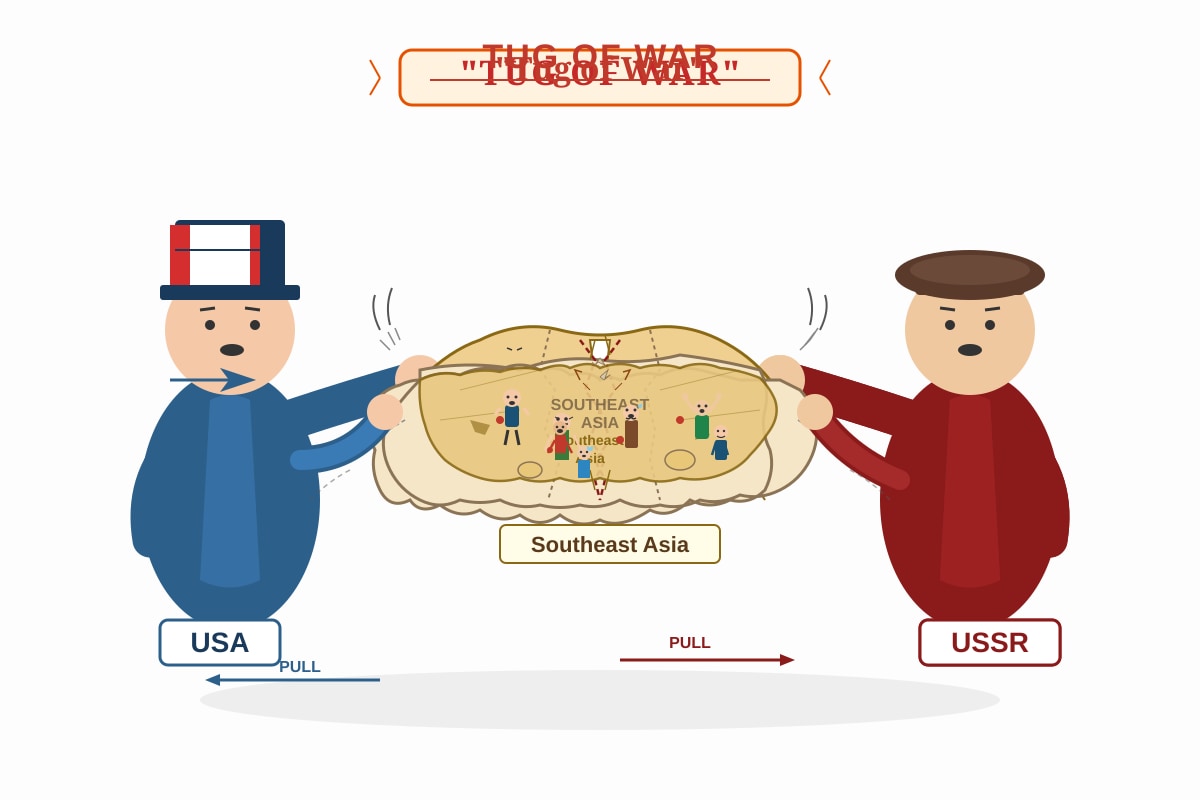
8. What message is the cartoonist trying to convey about the Cold War in Southeast Asia? Explain your answer using details from Source B. [4]
Answer: The cartoonist is conveying that the Cold War was tearing Southeast Asia apart. The two large figures (USA and USSR) are pulling the map of Southeast Asia in opposite directions, which symbolises how the superpowers were competing for influence and control over the region. The map being "stretched and torn in the middle" shows that this competition was destructive and was dividing the region. The small figures of Southeast Asian leaders looking worried suggest that the people and leaders of the region were helpless victims of superpower rivalry, with little control over their own fate.
Marking Descriptors:
- Level 1 (1 mark): Identifies the general message (e.g., "the superpowers were fighting over Southeast Asia") without specific details.
- Level 2 (2–3 marks): Explains the message using specific visual details from the cartoon (e.g., the pulling, the torn map, the worried leaders).
- Level 3 (4 marks): Fully explains the message, linking the visual elements to the broader context of superpower rivalry and its impact on Southeast Asia.
Teaching Note: For cartoon questions, always describe the visual elements (figures, symbols, labels, actions) and then explain what they symbolise. The message is usually about the cartoonist's opinion or criticism of a situation.
9. How reliable is Source B as evidence of the superpowers' influence in Southeast Asia? Explain your answer. [4]
Answer: Source B is partially reliable as evidence of superpower influence in Southeast Asia. The cartoon accurately reflects the reality that both the USA and USSR actively sought to expand their influence in the region through military alliances (SEATO), economic aid, and support for proxy wars (e.g., Vietnam). The idea that Southeast Asia was a "tug of war" between the superpowers is supported by historical evidence.
However, the cartoon has limitations as reliable evidence. It is a political cartoon, which means it is an opinion piece designed to make a point, not a factual record. The cartoonist may have exaggerated the helplessness of Southeast Asian countries, as some nations actively made their own choices (e.g., Singapore's pursuit of its own foreign policy, Indonesia's leadership in the Non-Aligned Movement). The cartoon also simplifies a complex situation – not all of Southeast Asia was equally affected by the Cold War.
Marking Descriptors:
- Level 1 (1 mark): States that the source is reliable/unreliable without explanation.
- Level 2 (2–3 marks): Explains reliability with reference to the source type (cartoon) and/or content, and provides some contextual evidence.
- Level 3 (4 marks): Provides a balanced assessment, discussing both the strengths and limitations of the source as evidence, with specific reference to the cartoon and contextual knowledge.
Teaching Note: Reliability is about whether we can trust the source as accurate evidence. Consider the source type (a cartoon is an opinion), the author's purpose, and whether the content matches what we know from other evidence.
10. Explain one way the Cold War contributed to the outbreak of conflict in a Southeast Asian country during this period. [4]
Answer: The Cold War contributed to the outbreak of the Vietnam War. After World War II, Vietnam was divided into a communist North (supported by the Soviet Union and China) and a non-communist South (supported by the USA). The USA, following its policy of containment, feared that if South Vietnam fell to communism, other Southeast Asian countries would also fall (the "domino theory"). To prevent this, the USA increasingly intervened militarily in South Vietnam, first through military advisors and then through direct combat troops. The conflict escalated into a full-scale war as North Vietnam, supported by the USSR and China, sought to reunify the country under communist rule. The Cold War rivalry thus turned a civil conflict into a major international war.
Marking Descriptors:
- Level 1 (1 mark): Identifies a conflict (e.g., Vietnam War) without explaining the link to the Cold War.
- Level 2 (2–3 marks): Explains the link between the Cold War and the conflict with some specific details.
- Level 3 (4 marks): Provides a clear, well-developed explanation with specific evidence (e.g., containment, domino theory, superpower support).
Teaching Note: The Cold War often turned local conflicts into international ones because the superpowers supported opposing sides. This is called a "proxy war."
Section C: Structured Response Questions (Questions 11–15, 4 marks each)
11. Explain two reasons why the United States became involved in the Vietnam War. [4]
Answer: Reason 1: The policy of containment. The USA believed it was its duty to stop the spread of communism. After the communist takeover of China in 1949, the USA feared that communism would spread throughout Asia. Vietnam was seen as a critical battleground – if South Vietnam fell to communism, other countries in the region might also fall (the "domino theory"). The USA therefore intervened to support the non-communist South Vietnamese government.
Reason 2: The desire to maintain credibility and influence. The USA wanted to show its allies and enemies that it would stand by its commitments. If the USA abandoned South Vietnam, it feared that its other allies would lose trust in American promises. The USA also wanted to limit the influence of the Soviet Union and China, who were supporting North Vietnam. By fighting in Vietnam, the USA hoped to demonstrate its strength and resolve in the Cold War.
Marking Descriptors:
- 1 mark for each valid reason identified (maximum 2 marks).
- 1 mark for each reason explained with specific detail (maximum 2 marks).
- Award full marks (4) for two clearly explained reasons with specific evidence.
Teaching Note: When explaining reasons, use the "because" test – do not just state a reason, explain how it led to the event. Use specific terms like "containment," "domino theory," and "credibility."
12. Explain how the policy of containment shaped American foreign policy in Southeast Asia during the Cold War. [4]
Answer: The policy of containment was the USA's strategy to prevent the spread of communism beyond its existing borders. In Southeast Asia, this policy shaped American foreign policy in several ways:
First, the USA formed military alliances, such as SEATO (1954), to provide collective defence against communist aggression. This committed the USA to the defence of Southeast Asian nations.
Second, the USA provided economic and military aid to anti-communist governments in the region, such as South Vietnam, Thailand, and the Philippines. This aid was designed to strengthen these countries so they could resist communist influence.
Third, the policy of containment led to direct military intervention, most notably in Vietnam. The USA believed that if it did not stop communism in Vietnam, it would spread to neighbouring countries (the domino theory). This led to the USA sending combat troops to Vietnam in the 1960s.
Marking Descriptors:
- Level 1 (1 mark): Defines containment or identifies one example of American policy.
- Level 2 (2–3 marks): Explains how containment shaped American policy with some specific examples.
- Level 3 (4 marks): Provides a clear, well-developed explanation with multiple specific examples (SEATO, aid, Vietnam War, domino theory).
Teaching Note: Containment was the overarching strategy – everything the USA did in the Cold War was designed to "contain" communism. Look for specific examples of how this strategy was implemented.
13. Explain two ways the Cold War affected Singapore's development in the 1950s and 1960s. [4]
Answer: Way 1: The threat of communism influenced Singapore's internal politics. In the 1950s and 1960s, communist elements were active in Singapore's labour unions, schools, and political movements. The British colonial government and later the Singapore government took strong measures to combat communist influence, including the arrest of communist sympathisers (e.g., Operation Coldstore in 1963). This shaped Singapore's political development and its leaders' determination to build a stable, non-communist society.
Way 2: The Cold War affected Singapore's security and foreign policy. Singapore's location in Southeast Asia, a region affected by the Cold War (e.g., the Vietnam War, the Indonesian Confrontation), meant that Singapore had to be careful in its foreign relations. After independence, Singapore adopted a policy of non-alignment while also seeking security through international ties. The British military base in Singapore was also important for regional security during the Cold War, and its eventual withdrawal in 1971 forced Singapore to build its own defence forces.
Marking Descriptors:
- 1 mark for each valid way identified (maximum 2 marks).
- 1 mark for each way explained with specific detail (maximum 2 marks).
- Award full marks (4) for two clearly explained ways with specific evidence.
Teaching Note: The Cold War was not just a global conflict – it had direct effects on Singapore's internal politics, security, and foreign policy. Think about both internal (communist threat) and external (regional conflicts, superpower rivalry) effects.
14. Why did some Southeast Asian countries choose to remain non-aligned during the Cold War? Explain your answer. [4]
Answer: Some Southeast Asian countries chose to remain non-aligned for several reasons:
First, many of these countries had recently gained independence from colonial rule and did not want to become dependent on another great power. They had experienced foreign domination and wanted to maintain their newly won independence and sovereignty.
Second, they wanted to focus on their own national development – economic growth, nation-building, and social stability – rather than being drawn into the superpowers' ideological conflict. Aligning with one side could bring unwanted military commitments and conflict.
Third, non-alignment allowed them to receive aid and support from both sides. Countries like Indonesia, under President Sukarno, played a leading role in the Non-Aligned Movement (founded in 1961) and sought to chart an independent path in international affairs.
Marking Descriptors:
- Level 1 (1 mark): States that they wanted to remain neutral without explanation.
- Level 2 (2–3 marks): Explains one or two reasons for non-alignment with some detail.
- Level 3 (4 marks): Provides a clear, well-developed explanation with multiple reasons and specific examples (e.g., Indonesia, Non-Aligned Movement, recent independence).
Teaching Note: Non-alignment was a positive choice, not just a refusal to choose. These countries wanted independence, development, and the ability to deal with both superpowers on their own terms.
15. Explain one impact of the Cold War on the relationship between Singapore and its neighbours during the 1960s. [4]
Answer: One impact of the Cold War on Singapore's relationship with its neighbours was the Indonesian Confrontation (Konfrontasi, 1963–1966) . Indonesia, under President Sukarno, opposed the formation of Malaysia (which included Singapore) and launched a policy of confrontation, including military raids and economic disruption. Sukarno was influenced by communist elements in Indonesia and saw Malaysia as a British-backed, neo-colonial project that threatened his vision of a united anti-imperialist front in Southeast Asia. The Cold War context made this conflict more dangerous, as Indonesia received support from the Soviet Union and China, while Malaysia and Singapore were supported by Britain and the USA. The Confrontation strained Singapore's relationship with its largest neighbour and forced Singapore to rely on British military protection. It also highlighted the security challenges Singapore faced as a small state in a volatile region.
Marking Descriptors:
- Level 1 (1 mark): Identifies a general impact (e.g., "Singapore had tense relations with neighbours") without specifics.
- Level 2 (2–3 marks): Explains the impact with some specific details (e.g., Confrontation, superpower involvement).
- Level 3 (4 marks): Provides a clear, well-developed explanation with specific evidence and links to the Cold War context.
Teaching Note: The Cold War often intensified regional conflicts. The Confrontation was not just a local dispute – it was connected to the global rivalry between communist and non-communist powers.
Section D: Extended Response Questions (Questions 16–20, 4 marks each)
16. Explain two reasons why the Cold War is considered a significant event in the history of Southeast Asia. [4]
Answer: Reason 1: It shaped the political development of the region. The Cold War forced Southeast Asian countries to choose sides or navigate between the superpowers. This influenced their political systems – some became military dictatorships (e.g., Thailand, Indonesia under Suharto) with strong anti-communist policies, while others (e.g., Vietnam, Laos) became communist states. The Cold War also led to the formation of alliances like SEATO and the Non-Aligned Movement, which shaped regional politics.
Reason 2: It caused devastating conflicts and human suffering. The most significant example is the Vietnam War, which caused millions of deaths and widespread destruction. The war also spilled over into neighbouring countries like Laos and Cambodia, where bombing and civil wars caused further suffering. The Cold War thus directly affected the lives of millions of people in Southeast Asia.
Marking Descriptors:
- 1 mark for each valid reason identified (maximum 2 marks).
- 1 mark for each reason explained with specific detail (maximum 2 marks).
- Award full marks (4) for two clearly explained reasons with specific evidence.
Teaching Note: Significance means "why does this matter?" Think about the long-term and wide-ranging effects of the Cold War on the region – political, economic, social, and human.
17. "The Cold War was mainly a conflict of ideas rather than a military conflict." Do you agree? Explain your answer. [4]
Answer: Agreement: The Cold War was fundamentally a conflict of ideas – capitalism and democracy versus communism. The superpowers competed to spread their ideologies through propaganda, education, cultural influence, and economic aid. The "Iron Curtain" in Europe and the "Bamboo Curtain" in Asia were ideological divides. The superpowers did not fight each other directly, which is why it was called a "cold" war.
Disagreement: However, the Cold War also involved significant military conflict, though fought indirectly. The superpowers fought "proxy wars" in countries like Vietnam, Korea, and Afghanistan, where they supported opposing sides. These wars caused massive casualties and destruction. The superpowers also engaged in a massive arms race, including nuclear weapons, which created the constant threat of a third world war. Military alliances like NATO and SEATO were formed, and military bases were established around the world.
Conclusion: The Cold War was both a conflict of ideas and a military conflict. While the superpowers never fought each other directly, they used military means to advance their ideological goals. The conflict of ideas was the driving force, but military conflict was a key method.
Marking Descriptors:
- Level 1 (1 mark): States agreement or disagreement without explanation.
- Level 2 (2–3 marks): Provides some explanation for one side of the argument.
- Level 3 (4 marks): Provides a balanced answer, discussing both sides and reaching a reasoned conclusion.
Teaching Note: For "do you agree" questions, you should consider both sides of the argument before giving your own opinion. Use specific examples to support your points.
18. Explain two ways the Cold War influenced the process of decolonisation in Southeast Asia. [4]
Answer: Way 1: The superpowers supported anti-colonial movements to gain influence. Both the USA and the Soviet Union presented themselves as opponents of colonialism. The USSR supported communist-led independence movements, such as in Vietnam, where Ho Chi Minh's forces fought against French colonial rule. The USA, while sometimes supporting its European allies' colonial interests, also pressured them to grant independence to prevent communist movements from gaining support. This competition accelerated the process of decolonisation.
Way 2: Newly independent countries became pawns in the Cold War. After gaining independence, Southeast Asian countries were courted by both superpowers. The USA offered economic aid and military protection to anti-communist governments (e.g., the Philippines, Thailand, South Vietnam), while the USSR and China supported communist movements and governments (e.g., North Vietnam). This meant that decolonisation did not lead to true independence – many countries remained dependent on one of the superpowers for support and protection.
Marking Descriptors:
- 1 mark for each valid way identified (maximum 2 marks).
- 1 mark for each way explained with specific detail (maximum 2 marks).
- Award full marks (4) for two clearly explained ways with specific evidence.
Teaching Note: Decolonisation and the Cold War happened at the same time. The superpowers saw newly independent countries as opportunities to expand their influence, which affected how and when these countries gained independence.
19. Explain how the rivalry between the United States and the Soviet Union affected the domestic politics of a Southeast Asian country during the Cold War. [4]
Answer: Example: Vietnam. The rivalry between the USA and the USSR directly shaped Vietnam's domestic politics. After the Geneva Accords of 1954, Vietnam was temporarily divided at the 17th parallel, with Ho Chi Minh's communist government in the North and a Western-backed government in the South. The USA supported Ngo Dinh Diem's government in the South, providing economic and military aid. Diem's government was authoritarian and corrupt, and its repressive policies (such as the persecution of Buddhists and the cancellation of the 1956 reunification elections) led to widespread opposition and the rise of the Viet Cong (communist guerrillas) in the South. The USSR and China supported the North, providing weapons and supplies. The superpowers' rivalry thus deepened the division within Vietnam, turning a nationalist struggle into a civil war between communist and anti-communist factions, each backed by a superpower.
Marking Descriptors:
- Level 1 (1 mark): Identifies a country and a general effect (e.g., "Vietnam was divided").
- Level 2 (2–3 marks): Explains how the superpower rivalry affected the country's politics with some specific details.
- Level 3 (4 marks): Provides a clear, well-developed explanation with specific evidence (e.g., division at the 17th parallel, Diem's government, superpower support).
Teaching Note: Choose one country and explain the specific ways the Cold War affected its internal politics. Use concrete examples – leaders, events, policies – to support your explanation.
20. Explain two lessons that Singapore learnt from the Cold War that shaped its foreign policy after independence. [4]
Answer: Lesson 1: The importance of non-alignment and friendly relations with all countries. Singapore observed how countries that aligned too closely with one superpower became drawn into conflicts and lost their independence of action. After independence in 1965, Singapore adopted a policy of non-alignment, seeking friendly relations with all countries regardless of their ideology. This allowed Singapore to maintain its independence and pursue its own interests, including economic development.
Lesson 2: The need for a strong defence force. The Cold War showed Singapore that small states were vulnerable to the ambitions of larger powers. The Indonesian Confrontation (1963–1966) and the eventual withdrawal of British military forces in 1971 demonstrated that Singapore could not rely on others for its security. This led to the development of National Service (1967) and the building of a credible Singapore Armed Forces (SAF) to deter potential aggressors.
Marking Descriptors:
- 1 mark for each valid lesson identified (maximum 2 marks).
- 1 mark for each lesson explained with specific detail (maximum 2 marks).
- Award full marks (4) for two clearly explained lessons with specific evidence.
Teaching Note: Singapore's foreign policy was shaped by its experiences during the Cold War. The key principles were: be friends with everyone, do not take sides, and be strong enough to defend yourself.
END OF ANSWER KEY