AI Generated Quiz
Secondary 2 History Conflict International Relations Quiz
Free Sec 2 History Conflict IR quiz, AI version, with questions, answers, and syllabus-aligned practice for Singapore students.
These static practice materials are generated from the site's syllabus and paper-generation workflow, with source and model context shown so students and parents can evaluate the material before use.
Questions
Free quiz and exam paper access
Enter your details to view this paper
Your access is remembered on this device.
Answers
Secondary 2 History Quiz - Conflict International Relations
Answer Key and Marking Scheme
Total Marks: 40
Section A: Understanding Conflict (Questions 1–5)
1. Define the term 'conflict' in the context of international relations. [2 marks]
Expected Answer: In the context of international relations, conflict is a serious disagreement, struggle, or clash between two or more countries (or groups of countries) over opposing interests, goals, or values. It can range from diplomatic tensions (disputes through words and negotiations) to armed warfare.
Marking Scheme:
- 1 mark: Defines conflict as a disagreement or struggle between countries/nations.
- 2 marks: Defines conflict and mentions that it involves opposing interests/goals and can involve different levels (diplomatic, economic, or military).
Teaching Note: Conflict is a core concept in international relations. It’s different from a simple argument; it usually involves power, resources, territory, or ideology. Remind students that conflict is not always war—it can be a trade war, a propaganda war, or a diplomatic standoff.
2. State one cause of conflict between countries. [1 mark]
Expected Answer (any one of the following):
- Disputes over territory/borders
- Competition for resources (e.g., oil, water, minerals)
- Ideological differences (e.g., communism vs. capitalism)
- Nationalism / desire for independence
- Historical grievances or revenge
- Trade disputes/economic competition
Teaching Note: This is a direct recall question. Accept any valid cause. Encourage students to think of specific examples (e.g., the Cold War was caused by ideological differences between the USA and USSR).
3. What is the difference between a 'treaty' and an 'alliance'? [2 marks]
Expected Answer:
- A treaty is a formal written agreement between two or more countries that outlines specific terms or rules (e.g., a peace treaty ending a war, a trade treaty).
- An alliance is a formal agreement of cooperation between countries for mutual benefit, often involving a promise to defend each other if attacked (e.g., NATO alliance). An alliance is a type of relationship that may be based on one or more treaties.
Marking Scheme:
- 1 mark: Defines a treaty as a formal agreement.
- 1 mark: Defines an alliance as a cooperative agreement, often for mutual defence between countries.
Teaching Note: Students often confuse these terms. Explain that a treaty is the document or agreement itself (e.g., the Treaty of Versailles), while an alliance is the relationship (e.g., the Triple Entente). A treaty can establish an alliance.
4. Name one international organisation formed after World War Two to prevent conflict. [1 mark]
Expected Answer (any one):
- United Nations (UN) – formed in 1945 to replace the League of Nations, with a primary goal of maintaining international peace and security.
Teaching Note: The UN is the most obvious answer. Students might also mention the North Atlantic Treaty Organization (NATO) formed in 1949, but note that NATO is a military alliance with a specific purpose (collective defence), while the UN is a broader global organisation for maintaining peace. Accept either with proper justification, but the UN is the standard expected answer for this level.
5. Explain what is meant by a 'proxy war'. Give one example. [2 marks]
Expected Answer:
- Definition (1 mark): A proxy war is a conflict where two powerful countries or groups support opposing sides in a smaller country's war, rather than fighting each other directly. They use 'proxies' (surrogates) to fight on their behalf.
- Example (1 mark): The Vietnam War (USA supported South Vietnam vs. USSR/China supported North Vietnam) OR the Korean War (USA led UN forces for South Korea; USSR/China supported North Korea) OR the Soviet-Afghan War (USSR fought directly; USA supported Mujahideen rebels).
Teaching Note: This is a key Cold War concept. The idea is that superpowers avoid direct war (which could escalate to nuclear war) but still compete by fighting through other countries. Encourage students to explain how the superpowers supported their side (e.g., money, weapons, advisors, logistics).
Section B: Source-Based Analysis – The Cold War (Questions 6–10)
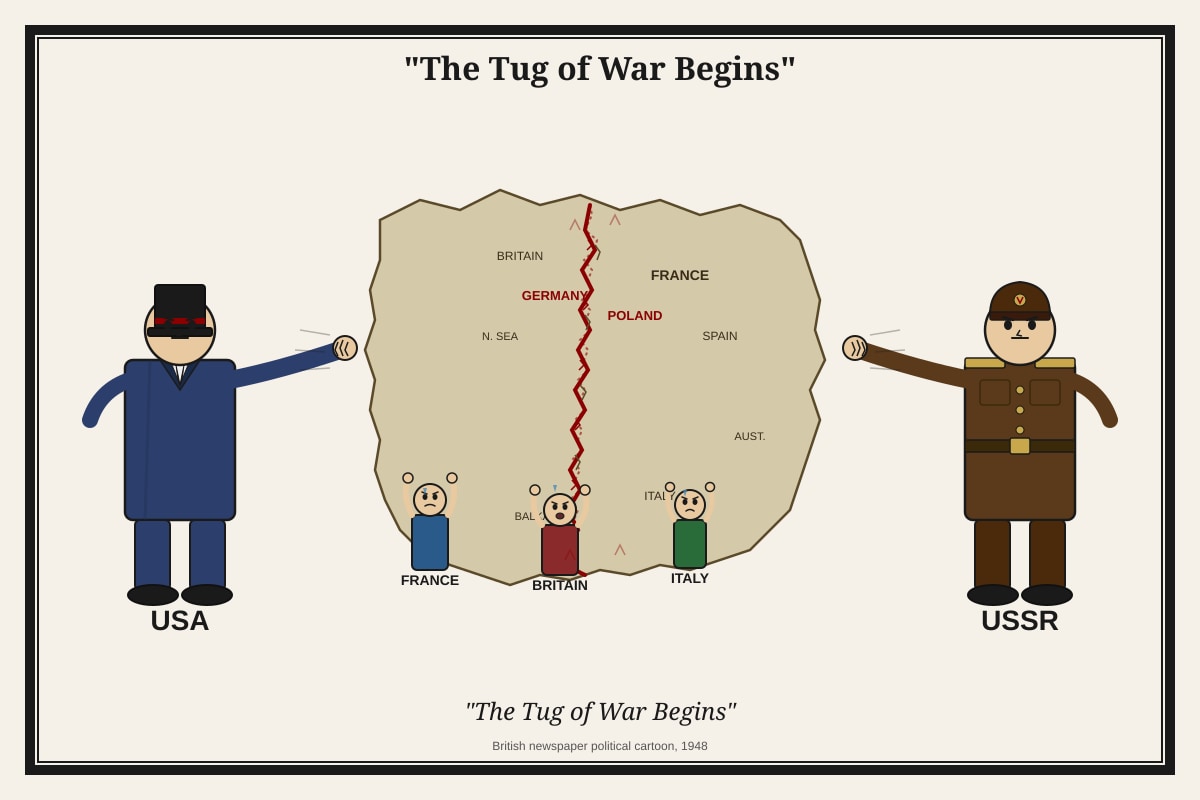
6. (a) What does Source A suggest about the relationship between the USA and the USSR after World War Two? Use details from the source to support your answer. [2 marks]
Expected Answer: Source A suggests that the relationship between the USA and USSR after WWII was tense and competitive, like a 'tug of war'. The source shows this through:
- The two large figures (USA and USSR) pulling opposite ends of a map of Europe, which is tearing apart—this represents the division of Europe into competing spheres of influence.
- The worried smaller European figures suggest that this competition was creating fear and instability.
Marking Scheme:
- 1 mark: Identifies the relationship as tense/competitive/confrontational.
- 1 mark: Supports with detail from the source (tearing map, worried figures, 'tug of war' caption).
6. (b) What might the worried expressions of the smaller European figures in the cartoon represent? [1 mark]
Expected Answer:
- The worried expressions represent the fear and uncertainty of European countries caught between the competing superpowers. They were anxious about being divided, controlled, or caught in a new conflict (a "hot war") between the USA and USSR.
Teaching Note: Accept interpretations such as: fear of being 'torn apart' by superpower rivalry, anxiety about being forced to choose sides, fear of another war. The key is that the smaller countries are vulnerable and have little control.
7. (a) According to the cartoon's caption, "The Tug of War Begins," what event or period in history is Source A referring to? [1 mark]
Expected Answer:
- The start of the Cold War (the period of tension and rivalry between the USA and USSR that began after WWII and lasted until 1991).
Teaching Note: The 'tug of war' metaphor directly refers to the emerging superpower rivalry. The date 1948 places this cartoon early in the Cold War period.
7. (b) How reliable is this British newspaper cartoon as a source for understanding the causes of the Cold War? Explain your answer. [3 marks]
Expected Answer: The cartoon is somewhat reliable but has limitations.
Reliable because:
- It accurately represents the division of Europe (the tearing map) which was a real consequence of post-war agreements.
- The concern of European states (worried figures) reflects genuine fears about the emerging superpower rivalry.
- As a newspaper cartoon from 1948, it is contemporary to the events, showing how people at the time understood the situation.
Not fully reliable because:
- It is a cartoon, not a factual report—it simplifies complex events into a simple image for a general audience.
- It has a British perspective (from a British newspaper) which may be biased. Britain was allied with the USA, so the cartoon may present a pro-Western view that makes the USA seem like an equal, not an instigator of tension.
- It only shows one aspect (the division of Europe) and omits other causes of the Cold War (ideology, nuclear weapons, etc.).
Marking Scheme (Levels):
- Level 1 (1 mark): States it is reliable/unreliable with simple reason (e.g., "It's just a cartoon" or "It shows the real tension").
- Level 2 (2-3 marks): Explains both strengths and limitations. 2 marks for one developed point; 3 marks for balanced evaluation.
Teaching Note: Source reliability questions require students to consider provenance (origin, author, date, type) and content (what it shows vs. what it omits). The key skill is balance—most sources have both strengths and weaknesses.
8. (a) What policy is President Truman announcing in Source B? [1 mark]
Expected Answer:
- The Truman Doctrine – the US policy of 'containment' to support free peoples resisting communist subjugation.
Teaching Note: The Truman Doctrine (1947) was the formal declaration of US Cold War policy. It marked a shift from isolationism to active intervention to 'contain' communism.
8. (b) According to President Truman in Source B, what conditions allow 'totalitarian regimes' to spread? [2 marks]
Expected Answer: Truman states that totalitarian regimes spread and grow in conditions of:
- Misery and want (poverty, economic hardship)
- The 'evil soil of poverty and strife' (desperate situations like famine, war, social unrest)
Marking Scheme:
- 1 mark: Identifies one condition (misery/poverty/strife).
- 2 marks: Identifies both conditions using source language ('misery and want', 'poverty and strife').
Teaching Note: Students must quote or paraphrase specific details from the source to support their answer. This tests the skill of extracting and using evidence from a source.
9. In what ways are Sources A and B similar in their message about the growing conflict between the USA and USSR? Explain your answer using details from both sources. [4 marks]
Expected Answer: Both sources are similar in that they portray the growing conflict between the USA and USSR as a major threat.
- Source A shows this through the visual metaphor of the map of Europe being torn apart, suggesting that superpower rivalry is destructive and dangerous. The worried European figures show the threat is real.
- Source B also shows this through Truman's language about 'totalitarian regimes' being a threat that 'may endanger the peace of the world'. He presents communism as a dangerous force that must be resisted.
Both sources also suggest that the USA is responding to a threat rather than starting the conflict. Source A shows the USA 'pulling' but so is the USSR—both are responsible. Source B frames the US as 'supporting free peoples' who are 'resisting subjugation'—the US is defensive, not aggressive.
Both sources agree that the conflict is just beginning (Source A: "The Tug of War Begins"; Source B: 1947, the early years of the Cold War).
Marking Scheme (Levels):
- Level 1 (1-2 marks): Identifies one similarity with simple reference to one source.
- Level 2 (3 marks): Identifies a similarity with details from both sources.
- Level 3 (4 marks): Explains similarity in terms of message/meaning with specific evidence from both sources, showing understanding of how both sources convey a similar warning about the emerging conflict.
10. Which source, A or B, is more useful for a historian studying the reasons for the start of the Cold War? Explain your answer. [3 marks]
Expected Answer: Source B is more useful for understanding the reasons for the start of the Cold War.
-
Source B is a primary source speech by US President Truman announcing the Truman Doctrine—a key policy that caused the Cold War to intensify. It directly states the US rationale for opposing communism, showing the ideological conflict. It is an official government document with a specific date and purpose.
-
Source A is a cartoon that reflects the tensions of the Cold War but does not explain why it started. It shows the division of Europe but not the causes—ideology, fear, post-war power vacuum. It is useful for understanding how people perceived the conflict, but less useful for reasons.
However, Source A is still useful because it shows the immediate post-war division of Europe (a result of the Yalta and Potsdam conferences) which was a major cause of Cold War tensions.
Marking Scheme (Levels):
- Level 1 (1 mark): States which source is more useful with simple reason.
- Level 2 (2-3 marks): Explains with developed reasoning, comparing both sources.
Teaching Note: 'Usefulness' is different from 'reliability'. A source can be biased but still useful for understanding perspectives or attitudes. The key is to state how the source helps the historian and for what purpose.
Section C: The Korean War (Questions 11–15)
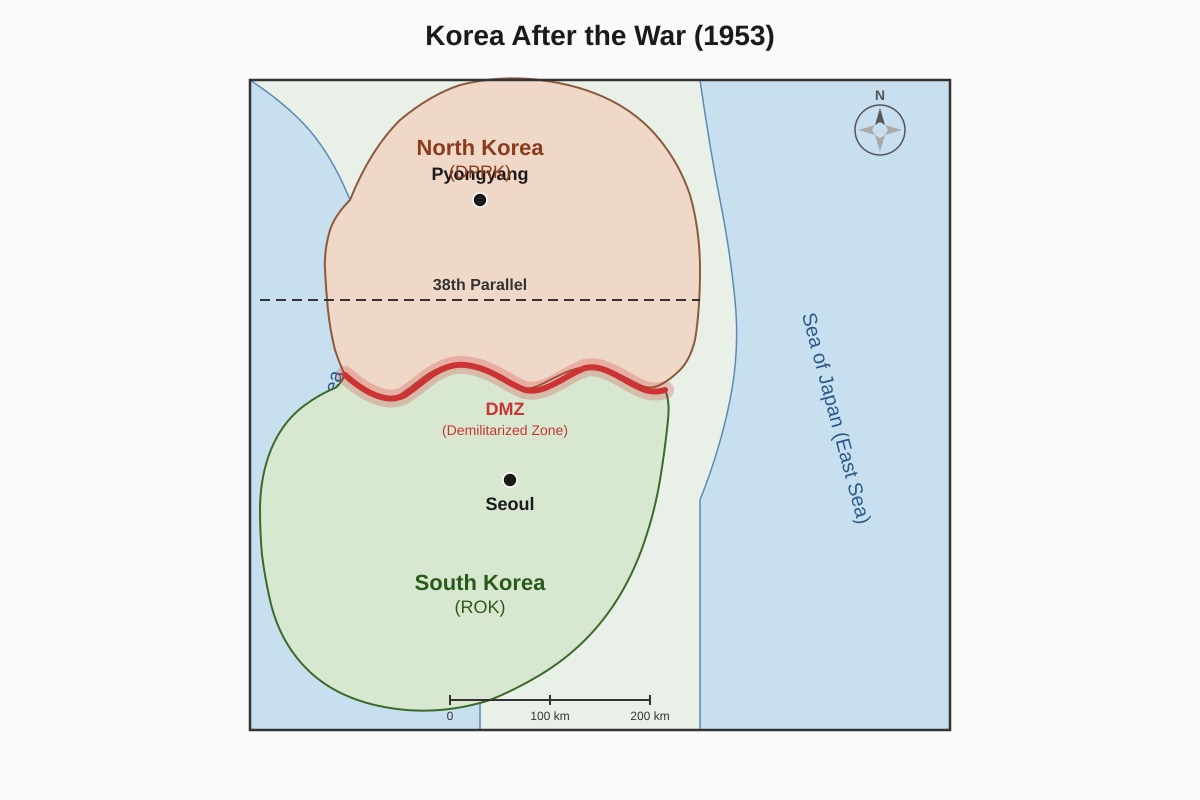
11. (a) What does the map in Source C show about the result of the Korean War? [1 mark]
Expected Answer: The Korean War ended in a stalemate. Korea remained divided into two countries—North Korea (communist) and South Korea (capitalist)—divided near the original 38th parallel with a Demilitarized Zone (DMZ). No side won the war.
Teaching Note: Many students mistakenly think the Korean War was a 'draw' or 'ended in a tie'. It's more accurate to say it was a stalemate where neither side achieved its goal (unifying Korea under its system).
11. (b) What is the Demilitarized Zone (DMZ)? [1 mark]
Expected Answer: The DMZ is a buffer zone between North and South Korea, established by the 1953 armistice. It is a strip of land where no military forces are allowed, acting as a 'no man's land' to prevent direct clashes.
Teaching Note: 'Demilitarized' means no military personnel or weapons are permitted. However, ironically the DMZ is one of the most heavily fortified borders in the world today.
12. Explain two reasons why the Korean War is considered a key event of the Cold War. [4 marks]
Expected Answer: Reason 1 (2 marks): The Korean War was a proxy war between the superpowers. The USA led UN forces to support South Korea, while the USSR and China supported North Korea. The superpowers used the Korean War to fight their ideological battle without directly fighting each other, but they provided weapons, advisors, and military support.
Reason 2 (2 marks): The Korean War intensified Cold War tensions and led to a permanent military build-up. It convinced the USA that containment must be enforced by military force, not just diplomacy. The war also led to the expansion of NATO (West Germany joined in 1955) and increased military spending on both sides.
Marking Scheme:
- 1 mark per reason for stating a valid reason.
- 1 additional mark per reason for explaining with specific detail/evidence.
Teaching Note: Accept other valid reasons: the war prevented the 'domino theory' from starting in Asia; it solidified the division of the Korean Peninsula as a lasting symbol of Cold War division; it led to the US commitment to defend Taiwan (Republic of China).
13. (a) Which country led the United Nations forces in the Korean War? [1 mark]
Expected Answer:
- The United States (led by General Douglas MacArthur as commander of UN forces).
Teaching Note: Although it was a UN force, the USA provided the overwhelming majority of troops (90%) and the commander. This shows how the Cold War was played out through international organisations.
13. (b) Which two major powers supported North Korea during the Korean War? [1 mark]
Expected Answer:
- The Soviet Union (USSR) and China (People's Republic of China) .
Teaching Note: China entered the war directly in October 1950, sending hundreds of thousands of troops. The USSR provided weapons, pilots (secretly), and diplomatic support but did not officially send ground troops.
14. Historian: "The Korean War was significant because it showed that the Cold War could turn into a 'hot war'." Do you agree with this statement? Explain your answer. [3 marks]
Expected Answer: Agree (2-3 marks development):
- The Korean War was a 'hot war' (actual military combat) between pro-communist and pro-capitalist forces, unlike the earlier 'Cold War' which was about diplomacy, propaganda, and economic competition.
- It showed that the superpowers were willing to fight through proxies, which could escalate. For example, the entry of Chinese forces nearly led to a direct USA-China war.
- The war lasted 3 years (1950-1953) and resulted in over 2.5 million deaths, proving the Cold War was not just a 'cold' conflict.
However (balance/qualification, 2-3 marks):
- The superpowers still avoided direct war with each other. USA and USSR did not fight each other directly—they fought through Korea. So the war can also be seen as evidence that the Cold War remained cold in terms of superpower direct confrontation.
- Other events (Berlin Blockade 1948-49) had already shown Cold War tensions could lead to crisis. The Korean War was a continuation, not a 'first'.
Marking Scheme (Levels):
- Level 1 (1 mark): States agree/disagree with simple reason.
- Level 2 (2 marks): Provides explanation with some evidence (e.g., "It was a hot war because many people died").
- Level 3 (3 marks): Provides balanced explanation, acknowledging both the 'hot war' reality and the fact that it was still a proxy war.
15. How did the Korean War impact the relationship between the USA and China after the war? [3 marks]
Expected Answer:
- The Korean War severely damaged US-China relations. Before the war, relations were already tense (China had become communist in 1949), but the war made them openly hostile.
- The USA saw China as an aggressive communist power that would use military force to expand. This led to the USA adopting a policy of containment of China—refusing to recognise the communist government, maintaining support for Taiwan, and imposing trade embargoes.
- The war also stopped any chance of US-China diplomatic relations for the next 20+ years (until Nixon's visit in 1972).
- China saw the USA as a threat to its security, leading to China's closer alliance with the USSR (at least until the Sino-Soviet split in the 1960s).
Marking Scheme (Levels):
- 1 mark: States that relations became hostile/worse.
- 2 marks: Explains one specific impact (e.g., US containment of China).
- 3 marks: Explains two or more specific impacts with historical context.
Section D: Case Study – The Vietnam War (Questions 16–20)
16. State one reason the USA became involved in the Vietnam War. [1 mark]
Expected Answer (any one):
- The Domino Theory: The US feared that if Vietnam fell to communism, then neighbouring countries (Laos, Cambodia, Thailand, etc.) would fall one by one like dominoes. This was a major Cold War fear.
- Containment policy: The US was committed to preventing the spread of communism worldwide.
- To support France/the French colonial effort: The US initially supported France to keep Vietnam from becoming communist (before direct US involvement in the 1960s).
Teaching Note: The Domino Theory is the most common and accurate answer for this level. It directly connects to Cold War ideology.
17. Explain how the French involvement in Vietnam (1946–1954) was connected to the Cold War. [2 marks]
Expected Answer:
- The French war in Vietnam was a colonial war, but it became connected to the Cold War because the main Vietnamese independence movement (the Viet Minh) was led by Ho Chi Minh, a communist. The USA saw the French fight as part of the global struggle against communism.
- The USA financially supported the French war effort (paying for about 80% of the cost by 1954) because stopping communism in Vietnam was seen as more important than opposing colonialism.
- The Cold War context meant that the conflict was framed as a fight between the 'free world' (France/USA) and communism (Viet Minh/USSR/China) rather than a simple anti-colonial struggle.
Marking Scheme:
- 1 mark: Identifies connection (Viet Minh was communist; USA supported France).
- 2 marks: Explains the connection with specific detail.
18. Why did the USA use tactics such as bombing campaigns and the use of chemical defoliants (Agent Orange) during the Vietnam War? Explain your answer. [3 marks]
Expected Answer: The USA used these tactics because of the nature of the war in Vietnam.
- Guerrilla warfare: The Viet Cong (South Vietnamese communist guerrillas) did not fight conventional battles. Instead, they used ambushes, booby traps, and hid among the civilian population. The US needed different tactics to find and destroy these hidden enemies.
- Bombing campaigns (like Operation Rolling Thunder) were intended to destroy supply lines, demoralise the enemy, and force North Vietnam to negotiate. The goal was to 'bomb them to the negotiation table'.
- Chemical defoliants (Agent Orange) were used to destroy the thick jungle cover that hid Viet Cong supply routes (particularly the Ho Chi Minh Trail). By destroying the forest, the US hoped to expose enemy movements and supply lines.
Marking Scheme (Levels):
- 1 mark: States a reason (e.g., "to win the war").
- 2 marks: Explains one tactic with reason (e.g., bombing to destroy supply lines).
- 3 marks: Explains both tactics with clear reasoning linking to the nature of the war.
19. (a) What was the Gulf of Tonkin Incident (1964) and how did it change US involvement in the war? [2 marks]
Expected Answer:
- The Gulf of Tonkin Incident (August 1964) was an alleged attack by North Vietnamese torpedo boats on a US Navy destroyer (USS Maddox) in the Gulf of Tonkin. (Historians now believe the second attack probably did not happen.)
- How it changed US involvement: President Johnson used the incident to get the Gulf of Tonkin Resolution passed by Congress. This gave the President authority to take 'all necessary measures' to defend US forces, effectively allowing him to dramatically escalate US military involvement in Vietnam without a formal declaration of war. It led to the bombing of North Vietnam and the introduction of hundreds of thousands of American combat troops.
Marking Scheme:
- 1 mark: Describes the incident.
- 1 mark: Explains how it escalated US involvement (Tonkin Resolution, troop increases).
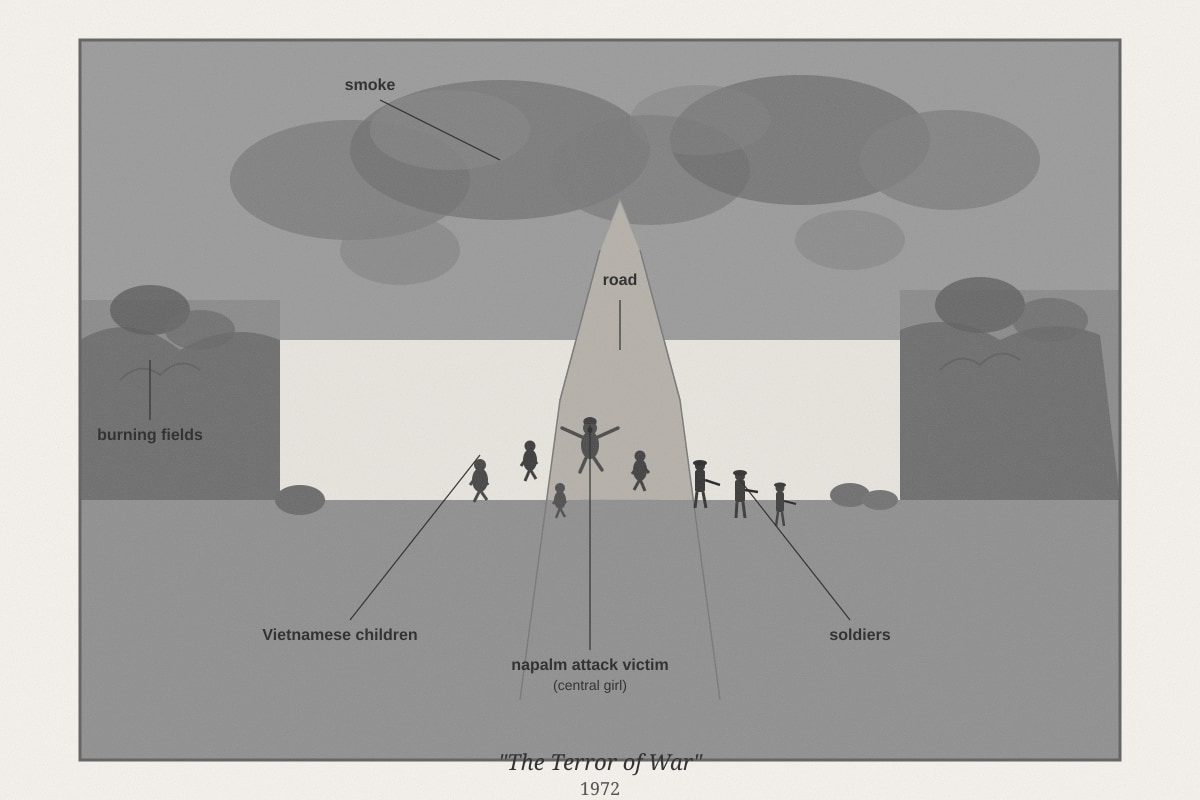
19. (b) Study the image below. It shows a famous photograph from the Vietnam War, known as "The Terror of War" or "Napalm Girl" (1972). What impact did photographs like this have on public opinion in the USA? [2 marks]
Expected Answer:
- Photographs like the "Napalm Girl" photo had a powerful impact on turning US public opinion against the war. The image showed innocent civilians (especially children) suffering from a US military tactic (napalm), making the war seem brutal and unjust.
- The photograph made the war 'real' for the American public, who saw the human cost on their television screens and in newspapers every day. This contributed to the growing anti-war movement and pressure on the government to withdraw from Vietnam.
- It became an iconic image that symbolised the suffering caused by the war and the failure of US military strategy.
Marking Scheme:
- 1 mark: States that it turned public opinion against the war.
- 2 marks: Explains how it impacted public opinion (human cost, anti-war movement, media's role).
Teaching Note: This photo is one of the most important images of the 20th century. It's a good example of how media coverage ('the living room war') shaped the outcome of the conflict.
20. Evaluate the impact of the Vietnam War on the people of Vietnam. In your answer, consider both the immediate and long-term effects of the conflict. [5 marks]
Expected Answer:
Immediate Impact:
- Massive loss of life: An estimated 1.5–3 million Vietnamese people (both North and South, civilians and soldiers) were killed. This was a devastating human cost.
- Widespread destruction: Heavy bombing (more bombs dropped than in all of WWII) destroyed cities, villages, farmland, and forests. Millions of people became refugees.
- Use of chemical weapons: Agent Orange and other defoliants caused immediate health problems and environmental damage.
Long-term Impact:
- Health legacy: Agent Orange has caused generations of birth defects, cancers, and other serious health problems. The effects continue to this day.
- Economic impact: The war destroyed Vietnam's economy. Post-war reconstruction was very difficult, and Vietnam remained one of the poorest countries in the world for decades.
- Social disruption: Millions of Vietnamese fled the country after the war as 'boat people'. Families were separated, and society was deeply traumatised.
- Political legacy: Vietnam was reunified under communist rule in 1976, but the war created lasting issues between North and South, with former South Vietnamese military and officials facing persecution in 're-education camps'.
- Environmental damage: Unexploded ordnance (bombs, landmines) remains a danger in many areas. Forests and farmland were destroyed by bombing and chemicals.
Marking Scheme (Levels):
- Level 1 (1-2 marks): Lists one or two general impacts (e.g., "many people died", "the environment was damaged").
- Level 2 (3-4 marks): Explains specific impacts with some detail, covering either immediate or long-term effects.
- Level 3 (5 marks): Provides a balanced evaluation covering both immediate and long-term impacts, with specific examples and explanation of the lasting significance of the effects.
Teaching Note: An 'evaluate' question requires students to make a judgement about the significance of the impacts, not just list them. Encouraging a balanced answer (some impacts are ongoing; some effects are more devastating than others) would strengthen a top-level response.
End of Answer Key