From Real Exams Quiz
Secondary 2 History Source Based Skills Quiz
Free Sec 2 History Source Based Skills quiz, LongCat Exam version, with questions, answers, and syllabus-aligned practice for Singapore students.
These static practice materials are generated from the site's syllabus and paper-generation workflow, with source and model context shown so students and parents can evaluate the material before use.
Questions
Free quiz and exam paper access
Enter your details to view this paper
Your access is remembered on this device.
Answers
Secondary 2 History Quiz - Source Based Skills
Answer Key
Section A: Inference from Sources
1. What can you infer from Source A about the challenges facing the British in Singapore after the Japanese Occupation? [4]
Answer: From Source A, I can infer that the British faced multiple serious challenges in post-war Singapore. First, the physical infrastructure — especially the port — was badly damaged, which would hinder economic recovery. Second, there were severe shortages of basic necessities such as food, medicine, and housing, meaning the British had to address urgent humanitarian needs. Third, widespread unemployment and growing labour unrest suggested social instability. Fourth, and perhaps most importantly, the source states that the people's confidence in British governance had been "shaken" by the swift Japanese conquest in 1942, meaning the British had to rebuild political legitimacy and trust. [4]
Marking Notes:
- 1 mark for each valid inference supported by evidence from the source (up to 4 marks).
- Accept any reasonable inference drawn directly from the source content.
- Do not award marks for unsupported general knowledge not linked to the source.
2. What message was the trade union leader in Source B trying to convey to the crowd? [4]
Answer: The trade union leader was conveying the message that the workers of Singapore were suffering under colonial rule and needed to unite to demand their rights. Specifically, the leader highlighted three problems: low wages, poor working conditions, and lack of political representation ("no voice in the government"). The leader's purpose was to rally the workers together by appealing to their shared grievances and to inspire collective action. The phrase "only through unity can we build a better future" shows that the leader was calling for solidarity among workers to fight for change. [4]
Marking Notes:
- 1 mark for identifying the main message (workers are suffering / need to unite for rights).
- 1 mark for referencing specific grievances from the source (low wages, poor conditions, no political voice).
- 1 mark for explaining the call to action (unity, collective action).
- 1 mark for linking the message to the context of colonial rule.
3. What does Source C tell you about the political mood in Singapore in 1955? [4]
Answer: Source C tells us that the political mood in Singapore in 1955 was one of strong desire for self-government and independence. The banners reading "Merdeka!" (freedom) and "Self-Government Now!" show that many Singaporeans wanted an end to colonial rule. The fact that there was a large crowd at a political rally indicates widespread public engagement with the political process and popular support for the self-government movement. The presence of a political leader addressing the crowd suggests that organised political parties were actively mobilising the people. [4]
Marking Notes:
- 1 mark for identifying the desire for self-government/independence.
- 1 mark for referencing the banners ("Merdeka", "Self-Government Now").
- 1 mark for noting the large crowd as evidence of popular support.
- 1 mark for explaining the significance (end of colonial rule, political mobilisation).
4. What can you infer from Source D about the ideas influencing some Singaporeans in the 1950s? [4]
Answer: From Source D, I can infer that some Singaporeans in the 1950s were influenced by anti-colonial and nationalist ideas. The student mentions being "inspired by the independence movements in India and Africa," showing that decolonisation movements elsewhere in the world were shaping the thinking of overseas Singaporean students. The letter also shows that these students were actively discussing and planning for self-government, and intended to contribute to the cause when they returned home. This suggests that a new generation of politically aware, educated Singaporeans was emerging who believed that Singapore and Malaya "must govern themselves." [4]
Marking Notes:
- 1 mark for identifying anti-colonial/nationalist ideas.
- 1 mark for referencing the influence of independence movements in India and Africa.
- 1 mark for noting the active discussion and planning for self-government.
- 1 mark for explaining the significance (emergence of a politically conscious generation).
5. What can you infer from Source E about the significance of the 1959 General Elections? [4]
Answer: From Source E, I can infer that the 1959 General Elections were highly significant because they marked Singapore's achievement of full internal self-government. The headline states that Singapore "wins full internal self-government," which was a major milestone in the nation's political development. The landslide victory of the People's Action Party (43 out of 51 seats) showed that the PAP had overwhelming popular support. Lee Kuan Yew becoming the first Prime Minister was also historically significant, as he would go on to lead Singapore through merger, separation, and early independence. [4]
Marking Notes:
- 1 mark for identifying the achievement of full internal self-government.
- 1 mark for referencing the PAP's landslide victory (43/51 seats).
- 1 mark for noting Lee Kuan Yew becoming the first Prime Minister.
- 1 mark for explaining the broader significance (milestone in Singapore's political development).
Section B: Source Comparison
6. How similar are Sources F and G regarding the reasons for forming Malaysia? [5]
Answer: Sources F and G are quite similar in their reasons for forming Malaysia. Both sources emphasise economic benefits: Source F mentions "economic growth for all our people," while Source G refers to "a larger common market that will attract investment and create jobs." Both also stress the idea of strength through unity — Source F says Malaysia will "resist the threat of communism," and Source G states that "a united Malaysia will be stronger than any of its parts standing alone." However, there is a slight difference in emphasis: Source F focuses more on security (resisting communism), while Source G focuses more on economic integration (common market). Overall, the sources are similar in presenting merger as beneficial for both security and economic reasons. [5]
Marking Notes:
- 1 mark for identifying similarity in economic reasons.
- 1 mark for identifying similarity in the idea of strength through unity.
- 1 mark for noting the slight difference in emphasis (security vs. economy).
- 1 mark for using evidence from both sources.
- 1 mark for a clear, well-structured comparison with a judgement on overall similarity.
7. How different are Sources H and I about the merger with Malaysia? [5]
Answer: Sources H and I are different in their attitudes towards the merger. Source H, a British government memo, presents the merger as a practical solution to Singapore's economic fragility and the threat of communist influence. It focuses on the problems Singapore faces and suggests merger as the answer. Source I, a Singapore newspaper editorial, is more cautious. While it acknowledges the economic benefits of merger, it raises concerns about protecting Singaporeans' interests, specifically regarding free trade, education policies, and workers' rights. Source I is essentially saying that merger is acceptable only if the terms are fair. The key difference is that Source H is broadly supportive and pragmatic, while Source I is conditional and protective of Singapore's interests. [5]
Marking Notes:
- 1 mark for identifying Source H's supportive/pragmatic stance.
- 1 mark for identifying Source I's cautious/conditional stance.
- 1 mark for noting the specific concerns raised in Source I (free trade, education, workers' rights).
- 1 mark for using evidence from both sources.
- 1 mark for a clear judgement on the difference with explanation.
8. How different are Sources J and K about life in Singapore in the 1960s? [5]
Answer: Sources J and K present very different pictures of life in Singapore in the 1960s. Source J shows a calm, orderly food market with well-stocked stalls and shoppers going about their daily business. This suggests a period of normalcy and economic activity. In contrast, Source K shows the aftermath of the 1964 racial riots, with damaged buildings, debris, and people in the distance, suggesting violence and destruction. The two sources are different because they capture different moments — Source J represents everyday life during a peaceful period, while Source K represents a moment of crisis and racial conflict. Together, they show that life in 1960s Singapore was not uniformly peaceful; there were periods of calm as well as episodes of serious unrest. [5]
Marking Notes:
- 1 mark for describing what Source J shows (calm, orderly, normal life).
- 1 mark for describing what Source K shows (violence, destruction, racial conflict).
- 1 mark for explaining the contrast between the two sources.
- 1 mark for noting that they represent different moments/periods.
- 1 mark for a clear, well-structured comparison.
9. How different are Sources L and M about racial policies in Malaysia? [5]
Answer: Sources L and M are fundamentally different in their views on racial policies in Malaysia. Source L, a Malaysian government official, argues that special privileges for the Malay community are "necessary to address historical economic imbalances" and are "corrective measures to ensure fairness." The official denies that these policies are discriminatory. In contrast, Source M, a Chinese community leader, argues that these same policies "create inequality for others" and that "all citizens should be treated equally regardless of race." Source M believes the policies are causing "resentment and division." The two sources represent opposing perspectives: Source L sees the policies as fair and necessary, while Source M sees them as unfair and divisive. [5]
Marking Notes:
- 1 mark for explaining Source L's position (special privileges are corrective/necessary).
- 1 mark for explaining Source M's position (policies create inequality/division).
- 1 mark for identifying the opposing perspectives.
- 1 mark for using evidence from both sources.
- 1 mark for a clear judgement on the difference with explanation.
10. How different are Sources N and O about the separation of Singapore from Malaysia? [5]
Answer: Sources N and O are very different in their tone and interpretation of the separation. Source N, a British news report, describes the separation as an emotional and painful event. It notes that Lee Kuan Yew was "visibly emotional" and described the moment as one of "anguish." The word "expelled" suggests that Singapore was forced out, which carries a negative connotation. In contrast, Source O, a Malaysian government statement, presents the separation as a positive and necessary decision "in the best interest of Malaysia." It describes the disagreements as "irreconcilable" and frames the separation as enabling Malaysia to move forward with "stability and unity." The key difference is that Source N portrays the separation as a tragedy for Singapore, while Source O portrays it as a beneficial decision for Malaysia. [5]
Marking Notes:
- 1 mark for describing Source N's portrayal (emotional, painful, "expelled," "anguish").
- 1 mark for describing Source O's portrayal (positive, necessary, "best interest," "stability").
- 1 mark for noting the different perspectives (Singapore vs. Malaysia).
- 1 mark for using evidence from both sources.
- 1 mark for a clear, well-structured comparison with a judgement.
Section C: Reliability and Usefulness of Sources
11. How reliable is Source P as evidence of British administration in post-war Singapore? [4]
Answer: Source P has limited reliability as evidence of British administration. The author is a British colonial officer writing his memoirs 30 years after the events (published in 1975, about events from 1945–1955). This means his account may be affected by the passage of time and fading memory. More importantly, the author has a clear bias — he was part of the British administration and would naturally want to present his own work in a positive light. Phrases like "we did our best" and "British administration served Singapore well" suggest a defensive and self-justifying tone. He also acknowledges "mistakes were made" but does not specify what they were, which suggests he may be downplaying failures. While the source provides a useful perspective from someone involved in the administration, it should be cross-referenced with other sources to get a more balanced picture. [4]
Marking Notes:
- 1 mark for identifying the author's bias (colonial officer, self-interest).
- 1 mark for noting the time gap (30 years later, memoirs).
- 1 mark for explaining the limitations (self-justifying tone, vague about mistakes).
- 1 mark for a clear judgement on reliability with reasoning.
12. How useful is Source Q as evidence of Singapore's progress after independence? [4]
Answer: Source Q is of limited usefulness as evidence of Singapore's actual progress after independence. The source is a government pamphlet distributed by the ruling party (PAP) just one year after independence. Its purpose was clearly to promote the government's achievements and boost public morale, not to provide an objective assessment. The language is highly positive and promotional — "future is bright," "remarkable progress," "every Singaporean can look forward to a better life" — which suggests it may exaggerate achievements and ignore ongoing problems. However, the source is useful as evidence of what the government wanted the public to believe and how it was trying to build national confidence during a period of uncertainty. [4]
Marking Notes:
- 1 mark for identifying the source type and purpose (government pamphlet, propaganda/promotion).
- 1 mark for noting the exaggerated/positive language.
- 1 mark for explaining the limitation (not objective, may ignore problems).
- 1 mark for noting what the source IS useful for (government messaging, public morale).
13. How reliable is Source R as evidence of Singapore's situation after independence? [4]
Answer: Source R is fairly reliable as evidence of Singapore's situation after independence. The author is a United Nations observer, who would be expected to provide an impartial and professional assessment. Unlike a government official or a political activist, a UN observer has no direct stake in Singapore's success or failure and would aim to be balanced. The report acknowledges both challenges (reliance on entrepôt trade, high unemployment, lack of natural resources) and positive signs (government determination, industrialisation efforts, education reform). The phrase "cautiously encouraging" suggests a measured, realistic assessment rather than outright praise or criticism. The main limitation is that the report was written only one year after independence, so the long-term outlook was still uncertain. [4]
Marking Notes:
- 1 mark for identifying the author as a likely impartial observer (UN).
- 1 mark for noting the balanced assessment (both challenges and positives).
- 1 mark for explaining the measured tone ("cautiously encouraging").
- 1 mark for a clear judgement on reliability with reasoning.
14. How useful is Source S in helping you understand how ordinary Singaporeans felt about independence? [4]
Answer: Source S is very useful in helping us understand how ordinary Singaporeans felt about independence. The source is a diary entry written on the very day of separation (9 August 1965), which means it captures immediate, raw emotions rather than reflections written long after the event. The author, a teacher, represents an ordinary citizen rather than a political leader. The entry expresses shock ("I could not believe my eyes"), concern for the students ("confused and frightened"), and personal anxiety about the future ("What will happen to us?"). The specific worries mentioned — no army, no natural resources, small size — reflect the genuine concerns of ordinary people. The main limitation is that it represents only one person's perspective and may not reflect all Singaporeans' views. [4]
Marking Notes:
- 1 mark for noting the immediacy of the source (written on the day).
- 1 mark for identifying the author as an ordinary citizen (teacher).
- 1 mark for referencing the emotions expressed (shock, fear, anxiety).
- 1 mark for a clear judgement on usefulness with reasoning.
15. How reliable is Source T as evidence of Singapore's challenges at independence? [4]
Answer: Source T is reasonably reliable as evidence of Singapore's challenges at independence, but it must be read with awareness of its purpose. The speaker is Lee Kuan Yew, Singapore's Prime Minister, speaking at the United Nations. He accurately describes real challenges: no natural resources, small territory, multiracial population. These are factual and verifiable. However, the purpose of the speech was to appeal to the international community for support, so Lee Kuan Yew had an incentive to emphasise Singapore's vulnerability and difficulties to gain sympathy and assistance. The phrase "independence was not our choice — it was thrust upon us" also serves a political purpose, framing Singapore as a victim to garner international goodwill. The source is reliable on the facts of Singapore's challenges but should be understood in its diplomatic context. [4]
Marking Notes:
- 1 mark for noting the factual accuracy of the challenges described.
- 1 mark for identifying the purpose of the speech (appeal to UN for support).
- 1 mark for explaining the potential bias (emphasising vulnerability for sympathy).
- 1 mark for a clear judgement on reliability with reasoning.
Section D: Cross-Referencing and Purpose
16. How does Source U help you decide whether the claims made in Source V are accurate? [4]
Answer: Source U helps to verify some of the claims made in Source V. Source V claims that the British colonial government "exploits our people" and that "workers are paid poverty wages." Source U, a British colonial report, states that "trade unions and Chinese schools are being used as platforms for communist propaganda," which confirms that there was indeed significant labour unrest and political agitation — supporting the idea that workers were dissatisfied. However, Source U does not directly confirm or deny the claim about exploitation and poverty wages. Source U is written from the British perspective and focuses on the communist threat rather than addressing workers' grievances. Therefore, Source U partially supports Source V by confirming worker dissatisfaction, but it does not confirm the specific claims about exploitation. [4]
Marking Notes:
- 1 mark for identifying what Source V claims (exploitation, poverty wages).
- 1 mark for noting what Source U confirms (labour unrest, political agitation).
- 1 mark for explaining that Source U does not confirm all claims.
- 1 mark for a clear judgement on how Source U helps evaluate Source V.
17. Study Sources W and X. Do these sources prove that the Rendel Constitution was a positive development for Singapore? [4]
Answer: Sources W and X together do not prove that the Rendel Constitution was entirely positive or entirely negative — they show that it depended on one's perspective and expectations. Source W, the British government announcement, presents the Rendel Constitution as "a significant step forward" because it introduced elected seats in the Legislative Assembly for the first time. This suggests progress towards self-government. However, Source X, the political activist's statement, argues that it "does not go far enough" because the British retained control over internal security and foreign affairs. The activist wanted full independence, not partial self-government. Together, the sources show that the Rendel Constitution was a step in the right direction but fell short of complete self-government. Whether it was "positive" depends on whether one views it as progress or as insufficient. [4]
Marking Notes:
- 1 mark for explaining Source W's positive view (significant step, elected seats).
- 1 mark for explaining Source X's critical view (not enough, British still in control).
- 1 mark for noting the different perspectives.
- 1 mark for a clear judgement that the sources together show a mixed picture.
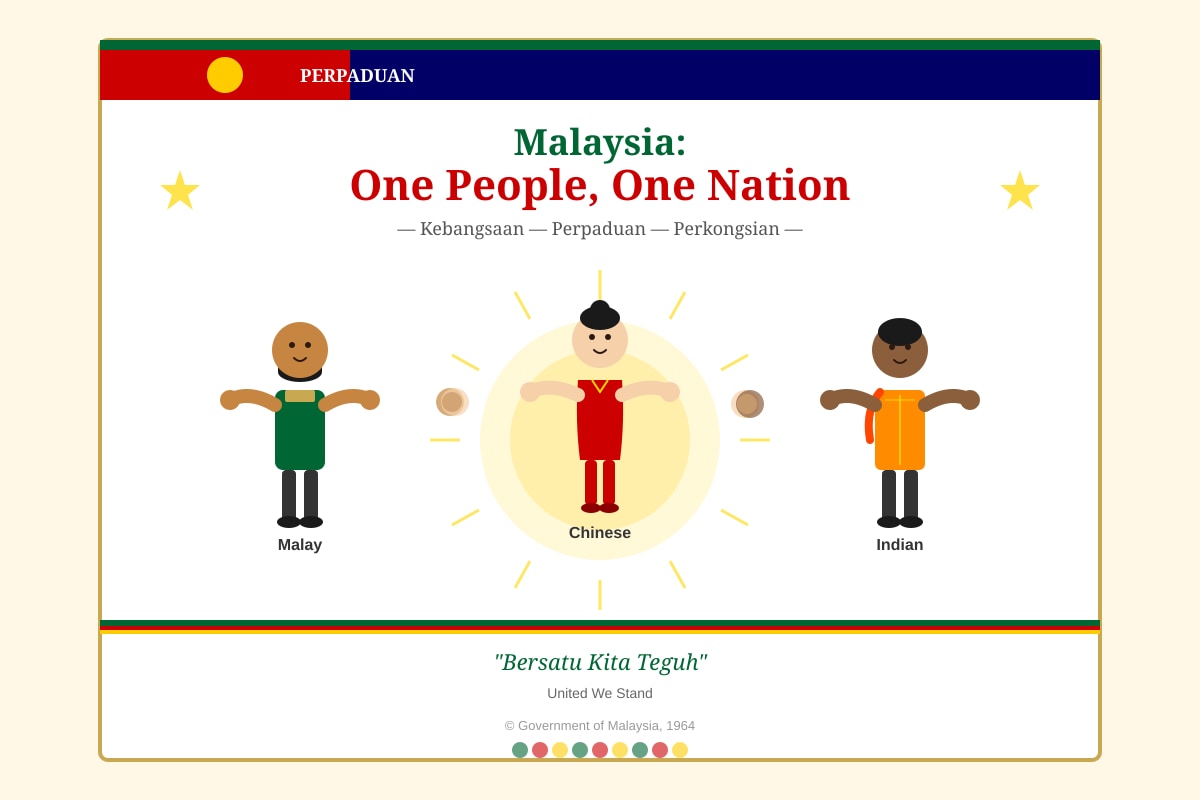
18. Study Sources Y and Z. Does Source Y prove that Malaysia was a harmonious multiracial society? [4]
Answer: No, Source Y does not prove that Malaysia was a harmonious multiracial society. Source Y is a government poster designed to promote national unity — its purpose was to present an idealised image of racial harmony, not to reflect reality. Government propaganda posters are created to influence public opinion and project a desired image, so they cannot be taken as evidence of actual conditions. Source Z directly contradicts the image presented in Source Y by describing the racial riots of July 1964, which "exposed deep racial tensions" and showed that the "ideal of a united Malaysia was shattered by the reality of racial hatred." Together, the sources show that while the Malaysian government wanted to project an image of harmony, the reality was far more complex and at times violent. [4]
Marking Notes:
- 1 mark for identifying Source Y as a government poster with a propaganda purpose.
- 1 mark for explaining that propaganda does not reflect reality.
- 1 mark for referencing Source Z as evidence contradicting Source Y.
- 1 mark for a clear judgement that Source Y does not prove harmony.
19. Study Sources AA and BB. Why do these two sources give very different accounts of the Japanese Occupation? [4]
Answer: Sources AA and BB give very different accounts of the Japanese Occupation because they were written by people with very different perspectives and purposes. Source AA is from a Singapore history textbook published in 1980, written from the perspective of the local population that suffered under Japanese rule. It describes "harsh rule," food scarcity, and severe punishment — reflecting the experiences of ordinary Singaporeans. Source BB is from a Japanese soldier's diary written in 1943 during the Occupation. The soldier describes bringing "order" and claims the population is "cooperating." He also refers to Japan's goal of building a "Greater East Asia Co-Prosperity Sphere" to "free Asian nations from Western colonialism." This reflects the Japanese military's propaganda and justification for their conquest. The soldier may also have been writing what he wanted to believe or what he was told, rather than the full reality. The difference in accounts is due to the authors' different positions — one a victim of occupation, the other a perpetrator/justifier. [4]
Marking Notes:
- 1 mark for identifying the different authors (textbook from local perspective vs. Japanese soldier).
- 1 mark for explaining the different purposes (recording suffering vs. justifying occupation).
- 1 mark for noting the different content (harsh rule vs. order and cooperation).
- 1 mark for a clear explanation of why the accounts differ.
20. Study Sources CC and DD. How do these two sources work together to give you a fuller picture of Singapore's progress after independence? [4]
Answer: Sources CC and DD work together to provide a fuller picture of Singapore's progress after independence by complementing each other. Source CC, a government minister's speech, provides the official, big-picture view of progress — mentioning HDB housing, economic growth, falling unemployment, and education reform. However, it is a political speech and may present an overly positive picture. Source DD, a factory worker's personal letter, provides the ground-level, human perspective. It confirms the government's claims with specific personal details — the worker has a factory job with better pay, can afford to send children to school, and has moved into an HDB flat. The worker also adds a note of realism by saying "life is still hard," which balances the minister's more optimistic tone. Together, the sources show both the government's achievements and the lived experience of ordinary people, giving a more complete and nuanced picture. [4]
Marking Notes:
- 1 mark for explaining what Source CC provides (official/big-picture view).
- 1 mark for explaining what Source DD provides (personal/ground-level view).
- 1 mark for noting how Source DD confirms and adds nuance to Source CC.
- 1 mark for a clear judgement on how the sources complement each other.