From Real Exams Quiz
Secondary 2 History Source Based Skills Quiz
Free Sec 2 History Source Based Skills quiz, Nemo3 Exam version, with questions, answers, and syllabus-aligned practice for Singapore students.
These static practice materials are generated from the site's syllabus and paper-generation workflow, with source and model context shown so students and parents can evaluate the material before use.
Questions
Free quiz and exam paper access
Enter your details to view this paper
Your access is remembered on this device.
Answers
Secondary 2 History Quiz - Source Based Skills (Answer Key)
Total Marks: 50
Section A: Source Analysis and Interpretation (20 marks)
1. Study Source A. What is the main message of David Marshall's speech? Support your answer with evidence from the source. [3]
Answer:
- Main message: David Marshall is advocating for self-government for Singapore, asserting that Singaporeans are capable of governing themselves while remaining within the British Empire. [1]
- Evidence 1: "We in Singapore want to be masters of our own destiny. We want to govern ourselves." [1]
- Evidence 2: "We are not asking for separation from the British Empire, but we are asking for the right to manage our own affairs." [1]
Marking Notes:
- 1 mark for identifying the main message (self-government/independence within Empire)
- 1 mark for each piece of supporting evidence (max 2)
- Do not accept vague answers like "he wants freedom" without textual support
2. Study Source B. Why would the British Colonial Office be concerned about granting full internal self-government to Singapore in 1956? Explain using the source. [3]
Answer:
- Reason 1: Fear of communist influence — the memorandum states "communist influence within the labour movement" and warns Singapore would risk "falling under communist control." [1]
- Reason 2: Threat to regional stability — "threatening regional stability." [1]
- Reason 3: Threat to British strategic interests — "and British strategic interests." [1]
Marking Notes:
- 1 mark for each distinct reason drawn from the source (max 3)
- Must reference the source explicitly; own knowledge not credited for this question
- Common mistake: listing general Cold War fears not mentioned in the source
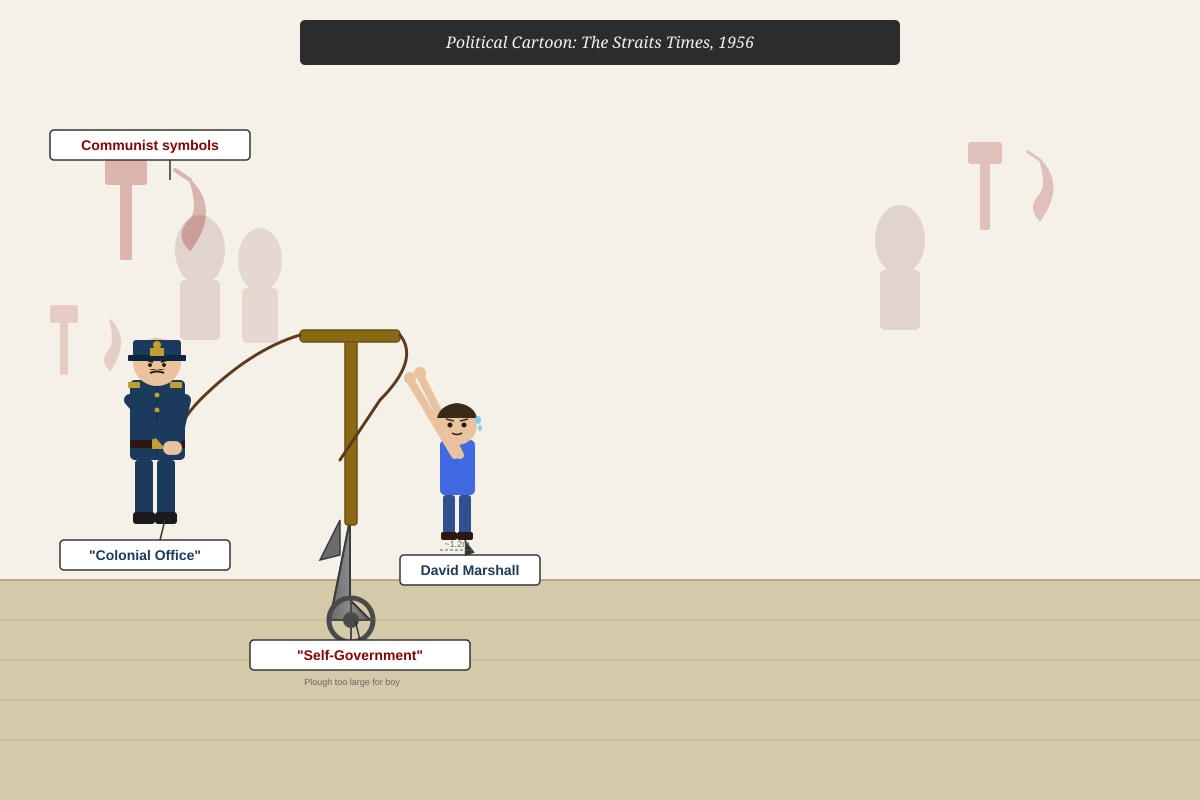
3. Study Source C. What is the cartoonist's view of David Marshall's push for self-government? Explain your answer using details from the cartoon. [4]
Answer:
- Cartoonist's view: The cartoonist portrays Marshall's push for self-government as naive, unrealistic, and potentially dangerous — suggesting he is too small/inexperienced for the task and that communist forces lurk in the background. [1]
- Detail 1 (size contrast): Marshall is drawn as a "small boy" trying to pull a "large plough" labelled "Self-Government," implying the task is beyond his capacity. [1]
- Detail 2 (British control): The British officer ("Colonial Office") holds the reins, showing real power still lies with the British, not Marshall. [1]
- Detail 3 (communist threat): Communist symbols (hammer and sickle) in the background shadows suggest a hidden communist threat behind the push for self-government. [1]
Marking Notes:
- 1 mark for identifying the overall view (critical/sceptical/negative)
- 1 mark each for three distinct visual details with explanation (max 3)
- Must link visual details to the cartoonist's message; mere description without interpretation gets partial credit
4. Study Sources A and B. How different are these two sources in their views on self-government for Singapore? Explain your answer. [5]
Answer:
- Difference in stance: Source A supports immediate self-government ("We want to govern ourselves"), while Source B opposes/urges caution against it ("Full internal self-government at this stage would risk Singapore falling under communist control"). [1]
- Difference in perspective/provenance: Source A is from David Marshall, the elected Chief Minister representing Singapore nationalist aspirations; Source B is from the British Colonial Office, representing British imperial/strategic interests. [1]
- Difference in reasoning: Source A argues Singaporeans are capable ("The people of Singapore have shown they are capable"); Source B argues self-government would enable communist takeover ("ignores the reality of communist influence"). [1]
- Similarity (for balance): Both acknowledge the desire for self-government — Source A explicitly, Source B implicitly by acknowledging Marshall's "rhetoric appeals to nationalist sentiment." [1]
- Conclusion: The sources are largely different in their assessment of whether Singapore is ready for self-government and what the consequences would be, reflecting their opposing political positions. [1]
Marking Notes:
- 1 mark for clear difference in stance
- 1 mark for provenance/perspective difference
- 1 mark for difference in reasoning/argument
- 1 mark for identifying a valid similarity (shows balanced comparison)
- 1 mark for overall judgement ("largely different")
- Common trap: listing content differences without explaining why they differ (provenance/purpose)
5. Study all three sources. How useful is Source C as evidence of British attitudes towards self-government in Singapore? Explain your answer. [5]
Answer:
- Useful — shows British scepticism: Source C reflects British/establishment scepticism — the British officer holding the reins shows the Colonial Office believed real power should remain with Britain, not Marshall is not ready. [1]
- Useful — shows communist fear: The communist symbols in the background reflect the British fear (also in Source B) that self-government would open the door to communist influence. [1]
- Useful — reflects media/establishment view: As a Straits Times cartoon (English-language, establishment paper), it represents mainstream British-aligned opinion in Singapore. [1]
- Limitation — not an official British view: It is a cartoonist's interpretation, not an official British government statement; it exaggerates for satirical effect (Marshall as a small boy). [1]
- Limitation — lacks nuance: Does not show the range of British views — some British officials supported gradual self-government (as seen in later 1957 talks). [1]
- Overall judgement: Moderately useful — it reveals British establishment fears and media portrayal but must be cross-referenced with official documents (like Source B) for a complete picture. [1]
Marking Notes:
- 1 mark for each valid point on usefulness (max 3)
- 1 mark for each valid limitation (max 2)
- 1 mark for overall balanced judgement
- Must address "British attitudes" specifically, not just the cartoon's message
- Common mistake: evaluating usefulness of Source C for studying Marshall rather than British attitudes
Section B: Source Reliability and Cross-Referencing (15 marks)
6. Study Source D. How reliable is Lee Kuan Yew's account of David Marshall and the 1955 election? Explain your answer. [5]
Answer:
- Provenance factors affecting reliability:
- Author: Lee Kuan Yew — political rival of Marshall (PAP vs Labour Front), later Prime Minister with vested interest in justifying his own rise. [1]
- Date: Published 1998 (memoir), 43 years after events — hindsight, memory distortion, possible retrospective justification. [1]
- Purpose: To explain PAP's rise and justify British caution; portrays Marshall as incompetent ("lacked political experience") to contrast with PAP's "sensible" approach. [1]
- Content corroboration:
- Supported by Source B (British also doubted Marshall's ability to handle communists) — increases reliability on this point. [1]
- Contradicted by Source A (Marshall's own confident assertion of capability) — shows contested view. [1]
- Overall judgement: Partially reliable — valuable as a PAP insider perspective and corroborated on communist threat, but biased against Marshall and written with hindsight; must be cross-referenced. [1]
Marking Notes:
- 1 mark each for provenance analysis (author, date, purpose) — max 3
- 1 mark for cross-referencing with other sources (support/contradict)
- 1 mark for balanced overall judgement
- Do not accept "biased therefore unreliable" — bias affects reliability but doesn't destroy all value
7. Study Sources E and F. How similar are these two sources in their explanation of the Chinese Middle School riots? Explain your answer. [5]
Answer:
- Difference in cause: Source E attributes riots to communist orchestration ("orchestrated by communist elements using students as pawns"); Source F attributes them to genuine student grievances ("fighting for our rights — Chinese education, fair treatment"). [1]
- Difference in nature of students: Source E claims students were controlled by MCP ("SCMSSU is under the control of the Malayan Communist Party"); Source F denies this ("We were not communists... labelled us communists to justify crackdown"). [1]
- Difference in legitimacy: Source E portrays demands as a cover for subversion ("demands for 'democratic rights' are a cover"); Source F portrays demands as legitimate ("just wanted dignity"). [1]
- Similarity (for balance): Both agree riots occurred and involved Chinese middle school students making demands. [1]
- Conclusion: The sources are fundamentally different in their explanation — they offer directly opposing interpretations of the same events, reflecting the provenance gap (Special Branch vs. student participant). [1]
Marking Notes:
- 1 mark for each clear difference (max 3)
- 1 mark for valid similarity
- 1 mark for overall judgement with provenance explanation
- Must explain why they differ (provenance/purpose), not just list content differences
8. A historian is investigating the causes of the 1956 Chinese Middle School riots. Which source — E or F — is more useful as evidence? Explain your answer. [5]
Answer:
- Source E (Special Branch report) is useful for:
- Official British/Malayan security perspective — shows how authorities interpreted and justified their response. [1]
- Reveals state mindset — "labelled us communists to justify crackdown" (corroborated by Source F's claim). [1]
- Contemporaneous — 1956 report, not retrospective. [1]
- Source F (student leader account) is useful for:
- Participant perspective — gives voice to students' own motivations (Chinese education, dignity). [1]
- Challenges official narrative — directly contradicts "communist pawn" claim. [1]
- But limitation: Recorded 1985 (29 years later) — memory, hindsight, possible romanticisation. [1]
- Judgement: Both are useful but for different purposes — Source E for state perception and policy rationale; Source F for lived experience and counter-narrative. A historian needs both to understand the contested nature of the riots. Neither is "more useful" alone; they complement each other. [1]
Marking Notes:
- 1 mark for usefulness of Source E (max 2)
- 1 mark for usefulness of Source F (max 2)
- 1 mark for balanced judgement explaining they serve different historical purposes
- Do not accept "Source E is more useful because it's official" or "Source F is more useful because it's first-hand" without nuance
Section C: Source-Based Structured Questions (15 marks)
9. Study Source G. Identify two changes in Singapore's constitutional status between 1955 and 1959. [2]
Answer (any two):
- 1955 → 1957/1958: Shift from limited self-government (British control defence, foreign affairs, internal security) to full internal self-government (British retain only defence and foreign affairs). [1]
- 1955 → 1959: Elected government gains full legislative/executive power over internal affairs — 1959 election produces Prime Minister with full cabinet authority. [1]
- 1956 → 1957: Internal Security Council created (1957) — shared British/Malayan/Singapore responsibility, replacing sole British control. [1]
- 1958 → 1959: Yang di-Pertuan Negara replaces Governor as head of state; Singapore gains its own head of state. [1]
Marking Notes:
- 1 mark per valid change (max 2)
- Must be drawn from Source G; own knowledge not required but accepted if accurate
10. Study Source G. Why did the First Merdeka Talks in 1956 break down? Use the source to support your answer. [3]
Answer:
- Direct from source: The talks broke down "over internal security" — Marshall demanded full internal self-government, but the British refused to cede control of internal security. [1]
- Context from table: Under Rendel Constitution (1955), British retained control of internal security; Marshall's demand for full internal self-government included this portfolio. [1]
- Inference: The British feared communist influence (see Source B) and would not transfer internal security to a government they distrusted. [1]
Marking Notes:
- 1 mark for "internal security" as the breaking point (from source)
- 1 mark for explaining what internal security control meant (from table)
- 1 mark for inference linking to British fears (corroboration with Source B/context)
11. Study Source H. What does the British White Paper suggest about British priorities in Singapore in 1957? Explain your answer. [4]
Answer:
- Priority 1: Safeguarding British strategic interests — "preserving British strategic interests through the Internal Security Council" and "protecting the wider interests of the Commonwealth." [1]
- Priority 2: Maintaining defence and foreign policy control — "safeguarding British defence and foreign policy interests" explicitly retained. [1]
- Priority 3: Managing decolonisation orderly/peacefully — "model for peaceful decolonisation"; granting self-government to prevent instability/communist takeover (implied). [1]
- Priority 4: Balancing local aspirations with imperial needs — "meets the aspirations of the people of Singapore while protecting..." — shows calibrated concession. [1]
Marking Notes:
- 1 mark per distinct priority identified with source evidence (max 4)
- Must use "suggests" language — this is inference from the source's language
- Common mistake: listing only what the constitution did, not what it reveals about British priorities
12. Using Sources G and H and your own knowledge, explain why the British were willing to grant full internal self-government by 1958 but not in 1956. [6]
Answer: From Source G (timeline):
- 1956: First Merdeka Talks fail "over internal security" — British refuse to cede control. [1]
- 1957: Second Merdeka Talks succeed — agreement on Internal Security Council (shared control). [1]
- 1958: State of Singapore Constitution grants full internal self-government. [1]
From Source H (British rationale):
- British created Internal Security Council to "preserve internal security" while granting self-government — a compromise mechanism. [1]
- British frame it as "balanced arrangement" meeting aspirations while protecting interests. [1]
Own knowledge:
- 1956 context: Marshall's confrontational style, communist threat perceived as high (riots, labour unrest), British distrust Marshall. [1]
- 1957–58 context: Marshall resigned 1956; Lim Yew Hock's tough anti-communist actions (raids, arrests, banning organisations) reassured British; PAP not yet in power; Internal Security Council gave British veto power via British commissioner. [1]
Synthesis: British granted self-government in 1958 because Lim Yew Hock proved he could suppress communists and the Internal Security Council guaranteed British oversight — conditions absent in 1956. [1]
Marking Notes (6 marks total):
- 1 mark each for 3 points from Source G
- 1 mark each for 2 points from Source H
- 1 mark for own knowledge point
- 1 mark for synthesis/conclusion (the "why" explanation)
- Note: 7 points listed above; award max 6 — typically 3 from sources, 1 from own knowledge, 1 synthesis, 1 for structure/coherence
Section D: Historical Concepts and Skills (10 marks)
13. Define the historical concept of 'provenance' in the context of source analysis. Give an example. [2]
Answer:
- Definition: Provenance refers to the origin, authorship, date, and context of a source — who created it, when, where, why, and for whom. [1]
- Example: Source A's provenance: David Marshall (author), 1955 (date), speech (type), Chief Minister of Singapore (role), audience: Singapore public/British (purpose: rally support for self-government). [1]
Marking Notes:
- 1 mark for accurate definition (origin/authorship/context)
- 1 mark for concrete example applied to a source in the quiz
14. Explain the difference between a primary source and a secondary source. Give one example of each from the study of Singapore's road to independence. [3]
Answer:
- Primary source: Created at the time of the event by a participant or eyewitness — direct evidence. [1]
- Example: Source A (Marshall's 1955 speech), Source B (1956 Colonial Office memo), Source E (1956 Special Branch report), Source I (1957 photograph). [1]
- Secondary source: Created after the event by someone not present, based on primary sources — interpretation/analysis. [1]
- Example: Source D (Lee Kuan Yew's 1998 memoir), a history textbook, a scholar's book on Merdeka talks. [1]
Marking Notes:
- 1 mark for clear distinction (time of creation + relationship to event)
- 1 mark for valid primary example from quiz/context
- 1 mark for valid secondary example from quiz/context
15. What does it mean to cross-reference sources? Why is this skill important for historians? [3]
Answer:
- Definition: Cross-referencing means comparing two or more sources to check for agreement or disagreement on facts, perspectives, or interpretations — using one source to test the claims of another. [1]
- Importance 1: Verifies reliability — if independent sources agree, confidence increases; if they contradict, further investigation needed. [1]
- Importance 2: Reveals bias/perspective — differences often stem from provenance (e.g., Source E vs F on riots), helping historians understand why accounts differ. [1]
Marking Notes:
- 1 mark for definition (comparison for verification)
- 1 mark for verification/reliability point
- 1 mark for perspective/bias point
- Can also accept: "builds a more complete picture" or "corroboration and contradiction"
16. A student writes: "Source A is biased, so it is not useful." Explain why this statement is incomplete as a historical judgement. [2]
Answer:
- Bias ≠ useless: A biased source reveals the perspective, motives, and arguments of its creator — which is itself valuable historical evidence (e.g., Source A shows Marshall's nationalist rhetoric and political strategy). [1]
- Usefulness depends on the question: For studying British policy, Source A is less useful; for studying Marshall's goals and public messaging, it is highly useful. [1]
Marking Notes:
- 1 mark for "bias does not equal useless / biased sources have value"
- 1 mark for "usefulness depends on the historical question being asked"
- Key concept: All sources have a perspective; historians use bias as evidence
Section E: Mini Source-Based Case Study (10 marks)
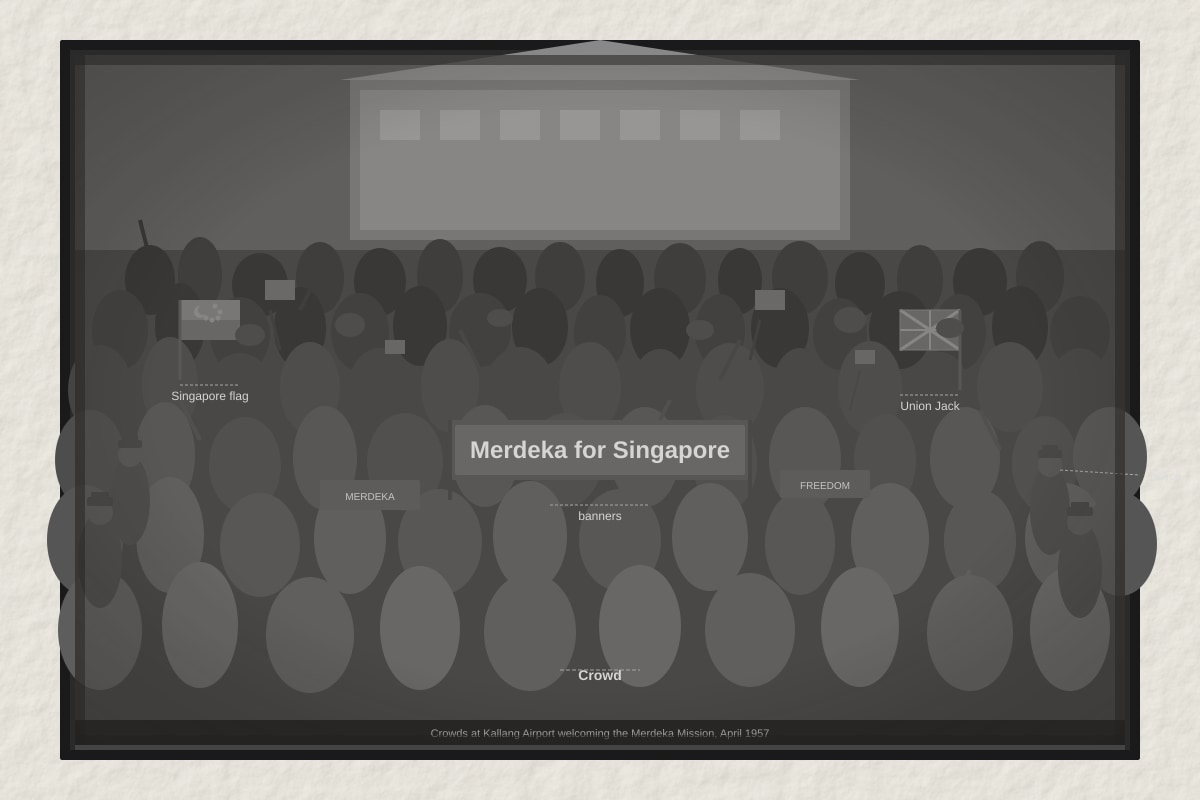
17. Study Source I. What does the photograph suggest about public support for the Merdeka Mission's achievement? Support your answer with evidence from the photograph. [3]
Answer:
- Suggestion: There was broad, enthusiastic, multi-ethnic public support for the Merdeka Mission's achievement. [1]
- Evidence 1: "Large crowds" gathered at the airport — shows widespread interest and turnout. [1]
- Evidence 2: Banner "Merdeka for Singapore" — explicit endorsement of the independence/self-government goal. [1]
- Evidence 3 (bonus): Multi-ethnic crowd and police not intervening — suggests peaceful, cross-community celebration, not just one group. [1]
Marking Notes:
- 1 mark for inference about public support
- 1 mark each for two distinct visual evidences (max 2)
- Must link evidence to inference
18. Study Source J. Why would a British newspaper describe the 1957 agreement as a 'triumph of sensible negotiation'? Explain your answer. [3]
Answer:
- Reason 1: The agreement protected British interests (defence, foreign affairs, Internal Security Council) — a "win" for Britain. [1]
- Reason 2: It was achieved peacefully through negotiation, not violence or insurgency — "model for peaceful decolonisation" enhances British reputation. [1]
- Reason 3: It averted a communist takeover (British fear) by installing a moderate, pro-British framework before PAP's rise — pragmatic success. [1]
Marking Notes:
- 1 mark per reason (max 3)
- Must link to British perspective/self-interest
- Can reference Source H ("safeguarding British defence and foreign policy interests")
19. How far do Sources I and J agree that the 1957 constitutional agreement was a success? Explain your answer. [4]
Answer:
- Agreement (Success):
- Both portray the outcome positively — Source I: celebratory crowds, "Merdeka" banner; Source J: "triumph," "sensible negotiation," "model." [1]
- Both imply legitimacy — Source I: public endorsement; Source J: "peaceful decolonisation" legitimacy. [1]
- Difference (Nature of success):
- Source I shows popular/grassroots success — people's joy, multi-ethnic unity, Singapore-centric ("Merdeka for Singapore"). [1]
- Source J frames it as British diplomatic success — "preserving British strategic interests," "Commonwealth interests," British-centric. [1]
- Conclusion: They agree it was a success but define success differently — Source I: Singapore's achievement; Source J: Britain's managed retreat. [1]
Marking Notes:
- 1 mark for agreement point with evidence
- 1 mark for second agreement/nuance point
- 1 mark for difference in perspective with evidence
- 1 mark for synthesised conclusion ("agree but for different reasons")
20. Using all the sources in this quiz (A–J) and your knowledge, explain how historians can use different types of sources to build a balanced understanding of Singapore's road to self-government. [5]
Answer:
- Official/government sources (B, E, H): Reveal state priorities, fears, and policy rationale — British strategic concerns, security assessments, constitutional design. Limitation: self-justifying, top-down. [1]
- Political leader sources (A, D): Show competing nationalist visions — Marshall's inclusive nationalism vs Lee's pragmatic anti-communism. Limitation: partisan, retrospective (D). [1]
- Participantagonist/participant sources (F): Provide ground-level perspectives — student motivations, lived experience, counter-narratives to official labels. Limitation: memory, hindsight, selective. [1]
- Media/visual sources (C, I, J): Capture public sentiment, media framing, symbolic moments — cartoonist's satire, crowd enthusiasm, British press spin. Limitation: editorial bias, staged/selective moments. [1]
- Statistical/tabular sources (G): Give factual timeline and structural changes — objective framework for constitutional progress. Limitation: no motives or experiences. [1]
- Synthesis: By cross-referencing these diverse types (official vs. participant, contemporary vs. retrospective, text vs. visual), historians triangulate — identifying where sources converge (e.g., communist threat feared by British, Marshall, Lee) and where they diverge (e.g., causes of riots) — to construct a multi-perspective, evidence-based narrative rather than a single story. [1]
Marking Notes:
- 1 mark per source type category with example from quiz (max 4 categories)
- 1 mark for synthesis: cross-referencing/triangulation leading to balanced understanding
- Must reference specific sources (A–J) by letter or description
- Own knowledge not required but can enhance answer
- Common mistake: listing sources without explaining how they contribute to balance
End of Answer Key