From Real Exams Quiz
Secondary 2 History Source Based Skills Quiz
Free Sec 2 History Source Based Skills quiz, HY3 Exam version, with questions, answers, and syllabus-aligned practice for Singapore students.
These static practice materials are generated from the site's syllabus and paper-generation workflow, with source and model context shown so students and parents can evaluate the material before use.
Questions
Free quiz and exam paper access
Enter your details to view this paper
Your access is remembered on this device.
Answers
Secondary 2 History Quiz - Source Based Skills (Answer Key)
Total Marks: 50
Duration: 60 minutes
Section A: Source Inference (Q1–5)
Q1 [4 marks]
- Answer: The British viewed Singapore as a valuable, successful part of their empire where different races lived together for trade.
- Teaching note: Source A is a British postcard (provenance: British, 1920, promotional). The caption "Pearl of the British Empire" shows pride and ownership. "Where the world's races meet in trade" implies they saw Singapore as a multicultural trading success.
- Mark breakdown: 2 marks for identifying view (pride, multicultural trade hub), 2 marks for using caption + visual details as evidence.
- Common mistake: Saying "Singapore was busy" without linking to British perspective.
Q2 [4 marks]
- Answer: Daily life was harsh; people faced food shortages and were controlled by Japanese soldiers.
- Teaching note: Photograph (1943) shows queue for rice ration (evidence of shortage) and soldiers supervising (evidence of control). Inference: occupation brought scarcity and military oversight.
- Mark breakdown: 2 marks for food shortage inference, 2 marks for control/security inference with visual evidence.
Q3 [4 marks]
- Answer: The PAP believed merger was necessary for economic survival and that Singapore alone was too small.
- Teaching note: Speech extract (1961, PAP leader). Phrase "must merge… to survive economically" and "too small to prosper" show pragmatic, urgent attitude.
- Mark breakdown: 2 marks for economic necessity, 2 marks for citing exact phrases.
Q4 [4 marks]
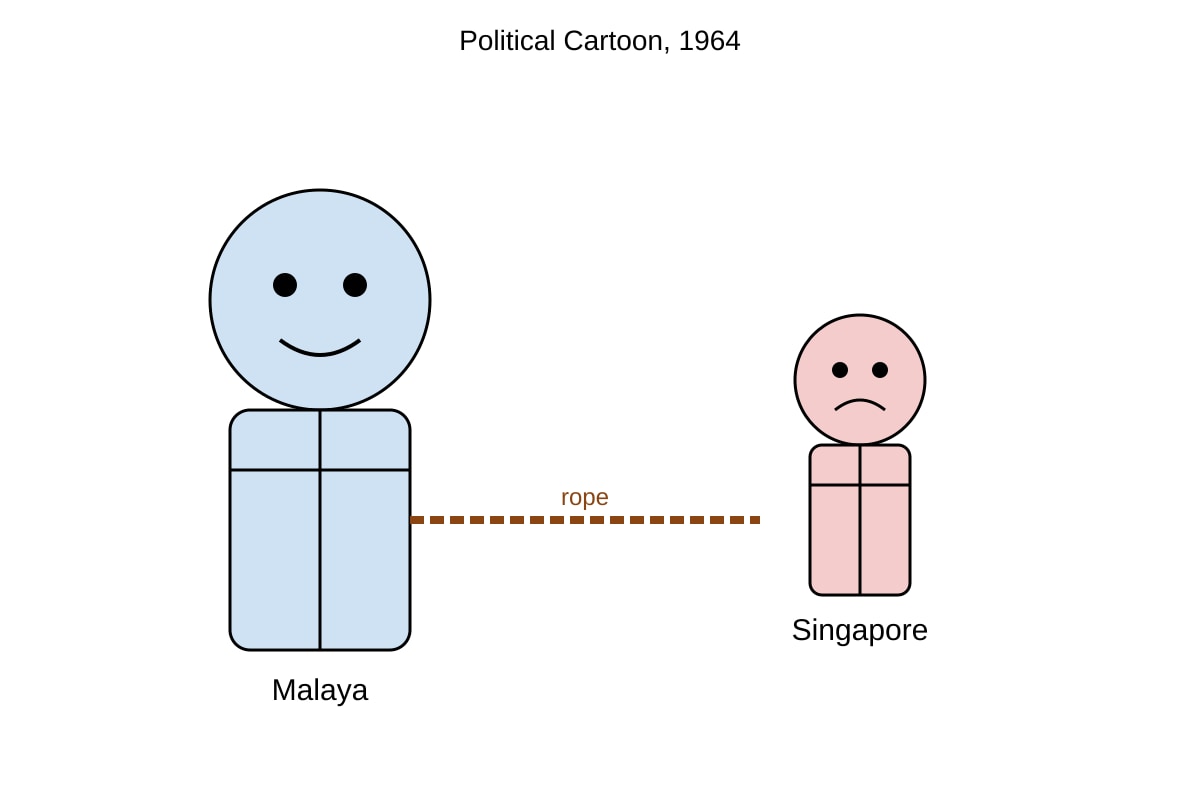
- Answer: The relationship was unequal; Malaya dominated Singapore which was unwilling.
- Teaching note: Cartoon (1964) shows size difference (Malaya large, Singapore small), rope (control/pull), unhappy face (reluctance). As a political cartoon, it uses exaggeration to show power imbalance.
- Mark breakdown: 2 marks for inequality/power imbalance, 2 marks for interpreting visual elements (size, rope, expression).
Q5 [4 marks]
- Answer: Post-war Singapore faced communist unrest and threats to law and order.
- Teaching note: 1950 report mentions "Communist agitators", "throwing stones", "growing unrest" → internal security challenge.
- Mark breakdown: 2 marks for communist threat, 2 marks for evidence from report.
Section B: Source Comparison (Q6–10)
Q6 [5 marks]
- Answer: Both sources agree British prestige fell and self-rule sentiment rose after the war.
- Teaching note: Source F (British report 1946) admits "weakened British prestige", Source G (Singaporean letter 1947) says "we can govern ourselves". Similar in conclusion though different authors.
- Mark breakdown: 1 mark similarity of view, 2 marks from F evidence, 2 marks from G evidence. (Or 3+2 for explanation of why similar)
- Common mistake: Only listing content, not stating similarity explicitly.
Q7 [5 marks]
- Answer: Very different: Source H shows positive propaganda of Asian unity; Source I shows fear and massacre.
- Teaching note: H is Japanese propaganda (biased, 1942) promoting unity; I is survivor account (1946) of Sook Ching massacre. Difference due to purpose and experience.
- Mark breakdown: 1 mark stated difference, 2 marks H analysis (type+bias), 2 marks I analysis (massacre evidence).
Q8 [5 marks]
- Answer: Similar: both show merger had public support (71% vote, PAP calls it people's choice).
- Teaching note: J is official ballot data (71%), K is PAP pamphlet claiming "people's choice". Both align on popularity though K is partisan.
- Mark breakdown: 1 mark similarity, 2 marks J (data), 2 marks K (pamphlet claim).
Q9 [5 marks]
- Answer: Different: Malaya blames Singapore's leaders; Singapore says they were forced out.
- Teaching note: L (Malaysian gov 1965) says Singapore stubborn; M (SG gov 1965) says forced out. Different provenance → different blame assignment.
- Mark breakdown: 1 mark difference, 2 marks L, 2 marks M.
Q10 [5 marks]
- Answer: Similar: both show housing was a key government priority after self-government.
- Teaching note: N (1959 photo of HDB construction) and O (1960 newsletter "first priority") both reflect state housing focus.
- Mark breakdown: 1 mark similarity, 2 marks N, 2 marks O.
Section C: Source Analysis and Explanation (Q11–20)
Q11 [4 marks]
- Answer: The Great Depression caused rubber price crash, unemployment, and hardship in Singapore.
- Teaching note: Source P (1930 headline) links "rubber prices crash" to "Great Depression" and "thousands unemployed". Shows economic vulnerability as port city.
- Mark breakdown: 2 marks for depression link, 2 marks for unemployment evidence.
Q12 [4 marks]
- Answer: Free port policy aimed to attract regional trade and make Singapore prosper.
- Teaching note: Raffles 1820 letter: "free port attracts traders… flourish". Purpose = economic growth via open trade.
- Mark breakdown: 2 marks purpose (attract trade), 2 marks for quote evidence.
Q13 [5 marks]
- Answer: Japanese used education to replace English with Japanese/Malay and promote loyalty to Japan.
- Teaching note: Source R (1942) closes English schools; S (1943) poster pushes Japanese learning. Method: cultural control + indoctrination.
- Mark breakdown: 2 marks for closing English/system change, 3 marks for linking to control/loyalty with both sources.
Q14 [5 marks]
- Answer: Nation-building required multi-racial harmony to avoid division and ensure survival.
- Teaching note: Lee 1963 speech: "multi-racial nation", "no discrimination", "only way to survive". Infers challenge = racial tension management.
- Mark breakdown: 2 marks for multi-racial point, 3 marks for explanation with quote.
Q15 [5 marks]
- Answer: Withdrawal left Singapore defenceless and forced urgent build-up of own military.
- Teaching note: U (1965 British) announces pull-out; V (1966 SG) states vulnerability. Challenge = security gap.
- Mark breakdown: 2 marks for vulnerability, 3 marks using both sources.
Q16 [4 marks]
- Answer: There was clear wealth inequality between business owners and workers.
- Teaching note: Cartoon (1947) contrasts "fat businessman" vs "thin worker" with "Who gets wealth?" → criticism of gap.
- Mark breakdown: 2 marks inequality, 2 marks visual evidence.
Q17 [4 marks]
- Answer: Self-government was gradual; British retained key powers like defence.
- Teaching note: 1955 document: "limited self-government", "British keep defence" → slow transfer.
- Mark breakdown: 2 marks gradual, 2 marks for defence retention evidence.
Q18 [5 marks]
- Answer: Both show post-war Singapore was physically ruined and economically stalled.
- Teaching note: Y (photo destroyed building), Z (report infrastructure ruined, trade standstill). Similar devastation.
- Mark breakdown: 1 mark similarity, 2 marks Y, 2 marks Z.
Q19 [5 marks]
- Answer: Political tension was high; Malaya imposed conditions threatening Singapore's exit.
- Teaching note: 1964 Malaysian paper: "accept Malay agenda or leave" → ultimatum, cause of separation pressure.
- Mark breakdown: 2 marks for tension/ultimatum, 3 marks explanation with source phrase.
Q20 [6 marks]
- Answer: Source BB (1961) welcomes Singapore; Source CC (1965) expels Singapore. Completely opposite views.
- Teaching note: BB by Tunku 1961 (pro-merger speech), CC by Tunku 1965 (expulsion). Provenance same author but different time/context changes stance. Content: "welcome" vs "expelled".
- Mark breakdown: 1 mark stated difference, 2 marks BB (welcome + context), 2 marks CC (expel + context), 1 mark provenance/time note.
- Common mistake: Not noting same author changed position over time.