From Real Exams Quiz
Secondary 2 History Singapore Southeast Asia Quiz
Free Sec 2 History Singapore SEA quiz, HY3 Exam version, with questions, answers, and syllabus-aligned practice for Singapore students.
These static practice materials are generated from the site's syllabus and paper-generation workflow, with source and model context shown so students and parents can evaluate the material before use.
Questions
Free quiz and exam paper access
Enter your details to view this paper
Your access is remembered on this device.
Answers
Secondary 2 History Quiz - Singapore Southeast Asia: Answer Key
Total Marks: 40
Level: Secondary 2
Topic: Singapore Southeast Asia
Section A: Source-Based Questions
Q1 [2 marks]
- Answer: The photograph shows a long queue for rice, inferring food shortages and difficult living conditions after the war.
- Teaching note: A post-war photograph is a visual source. The detail "long queue outside rice distribution centre" implies rationing and scarcity. Students should link the detail to inference: shortage of food = hard life.
- Marking: 1 mark for identifying queue/scarcity detail, 1 mark for inference about poor living conditions.
Q2 [2 marks]
- Answer: The British wanted slow, controlled self-government to keep order; they did not plan immediate independence.
- Teaching note: Speech is a written source showing author's attitude. "Slowly towards" and "order is maintained" show caution. Infer: British seen as reluctant to give up control quickly.
- Marking: 1 mark for detail from speech, 1 mark for inferred attitude.
Q3 [2 marks]
- Answer: They are different. Source C shows fear of Chinese dominance (negative view from Malay leaders), Source D shows merger as necessary for freedom (positive from PAP).
- Teaching note: Compare provenance: C = newspaper (Malaya fear), D = PAP letter (Singapore support). Difference due to different political positions.
- Marking: 1 mark for stating difference, 1 mark for explaining with source reference.
Q4 [2 marks]
- Answer: Cartoon shows separation as a broken link; British figure waving implies Britain is unaffected or distant from the break.
- Teaching note: Cartoon is symbolic. Broken chain = end of merger. Use visual detail to infer message of separation being final and Britain uninvolved.
- Marking: 1 mark for detail (broken chain), 1 mark for message explained.
Q5 [2 marks]
- Answer: Poster aimed to encourage enlistment and patriotism in National Service.
- Teaching note: Poster is propaganda. "Every Son Protects" shows purpose = mobilise youth. Infer: nation-building through defence.
- Marking: 1 mark for poster detail, 1 mark for purpose inferred.
Section B: Structured Response
Q6 [2 marks]
- Answer: Propaganda controlled people by shaping their beliefs to accept Japanese rule and reduce resistance.
- Teaching note: Control method = propaganda. Explain mechanism: radio, newspapers told people Japan was liberator. This kept order without force.
- Marking: 1 mark reason, 1 mark explanation of control.
Q7 [2 marks]
- Answer: Free port meant no taxes on goods, so ships came to trade, increasing port activity and wealth.
- Teaching note: British policy. Free port attracted merchants (pull). More trade = growth.
- Marking: 1 mark for policy, 1 mark for effect.
Q8 [2 marks]
- Answer: Example: food shortages / inflation / forced labour. One hardship described.
- Teaching note: Use specific (e.g., hyperinflation meant money worthless). Shows daily experience.
- Marking: 1 mark identify, 1 mark describe.
Q9 [4 marks]
- Answer: Reason 1: Political disagreements – PAP and UMNO clashed over racial policies and power sharing; this caused distrust leading to separation. Reason 2: Economic tensions – Singapore wanted common market, Malaya feared competition; failure to agree made merger unworkable.
- Teaching note: Two-cause structure. Each reason must link to 1965 outcome. L3 answer uses specific evidence.
- Marking: 2 marks per reason (1 identify, 1 explain link).
Q10 [2 marks]
- Answer: Suez Canal shortened route to Europe, so more ships stopped at Singapore, boosting trade.
- Teaching note: Global link. Faster route = more commerce through port.
- Marking: 1 mark canal effect, 1 mark Singapore trade boost.
Q11 [2 marks]
- Answer: Similar in that both see unions as powerful groups affecting politics; G as workers' voice, H as communist tool.
- Teaching note: Both acknowledge union influence. Similarity in recognising significance, difference in judgement.
- Marking: 1 mark similarity stated, 1 mark explained via sources.
Q12 [2 marks]
- Answer: Withdrawal removed British defence and jobs, leaving Singapore needing own army and new economy.
- Teaching note: Challenge = security + employment. Explain linkage.
- Marking: 1 mark point, 1 mark effect.
Q13 [2 marks]
- Answer: HDB flats gave homes to crowded squatters, improving living standards and stability.
- Teaching note: Social challenge = housing. State action solved it.
- Marking: 1 mark action, 1 mark result.
Section C: Mixed Recall and Interpretation
Q14 [1 mark] 1819.
Q15 [1 mark] Example: poverty / war in China.
Q16 [1 mark] Melaka.
Q17 [1 mark] 1942.
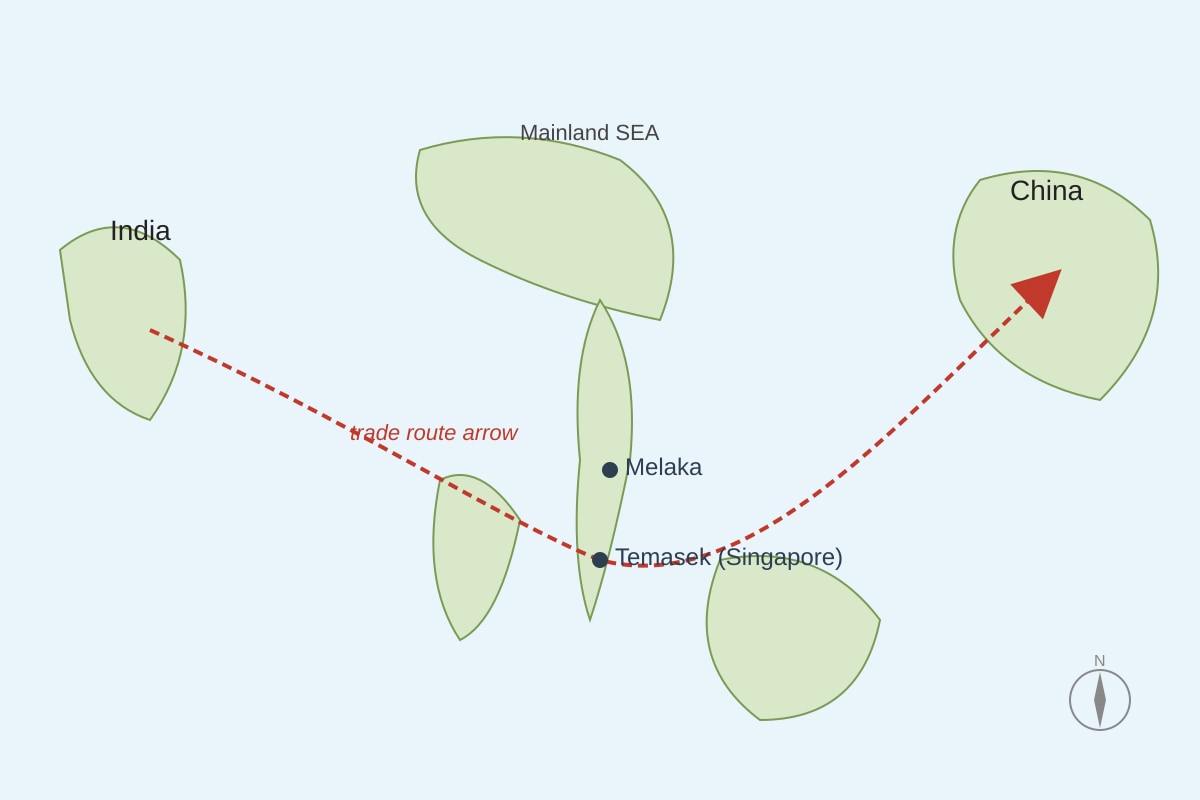
Q18 [2 marks] Map shows Temasek on India–China route; so traders stopped there. Answer uses position from placeholder. Marking: 1 mark location, 1 mark trade use.
Q19 [1 mark] Example: built railways / police / cattle trade.
Q20 [2 marks] Occupation showed British could not protect Singapore, so people wanted self-rule. Marking: 1 mark change, 1 mark explain.