Secondary 2 History Quiz - Conflict International Relations
Name: ___________________________
Class: ___________
Date: ___________
Score: ___________ / 40
Duration: 60 minutes
Total Marks: 40
Topic: Conflict & International Relations
Instructions:
- Answer all 20 questions.
- Section A: Source-Based Questions (Q1–Q8)
- Section B: Structured Response (Q9–Q14)
- Section C: Short Answer & Recall (Q15–Q20)
- Use the sources provided. Write your answers in the spaces given.
Section A: Source-Based Questions (16 marks)
Study Source A
A cartoon published in a Singapore newspaper in 1963, showing a large elephant labelled "Malaya" with a small mouse labelled "Singapore" tied to its tail by a rope labelled "Merger". The elephant is walking towards a signpost reading "Greater Malaysia".
Study Source B
A speech by a Malaysian politician in 1964: "The merger was meant to unite the peoples of Malaya and Singapore for mutual benefit, but we must ensure the dominant voice remains with the majority."
1. Study Source A. What can you infer about the relationship between Malaya and Singapore during the merger? Explain your answer using details from the cartoon. [2]
2. Study Source B. What does the politician mean by "the dominant voice remains with the majority"? Explain your answer. [2]
3. Study Sources A and B. How similar are the two sources about the merger? Explain your answer. [3]
Study Source C
A photograph taken in 1942 showing Japanese soldiers patrolling a street in Singapore with local people bowing as they pass.
Study Source D
A diary entry of a Singapore resident in 1942: "The Japanese soldiers control everything. We must bow or be beaten. They have taken over our schools and changed our books."
4. Study Source C. What can you infer about Japanese control methods from the photograph? Explain. [2]
5. Study Source D. What does the diary tell you about daily life under the Japanese? [2]
6. Study Sources C and D. How different are these sources about Japanese control? Explain your answer. [3]
Study Source E
A map showing British military bases in Singapore before 1942 and Japanese advance routes from the north.
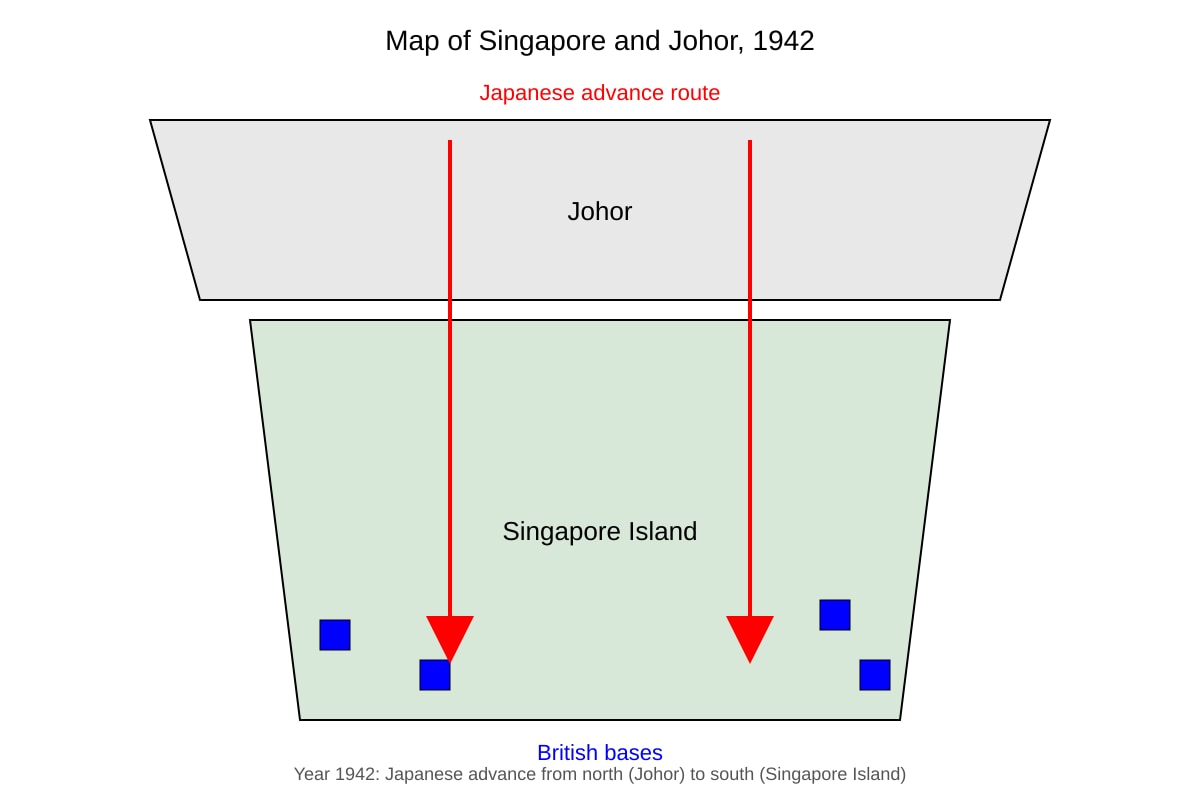
Generated map for Q7.
7. Study Source E. Using the map, explain one reason why Singapore fell to the Japanese in 1942. [1]
8. Study Sources C, D and E. How reliable is Source D as evidence of Japanese control? Explain. [1]
Section B: Structured Response (18 marks)
9. Explain two reasons which caused the separation of Singapore from Malaysia in 1965. [10]
10. Explain how the Japanese controlled the people of Singapore during the Japanese Occupation. [7]
11. "The Cold War increased conflict in Southeast Asia." Explain one way this happened. [1]
12. Explain how the Anglo-Dutch rivalry in the 1800s affected Singapore's founding. [1]
13. Give one example of an international conflict that involved Singapore before independence. [1]
14. Explain why the fall of Singapore in 1942 was significant for its people. [1]
Section C: Short Answer & Recall (6 marks)
15. What year did the Japanese Occupation of Singapore begin? [1]
16. Name one method used by the Japanese to control the economy. [1]
17. What was the name of the union between Malaya and Singapore in 1963? [1]
18. Who founded British Singapore in 1819? [1]
19. What global conflict was happening when Singapore fell in 1942? [1]
20. Give one reason why the British built a naval base in Singapore before the war. [1]
</stage3_quiz_answers_md>
<stage3_quiz_answers_md>
Secondary 2 History Quiz - Answer Key
Topic: Conflict & International Relations
Total Marks: 40
Section A: Source-Based Questions
Q1. [2 marks]
- Inference: Singapore was in a weak or subordinate position compared to Malaya during the merger. (1 mark)
- Explanation using detail: The cartoon shows a small mouse "Singapore" tied to the tail of a large elephant "Malaya" by a rope "Merger", suggesting Singapore had little power and was pulled along by Malaya. (1 mark)
Teaching note: A cartoon uses symbols. Size shows power. The rope shows forced link.
Q2. [2 marks]
- Meaning: The Malay majority in Malaya should have more say than the Chinese-majority Singapore. (1 mark)
- Explanation: "Majority" refers to population; the politician wants Malaya's views to lead. (1 mark)
Common mistake: Thinking "majority" means Singapore; it means Malaya's larger population.
Q3. [3 marks]
- Both sources show merger as unequal: Source A visually, Source B in words. (1 mark)
- Source A is a cartoon (biased, simplified); Source B is a speech (political view). (1 mark)
- Difference: A shows Singapore powerless; B says "mutual benefit" but warns of dominance. (1 mark)
Marking: 1 pt similarity, 1 pt source type, 1 pt difference explained.
Q4. [2 marks]
- Inference: Japanese used fear and public display of power. (1 mark)
- From photo: Soldiers patrol, locals bow, shows military control on streets. (1 mark)
Q5. [2 marks]
- Diary shows daily life was fearful; people forced to bow, schools changed. (1 mark)
- Hardship: punishment by beating, loss of education freedom. (1 mark)
Q6. [3 marks]
- Source C (photo) shows public control visually; Source D (diary) gives personal experience. (1 mark)
- Both show control but C is outside view, D is inside view. (1 mark)
- Different because photo cannot show feelings, diary can. (1 mark)
Q7. [1 mark]
- Answer: Japanese attacked from the north (via Johor) while British bases were in south/east, so they were surprised.
Based on map labels and arrows.
Q8. [1 mark]
- Reliable because it is a firsthand account, but biased as one person's view. (accept either with reason)
Section B: Structured Response
Q9. [10 marks]
Mark descriptors: L1 (1–3): lists reasons; L2 (4–6): explains with some detail; L3 (7–10): explains with evidence and link.
- Reason 1: Political disagreements – PAP and UMNO clashed over politics; e.g., PAP contested Malaysian elections, causing distrust. (5 marks for full dev)
- Reason 2: Economic disputes – Malaysia imposed tariffs hurting Singapore trade; Singapore wanted common market not given. (5 marks)
Teaching: Cause must link to 1965 separation.
Q10. [7 marks]
- Military: soldiers patrolled, punished resistance (2m)
- Propaganda: changed books, taught Japanese language (2m)
- Economic: controlled food, used rationing (2m)
- Conclusion: all methods kept control (1m)
Common trap: only saying "they were strict" without method.
Q11. [1 mark]
- E.g., Communist threat led to arrests and emergency in Malaya/Singapore.
Q12. [1 mark]
- British and Dutch competed for trade; Raffles used rivalry to set up post in 1819.
Q13. [1 mark]
- WWII (Japanese invasion) or Cold War conflicts.
Q14. [1 mark]
- Showed British could not protect them; led to push for self-rule.
Section C: Short Answer
Q15. [1] 1942
Q16. [1] Rationing / used banana money / controlled trade
Q17. [1] Malaysia (or Federation of Malaysia)
Q18. [1] Stamford Raffles
Q19. [1] World War II
Q20. [1] To defend against enemy attacks / protect trade routes
</stage3_quiz_answers_md>
<stage3_quiz_md>
Secondary 2 History Quiz - Conflict International Relations
Name: ___________________________
Class: ___________
Date: ___________
Score: ___________ / 40
Duration: 60 minutes
Total Marks: 40
Topic: Conflict & International Relations
Instructions:
- Answer all 20 questions.
- Section A: Source-Based Questions (Q1–Q8)
- Section B: Structured Response (Q9–Q14)
- Section C: Short Answer & Recall (Q15–Q20)
- Use the sources provided. Write your answers in the spaces given.
Section A: Source-Based Questions (16 marks)
Study Source A
A cartoon published in a Singapore newspaper in 1963, showing a large elephant labelled "Malaya" with a small mouse labelled "Singapore" tied to its tail by a rope labelled "Merger". The elephant is walking towards a signpost reading "Greater Malaysia".
Study Source B
A speech by a Malaysian politician in 1964: "The merger was meant to unite the peoples of Malaya and Singapore for mutual benefit, but we must ensure the dominant voice remains with the majority."
1. Study Source A. What can you infer about the relationship between Malaya and Singapore during the merger? Explain your answer using details from the cartoon. [2]
2. Study Source B. What does the politician mean by "the dominant voice remains with the majority"? Explain your answer. [2]
3. Study Sources A and B. How similar are the two sources about the merger? Explain your answer. [3]
Study Source C
A photograph taken in 1942 showing Japanese soldiers patrolling a street in Singapore with local people bowing as they pass.
Study Source D
A diary entry of a Singapore resident in 1942: "The Japanese soldiers control everything. We must bow or be beaten. They have taken over our schools and changed our books."
4. Study Source C. What can you infer about Japanese control methods from the photograph? Explain. [2]
5. Study Source D. What does the diary tell you about daily life under the Japanese? [2]
6. Study Sources C and D. How different are these sources about Japanese control? Explain your answer. [3]
Study Source E
A map showing British military bases in Singapore before 1942 and Japanese advance routes from the north.
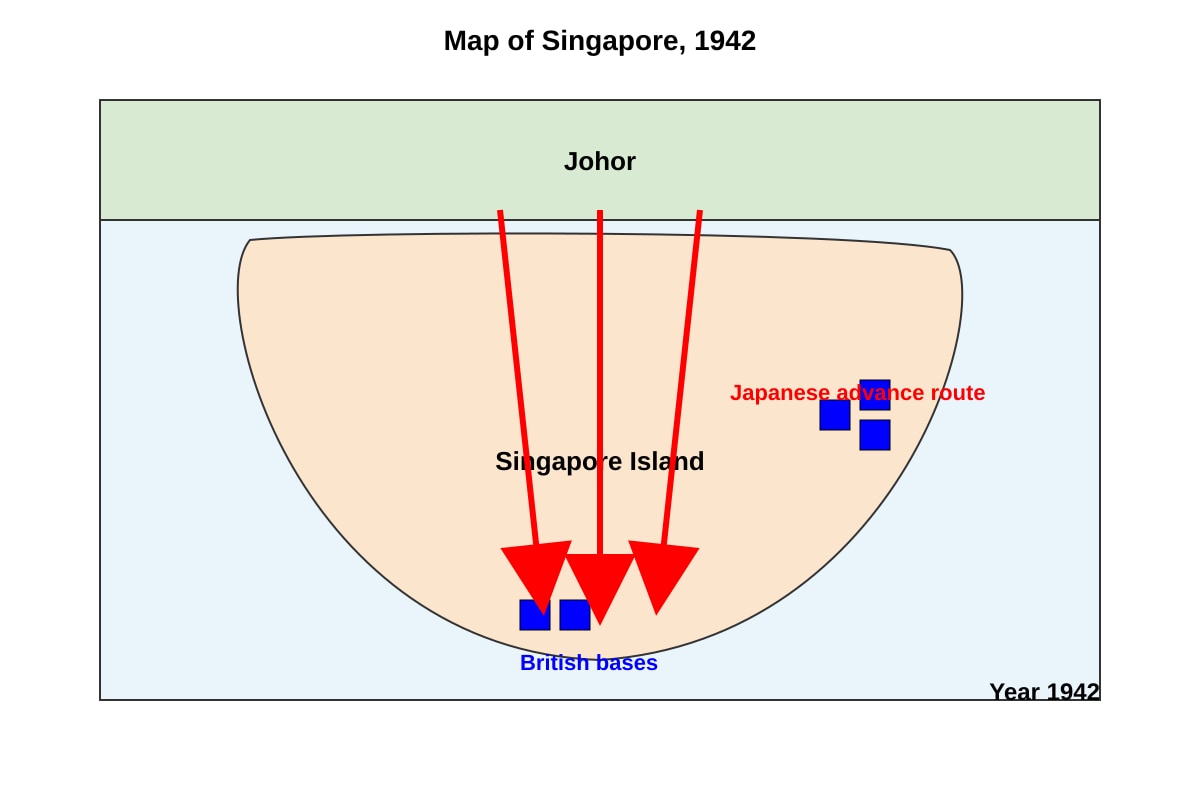
Generated map for Q7.
7. Study Source E. Using the map, explain one reason why Singapore fell to the Japanese in 1942. [1]
8. Study Sources C, D and E. How reliable is Source D as evidence of Japanese control? Explain. [1]
Section B: Structured Response (18 marks)
9. Explain two reasons which caused the separation of Singapore from Malaysia in 1965. [10]
10. Explain how the Japanese controlled the people of Singapore during the Japanese Occupation. [7]
11. "The Cold War increased conflict in Southeast Asia." Explain one way this happened. [1]
12. Explain how the Anglo-Dutch rivalry in the 1800s affected Singapore's founding. [1]
13. Give one example of an international conflict that involved Singapore before independence. [1]
14. Explain why the fall of Singapore in 1942 was significant for its people. [1]
Section C: Short Answer & Recall (6 marks)
15. What year did the Japanese Occupation of Singapore begin? [1]
16. Name one method used by the Japanese to control the economy. [1]
17. What was the name of the union between Malaya and Singapore in 1963? [1]
18. Who founded British Singapore in 1819? [1]
19. What global conflict was happening when Singapore fell in 1942? [1]
20. Give one reason why the British built a naval base in Singapore before the war. [1]