From Real Exams Quiz
Secondary 2 History Conflict International Relations Quiz
Free Sec 2 History Conflict IR quiz, Exam version, with questions, answers, and syllabus-aligned practice for Singapore students.
These static practice materials are generated from the site's syllabus and paper-generation workflow, with source and model context shown so students and parents can evaluate the material before use.
Questions
Free quiz and exam paper access
Enter your details to view this paper
Your access is remembered on this device.
Answers
Secondary 2 History Quiz - Conflict International Relations - Answer Key
Total Marks: 40
Section A: Multiple Choice Questions (5 Marks)
1. Which of the following was a major cause of the Cold War?
- Correct Answer: B) Ideological differences between the USA and the Soviet Union [1 mark]
Explanation: The Cold War was fundamentally a conflict between two opposing ideologies: capitalism (led by the USA) and communism (led by the Soviet Union). After World War II, these two superpowers had different visions for how the world should be organised, leading to mistrust and rivalry. Option A is incorrect because the Treaty of Versailles (1919) ended WWI and contributed to WWII, not the Cold War. Option C is incorrect because the UN was formed to promote peace, not cause conflict. Option D is incorrect because the Japanese Occupation ended in 1945 and is not a direct cause of the Cold War.
Common mistake: Students may confuse the Cold War with WWII or earlier conflicts. Remember that the Cold War began after WWII ended, in the late 1940s.
2. The Korean War (1950–1953) began when:
- Correct Answer: C) North Korea invaded South Korea [1 mark]
Explanation: On 25 June 1950, North Korean forces crossed the 38th parallel (the border between North and South Korea) and invaded South Korea. This was a direct act of aggression supported by the Soviet Union and China. The USA and UN forces intervened to support South Korea, turning the conflict into a major Cold War confrontation. Option A is incorrect because the USA did not invade North Korea first. Option B is incorrect because China entered the war later, after UN forces approached the Chinese border. Option D is incorrect because the Soviet Union did not occupy the peninsula after WWII; Korea was divided at the 38th parallel by agreement between the USA and USSR.
Common mistake: Students may think the war started because of a dispute over the border. While the division of Korea was a cause, the actual trigger was the invasion.
3. What was the main purpose of the North Atlantic Treaty Organization (NATO), formed in 1949?
- Correct Answer: B) To provide collective defence against the Soviet Union [1 mark]
Explanation: NATO was a military alliance of Western countries (USA, Canada, and Western European nations) formed to counter the threat of Soviet expansion. The key principle was collective defence: an attack on one member was considered an attack on all. This was a direct response to the Soviet Union's control over Eastern Europe and fears that the USSR would try to expand further. Option A is incorrect because economic cooperation was the role of other organisations like the European Economic Community. Option C is incorrect because decolonisation was not NATO's purpose. Option D is incorrect because trade disputes were handled by other bodies.
Common mistake: Students may confuse NATO with the UN or other international organisations. NATO is specifically a military alliance.
4. The 'Domino Theory' was a belief held by the USA that:
- Correct Answer: A) If one country fell to communism, neighbouring countries would also fall [1 mark]
Explanation: The Domino Theory was a key idea that shaped US foreign policy during the Cold War, especially in Asia. US leaders believed that if one country became communist, nearby countries would follow like a row of falling dominoes. This theory was used to justify US involvement in the Vietnam War and other interventions to prevent the spread of communism. Options B, C, and D describe different concepts not related to the Domino Theory.
Common mistake: Students may think the Domino Theory was about economic or democratic spread. It specifically refers to the spread of communism.
5. Which international organisation was established in 1945 to promote peace and prevent future wars after World War II?
- Correct Answer: B) The United Nations [1 mark]
Explanation: The United Nations (UN) was founded in 1945 after World War II to replace the failed League of Nations. Its main goals were to maintain international peace and security, promote human rights, and foster cooperation among nations. Option A is incorrect because the League of Nations was formed after WWI (1919) and had already failed by 1945. Option C is incorrect because the European Union was formed much later (1993) for economic and political integration. Option D is incorrect because SEATO was a regional military alliance formed in 1954.
Common mistake: Students may confuse the UN with the League of Nations. Remember: League = after WWI, UN = after WWII.
Section B: Source-Based Questions (15 Marks)
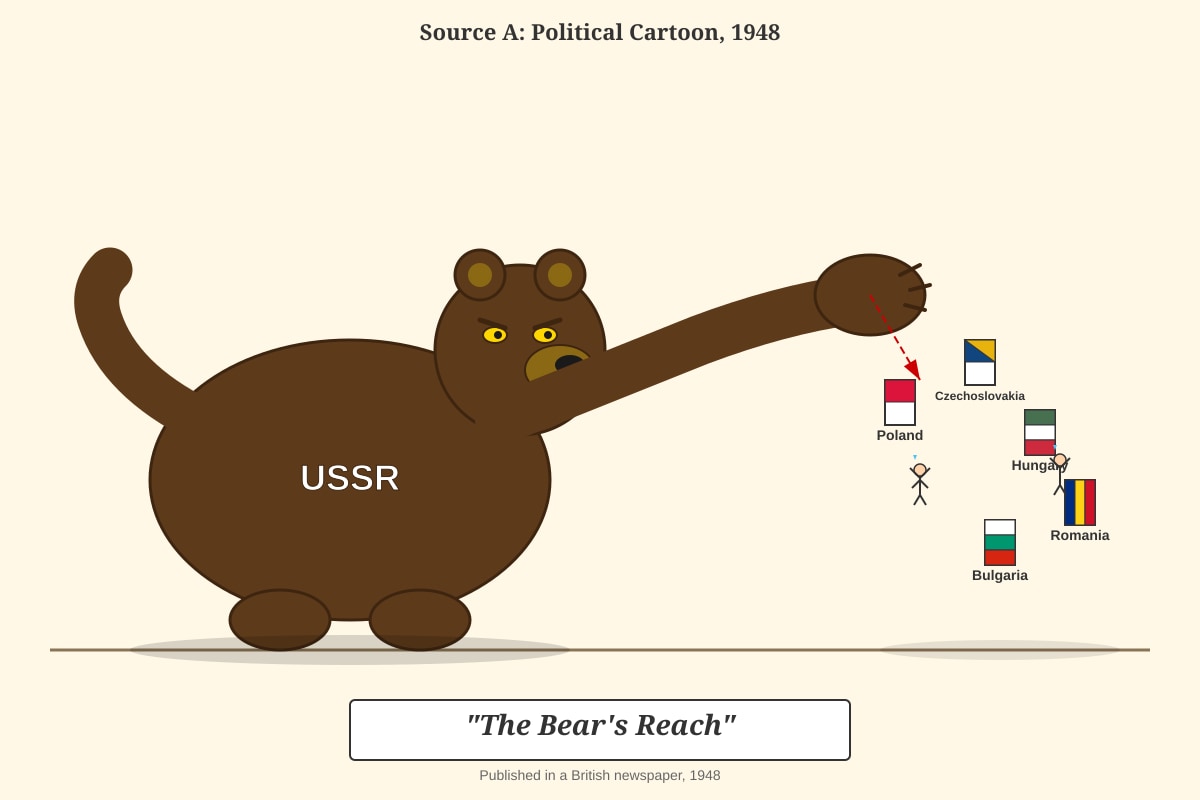
6. What can you infer from Source A about the relationship between the Soviet Union and Eastern European countries after World War II? Explain your answer using details from the source.
[3 marks]
Expected Answer:
- From Source A, we can infer that the Soviet Union had a dominant and threatening relationship with Eastern European countries after WWII. [1 mark]
- The bear (representing the USSR) is shown as large and menacing, stretching its paw towards small countries like Poland, Czechoslovakia, Hungary, Romania, and Bulgaria. This suggests that the USSR was aggressively expanding its influence over these nations. [1 mark]
- The caption "The Bear's Reach" implies that the Soviet Union was extending its control or influence over these countries, which were shown as small and vulnerable. This reflects the reality of Soviet domination of Eastern Europe after 1945. [1 mark]
Marking Notes:
- Award 1 mark for a valid inference about the relationship (e.g., dominant, threatening, controlling).
- Award 1 mark for using specific details from the source (bear, paw, small countries, caption).
- Award 1 mark for explaining how the detail supports the inference.
Common mistake: Students may describe the cartoon literally without making an inference. The question asks "what can you infer" – this means you need to go beyond what is shown and explain what it suggests.
7. How useful is Source A as evidence of Soviet expansion in Europe after 1945? Explain your answer using details from the source and your own knowledge.
[4 marks]
Expected Answer:
Useful aspects:
- The source is useful because it shows the perspective of Western countries (Britain) at the time. The cartoon was published in a British newspaper in 1948, which was during the early Cold War when fears of Soviet expansion were high. [1 mark]
- The visual representation of the USSR as a large bear reaching for small Eastern European countries accurately reflects the real Soviet takeover of these countries after WWII (e.g., communist governments were established in Poland, Czechoslovakia, Hungary, etc.). [1 mark]
Limitations:
- However, the source has limited usefulness because it is a political cartoon, not a factual document. It is biased towards a Western, anti-Soviet perspective and exaggerates the threat to make a point. [1 mark]
- The source does not show the Soviet perspective – the USSR argued it was establishing a buffer zone for its own security after being invaded twice (WWI and WWII) through Eastern Europe. A historian would need other sources (e.g., Soviet documents, speeches) for a balanced view. [1 mark]
Marking Notes:
- Award up to 2 marks for explaining how the source is useful (must use source details and own knowledge).
- Award up to 2 marks for explaining limitations (must use own knowledge about bias, perspective, or missing context).
- Maximum 4 marks.
Common mistake: Students may say the source is "not useful at all" because it is a cartoon. Even biased sources are useful for understanding the perspective of the creator. The key is to explain both usefulness and limitations.
8. According to Source B, what did President Truman believe the role of the United States should be in the world after World War II? Explain your answer using details from the source.
[3 marks]
Expected Answer:
- President Truman believed the USA should take a leadership role in supporting free peoples against communist threats. [1 mark]
- He states that the US must "support free peoples who are resisting attempted subjugation by armed minorities or by outside pressures." This means the USA should help countries that are threatened by communist forces (either internal rebels or external Soviet pressure). [1 mark]
- He also says the USA must "assist free peoples to work out their own destinies in their own way," suggesting the US role was to protect democracy and self-determination. He warns that if the US "falters in leadership," world peace would be endangered. [1 mark]
Marking Notes:
- Award 1 mark for identifying the role (leadership, supporting free peoples, containing communism).
- Award 1 mark for quoting or paraphrasing specific details from the source.
- Award 1 mark for explaining how the details support the identified role.
Common mistake: Students may simply copy the source without explaining what it means. You must show understanding by putting Truman's words into your own explanation.
9. How different are Sources A and B in their messages about international relations after World War II? Explain your answer.
[5 marks]
Expected Answer:
Similarities:
- Both sources reflect the Cold War context and the division between the Western (US-led) and Soviet blocs. Source A shows Soviet aggression, while Source B shows the US response to that aggression. [1 mark]
Differences:
- Format and tone: Source A is a political cartoon that uses visual symbolism (bear = USSR) to criticise Soviet expansion. It is indirect and uses humour/satire. Source B is a formal political speech that directly states US policy. It is serious and authoritative. [1 mark]
- Perspective: Source A shows the Soviet Union as the aggressor (the bear reaching out). Source B shows the USA as the defender (supporting free peoples). They present opposite sides of the same conflict. [1 mark]
- Message: Source A's message is that the USSR is threatening and expansionist. Source B's message is that the USA must act to stop this threat. Together, they show the two opposing sides of the Cold War. [1 mark]
- Purpose: Source A was published to warn the British public about Soviet expansion. Source B was a speech to Congress to gain support for US intervention in Greece and Turkey (the Truman Doctrine). [1 mark]
Marking Notes:
- Award 1 mark for identifying a similarity.
- Award up to 4 marks for explaining differences (format, perspective, message, purpose).
- Maximum 5 marks.
Common mistake: Students may only list differences without explaining why they exist. For each difference, explain the reason (e.g., different formats because they had different audiences and purposes).
Section C: Structured Response Questions (20 Marks)
10. Explain one reason why the Cold War was considered a 'global conflict' even though the USA and the Soviet Union never fought each other directly.
[2 marks]
Expected Answer:
- The Cold War was considered a global conflict because it involved proxy wars in many different regions of the world. [1 mark]
- For example, the USA and USSR supported opposing sides in conflicts such as the Korean War (1950-1953), the Vietnam War (1955-1975), and the Afghanistan War (1979-1989). These wars were fought in Asia, Africa, and Latin America, making the Cold War a truly global struggle for influence. [1 mark]
Marking Notes:
- Award 1 mark for identifying the concept of proxy wars or global involvement.
- Award 1 mark for providing a specific example.
Common mistake: Students may say the Cold War was global because many countries were involved. This is too vague. You need to explain how it was global (through proxy wars in different continents).
11. State two ways in which the United Nations (UN) was different from the League of Nations.
[2 marks]
Expected Answer: Any two of the following:
- The UN had a Security Council with five permanent members (USA, USSR, UK, France, China) who had veto power, giving it more authority than the League. [1 mark]
- The UN was more successful in maintaining peace because it had the power to impose economic sanctions and authorise military action, unlike the League which relied on moral persuasion. [1 mark]
- The UN had the support of the USA (a major power), whereas the USA never joined the League of Nations, weakening it. [1 mark]
Marking Notes:
- Award 1 mark for each valid difference (maximum 2 marks).
- Accept any reasonable difference that shows understanding of both organisations.
Common mistake: Students may list similarities instead of differences. Read the question carefully – it asks for differences.
12. Explain one way in which the Korean War reflected the tensions of the Cold War.
[2 marks]
Expected Answer:
- The Korean War reflected Cold War tensions because it was a proxy war between the USA and the Soviet Union. [1 mark]
- North Korea was supported by the Soviet Union and China (communist bloc), while South Korea was supported by the USA and UN forces (capitalist bloc). Although US and Soviet troops did not fight each other directly, they supported opposing sides, showing how Cold War rivalries played out in regional conflicts. [1 mark]
Marking Notes:
- Award 1 mark for identifying the connection to Cold War tensions (proxy war, ideological conflict).
- Award 1 mark for explaining with specific details.
Common mistake: Students may describe the war itself without linking it to the Cold War. The question asks how it reflected Cold War tensions, so you must make the connection explicit.
13. Identify two countries that were members of the Southeast Asia Treaty Organization (SEATO), formed in 1954.
[2 marks]
Expected Answer: Any two of the following:
- USA
- United Kingdom
- France
- Australia
- New Zealand
- Pakistan
- Thailand
- Philippines
[1 mark each, maximum 2 marks]
Marking Notes:
- Accept any two SEATO members. Note that Singapore and Malaysia were not members (they were not independent at the time).
- Do not accept non-member countries like China, India, or Indonesia.
Common mistake: Students may list Southeast Asian countries that were not members (e.g., Indonesia, Myanmar). SEATO had only two Southeast Asian members: Thailand and the Philippines.
14. Explain one reason why the USA became involved in the Vietnam War.
[2 marks]
Expected Answer:
- The USA became involved in the Vietnam War because of the Domino Theory. [1 mark]
- US leaders believed that if South Vietnam fell to communism, other countries in Southeast Asia (like Laos, Cambodia, Thailand, and even Singapore) would also become communist. Therefore, the USA intervened to prevent the spread of communism in the region. [1 mark]
Marking Notes:
- Award 1 mark for identifying a reason (Domino Theory, containing communism, supporting an ally).
- Award 1 mark for explaining the reason with specific details.
Common mistake: Students may say the USA wanted to "help Vietnam" without explaining the Cold War context. The reason was strategic, not humanitarian.
15. Explain two reasons why the Soviet Union established control over Eastern European countries after World War II.
[4 marks]
Expected Answer:
Reason 1: Security buffer zone
- The Soviet Union wanted to create a buffer zone of friendly states between itself and Western Europe. [1 mark]
- The USSR had been invaded twice through Eastern Europe in the 20th century (by Germany in WWI and WWII). By establishing control over countries like Poland, Czechoslovakia, and Hungary, Stalin aimed to prevent future invasions from the West. [1 mark]
Reason 2: Spread of communism
- The Soviet Union wanted to spread communist ideology and expand its influence globally. [1 mark]
- Stalin believed that communism should replace capitalism, and Eastern Europe was the first step in this process. By installing communist governments in these countries, the USSR created a bloc of allied states that shared its ideology and would support Soviet policies. [1 mark]
Marking Notes:
- Award 1 mark for identifying each reason (must be a clear, distinct reason).
- Award 1 mark for explaining each reason with specific details.
- Maximum 4 marks (2 reasons × 2 marks each).
Common mistake: Students may give two very similar reasons (e.g., "to spread communism" and "to have allies" – these are essentially the same). Ensure your two reasons are clearly different.
16. Explain one way in which the Cuban Missile Crisis (1962) brought the world close to nuclear war.
[2 marks]
Expected Answer:
- The Cuban Missile Crisis brought the world close to nuclear war because the USA discovered that the Soviet Union had placed nuclear missiles in Cuba, just 90 miles from the US coast. [1 mark]
- President Kennedy demanded the removal of the missiles and imposed a naval blockade around Cuba. The Soviet ships approached the blockade, and for 13 days, the world was on the brink of nuclear conflict. A US attack on the ships or Cuba could have triggered a Soviet nuclear response, potentially leading to a full-scale nuclear war. [1 mark]
Marking Notes:
- Award 1 mark for identifying the situation (Soviet missiles in Cuba, US blockade).
- Award 1 mark for explaining why this brought the world close to nuclear war (risk of escalation, potential nuclear response).
Common mistake: Students may simply say "there were nuclear missiles" without explaining the danger. You must explain why this was dangerous (proximity to USA, risk of miscalculation, potential for escalation).
17. State two consequences of the end of the Cold War for international relations.
[2 marks]
Expected Answer: Any two of the following:
- The USA emerged as the world's sole superpower, leading to a period of US dominance in international affairs. [1 mark]
- Many former Soviet republics and Eastern European countries became independent and transitioned to democratic governments and market economies. [1 mark]
- The threat of global nuclear war decreased significantly, although regional conflicts continued. [1 mark]
- International organisations like the UN and NATO took on new roles, with NATO expanding eastward to include former communist countries. [1 mark]
Marking Notes:
- Award 1 mark for each valid consequence (maximum 2 marks).
- Accept any reasonable consequence that shows understanding of the post-Cold War world.
Common mistake: Students may list causes of the end of the Cold War instead of consequences. The question asks what happened after the Cold War ended.
18. Explain one reason why the Non-Aligned Movement was formed during the Cold War.
[2 marks]
Expected Answer:
- The Non-Aligned Movement was formed because many newly independent countries in Asia, Africa, and Latin America did not want to take sides in the Cold War. [1 mark]
- These countries wanted to maintain their independence and avoid being drawn into the rivalry between the USA and the Soviet Union. They believed that aligning with either superpower would compromise their sovereignty and could lead to conflict on their soil. The movement was founded in 1961 by leaders like Jawaharlal Nehru (India), Josip Broz Tito (Yugoslavia), and Gamal Abdel Nasser (Egypt). [1 mark]
Marking Notes:
- Award 1 mark for identifying the reason (desire to remain neutral, avoid Cold War alignment).
- Award 1 mark for explaining with specific details (founding leaders, goals, context).
Common mistake: Students may think the Non-Aligned Movement was against both superpowers equally. In reality, many member countries had closer ties to one side but officially remained non-aligned.
19. Explain one way in which the arms race between the USA and the Soviet Union affected international relations.
[2 marks]
Expected Answer:
- The arms race increased tensions and mistrust between the USA and the Soviet Union. [1 mark]
- Both superpowers competed to build more and better nuclear weapons, leading to a constant state of fear and suspicion. This arms race led to the formation of military alliances (NATO and the Warsaw Pact) and contributed to proxy wars, as each side tried to gain strategic advantages. The threat of mutually assured destruction (MAD) meant that both sides were deterred from direct conflict, but the constant build-up of weapons made the world a more dangerous place. [1 mark]
Marking Notes:
- Award 1 mark for identifying an effect (increased tension, formation of alliances, proxy wars, deterrence).
- Award 1 mark for explaining the effect with specific details.
Common mistake: Students may describe the arms race without explaining its effect on international relations. The question asks how it affected relations, so you must explain the consequence.
20. Explain one reason why the Cold War ended in the late 1980s and early 1990s.
[2 marks]
Expected Answer:
- The Cold War ended because of internal reforms in the Soviet Union under leader Mikhail Gorbachev. [1 mark]
- Gorbachev introduced policies of glasnost (openness) and perestroika (restructuring), which allowed more political freedom and economic reform. He also pursued better relations with the USA, reducing tensions. The Soviet Union could no longer afford the arms race, and Eastern European countries began to break away from Soviet control. By 1991, the Soviet Union itself collapsed, bringing the Cold War to an end. [1 mark]
Marking Notes:
- Award 1 mark for identifying a reason (Gorbachev's reforms, economic pressure, popular uprisings in Eastern Europe).
- Award 1 mark for explaining the reason with specific details.
Common mistake: Students may say the Cold War ended "because the USA won." This is an oversimplification. The end of the Cold War was a complex process involving internal Soviet changes, economic factors, and popular movements in Eastern Europe.
End of Answer Key