From Real Exams Quiz
Secondary 2 History Ancient Civilisations Quiz
Free Sec 2 History Ancient Civilisations quiz, Qwen3.7 Exam version, with questions, answers, and syllabus-aligned practice for Singapore students.
These static practice materials are generated from the site's syllabus and paper-generation workflow, with source and model context shown so students and parents can evaluate the material before use.
Questions
Free quiz and exam paper access
Enter your details to view this paper
Your access is remembered on this device.
Answers
Secondary 2 History Quiz - Ancient Civilisations - Answer Key
Section A: Knowledge and Understanding
1. B
Reasoning: River valleys like the Tigris/Euphrates and Nile flooded annually, depositing nutrient-rich silt (alluvium) that made farming highly productive, supporting large populations.
2. B
Reasoning: Hammurabi’s Code was one of the earliest written legal codes, designed to standardise laws across the Babylonian empire to ensure order and consistency.
3. B
Reasoning: Mohenjo-Daro and Harappa featured grid-pattern streets, standardized bricks, and sophisticated covered drainage systems, indicating advanced urban planning.
4. C
Reasoning: Hieroglyphics ("sacred carvings") were the formal writing system of Ancient Egypt, used for monuments and religious texts. Cuneiform was Mesopotamian.
5. A
Reasoning: The Mandate of Heaven was a Chinese philosophical concept stating that heaven granted the right to rule to a just leader. Natural disasters or rebellions signaled the loss of this mandate.
6. B
Reasoning: Most ancient civilisations had rigid social hierarchies. In India, this evolved into the Caste System; elsewhere, it was general social stratification (rulers, priests, commoners, slaves).
7. B
Reasoning: The Sumerians in Mesopotamia are credited with inventing the wheel (initially for pottery, then transport) and the plough to aid agriculture.
8. C
Reasoning: Ziggurats were massive stepped towers built as temples to honour the patron god of the city-state. They were considered the dwelling place of the deity.
9. B
Reasoning: The Shang Dynasty is famous for its bronze casting technology, producing intricate ritual vessels and weapons.
10. C
Reasoning: The Yellow River carries large amounts of loess (yellow soil), which causes frequent flooding ("Sorrow of China") but also creates fertile land for agriculture.
Section B: Source-Based Questions
11. The principle of retribution or "eye for an eye" (Lex Talionis).
Marking Note: Accept answers stating that the punishment matches the crime, or that the builder suffers the same fate as the victim (death). [1]
12. Level 3 (3-4 marks): Detailed comparison with explanation.
Answer:
Source A suggests a strict, uniform application of justice where the punishment directly mirrors the harm done (e.g., eye for an eye, death for death), implying a sense of equal retribution regardless of status in those specific examples.
However, Source B argues that the laws were not equal and depended heavily on social status. It states that nobles received lighter punishments (fines) compared to commoners for similar crimes.
Therefore, they are different because Source A highlights the harsh, literal reciprocity of the law, while Source B highlights the inequality and class bias inherent in the system.
Marking Breakdown:
- 1 mark for identifying Source A’s focus on retribution/equality of punishment.
- 1 mark for identifying Source B’s focus on social status/inequality.
- 1-2 marks for explaining the difference (uniformity vs. class bias). [4]
13. Level 2 (3-4 marks): Explanation with own knowledge.
Answer:
The historian suggests there was "some protection" because, unlike in many other ancient societies where women had no rights, the Code allowed women to own property and conduct business in certain situations.
From own knowledge: While patriarchal, Mesopotamian law did allow women to initiate divorce under specific conditions and inherit property if they had no brothers. This was significant because it gave women a degree of economic independence not seen in all ancient cultures. The source implies that despite the harsh physical punishments for men, the legal framework acknowledged women as legal entities to some extent.
Marking Breakdown:
- 1 mark for referencing the source (property ownership).
- 1-2 marks for own knowledge (divorce rights, inheritance, economic role).
- 1 mark for linking to the idea of "protection" or legal status. [4]
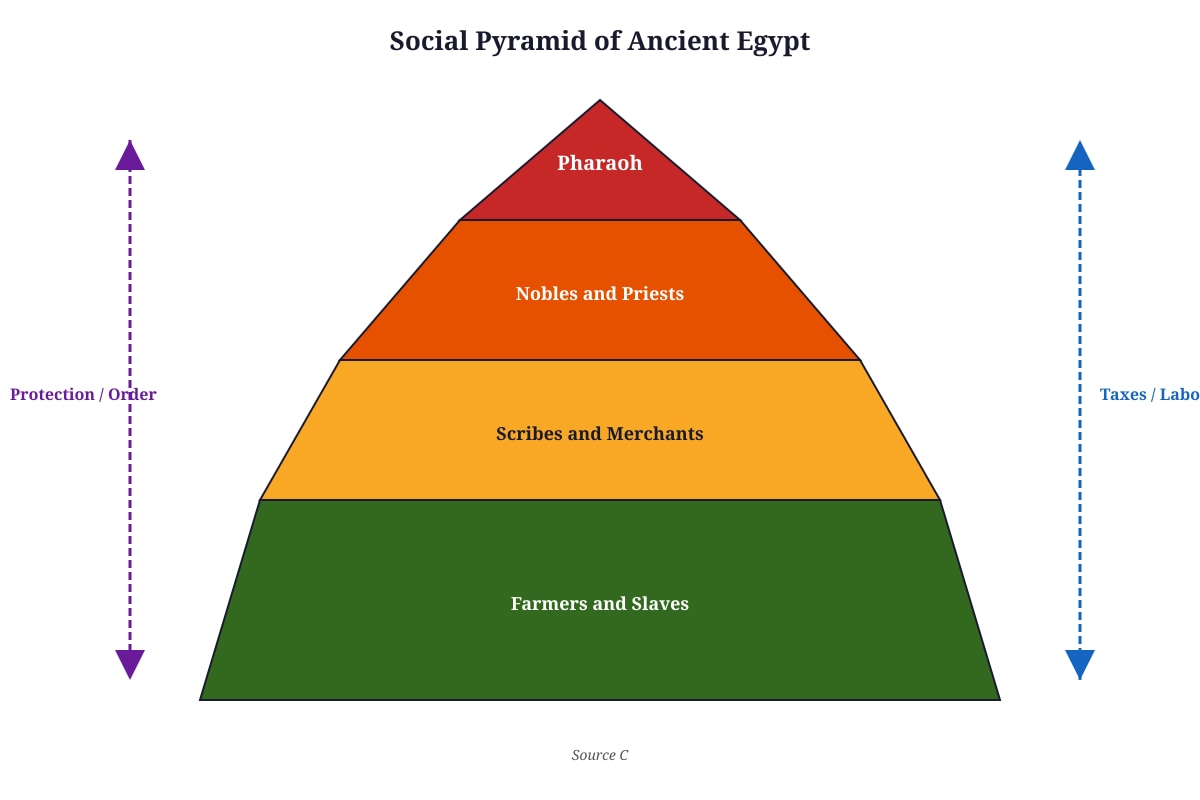
14. It suggests that the vast majority of the population consisted of farmers and slaves.
Answer:
The bottom section is the widest part of the pyramid, visually representing that farmers and slaves made up the largest portion of the population. The top section (Pharaoh) is the smallest, indicating there was only one ruler. This reflects an agricultural society reliant on mass labour.
Marking Breakdown:
- 1 mark for identifying farmers/slaves as the largest group.
- 1 mark for linking the visual size to population numbers. [2]
15. The Pharaoh was placed at the top because he was considered a god-king.
Answer:
Egyptians believed the Pharaoh was the earthly embodiment of the god Horus and the son of Ra. This divine status gave him absolute authority over the land and people.
Being at the top symbolised his role as the intermediary between the gods and the people. He was responsible for maintaining Ma’at (order, balance, and truth). If the Pharaoh failed, chaos would ensue. Therefore, his position was not just political but religiously essential for the survival of the civilisation.
Marking Breakdown:
- 1 mark for identifying Pharaoh as god/divine.
- 1 mark for mentioning Horus/Ra or divine right.
- 1 mark for explaining the role of maintaining order (Ma’at).
- 1 mark for linking religious belief to his supreme authority. [4]
Section C: Structured Response Questions
16. Two ways geography helped Egypt flourish:
- Predictable Flooding: The Nile flooded annually at the same time, depositing rich black silt (kemet) on the banks. This made the soil extremely fertile, allowing for surplus food production which supported population growth and specialised workers.
- Natural Barriers: Deserts to the east and west, and cataracts (rapids) to the south, protected Egypt from invasion. This isolation allowed the civilisation to develop securely without constant warfare, unlike Mesopotamia.
Marking Breakdown:
- 2 marks for each well-explained point (1 for identification, 1 for explanation). [4]
17. Significance of writing systems for administration:
Writing allowed rulers to keep accurate records of taxes, grain storage, and trade.
It enabled the creation of laws (like Hammurabi’s Code) that could be written down and applied consistently across the empire, rather than relying on memory.
It also facilitated communication between the central government and distant provinces, helping to maintain control over a large territory.
Marking Breakdown:
- 1 mark for record-keeping (taxes/trade).
- 1 mark for standardisation of laws.
- 1 mark for communication/control.
- 1 mark for overall explanation of administrative efficiency. [4]
18. "Religion was the most important factor in holding ancient societies together."
Level 3 (6-7 marks): Balanced argument with clear judgement.
Sample Answer:
I agree to a large extent that religion was the most important factor, particularly in Ancient Egypt.
Argument for Religion:
Religion provided a shared belief system that unified the people. The concept of Ma’at (order) meant that obeying the Pharaoh was a religious duty. Temples were centres of economic and social life, where people gathered for festivals. The belief in the afterlife motivated people to work on monumental projects like pyramids, creating a sense of collective purpose.
Argument for Other Factors (e.g., Geography/Economy):
However, one could argue that geography was equally important. The Nile provided the economic basis for society; without the surplus food from the river, the complex social structure and religious institutions could not have been supported. Additionally, the need for irrigation cooperation forced communities to work together, creating social cohesion through necessity rather than just belief.
Conclusion:
While geography provided the means for survival, religion provided the meaning and structure for society. It justified the hierarchy and motivated the labour force. Therefore, religion was the primary glue holding the social and political order together.
Marking Breakdown:
- 1-2 marks for identifying religion's role (unity, Ma'at, afterlife).
- 1-2 marks for identifying alternative factors (geography, economy, law).
- 1-2 marks for detailed explanation and examples.
- 1 mark for a clear, justified conclusion. [7]
Section D: Extended Response and Synthesis
19. Compare the role of the ruler in Ancient Egypt and Ancient China. How did their sources of authority differ?
Level 2 (4-5 marks): Clear comparison with specific details.
Answer:
In Ancient Egypt, the Pharaoh was considered a god on earth (the living Horus). His authority was absolute and divine by nature; he was the deity. His role was to maintain Ma’at (cosmic order) through religious rituals and governance.
In Ancient China, the Emperor ruled via the Mandate of Heaven. He was not a god himself, but the "Son of Heaven." His authority was conditional; if he ruled unjustly or if natural disasters occurred, it was believed he had lost the Mandate, justifying rebellion.
Difference: The key difference is that the Pharaoh’s authority was inherent and permanent (divine status), whereas the Chinese Emperor’s authority was conditional and based on moral performance and heavenly approval.
Marking Breakdown:
- 1 mark for describing Pharaoh as divine/god-king.
- 1 mark for describing Chinese Emperor's Mandate of Heaven.
- 1 mark for explaining the conditional nature of the Mandate vs. inherent divinity.
- 1-2 marks for clear comparison and structure. [5]
20. Evaluate the impact of technological innovations (such as irrigation, bronze working, or writing) on the stability of ancient river valley civilisations.
Level 2 (4-5 marks): Evaluation of impact with examples.
Answer:
Technological innovations were crucial for stability in three main ways:
- Irrigation: Allowed for predictable agriculture despite irregular rainfall or flooding. This created food surpluses, which supported population growth and reduced famine-related unrest. For example, canal systems in Mesopotamia ensured consistent crop yields.
- Writing: Enabled efficient administration. Rulers could track taxes, store records of grain, and codify laws (like Hammurabi’s Code). This reduced corruption and disputes, creating a stable legal and economic framework.
- Bronze Working: Provided superior tools for farming and construction, and stronger weapons for defence. This protected the civilisation from external threats and internal rebellion, ensuring political stability.
Evaluation:
While geography provided the potential for civilisation, technology unlocked it. Without irrigation, surplus food was impossible; without writing, large empires could not be managed. Therefore, technology was the foundation of long-term stability.
Marking Breakdown:
- 1 mark for explaining impact of irrigation (food surplus).
- 1 mark for explaining impact of writing (administration/law).
- 1 mark for explaining impact of bronze/technology (defence/efficiency).
- 1-2 marks for overall evaluation of their importance to stability. [5]