From Real Exams Quiz
Secondary 2 History Ancient Civilisations Quiz
Free Sec 2 History Ancient Civilisations quiz, Exam version, with questions, answers, and syllabus-aligned practice for Singapore students.
These static practice materials are generated from the site's syllabus and paper-generation workflow, with source and model context shown so students and parents can evaluate the material before use.
Questions
Free quiz and exam paper access
Enter your details to view this paper
Your access is remembered on this device.
Answers
Secondary 2 History Quiz - Ancient Civilisations: Answer Key
Total Marks: 50
Section A: Multiple Choice (Questions 1-5) — 10 marks
1. Answer: C) It was located along the main trade route between India and China.
- Marks: 2
- Explanation: The most important geographical advantage for a trading port is its strategic location. Temasek (ancient Singapore) was situated at the southern tip of the Malay Peninsula, right where the major maritime trade route connecting India and China passed through the narrow Straits of Melaka. This meant that ships travelling between these two great civilisations had to pass by Temasek, making it a natural stopping point for trade, fresh water, and supplies. Options A, B, and D are incorrect — there is no evidence of large gold reserves, a river leading into China, or an unusual number of skilled shipbuilders being the key factor.
- Marking Note: Award 2 marks for the correct answer only.
- Common Mistake: Students might choose B, confusing the general location on the sea route with a river route into China.
2. Answer: B) The Srivijaya Empire
- Marks: 2
- Explanation: The Srivijaya
<stage3_quiz_answers_md>
Secondary 2 History Quiz - Ancient Civilisations: Answer Key
Total Marks: 50
Section A: Multiple Choice (Questions 1-5) — 10 marks
1. Answer: C) It was located along the main trade route between India and China.
- Marks: 2
- Explanation: The most important geographical advantage for a trading port is its strategic location. Temasek (ancient Singapore) was situated at the southern tip of the Malay Peninsula, right where the major maritime trade route connecting India and China passed through the narrow Straits of Melaka. This meant that ships travelling between these two great civilisations had to pass by Temasek, making it a natural stopping point for trade, fresh water, and supplies. Options A, B, and D are incorrect — there is no evidence of large gold reserves, a river leading into China, or an unusual number of skilled shipbuilders being the key factor.
- Marking Note: Award 2 marks for the correct answer only.
- Common Mistake: Students might choose B, confusing the general location on the sea route with a river route into China.
2. Answer: B) The Srivijaya Empire
- Marks: 2
- Explanation: The Srivijaya Empire, based in Palembang (Sumatra), was the dominant maritime power in the region from the 7th to the 13th century. Its decline in the 13th century created a power vacuum and disrupted the existing trade networks. This allowed other port cities, like Temasek, to emerge and attract traders who were previously under Srivijaya's control. Options A, C, and D are incorrect: the Majapahit Empire rose after Srivijaya's fall, the Ottoman Empire was based in the Middle East, and the Mughal Empire was in India.
- Marking Note: Award 2 marks for the correct answer only.
- Common Mistake: Students may confuse Srivijaya with Majapahit, which was a later empire.
3. Answer: B) Shows that Singapore had a written script and civilisation before 1819.
- Marks: 2
- Explanation: The Singapore Stone was a large sandstone slab inscribed with an ancient script (likely from the 10th-14th centuries). Its existence is crucial evidence that a literate and organised society existed in Singapore long before the arrival of Sir Stamford Raffles in 1819. This challenges the colonial narrative that Singapore was a "fishing village" before the British. Options A, C, and D are incorrect: the stone does not mention Raffles, contain a map, or list rulers.
- Marking Note: Award 2 marks for the correct answer only.
- Common Mistake: Students might think the stone proves Raffles founded Singapore, but it actually proves the opposite.
4. Answer: B) The rise of Melaka as a more powerful and well-located trading centre.
- Marks: 2
- Explanation: In the early 1400s, the port of Melaka was founded on the west coast of the Malay Peninsula. It quickly grew into a major trading centre due to its even more strategic location, its deep, sheltered harbour, and its ability to control the narrowest part of the Straits of Melaka. Melaka's rise drew trade away from Temasek, leading to the latter's decline. Options A, C, and D are not supported by historical evidence.
- Marking Note: Award 2 marks for the correct answer only.
- Common Mistake: Students might think Temasek was destroyed by an attack, but the primary reason was economic competition.
5. Answer: B) China, India, and the Malay Archipelago
- Marks: 2
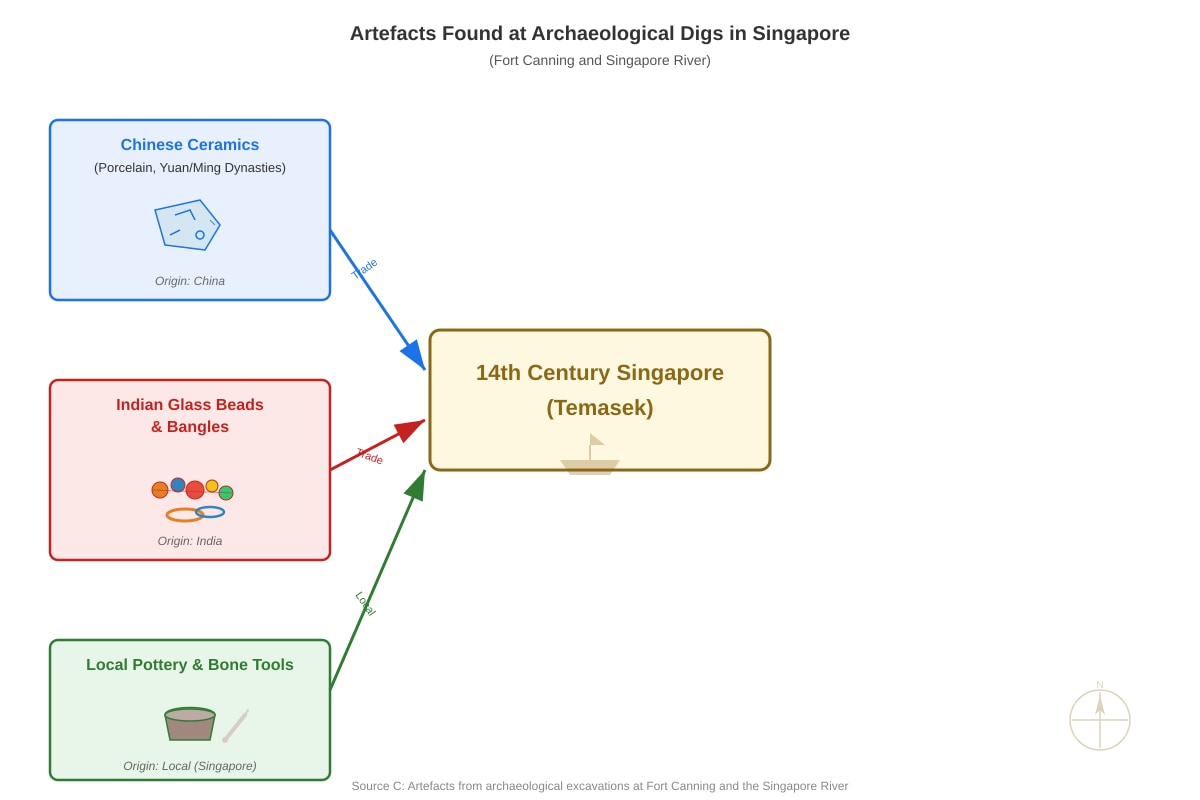
- Explanation: Archaeological digs at Fort Canning have unearthed a wide variety of artefacts. These include Chinese ceramics (porcelain from the Yuan and Ming dynasties), Indian glass beads and bangles, and local pottery and tools. This mix of items from different regions provides strong evidence that Temasek was a cosmopolitan trading port with connections to China, India, and the surrounding Malay Archipelago. Options A, C, and D are incorrect as there is no significant evidence of trade with those distant regions.
- Marking Note: Award 2 marks for the correct answer only.
- Common Mistake: Students might only mention China, forgetting the evidence of trade with India and the local region.
Section B: Source-Based Questions (Questions 6-15) — 20 marks
6. What does Source A tell us about the economy of Temasek in the 1330s?
- Answer: Source A tells us that Temasek's economy was based on trade. It mentions that the island produced goods like laka-wood, lard, and red cloth, and that the local people actively traded these goods with Chinese junks (ships). This shows that Temasek was involved in both local production and international trade.
- Marks: 2
- Marking Scheme:
- 2 marks: Identifies that Temasek produced goods (laka-wood, lard, red cloth) and traded them with Chinese merchants.
- 1 mark: Partially correct answer (e.g., only mentions trade or only mentions production).
- 0 marks: Incorrect or irrelevant answer.
- Common Mistake: Students might only describe the people's appearance ("fierce disposition") instead of focusing on the economy.
7. According to Source A, what challenge might traders have faced in Temasek?
- Answer: According to Source A, traders might have faced the challenge of dealing with the local inhabitants, who are described as being "of a fierce disposition." This could imply that they were aggressive or difficult to negotiate with, making trade potentially risky or challenging.
- Marks: 2
- Marking Scheme:
- 2 marks: Correctly identifies the "fierce disposition" of the inhabitants as a potential challenge.
- 1 mark: Mentions a challenge but is not specific to the source (e.g., "poor soil").
- 0 marks: Incorrect or irrelevant answer.
- Common Mistake: Students might focus on the "poor soil" as a challenge for farming, but the question asks about challenges for traders.
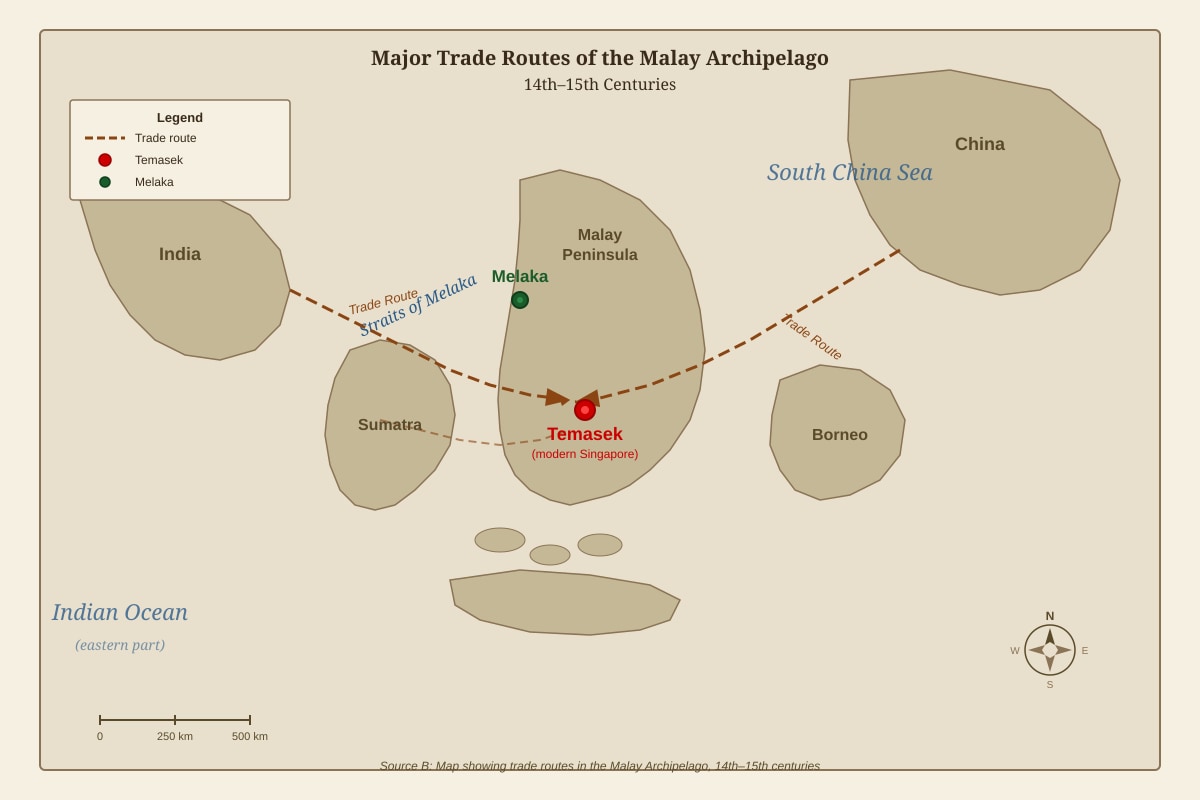
8. Based on Source B, explain one reason why Temasek was strategically located for trade.
- Answer: Source B shows that Temasek was located at the southern tip of the Malay Peninsula, where major trade routes from India (west) and China (northeast) converged. This meant that ships travelling between these two regions had to pass by Temasek, making it a natural and convenient stopping point for them to trade, restock supplies, and wait for favourable winds.
- Marks: 2
- Marking Scheme:
- 2 marks: Clearly explains the convergence of trade routes from India and China at Temasek's location.
- 1 mark: Mentions Temasek's location on a map but does not explain its strategic advantage.
- 0 marks: Incorrect or irrelevant answer.
- Common Mistake: Students might simply describe the map without explaining why the location was strategic.
9. Using Source B, which port city became a rival to Temasek in the 1400s, and why?
- Answer: According to Source B, Melaka became a rival to Temasek. The map shows Melaka located on the west coast of the Malay Peninsula, also along the Straits of Melaka. Its position was even more strategic because it was located at the narrowest point of the straits, giving it greater control over the main shipping route.
- Marks: 2
- Marking Scheme:
- 2 marks: Correctly identifies Melaka and explains that it was located at a more strategic point (narrowest part of the straits).
- 1 mark: Identifies Melaka but gives a weak or incomplete explanation.
- 0 marks: Incorrect or irrelevant answer.
- Common Mistake: Students might identify Melaka but fail to explain why it was a rival based on the map.
10. What does the presence of Chinese porcelain and Indian beads in Source C suggest about Temasek's trade connections?
- Answer: The presence of Chinese porcelain and Indian beads suggests that Temasek had extensive and active trade connections with both China and India. These were not locally produced items, so they must have been brought to Temasek by merchants from those countries. This shows that Temasek was a key node in the international trade network of the 14th century.
- Marks: 2
- Marking Scheme:
- 2 marks: Clearly states that Temasek traded with both China and India.
- 1 mark: Mentions trade with one country only.
- 0 marks: Incorrect or irrelevant answer.
- Common Mistake: Students might only mention China, forgetting the Indian beads.
11. Besides trade, what else could the mixture of local pottery with Chinese and Indian goods indicate about Temasek?
- Answer: The mixture of local pottery with imported Chinese and Indian goods could indicate that Temasek was a cosmopolitan and multicultural society. It suggests that local people and foreign merchants lived and interacted together, exchanging not only goods but also ideas, cultures, and technologies. It could also indicate that Temasek had a local population that produced its own goods while also consuming imported items.
- Marks: 2
- Marking Scheme:
- 2 marks: Suggests a multicultural society or cultural exchange.
- 1 mark: Mentions a less specific idea like "people lived together."
- 0 marks: Incorrect or irrelevant answer.
- Common Mistake: Students might repeat the idea of trade instead of thinking about social or cultural implications.
12. What does Source D suggest about the origins of the name "Singapura"?
- Answer: Source D suggests that the name "Singapura" (which means "Lion City" in Sanskrit) originated from a legend. According to the story, Sang Nila Utama saw a creature he believed was a lion, and he decided to found a city there, naming it Singapura. The source directly links the name to this mythical sighting.
- Marks: 2
- Marking Scheme:
- 2 marks: Clearly explains the link between the sighting of the "lion" and the naming of the city.
- 1 mark: Mentions the story but does not connect it to the name.
- 0 marks: Incorrect or irrelevant answer.
- Common Mistake: Students might think the source proves there were lions in Singapore, rather than understanding it as a legend.
13. Is Source D a reliable account of the founding of Singapura? Give one reason for your answer.
- Answer: No, Source D is not a very reliable account. One reason is that it is a legend or myth written down centuries after the supposed event. The Sejarah Melayu was written in the 15th-16th centuries, long after the 13th century when Sang Nila Utama supposedly lived. Stories passed down orally can change over time. Also, there is no archaeological evidence that lions ever lived in Singapore, so the story is likely symbolic rather than factual.
- Marks: 2
- Marking Scheme:
- 2 marks: Gives a clear reason for unreliability (e.g., written long after the event, it's a legend, no evidence of lions).
- 1 mark: States it is unreliable but gives a weak reason.
- 0 marks: Incorrect or irrelevant answer.
- Common Mistake: Students might say it is reliable because it is a historical text, without considering its legendary nature.
14. According to Source E, what evidence supports the idea that Temasek was a significant trading centre?
- Answer: According to Source E, the discovery of a large amount of Chinese porcelain and coins from the Song and Yuan periods at Fort Canning and along the Singapore River supports the idea that Temasek was a significant trading centre. The large quantity and high value of these items suggest that Temasek was a major hub for trade with China.
- Marks: 2
- Marking Scheme:
- 2 marks: Correctly identifies the Chinese porcelain and coins as evidence.
- 1 mark: Mentions evidence but is vague (e.g., "archaeological evidence").
- 0 marks: Incorrect or irrelevant answer.
- Common Mistake: Students might mention the location (Fort Canning) but forget to state the specific artefacts.
15. Why does the author of Source E say historians must be cautious about this evidence?
- Answer: The author says historians must be cautious because much of this evidence was found in "disturbed soil layers." This means the original context of the artefacts has been compromised. Without knowing the exact layer in which an artefact was found, it is difficult to accurately date it or link it to a specific time period. This makes the evidence less reliable for drawing firm conclusions.
- Marks: 2
- Marking Scheme:
- 2 marks: Clearly explains the problem of "disturbed soil layers" and its impact on reliability.
- 1 mark: Mentions the evidence is not reliable but does not explain why.
- 0 marks: Incorrect or irrelevant answer.
- Common Mistake: Students might say historians must be cautious because the evidence is old, which is not the specific reason given in the source.
Section C: Structured Response Questions (Questions 16-20) — 20 marks
16. Explain two reasons why the fall of the Srivijaya Empire helped Temasek to grow as a trading port in the 13th and 14th centuries.
- Answer:
- Reason 1: The fall of Srivijaya created a power vacuum in the region. Srivijaya had controlled the major trade routes and forced ships to stop at its ports. When it declined, it could no longer enforce this control. This allowed other ports, like Temasek, to attract traders who were now free to choose where to stop.
- Reason 2: The decline of Srivijaya led to a disruption of its trade network. Merchants who had previously traded under Srivijaya's protection needed new, safe ports. Temasek, with its strategic location and natural harbour, was well-positioned to fill this gap and become a new hub for regional and international trade.
- Marks: 4 (2 marks per well-explained reason)
- Marking Scheme:
- 4 marks: Two clear, well-explained reasons.
- 3 marks: Two reasons, but one is less well-explained.
- 2 marks: One well-explained reason.
- 1 mark: One vague reason.
- 0 marks: Incorrect or irrelevant answer.
- Common Mistake: Students might describe the fall of Srivijaya without explaining how it helped Temasek.
17. Describe two types of historical evidence that historians use to learn about Temasek, and explain why each type is useful.
- Answer:
- Type 1: Archaeological Evidence (e.g., artefacts like Chinese porcelain, Indian beads, the Singapore Stone). This is useful because it provides physical, tangible proof of past activities. Artefacts can be scientifically dated (e.g., using the style of pottery) and can show trade links, daily life, and cultural influences. For example, Chinese porcelain found in Singapore proves trade with China.
- Type 2: Written Evidence (e.g., the writings of Wang Dayuan, the Sejarah Melayu). This is useful because it provides a contemporary or near-contemporary account of events, people, and places. Written sources can give us names, descriptions, and perspectives that archaeology cannot. For example, Wang Dayuan's account describes the economy and people of Temasek in the 1330s.
- Marks: 4 (2 marks per well-described type with explanation of usefulness)
- Marking Scheme:
- 4 marks: Two clear types of evidence with a good explanation of why each is useful.
- 3 marks: Two types, but one explanation is weak.
- 2 marks: One well-explained type.
- 1 mark: One vague type.
- 0 marks: Incorrect or irrelevant answer.
- Common Mistake: Students might list types of evidence without explaining why they are useful to historians.
18. Explain how the rise of Melaka in the 1400s contributed to the decline of Temasek as a major trading port.
- Answer: The rise of Melaka directly contributed to Temasek's decline in several ways:
- Strategic Location: Melaka was founded at the narrowest point of the Straits of Melaka, giving it even greater control over the main shipping route than Temasek. Ships could not easily bypass Melaka.
- Better Harbour: Melaka had a deep, sheltered harbour that could accommodate larger ships, while Temasek's harbour was less suitable.
- Political Support: Melaka received strong support from the Chinese Ming dynasty, which sent Admiral Zheng He's fleet there, boosting its status and security. This made Melaka a more attractive and safer port for traders.
- Diversion of Trade: As Melaka grew, it actively attracted the trade that had previously gone to Temasek. Merchants found it more convenient and profitable to stop at Melaka, leading to a gradual but steady decline in Temasek's commercial importance.
- Marks: 4
- Marking Scheme:
- 4 marks: A comprehensive explanation covering at least two clear factors.
- 3 marks: A good explanation with one strong factor and one weaker factor.
- 2 marks: A basic explanation with one factor.
- 1 mark: A vague or partially correct answer.
- 0 marks: Incorrect or irrelevant answer.
- Common Mistake: Students might simply state that Melaka rose and Temasek fell, without explaining the connection between the two events.
19. In what ways did external factors, rather than internal factors, shape the development of Temasek in the 14th century? Explain your answer.
- Answer: External factors played a much larger role in shaping Temasek's development than internal factors.
- External Factor 1: The Fall of Srivijaya. This was the single most important external factor. The decline of this powerful empire created the opportunity for Temasek to emerge as a new trading centre. Temasek did not cause Srivijaya's fall; it simply benefited from it.
- External Factor 2: The Pattern of International Trade. Temasek's growth was largely dependent on the existing trade routes between India and China. Its location was only valuable because of this external demand for trade. The port did not create the trade; it was a product of it.
- External Factor 3: The Rise of Melaka. Similarly, Temasek's decline was caused by the external rise of a more powerful competitor. This was not due to any internal failure of Temasek, but because a new, more strategically located port emerged.
- Internal Factors (Limited): While internal factors like a stable leadership or a welcoming attitude to traders might have helped, the historical evidence suggests that Temasek's fate was primarily determined by larger regional and international forces beyond its control.
- Marks: 4
- Marking Scheme:
- 4 marks: A well-argued answer that clearly prioritises external factors (e.g., fall of Srivijaya, rise of Melaka, trade routes) over internal ones.
- 3 marks: A good answer that mentions external factors but could be more specific.
- 2 marks: A basic answer that lists some factors without clearly distinguishing between external and internal.
- 1 mark: A vague or partially correct answer.
- 0 marks: Incorrect or irrelevant answer.
- Common Mistake: Students might focus on internal factors like "good leadership" without sufficient evidence, rather than the more significant external forces.
20. Do you agree that the story of Sang Nila Utama is more of a legend than a reliable historical account? Explain your answer.
- Answer: Yes, I agree that the story of Sang Nila Utama is more of a legend than a reliable historical account.
- Reasons for it being a legend:
- Lack of Corroborating Evidence: There is no archaeological or contemporary written evidence from the 13th century to confirm the existence of Sang Nila Utama or the specific events described. No lion bones or remains have ever been found in Singapore, suggesting the animal was likely a mythological symbol.
- Written Long After the Event: The story was written down in the Sejarah Melayu in the 15th-16th centuries, hundreds of years after it supposedly took place. Oral traditions can change significantly over time, making them less reliable as factual accounts.
- Symbolic Nature: The story has many elements of a classic "founding myth." The hero, the sighting of a mythical beast, and the naming of a city are common themes in legends. The story likely served to legitimise the rule of the Melaka Sultanate by giving it a glorious and ancient origin.
- Why it is still valuable: Despite being a legend, the story is still valuable to historians. It tells us about the beliefs, values, and worldview of the people who wrote and told it. It also provides a cultural origin story for Singapore and reflects the strong Indian influence (Sanskrit name, concept of a lion king) in the region.
- Reasons for it being a legend:
- Marks: 4
- Marking Scheme:
- 4 marks: A clear, well-reasoned argument agreeing that it is a legend, supported by at least two strong pieces of evidence (e.g., no evidence of lions, written long after, symbolic nature).
- 3 marks: A good argument with one strong piece of evidence.
- 2 marks: A basic answer that states agreement but gives a weak explanation.
- 1 mark: A vague or partially correct answer.
- 0 marks: Incorrect or irrelevant answer.
- Common Mistake: Students might argue it is reliable because it is in a "history book" (the Sejarah Melayu), without understanding the difference between a primary source and a legendary account.
— End of Answer Key —