From Real Exams Quiz
Secondary 2 History Ancient Civilisations Quiz
Free Sec 2 History Ancient Civilisations quiz, Exam version, with questions, answers, and syllabus-aligned practice for Singapore students.
These static practice materials are generated from the site's syllabus and paper-generation workflow, with source and model context shown so students and parents can evaluate the material before use.
Questions
Free quiz and exam paper access
Enter your details to view this paper
Your access is remembered on this device.
Answers
Secondary 2 History Quiz - Ancient Civilisations: Answer Key
Total Marks: 40
Section A: Multiple Choice and Short Answer Questions (Questions 1–5)
1. Which ancient civilisation developed along the Indus River? [1] Answer: The Indus Valley Civilisation (also known as the Harappan Civilisation). Marking: 1 mark for naming the civilisation. Accept "Harappan Civilisation" or "Indus Valley Civilisation". Teaching Note: The Indus Valley Civilisation flourished around 2600–1900 BCE in what is now Pakistan and northwest India. Its two main cities were Harappa and Mohenjo-Daro.
2. Name one major contribution of Ancient Greece to the modern world. [1] Answer: Democracy (or philosophy, theatre, the Olympic Games, mathematics, medicine, etc.). Marking: 1 mark for any valid contribution. Teaching Note: Ancient Greece, particularly Athens, is credited with developing the concept of democracy, where citizens had a direct role in governing. Other major contributions include Western philosophy (Socrates, Plato, Aristotle), theatre (tragedy and comedy), and the Olympic Games.
3. What was the main writing system used in Ancient Egypt? [1] Answer: Hieroglyphics. Marking: 1 mark for "hieroglyphics" or "hieroglyphs". Teaching Note: Hieroglyphics used pictorial symbols to represent sounds and ideas. It was a complex system used for religious texts, monumental inscriptions, and official records. The Rosetta Stone helped scholars decipher it in the 19th century.
4. Which ancient civilisation is known for building the Great Wall? [1] Answer: Ancient China. Marking: 1 mark for "Ancient China" or "China". Teaching Note: The Great Wall of China was built over centuries by various Chinese dynasties, beginning as early as the 7th century BCE, to protect against invasions from nomadic groups to the north.
5. The Fertile Crescent was located in which region of the world? [1] Answer: The Middle East (or modern-day Iraq, Syria, Lebanon, Israel, Jordan, and parts of Turkey and Iran). Marking: 1 mark for "Middle East" or a specific country within the region. Accept "Mesopotamia" as it is part of the Fertile Crescent. Teaching Note: The Fertile Crescent is a crescent-shaped region in the Middle East, stretching from the Nile River in Egypt to the Tigris and Euphrates rivers in Mesopotamia. Its fertile soil and access to water made it ideal for early agriculture and the development of the first civilisations.
Section B: Source-Based Questions (Questions 6–10)
6. According to Source A, which group in Ancient Indian society was responsible for teaching and religious duties? [1] Answer: The Brahmins. Marking: 1 mark for "Brahmins". Teaching Note: The source explicitly states, "At the top were the Brahmins, who were priests and teachers." This is a direct retrieval question.
7. Using Source A, explain one way in which a person's social position in Ancient India was determined. [2] Answer: A person's social position was determined by birth. The source states that "a person's varna was determined by birth," meaning that one was born into a particular social group and could not easily move to another. For example, a child born to Shudra parents would remain a Shudra. Marking:
- 1 mark for identifying that social position was determined by birth.
- 1 mark for explaining this using evidence from the source (e.g., quoting "determined by birth" or explaining the lack of movement between varnas). Teaching Note: This question tests the skill of inference from a source. The student must not only find the relevant information but also explain how it answers the question. The key phrase is "determined by birth."
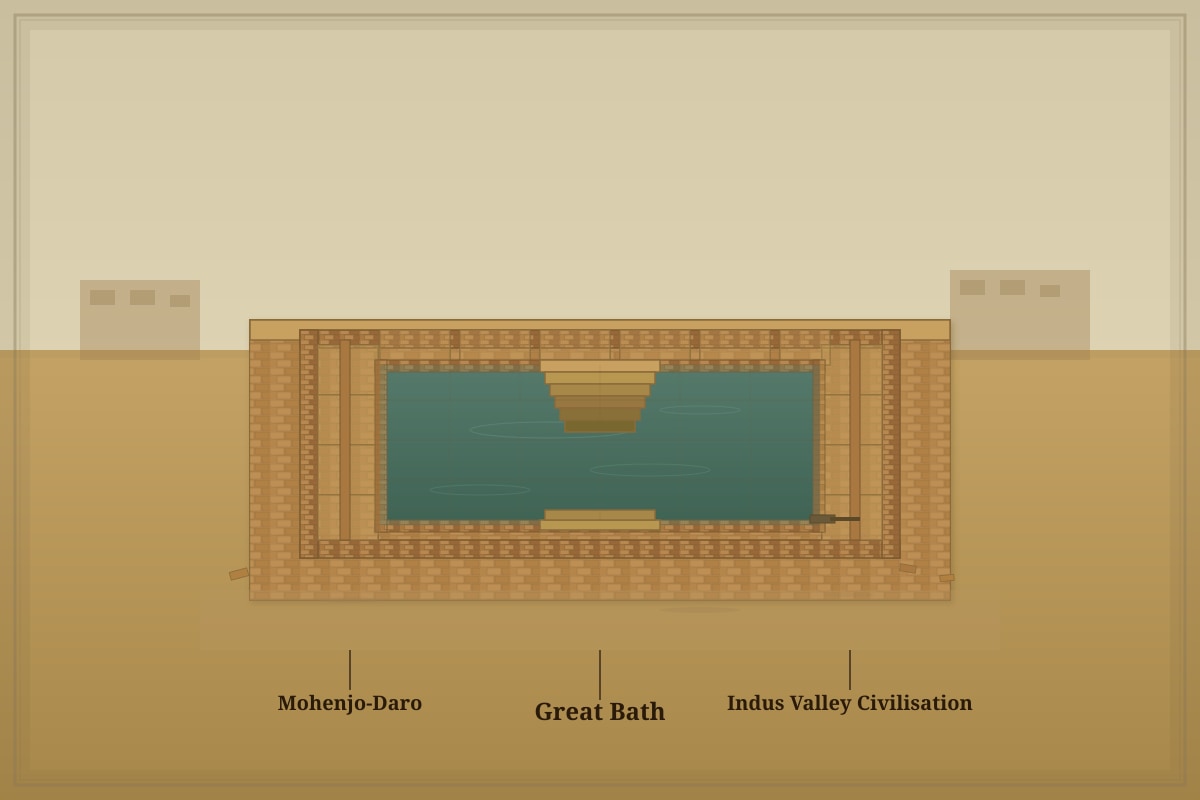
8. What does Source B suggest about the importance of water or bathing in the Indus Valley Civilisation? Explain your answer using details from the source. [3] Answer: Source B suggests that water and bathing were very important to the Indus Valley Civilisation. The Great Bath is a large, carefully constructed brick-lined pool, which shows that it was a significant public structure. The presence of steps leading into the pool suggests it was designed for people to enter the water, likely for ritual purification or communal bathing. The surrounding rooms may have been used for changing or other related activities. The effort and resources put into its construction indicate that it was not just a practical structure but held cultural or religious importance. Marking:
- 1 mark for stating that water/bathing was important.
- 1 mark for citing a specific detail from the source (e.g., "large brick-lined pool," "steps leading down").
- 1 mark for explaining what that detail suggests (e.g., "ritual purification," "communal activity," "significant public structure"). Teaching Note: This question requires students to make an inference based on visual evidence. They should not just describe the image but explain what it implies about the civilisation. The size and complexity of the structure are key indicators of its importance.
9. What type of source is Source B? How might this affect its usefulness to a historian studying the Indus Valley Civilisation? [2] Answer: Source B is a primary source (a photograph of an archaeological remain). It is useful because it provides direct, physical evidence of the civilisation's architecture, engineering skills, and urban planning. However, it has limitations: a photograph alone cannot tell us about the beliefs or rituals associated with the bath, nor can it provide information about daily life, politics, or social structure without further interpretation. Marking:
- 1 mark for identifying it as a primary source (or archaeological/photographic evidence).
- 1 mark for explaining one aspect of its usefulness or limitation (e.g., "it shows real physical evidence" or "it cannot tell us about beliefs"). Teaching Note: Students should understand the difference between primary and secondary sources. A primary source from the time period (like a ruin) is valuable for direct evidence, but it often requires interpretation and may be incomplete.
10. How different are the views of the two historians in Sources C and D? Explain your answer. [4] Answer: The views of the two historians are very different. Source C argues that the invention of writing was the most important achievement of the Sumerians, as it enabled them to record laws, trade, and stories. Source D, however, argues that advanced irrigation systems were more significant because they allowed cities to grow and prosper. The difference lies in what each historian considers the most important factor for Sumerian civilisation's development: Source C emphasises cultural and administrative advancement, while Source D emphasises economic and agricultural foundation. They are not necessarily contradictory, but they prioritise different aspects of civilisation. Marking:
- 1 mark for identifying that the views are different.
- 1 mark for explaining Source C's view (writing for recording laws/trade/stories).
- 1 mark for explaining Source D's view (irrigation for city growth/prosperity).
- 1 mark for explaining the basis of the difference (e.g., different criteria for "importance," one focuses on culture, the other on economics). Teaching Note: This question tests the skill of comparing sources. Students should identify the key claim of each source and then explain why they differ. A simple "they are different because one says writing and the other says irrigation" is worth 2 marks. A deeper explanation of the reason for the difference (different priorities) earns full marks.
Section C: Structured Response Questions (Questions 11–15)
11. Explain two reasons why rivers were important to the development of early civilisations. [4] Answer:
- Reason 1: Rivers provided a reliable source of water for agriculture. The annual flooding of rivers like the Nile, Tigris, and Euphrates deposited fertile silt on the land, allowing farmers to grow surplus crops. This surplus supported larger populations and the growth of cities.
- Reason 2: Rivers served as transportation routes. They allowed for the movement of people, goods, and ideas between different settlements. This facilitated trade, cultural exchange, and the spread of technologies, which helped civilisations to develop and grow. Marking:
- 1 mark for each valid reason identified (2 marks total).
- 1 mark for each reason explained with specific detail or example (2 marks total). Teaching Note: Students should provide two distinct reasons, not two versions of the same idea. Common acceptable reasons include: water for drinking/irrigation, fertile soil from flooding, transportation/trade, and defence.
12. Describe one way in which the social structure of Ancient Egypt was similar to that of Ancient India. [2] Answer: Both Ancient Egypt and Ancient India had a hierarchical social structure with a clear ruling class at the top. In Egypt, the Pharaoh and nobles were at the top, while in India, the Brahmins and Kshatriyas were at the top. Both societies also had a large class of labourers at the bottom (peasants/farmers in Egypt, Shudras in India). Both systems were largely determined by birth and were difficult to change. Marking:
- 1 mark for identifying a valid similarity (e.g., "both had a hierarchy," "both had a ruling class," "both had labourers at the bottom").
- 1 mark for providing specific detail or examples from both civilisations. Teaching Note: This question requires comparative thinking. Students must identify a feature common to both societies and explain it. Avoid vague answers like "they were both divided."
13. What is the main difference between a primary source and a secondary source? Give an example of each. [2] Answer: A primary source is a firsthand account or direct evidence from the time period being studied (e.g., a diary, a photograph, an artifact). A secondary source is an interpretation or analysis of primary sources created after the time period (e.g., a textbook, a historian's article, a documentary). Marking:
- 1 mark for correctly defining the difference.
- 1 mark for providing a valid example of each. Teaching Note: The key distinction is that a primary source was created during the time under study, while a secondary source was created later by someone who was not present.
14. Explain one reason why historians find it difficult to learn about the Indus Valley Civilisation compared to Ancient Egypt or Mesopotamia. [2] Answer: The main reason is that the writing system of the Indus Valley Civilisation has not been deciphered. Unlike Egyptian hieroglyphics or Sumerian cuneiform, which have been translated, the Indus script remains a mystery. This means historians cannot read their records, laws, or literature, and must rely almost entirely on archaeological evidence (buildings, artifacts, seals) to understand their society. Marking:
- 1 mark for identifying the undeciphered script.
- 1 mark for explaining the consequence (e.g., "we cannot read their records"). Teaching Note: Accept other valid reasons, such as the lack of large, well-preserved monumental structures compared to Egypt, or the fact that many Indus sites were buried and only discovered relatively recently. The undeciphered script is the most common and significant reason.
15. How did the development of agriculture lead to the growth of cities in ancient civilisations? Explain your answer. [4] Answer: The development of agriculture led to the growth of cities through a chain of events:
- Food Surplus: Farming produced more food than was needed for immediate survival. This surplus could be stored for future use.
- Specialisation of Labour: Because not everyone needed to farm, some people could specialise in other jobs like crafting tools, building, trading, or governing. This led to a more complex society.
- Population Growth: A reliable food supply supported larger populations. People began to live together in larger, more permanent settlements.
- Centralisation: As settlements grew, they needed organisation: leaders, laws, storage facilities, and defence. This led to the development of governments, trade networks, and the complex social structures that define a civilisation. Marking:
- 1 mark for each well-explained step in the process (up to 4 marks).
- Accept answers that provide 2-3 clear steps with good explanation. Teaching Note: This is a cause-and-effect question. Students should explain the process by which agriculture led to cities, not just state that it did. The key concepts are food surplus, specialisation, population growth, and centralisation.
Section D: Extended Response Questions (Questions 16–20)
16. Explain two features of the government of Ancient Athens that made it a democracy. [4] Answer:
- Feature 1: Direct Citizen Participation. In Athens, all male citizens could participate directly in the Assembly (Ekklesia), which met regularly to debate and vote on laws, war, and foreign policy. This meant that citizens had a direct say in governing, rather than electing representatives.
- Feature 2: Selection by Lot (Sortition). Many public officials, including members of the Council of 500 (Boule), were chosen by random lottery rather than by election. This was intended to prevent the wealthy or powerful from dominating the government and to give every citizen an equal chance to serve. Marking:
- 1 mark for each feature correctly identified (2 marks total).
- 1 mark for each feature explained with specific detail (2 marks total). Teaching Note: Students should avoid vague answers like "people could vote." They need to explain how the system worked (e.g., the Assembly, sortition, ostracism) to show understanding of Athenian democracy.
17. How did the geography of Ancient Greece influence the development of its city-states? Explain your answer. [2] Answer: Greece's mountainous terrain and many islands divided the land into small, isolated valleys and coastal plains. This made communication and travel difficult, so communities developed independently as separate city-states (poleis) rather than as a single unified empire. Each city-state had its own government, laws, and army. Marking:
- 1 mark for identifying the geographical feature (mountains, islands, isolation).
- 1 mark for explaining the consequence (development of independent city-states). Teaching Note: This is a classic cause-and-effect relationship in Ancient Greek history. The geography caused political fragmentation.
18. Name the two main rivers of Ancient Mesopotamia. [1] Answer: The Tigris and the Euphrates. Marking: 1 mark for naming both rivers. Award 0.5 marks if only one is named (but total marks are whole numbers, so accept partial in spirit). Teaching Note: Mesopotamia means "land between the rivers" in Greek. These rivers provided water for irrigation and transportation, but also caused unpredictable flooding.
19. What was the purpose of the pyramids in Ancient Egypt? [1] Answer: The pyramids were built as tombs for the Pharaohs (and sometimes their queens). They were designed to protect the Pharaoh's body and possessions for the afterlife. Marking: 1 mark for "tombs for Pharaohs" or similar. Teaching Note: The pyramids were part of a larger funerary complex. The Egyptians believed in an afterlife and that the Pharaoh's body needed to be preserved (mummified) and protected for his spirit to continue its journey.
20. Explain one way in which the religious beliefs of the Ancient Egyptians influenced their daily life. [2] Answer: The Ancient Egyptians' belief in the afterlife and the importance of pleasing the gods influenced many aspects of daily life. For example, they practiced mummification to preserve the body for the afterlife. They also built and maintained temples, made offerings to the gods, and followed religious rituals to ensure the Nile flooded at the right time and the sun rose each day. Their calendar and festivals were also tied to religious events. Marking:
- 1 mark for identifying a specific way religion influenced daily life (e.g., mummification, temple building, offerings).
- 1 mark for explaining the connection between the belief and the action. Teaching Note: Accept any valid example. The key is to show the link between a religious belief and a daily practice. For example: "Because they believed in an afterlife, they mummified their dead."
END OF ANSWER KEY