AI Generated Exam Paper
Secondary 2 History Practice Paper 4
Free Sec 2 History Practice Paper 4, Nemo3 AI version, with questions, answers, and syllabus-aligned practice for Singapore students.
These static practice materials are generated from the site's syllabus and paper-generation workflow, with source and model context shown so students and parents can evaluate the material before use.
Questions
Free quiz and exam paper access
Enter your details to view this paper
Your access is remembered on this device.
Answers
TuitionGoWhere Practice Paper - History Secondary 2 (Answer Key)
Subject: History
Level: Secondary 2 (G2/G3)
Paper: Practice Paper — Singapore & Southeast Asia (1942–1965) — Version 4
Total Marks: 50
Section A: Source-Based Case Study [25 marks]
1(a) Study Source A. What can you infer about David Marshall's view of the British colonial government's approach to self-government? Support your inference with evidence from the source. [3]
Answer:
- Inference: David Marshall viewed the British colonial government's approach as too slow, dismissive of the people's urgent needs, and out of touch with the realities faced by ordinary Singaporeans. [1 mark]
- Evidence 1: He criticises the British talk of "gradual constitutional progress" and contrasts it with the people's immediate needs — "they cannot eat 'gradual progress'. They need rice on the table, fair wages, and the dignity of being masters in their own house." [1 mark]
- Evidence 2: He frames the riots as a "symptom of a people who have been told to wait, and wait, and wait — while their children go hungry," implying the British policy of delay is the root cause of unrest. [1 mark]
Marking Notes:
- 1 mark for a valid inference about Marshall's view (critical, impatient, pro-people).
- 1 mark for each piece of supporting evidence from the source (max 2 marks for evidence).
- Answers that only paraphrase without inferring an attitude/view: max 1 mark.
- Common mistake: Stating Marshall was "anti-British" — the source explicitly says "not because we are anti-British, but because we are pro-Singapore."
1(b) Study Source B. Why would the British Colonial Office have classified this memorandum as "Secret"? Explain your answer using details from the source. [4]
Answer: The memorandum was classified "Secret" because it contains frank assessments of the Chief Minister's competence and political reliability that could damage Anglo-Singapore relations and undermine the constitutional experiment if made public. [1 mark for identifying the reason: sensitivity of content]
Supporting details from the source:
- It describes Marshall as having "political naivety or tacit sympathy" with communist-front organisations — a serious accusation against a sitting Chief Minister. [1 mark]
- It questions whether the "constitutional experiment can survive" under his leadership, revealing British doubts about the viability of self-government. [1 mark]
- It links the situation to "the security of the Federation of Malaya and the broader strategic interests of the Commonwealth in Southeast Asia," indicating high-level strategic sensitivity. [1 mark]
Marking Notes:
- 1 mark for identifying the general reason (sensitive/politically damaging content).
- Up to 3 marks for specific evidence from the source explaining why it is sensitive (1 mark per distinct point).
- Do not accept generic answers like "it was a government document" without source support.
- Common mistake: Focusing only on the "communist" aspect without linking to why that makes it secret (i.e., diplomatic/political sensitivity).
2 Study Sources A and B. How different are these two sources in their portrayal of David Marshall and the unrest in 1955? Explain your answer using details from both sources. [6]
Answer:
Similarity (1–2 marks): Both sources acknowledge that unrest existed in 1955 and that David Marshall was the Chief Minister dealing with it. Source A refers to "the riots we see today"; Source B mentions "the recent Hock Lee Bus dispute" and "Anti-National Service Riots of May 1954."
Differences (4–5 marks for well-explained differences):
| Aspect | Source A (Marshall's speech) | Source B (British memorandum) |
|---|---|---|
| Portrayal of Marshall | Champion of the people, fighting for "immediate self-government" and "dignity"; "pro-Singapore", not anti-British. | "Brilliant orator but poor administrator"; "political naivety or tacit sympathy" with communists; unable to "distinguish between democratic dissent and subversion." |
| Cause of unrest | Legitimate grievances: hunger, low wages, delayed self-government; riots are a "symptom" of British inaction. | Communist exploitation: "communist-front organisations... exploiting legitimate grievances to destabilise the government"; Hock Lee strike was a challenge to authority, not about wages. |
| Provenance/Purpose | Public speech to Legislative Assembly — aims to rally support, justify Labour Front's mandate, pressure British. | Classified internal memo — aims to assess security risk, advise HMG on viability of constitutional experiment. |
| Tone | Empathetic, urgent, moral. | Suspicious, analytical, strategic. |
Conclusion: The sources are very different in their portrayal. Source A presents Marshall as a heroic leader responding to popular will; Source B portrays him as a weak leader enabling a communist threat. They disagree fundamentally on the nature of the unrest (popular vs. subversive) and Marshall's role (champion vs. liability).
Marking Notes:
- L1 (1–2 marks): Identifies similarity OR difference without explanation, or only compares content superficially (e.g., "Source A says X, Source B says Y").
- L2 (3–4 marks): Explains one difference well with evidence from both sources, OR explains similarity and one difference.
- L3 (5–6 marks): Explains two or more differences with clear evidence from both sources, and addresses provenance/purpose/tone as a reason for the difference. Must reach a clear overall judgement ("very different", "largely different").
- Common trap: Listing content differences without explaining why the sources differ (provenance, purpose, perspective). Provenance analysis is essential for top marks.
3 Study Source C. How useful is Source C as evidence about the causes of the 1955 Hock Lee Bus Riots? Explain your answer using the source and your knowledge. [6]
Answer:
Useful (3–4 marks):
- Insider perspective: Lee Kuan Yew was a key political figure in 1955–56 (legal advisor to unions, later PAP leader). His memoir offers a first-hand, contemporaneous political analysis from someone close to events. [1 mark]
- Specific claim about communist role: He states the Hock Lee strike was organised "not for better wages — the workers already had a fair offer — but to challenge the government's authority" by communists using unions as their base. This provides a clear argument for communist instigation as a cause. [1 mark]
- Explains escalation: Links Marshall's hesitation ("negotiated instead of clearing the streets") to British loss of confidence and communist emboldenment, helping explain why unrest continued into 1956. [1 mark]
Not Useful / Limitations (3–4 marks):
- Hindsight and bias: Written in 1998, over 40 years later, by Lee as Prime Minister reflecting on his political rival (Marshall) and justifying his own anti-communist narrative. He had a vested interest in portraying communists as the main villains and Marshall as incompetent. [1 mark]
- Contradicted by other evidence: Source A (Marshall) frames unrest as legitimate grievance; Source D shows strike activity peaking in 1955 — suggesting genuine labour discontent, not just communist manipulation. The "fair offer" claim is contested — workers rejected it. [1 mark]
- Selective memory: Omits British role in provoking unrest (e.g., National Service Ordinance) and downplays genuine socio-economic causes (low wages, poor conditions). [1 mark]
Overall Judgement (1–2 marks for balanced conclusion): Source C is useful as a perspective from a key anti-communist leader but must be cross-referenced with Sources A, B, D and knowledge of genuine labour grievances. It is not reliable as a standalone account of the riots' causes due to hindsight, political bias, and selective evidence.
Marking Notes:
- L1 (1–2 marks): Asserts useful/not useful with no support, or only summarises source.
- L2 (3–4 marks): Explains usefulness OR limitations with source evidence and some knowledge.
- L3 (5–6 marks): Balanced evaluation — explains both usefulness and limitations with specific source details and contextual knowledge, reaching a reasoned conclusion. Must mention provenance (memoir, 1998, Lee's role) and cross-reference.
- Common mistake: Treating Lee's memoir as objective fact. Top answers recognise it as a political interpretation.
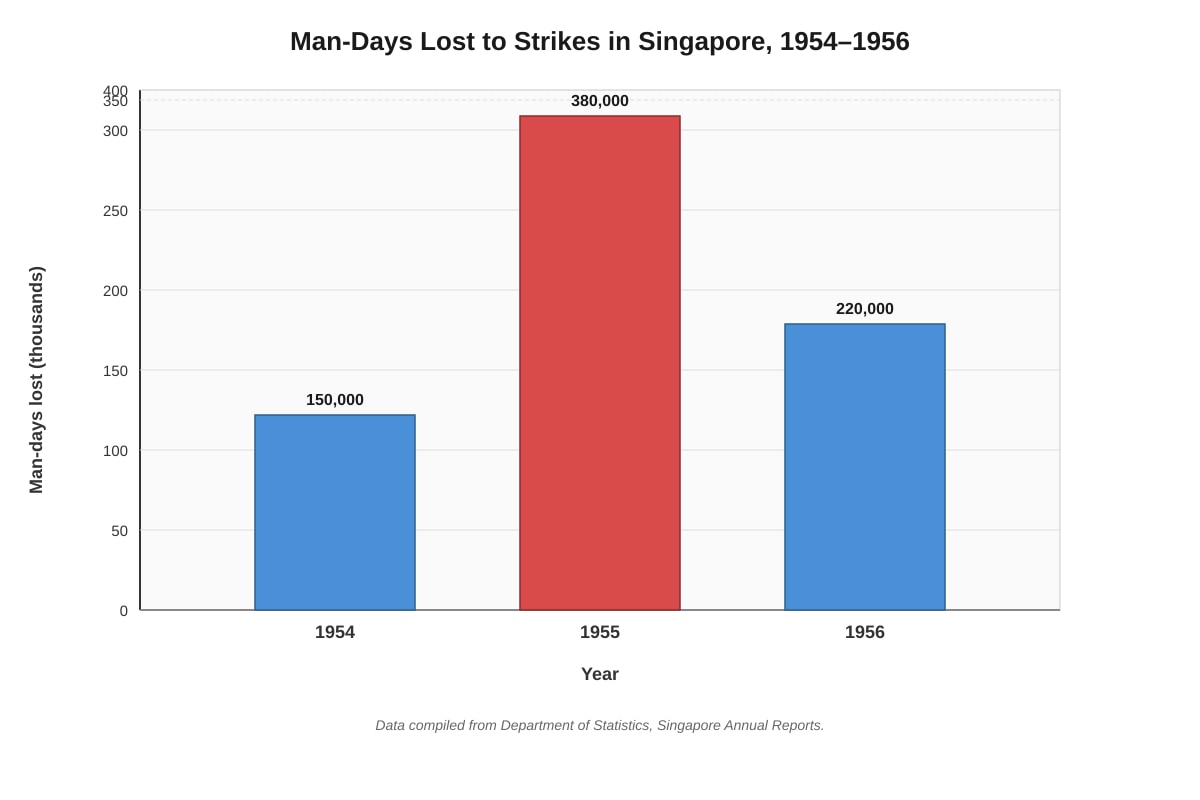
4 Study Source D. What does Source D tell you about the trend of labour unrest in Singapore from 1954 to 1956? Support your answer with evidence from the source. [3]
Answer:
- Overall trend: Labour unrest increased sharply from 1954 to 1955, then declined in 1956 but remained higher than 1954 levels. [1 mark]
- Evidence 1: Man-days lost rose from ~150,000 in 1954 to ~380,000 in 1955 — more than doubling. [1 mark]
- Evidence 2: In 1956, man-days lost fell to ~220,000, but this was still ~70,000 higher than 1954. [1 mark]
Marking Notes:
- 1 mark for correct overall trend description (rise then fall, but 1956 > 1954).
- 1 mark each for two accurate data points with units (man-days, years).
- Do not accept "decreased from 1955 to 1956" without noting 1956 > 1954.
- Common mistake: Saying unrest "decreased overall" from 1954–1956 — incorrect.
5 "The main cause of social unrest in Singapore from 1954 to 1956 was communist exploitation of legitimate grievances." Using all four sources and your knowledge, explain how far you agree with this statement. [8]
Answer:
Agree (Communist exploitation was a major cause) — Supported by Sources B, C, and knowledge:
- Source B (British memo): Explicitly states "communist-front organisations... are exploiting legitimate grievances to destabilise the government" — names SFSWU and Chinese Middle School Students' Union. [1 mark]
- Source C (Lee Kuan Yew): Argues Hock Lee strike was "not for better wages" but to "challenge the government's authority"; Chinese Middle School riots (1956) were students "manipulated by communist cadres". [1 mark]
- Knowledge: Communist Party of Malaya (CPM) used united front tactics — infiltrated unions (SFSWU), Chinese schools, and cultural groups. The 1954 Anti-National Service Riots were sparked by the NS Ordinance but organised by communist-linked students. The 1956 riots followed the deregistration of Chinese Middle School Students' Union and closure of Chung Cheng High — communist cadres mobilised students. [1–2 marks]
Disagree (Legitimate grievances / other factors were equally/more important) — Supported by Sources A, D, and knowledge:
- Source A (Marshall): Unrest is a "symptom" of people "told to wait... while their children go hungry" — socio-economic grievances (food, wages, dignity) and political frustration (delayed self-government) are the root cause; communists are not mentioned. [1 mark]
- Source D (Chart): Strike activity peaked in 1955 (380k man-days) — the year Marshall's Labour Front government was in power and before the major 1956 communist-linked school riots. Suggests genuine industrial unrest driven by labour demands, not just communist plotting. [1 mark]
- Knowledge: Post-war conditions — inflation, unemployment, housing shortages, low wages — fuelled genuine discontent. The British Military Administration's failures (1945–47) created a legacy of distrust. The Rendel Constitution (1955) gave limited self-government (no control over defence, foreign affairs, internal security), frustrating nationalists. The National Service Ordinance (1954) was seen as forcing locals to defend a colonial regime. [1–2 marks]
Synthesis / Judgement (1–2 marks): Communist exploitation was a significant factor, especially in escalating and directing unrest (e.g., 1956 school riots), but it required the fuel of legitimate grievances to gain traction. The unrest was not mainly caused by communists — they exploited conditions created by British colonial policy, post-war hardship, and political frustration. A more accurate view: legitimate grievances were the underlying cause; communist exploitation was a key accelerant and organisational force, particularly from 1955 onward.
Marking Notes:
- L1 (1–2 marks): One-sided answer, asserts agreement/disagreement with little evidence.
- L2 (3–5 marks): Uses sources to support one side well, or both sides superficially. May list sources without evaluating them.
- L3 (6–7 marks): Balanced use of all four sources + knowledge, clear explanation of both sides, with evidence.
- L4 (8 marks): Synthesised judgement — weighs the relative importance, explains interaction between grievances and exploitation, uses provenance awareness (e.g., Source B/C reflect British/anti-communist view; Source A reflects popular view; Source D shows empirical trend). Reaches a nuanced conclusion.
- Common mistake: Treating "communist exploitation" and "legitimate grievances" as mutually exclusive. Best answers show they interacted.
Section B: Structured Response Questions [25 marks]
6(a) Explain two reasons why the Japanese were able to conquer Singapore so quickly in February 1942. [4]
Answer: Reason 1: British military unpreparedness and strategic miscalculations. [1 mark for identification]
- The British expected a sea attack from the south; defences (large naval guns) faced seaward and could not traverse effectively inland. The Japanese advanced down the Malay Peninsula by land, using bicycles and light tanks through jungle terrain the British considered "impassable". [1 mark for elaboration]
Reason 2: Japanese tactical superiority and morale. [1 mark for identification]
- Japanese forces were battle-hardened from campaigns in China, used combined arms tactics (infantry, tanks, air support), and had air superiority after sinking HMS Prince of Wales and Repulse (Dec 1941). Their soldiers were highly motivated by the "spirit of Yamato" and the goal of liberating Asia from Western colonialism. [1 mark for elaboration]
Other acceptable reasons (any two):
- British forces were outnumbered, poorly trained, and included many inexperienced recruits (e.g., 18th Division arrived weeks before surrender).
- Lack of naval and air cover after the sinking of Force Z and destruction of RAF squadrons.
- Poor coordination between British, Australian, and Indian units; Percival's dispersal of forces across the island instead of concentrating at critical points (e.g., Jurong Line).
- Psychological impact of rapid Japanese advance and propaganda ("Asia for Asians") undermined British/Commonwealth morale.
Marking Notes:
- 2 marks per reason: 1 for identification, 1 for specific elaboration/evidence.
- Do not accept "British were weak" without specifics.
- Common mistake: Confusing the 1942 conquest with the 1941–42 Malayan Campaign — ensure the focus is on the final assault on Singapore Island (8–15 Feb 1942).
6(b) "The Japanese Occupation (1942–1945) had a greater impact on the political awakening of Singaporeans than the British Military Administration (1945–1947)." How far do you agree? Explain your answer. [8]
Answer:
Agree: Japanese Occupation had greater impact (4–5 marks for well-developed points):
- Shattered the myth of Western superiority: The swift defeat of the British in 1942 destroyed the aura of European invincibility. Singaporeans saw that Asians could defeat Europeans — a powerful psychological shift. [1 mark]
- Harsh rule fostered nationalism and anti-colonialism: The Sook Ching massacre (25,000–50,000 Chinese males killed), forced labour (Death Railway), inflation, and food shortages created shared trauma and resentment against foreign rule — whether Japanese or British. [1 mark]
- Political opportunities for locals: The Japanese recruited locals into administration (e.g., Mamoru Shinozaki, Dr. Paglar), allowed Indian National Army (INA) and Kesatuan Melayu Muda (KMM) to operate, and promoted "Asia for Asians" propaganda. This gave future leaders (Lee Kuan Yew, Goh Keng Swee, etc.) administrative experience and a vision of self-rule. [1 mark]
- Radicalisation of Chinese-educated: Chinese community leaders were executed or co-opted; Chinese schools became centres of anti-Japanese resistance, later morphing into pro-communist, anti-colonial activism (e.g., Chinese Middle School Students' Union). [1 mark]
Disagree: BMA period was equally/more important (4–5 marks for well-developed points):
- Return of British rule exposed colonial contradictions: The BMA (Sept 1945–April 1946) was incompetent and corrupt — food rationing failures, black markets, unemployment, currency issues (Banana Money worthless). This deepened disillusionment with British competence and legitimacy. [1 mark]
- Failure to address grievances sparked organised politics: The BMA's slow response to strikes, high cost of living, and lack of political representation led directly to the rise of trade unions, the Malay Union, the Indian Association, and the formation of political parties (Labour Front 1954, PAP 1954, UMNO/MCA in Malaya). [1 mark]
- Constitutional awakening: The British White Paper of 1946 (proposing Malayan Union) and subsequent Federation of Malaya Agreement (1948) galvanised Malay nationalism (anti-Malayan Union protests) and Chinese political consciousness (fear of marginalisation). The 1948 Constitution (Legislative Council with elected seats) began the electoral path. [1 mark]
- Labour movement explosion: 1946–47 saw major strikes (General Strike Jan 1946, Telok Ayer Basin strike) — the first mass political mobilisation of workers, laying groundwork for 1950s unrest. [1 mark]
Synthesis / Judgement (1–2 marks): The Japanese Occupation provided the psychological breakthrough — proving colonial rule was not permanent, inspiring nationalist aspirations, and radicalising a generation. However, the BMA period provided the political opening — the return of a discredited colonial power that failed to govern, creating the conditions for organised political parties, elections, and the demand for self-government. Both were essential: the Occupation ignited the desire for self-rule; the BMA enabled its organised expression. If forced to choose, the Occupation's impact was more foundational — without it, the post-war political awakening would have lacked its anti-colonial urgency and mass base.
Marking Notes:
- L1 (1–2 marks): One-sided, general assertions.
- L2 (3–5 marks): Explains one side well with specific evidence, or both sides superficially.
- L3 (6–7 marks): Balanced explanation with specific evidence for both periods (Sook Ching, INA, KMM, BMA failures, 1946 strikes, constitutional steps).
- L4 (8 marks): Synthesised judgement — explains how the two periods interacted (Occupation created the will; BMA created the way), uses precise evidence, and reaches a nuanced conclusion.
- Common mistake: Describing hardships during Occupation without linking to political awakening. Must connect suffering/trauma to political consciousness.
7(a) Describe two key features of the Rendel Constitution (1955). [4]
Answer: Feature 1: Limited self-government with a Legislative Assembly. [1 mark]
- Established a 32-member Legislative Assembly with 25 elected seats (first time majority elected), 7 nominated by the Governor. The Chief Minister (David Marshall) and Council of Ministers (6 elected members) were drawn from the Assembly, responsible for domestic policy (education, health, labour, housing). [1 mark for elaboration]
Feature 2: British retention of reserved powers (internal security, defence, foreign affairs, finance). [1 mark]
- The Governor (British appointee) retained control over internal security, defence, foreign affairs, and finance — the "reserved matters". The Chief Minister and ministers had no authority over these critical areas. The British High Commissioner could veto legislation. [1 mark for elaboration]
Other acceptable features (any two):
- Automatic voter registration (expanded electorate to ~300,000, including many Chinese-educated and women).
- Formation of political parties to contest elections (Labour Front, PAP, UMNO-MCA Alliance, etc.).
- Leader of the Opposition formally recognised.
- Public Service Commission established to reduce patronage.
Marking Notes:
- 2 marks per feature: 1 for identification, 1 for specific detail.
- Must distinguish from 1948 Constitution (only 6 elected seats) and 1958 Constitution (full internal self-government).
- Common mistake: Claiming full self-government — the Rendel Constitution was partial self-government.
7(b) "The merger with Malaya in 1963 was driven primarily by economic necessity." How far do you agree? Explain your answer. [9]
Answer:
Agree: Economic necessity was a primary driver (4–5 marks for well-developed points):
- Small domestic market: Singapore had no natural resources, no hinterland, and a population of ~1.7 million. Industrialisation required a larger market — Malaya offered 6+ million consumers. [1 mark]
- Unemployment and entrepôt decline: Post-war unemployment was ~14% (1959). The traditional entrepôt trade was declining due to Indonesian confrontation (Konfrontasi later) and containerisation. A common market with Malaya would allow tariff-free access, attracting investment and creating jobs. [1 mark]
- PAP's survival depended on economic delivery: The PAP won 1959 on promises of "work, wages, welfare". By 1961, industrialisation (Jurong) was struggling without a guaranteed market. Merger was sold as the economic lifeline — "Malaysia is our hinterland." [1 mark]
- Water and food security: Singapore relied on Malaya for raw water (Johor River) and food supplies — merger guaranteed these via federal agreement. [1 mark]
Disagree: Political and security factors were equally/more important (4–5 marks for well-developed points):
- Anti-communist security: The British and Malayan leaders (Tunku Abdul Rahman) feared a communist takeover in Singapore (PAP's left wing, Barisan Sosialis). Merger would place Singapore's internal security under Kuala Lumpur, allowing the Internal Security Council (ISC) to detain communists — which happened in Operation Coldstore (Feb 1963). [1 mark]
- British strategic interest: Britain wanted to protect its military bases and economic investments in the region. A merged Malaysia would be a stable, pro-Western, anti-communist federation — a bulwark against communism in Southeast Asia (domino theory). Britain pressured the Tunku to accept merger. [1 mark]
- PAP's political survival: By 1961, the PAP faced a split (13 left-wing assemblymen defected to form Barisan Sosialis). The PAP needed merger to legitimise its mandate, call a referendum (1962), and use federal power to crush the communist challenge. Lee Kuan Yew admitted: "Without merger, we would have been swallowed by the communists." [1 mark]
- Malay nationalism / Tunku's calculation: The Tunku initially opposed merger (feared Chinese majority). He agreed only after Sabah, Sarawak, and Brunei were included to balance the racial demographics (Malay majority in federation). This was a political/racial calculation, not economic. [1 mark]
Synthesis / Judgement (1–2 marks): Economic necessity was the public justification and a real constraint, but political survival — of the PAP, the British position, and the Tunku's racial arithmetic — was the decisive driver. The PAP needed merger to defeat the Barisan; the British needed it to secure their base and exit honourably; the Tunku accepted it only with Borneo territories to preserve Malay dominance. Economics provided the rhetoric; politics provided the imperative. Therefore, the statement overstates economics and understates politics — merger was primarily a political act with economic benefits.
Marking Notes:
- L1 (1–2 marks): One-sided, general.
- L2 (3–5 marks): One side well explained, or both sides listed without depth.
- L3 (6–7 marks): Balanced, specific evidence for both economic and political factors (common market, unemployment, ISC, Coldstore, Borneo territories, PAP split).
- L4 (8–9 marks): Synthesised judgement — distinguishes public rationale from private motives, explains interaction (e.g., PAP used economic argument to win referendum, but political motive was survival), uses precise evidence (Operation Coldstore, 1962 referendum, Borneo inclusion), and reaches a nuanced conclusion.
- Common mistake: Treating "economic necessity" and "political survival" as separate. Best answers show how the PAP used economics to achieve political ends.
END OF ANSWER KEY