AI Generated Exam Paper
Secondary 2 History Practice Paper 3
Free Sec 2 History Practice Paper 3, Nemo3 AI version, with questions, answers, and syllabus-aligned practice for Singapore students.
These static practice materials are generated from the site's syllabus and paper-generation workflow, with source and model context shown so students and parents can evaluate the material before use.
Questions
Free quiz and exam paper access
Enter your details to view this paper
Your access is remembered on this device.
Answers
TuitionGoWhere Practice Paper - History Secondary 2 (Answer Key)
Subject: History
Level: Secondary 2 (G2/G3)
Paper: Practice Paper — Singapore & Southeast Asia (1942–1965) — Version 3
Total Marks: 50
Section A: Source-Based Case Study [25 marks]
1. Study Source A. What can you infer from Source A about David Marshall's view of British colonial rule? Support your inference with evidence from the source. [3]
Answer:
Inference: David Marshall viewed British colonial rule as illegitimate, outdated, and something Singaporeans had suffered under long enough. He believed Singapore had earned the right to self-government through its endurance of hardship.
Evidence from Source A:
- "We are not asking for charity. We are asking for the right to govern ourselves." → Shows he saw self-government as a right, not a favour.
- "The people of Singapore have suffered under colonial rule long enough." → Explicitly states colonial rule caused suffering.
- "They have endured the Japanese Occupation... and they have shown they are capable of managing their own affairs." → Argues Singaporeans proved their capability through suffering.
- "The era of colonialism is over." → Declares colonial rule historically obsolete.
Marking Notes:
- 1 mark for a valid inference about Marshall's view.
- 1 mark for relevant evidence from the source.
- 1 mark for explaining how the evidence supports the inference.
- Common mistake: Paraphrasing the source without making an inference (e.g., "He wanted self-government" is not an inference — it is stated directly).
2. Study Sources A and B. How different are Sources A and B in their views on self-government for Singapore? Explain your answer using details from both sources. [6]
Answer:
Overall: Sources A and B are very different in their views on self-government for Singapore.
Difference 1: Timing and urgency
- Source A (Marshall): Demands immediate self-government — "not in five years, not in ten years, but now."
- Source B (British Colonial Office): Opposes "premature self-government" and argues for retaining British control of defence and external affairs while allowing only "limited local autonomy in domestic matters."
Difference 2: Assessment of Singapore's readiness
- Source A: Argues Singaporeans "have shown they are capable of managing their own affairs" through enduring the Japanese Occupation and post-war hardships.
- Source B: Warns that "premature self-government would risk handing power to elements sympathetic to the Communist cause" and that the "Communist threat remains acute."
Difference 3: View of British role
- Source A: Sees British rule as something to end — "the era of colonialism is over."
- Source B: Sees British military presence as "vital to the defence of the Sterling Area and the security of Southeast Asia" — a strategic necessity.
Provenance/Context Support:
- Source A is a public speech by Marshall in 1955, aimed at rallying popular support and pressuring the British — its purpose is to mobilise and demand.
- Source B is a classified British memorandum from 1955, reflecting internal strategic calculations — its purpose is to justify retaining control.
Marking Notes:
- 1–2 marks: Identifies one difference with evidence from both sources.
- 3–4 marks: Identifies two differences with evidence from both sources.
- 5–6 marks: Identifies two or more differences, uses evidence from both sources, and explains why the sources differ (provenance/purpose/audience).
- Common mistake: Listing content differences without explaining the reason for the difference (e.g., author, purpose, date, perspective).
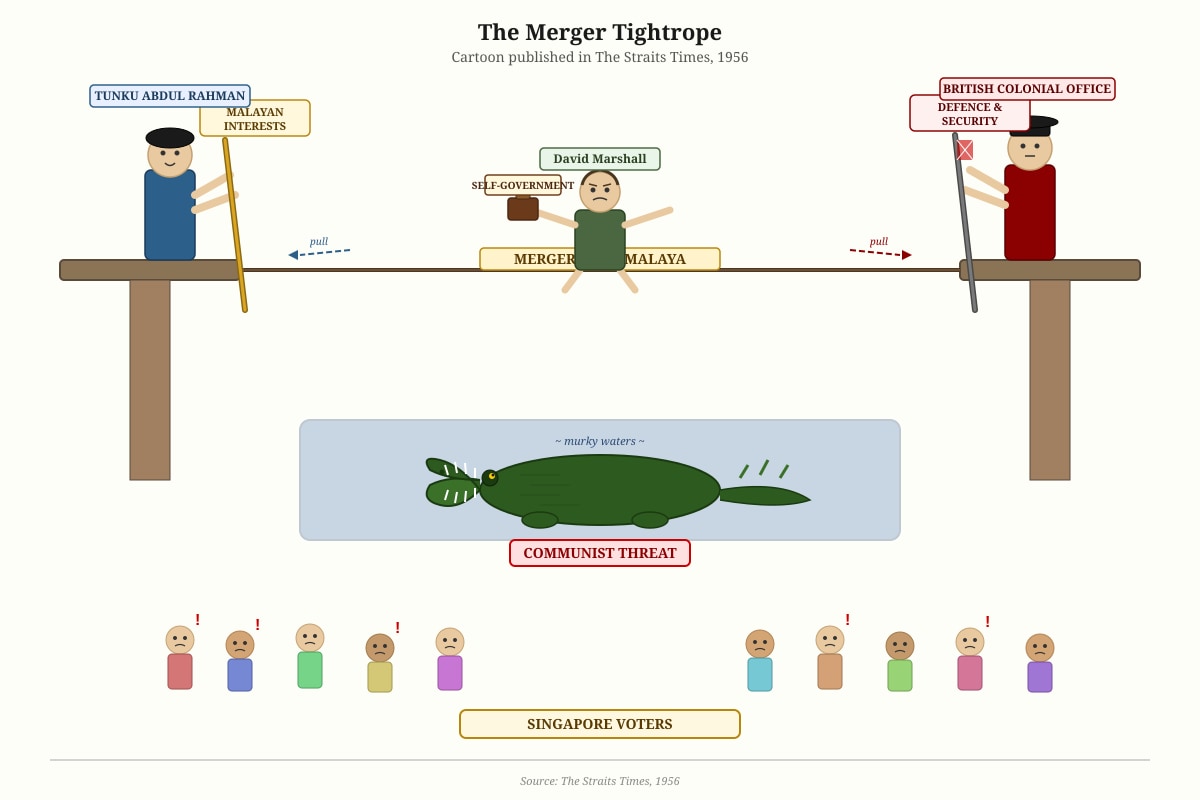
3. Study Source C. What is the cartoonist's message about the merger negotiations in 1956? Explain your answer using details from the cartoon. [5]
Answer:
Message: The cartoonist portrays the 1956 merger negotiations as a dangerous, high-stakes balancing act for David Marshall, where he must navigate conflicting pressures from Malaya, the British, and the communist threat, with the risk of political failure (falling into the crocodile's jaws) if he loses balance.
Supporting details from the cartoon:
- Tightrope metaphor: Marshall walking a tightrope labelled "MERGER WITH MALAYA" shows merger is precarious and requires careful balance.
- Three-way tension:
- Tunku Abdul Rahman pulls one pole labelled "MALAYAN INTERESTS" — Malaya has its own demands.
- British Colonial Office pulls the other pole labelled "DEFENCE & SECURITY" — Britain refuses to relinquish strategic control.
- Marshall is caught in the middle, carrying a briefcase labelled "SELF-GOVERNMENT" — his goal is squeezed between external pressures.
- Crocodile ("COMMUNIST THREAT"): Waiting below with open jaws — failure to balance means political destruction by communist forces.
- Anxious spectators ("SINGAPORE VOTERS"): The public watches uncertainly — their future depends on the outcome.
Marking Notes:
- 1 mark: Identifies the main message (merger as dangerous balancing act).
- 2 marks: Message + 1–2 supporting details from the cartoon.
- 3–4 marks: Message + multiple details + explanation of what the symbols represent.
- 5 marks: Full explanation of message, detailed use of visual evidence (labels, positions, symbols), and interpretation of the cartoonist's perspective (critical of the process, highlighting danger).
- Common mistake: Describing the cartoon without stating the message (what the cartoonist thinks/feels about the situation).
4. Study Sources C and D. Does Source C prove that Source D is wrong about the benefits of merger? Explain your answer. [5]
Answer:
No, Source C does not prove Source D is wrong.
Reasoning:
- Source D (Lee Kuan Yew, 1961) argues merger brings benefits: "jobs", "survival", "future for our children", and a "common market". It presents merger as the solution to Singapore's economic and political vulnerability.
- Source C (Cartoon, 1956) depicts the process of negotiating merger as dangerous and difficult — Marshall balancing competing demands from Malaya, Britain, and the communist threat. It highlights the risks and challenges of achieving merger, not the outcome of merger itself.
Key distinction:
- Source D makes a claim about the outcome/benefits of a successful merger (looking forward to 1961, after terms were agreed).
- Source C illustrates the perils of the negotiation process in 1956 (before terms were settled).
- A source showing that negotiating merger is risky does not disprove that achieving merger would be beneficial. They address different stages and aspects.
Provenance context:
- Source C (1956) reflects the uncertainty of the Marshall-era talks, which eventually failed.
- Source D (1961) reflects the PAP's campaign for the successful merger terms negotiated later.
Marking Notes:
- 1–2 marks: "No" with weak or no explanation.
- 3 marks: "No" with explanation that they address different things (process vs. outcome) but limited use of source details.
- 4–5 marks: Clear "No", explains the distinction between negotiation risks (Source C) and merger benefits (Source D), uses specific details from both sources, and references provenance/dates.
- Common mistake: Saying "Source C shows merger is dangerous, so it proves Source D wrong" — confusing difficulty of process with value of outcome.
5. Study Source E. How useful is Source E as evidence for the reasons why Singapore separated from Malaysia? Explain your answer. [6]
Answer:
Source E is useful to a limited extent. It provides the official Singapore Government position on the separation but has limitations as a complete explanation.
Useful aspects (what it tells us):
- Official reasons stated by Singapore: "fundamental differences" on:
- "Malaysian Malaysia versus a Malay Malaysia" → political vision (equality vs. Malay supremacy).
- "Economic policy" → disputes over common market, revenue contributions, pioneer status.
- "Political approach" → PAP's participation in Malaysian politics (1964 federal election) vs. Alliance's communal politics.
- Singapore's perspective: Separation was agreed to "in the interests of peace and stability" — frames it as a reluctant, rational choice.
- Provenance: Official White Paper (9 Aug 1965) — authoritative statement of Singapore's position at the moment of independence.
Limitations (what it does NOT tell us / reliability issues):
- Malaysian perspective: No mention of Tunku's reasons (e.g., fear of PAP challenging Malay dominance, racial riots of 1964, political rivalry).
- Deeper causes: Does not explain the build-up — 1964 racial riots, PAP–Alliance conflict, economic disputes (revenue sharing, Borneo markets), "Malaysian Malaysia" campaign.
- Self-justification: As an official government document, it presents Singapore's actions in the best light — "agreed to separation" downplays the fact that Singapore was expelled by a 126–0 vote in the Malaysian Parliament.
- Timing: Written on the day of separation — retrospective, not a contemporaneous record of negotiations.
Conclusion: Useful for Singapore's official narrative and stated reasons, but not sufficient alone — must be cross-referenced with Malaysian sources, records of 1964 riots, economic data, and political correspondence for a full picture.
Marking Notes:
- 1–2 marks: Identifies usefulness OR limitations only, with little evidence.
- 3–4 marks: Balanced answer — identifies both usefulness and limitations, uses source details.
- 5–6 marks: Well-developed evaluation — specific content from Source E, clear explanation of why it is useful/limited (provenance, purpose, omissions), and conclusion on extent of usefulness.
- Common mistake: Saying "It is useful because it is a primary source" without analysing what it shows and what it leaves out.
Section B: Structured Response Questions [25 marks]
6. Explain two reasons why the British Military Administration (BMA) faced difficulties in governing Singapore after the Japanese surrender in 1945. [4]
Answer:
Reason 1: Severe post-war economic and social disruption
- The Japanese Occupation (1942–1945) devastated Singapore's economy — infrastructure (port, utilities, railways) was damaged or neglected.
- Acute food shortages (rice imports cut off), hyperinflation (banana money worthless), and unemployment (port idle, factories stripped) created desperate conditions.
- The BMA lacked resources to quickly restore food supply, repair infrastructure, and create jobs, leading to widespread discontent.
Reason 2: Loss of British prestige and legitimacy
- The swift British defeat in February 1942 shattered the myth of British invincibility and superiority.
- Many locals no longer accepted British authority as natural or legitimate — the Occupation showed Asians could govern (e.g., Japanese administration, Indian National Army).
- This fueled political awakening and demands for self-rule, making it harder for the BMA to govern without consent.
Alternative valid reasons (any two):
- Labour unrest/strikes (e.g., 1946 General Strike, 1947–48 strikes) driven by economic hardship and communist influence.
- Inadequate personnel and resources — BMA staff were often inexperienced, military officers untrained in civil administration.
- Rising nationalist and communist movements — MCP and trade unions mobilised workers against colonial rule.
- Housing and sanitation crises — overcrowding, squatter settlements, disease outbreaks (e.g., cholera).
Marking Notes:
- 1 mark per reason identified + 1 mark for explanation/elaboration with specific detail.
- Total 4 marks (2 × 2).
- Common mistake: Vague reasons like "the economy was bad" without specifics (food, inflation, infrastructure).
7. "The main reason for the declaration of the Malayan Emergency in 1948 was the communist insurgency." How far do you agree? Explain your answer. [8]
Answer:
Stand: The communist insurgency was the immediate trigger, but the Emergency was declared due to a combination of factors — communist violence, British strategic interests, and the failure of political solutions. I partially agree.
Argument 1: Communist insurgency was the direct trigger (Agree)
- MCP (Malayan Communist Party) launched armed struggle in June 1948 — attacks on rubber plantations, tin mines, and police stations.
- Three European planters murdered in Sungai Siput (16 June 1948) → High Commissioner Sir Edward Gent declared Emergency on 18 June 1948.
- MCP aimed to overthrow British rule and establish a communist state — inspired by Chinese Revolution (1949) and global Cold War context.
- Without this armed uprising, the Emergency would not have been declared at that moment.
Argument 2: British strategic and economic interests were underlying causes (Disagree — broader reasons)
- Malaya's rubber and tin were vital to British post-war economic recovery (dollar earnings for Sterling Area).
- British military bases (Singapore, Malaya) were key to defence in Asia — could not risk communist control.
- The British refused to recognise MCP as a legal political party (1947–48), banning it and pushing it underground — political repression contributed to MCP's turn to violence.
- Cold War context: British and US fears of communist expansion in Southeast Asia (Domino Theory) made a hard line inevitable.
Argument 3: Failure of political negotiation and social grievances (Disagree — structural causes)
- Post-war hardship: Food shortages, unemployment, low wages, poor living conditions fuelled support for MCP among Chinese squatters and workers.
- British policies: Deportation of union leaders, ban on trade unions, use of force against strikes (e.g., 1947–48) alienated Chinese community.
- MCP's shift to violence was partly a response to closed political space — the "White Paper on Federation" (1947) excluded non-Malays from easy citizenship, angering Chinese.
Synthesis/Conclusion:
The communist insurgency was the proximate cause (the spark), but British economic interests, Cold War geopolitics, and the failure to address Chinese political and socio-economic grievances were fundamental causes (the fuel). The Emergency was declared because of the insurgency, but the insurgency itself arose from deeper structural conditions.
Marking Notes (Levels of Response):
- L1 (1–2 marks): One-sided answer — only agrees OR only disagrees, limited evidence.
- L2 (3–5 marks): Two-sided but imbalanced — identifies insurgency as trigger AND other factors, but explanation is general or lacks specific evidence.
- L3 (6–8 marks): Balanced, well-supported argument — explains how insurgency triggered Emergency, and explains British interests/policies/grievances as underlying causes, with specific evidence (dates, events, policies). Clear conclusion weighing "how far".
- Key evidence expected: Sungai Siput murders (June 1948), MCP armed struggle, rubber/tin importance, Cold War, Federation proposals, citizenship issue, squatter support for MCP.
8. Explain two ways in which the Rendel Constitution (1955) changed the political landscape in Singapore. [4]
Answer:
Way 1: Introduced limited self-government with a majority-elected legislature
- For the first time, 25 out of 32 seats in the Legislative Assembly were elected (previously only 6 elected seats in 1948, 9 in 1951).
- This allowed political parties (Labour Front, PAP, UMNO-MCA, etc.) to contest elections and form a government — David Marshall became the first Chief Minister in 1955.
- Shifted power from the Governor and appointed officials to locally elected representatives in domestic affairs.
Way 2: Catalysed the rise of mass-based political parties and competitive politics
- The expanded franchise (automatic voter registration, lowered voting age to 21) brought ~300,000 voters (vs. ~48,000 in 1951).
- Parties had to mobilise mass support — Labour Front appealed to workers/unions; PAP (formed 1954) mobilised Chinese-educated, trade unions, students.
- 1955 Election saw high turnout (52.7%) and a fragmented Assembly — no party won a majority, forcing coalition politics and giving the Governor retained powers (defence, external affairs, internal security) ongoing relevance.
Alternative valid ways (any two):
- Retained British reserve powers (defence, external affairs, internal security, finance) created tension — Marshall's 1956 Merdeka Mission failed partly over these.
- Legitimised left-wing politics temporarily — PAP and Barisan Sosialis could operate legally (until later bans), shaping the 1950s–60s political struggle.
- Exposed communal divisions — UMNO-MCA alliance vs. Malay-based parties vs. Chinese-based parties foreshadowed merger/separation dynamics.
Marking Notes:
- 1 mark per way identified + 1 mark for explanation with specific detail (numbers, names, outcomes).
- Total 4 marks (2 × 2).
- Common mistake: Confusing Rendel (1955) with later constitutions (1958 State Constitution, 1963 Malaysia Agreement).
9. "The 1962 Merger Referendum was a genuine exercise in democracy." How far do you agree? Explain your answer. [9]
Answer:
Stand: The 1962 Referendum had democratic forms (universal suffrage, secret ballot, high turnout) but lacked genuine choice — the options were structured to ensure a pro-merger outcome. I disagree to a large extent.
Argument 1: Democratic features existed (Agree — limited)
- Universal adult suffrage — all citizens aged 21+ could vote (automatic registration).
- Secret ballot — voters could choose without fear of intimidation (though campaign pressure existed).
- High turnout — 90% (624,000 voted), showing public engagement.
- Three options on the ballot — technically offered alternatives.
Argument 2: Options were engineered to split the anti-merger vote (Disagree — core flaw)
- Option A (PAP): Merger on terms agreed in 1961 White Paper (autonomy in education, labour, finance; 15 seats in Federal Parliament).
- Option B: "Complete, unconditional merger" — a straw man no serious party advocated (would mean surrendering all autonomy).
- Option C: Merger on terms "no less favourable than Borneo territories" — vague, undefined, and not on offer (Borneo terms not yet negotiated).
- No "No Merger" option — Barisan Sosialis campaigned for blank votes to protest.
- Result: Option A won 71% (397,626 votes), but 26% (144,077) cast blank votes — a massive protest vote excluded from the "choice".
Argument 3: Campaign environment was unequal (Disagree)
- PAP controlled government machinery — radio, print media, public meetings.
- Barisan Sosialis leaders detained or restricted (e.g., Lim Chin Siong, Fong Swee Suan arrested under Preservation of Public Security Ordinance, Feb 1963 — Operation Coldstore was 1963, but restrictions existed in 1962).
- PAP framed blank votes as "communist" — "A blank vote is a vote for the communists."
- No independent election commission — the government ran the referendum.
Argument 4: Outcome was predetermined by design (Disagree)
- The PAP government drafted the options and set the rules.
- Lee Kuan Yew stated: "We have no intention of losing the referendum."
- The result was used to claim a "mandate" for merger terms that had already been agreed with Tunku (1961) — the referendum ratified a done deal.
Synthesis/Conclusion:
While the referendum had the trappings of democracy (vote, secrecy, turnout), the absence of a genuine "No" option, the engineered three-option structure, the unequal campaign, and the pre-negotiated terms mean it was a plebiscite to legitimise a decision already made, not a genuine democratic choice. The 26% blank votes — unprecedented in a legitimate referendum — confirm many voters saw it as a sham.
Marking Notes (Levels of Response):
- L1 (1–3 marks): One-sided — only describes the referendum or only gives one view. Limited evidence.
- L2 (4–6 marks): Two-sided but descriptive — lists features of both sides without evaluating "genuine exercise in democracy". Some evidence (options, blank votes).
- L3 (7–9 marks): Evaluative, balanced, evidence-rich — explains why the form was democratic but the substance was not, uses specific details (three options, blank vote %, PAP control, Barisan restrictions, pre-negotiated terms), and reaches a reasoned conclusion on "how far".
- Key evidence expected: Three options text, 71% vs 26% blank, no "No" option, Barisan's blank vote campaign, PAP media control, 1961 agreement with Tunku.
END OF ANSWER KEY