AI Generated Exam Paper
Secondary 2 History Practice Paper 3
Free Sec 2 History Practice Paper 3, HY3 AI version, with questions, answers, and syllabus-aligned practice for Singapore students.
These static practice materials are generated from the site's syllabus and paper-generation workflow, with source and model context shown so students and parents can evaluate the material before use.
Questions
Free quiz and exam paper access
Enter your details to view this paper
Your access is remembered on this device.
Answers
TuitionGoWhere Practice Paper - History Secondary 2 (Answer Key)
Version 3 of 5 — Total Marks: 60
Section A: Short Questions (20 marks)
1. Temasek [2]
Teaching note: In the 1300s, Singapore was known as Temasek, a small trading port. Students should recall the early name from Unit 1.
2. Portugal [2]
Teaching note: The Portuguese captured Melaka in 1511, shifting trade to Melaka and causing Temasek's decline.
3. Stamford Raffles [2]
Teaching note: Raffles established the British trading post in 1819 during Anglo-Dutch rivalry.
4. Trading post under East India Company [2]
Teaching note: Before becoming a Crown Colony, Singapore was run by the East India Company as a trading settlement.
5. Poverty / war / famine in China [2]
Teaching note: Any one push factor (e.g., poverty, conflict) that drove Chinese to leave home.
6. Suez Canal [2]
Teaching note: Opened in 1869, it shortened the route to Europe and increased trade via Singapore.
7. 1942 [2]
Teaching note: Japan occupied Singapore in February 1942 after the Fall of Singapore.
8. UMNO [2]
Teaching note: United Malays National Organisation led the federal government and wanted Malay dominance.
9. July or September [2]
Teaching note: Racial riots occurred in July and September 1964.
10. Housing and Development Board [2]
Teaching note: HDB was created to build public housing and improve living conditions.
Section B: Source-Based Questions (20 marks)
11. (a) Local people were fearful and under threat. [2]
(b) The photograph shows men "kneeling with hands behind heads" and "frightened", proving Japanese used force and screening. [2]
Marking: (a) 1 mark for inference, 1 for relevance; (b) 1 mark per detailed reference.
12. Sources B and C are different in perspective. [6]
- Source B (Lee Kuan Yew speech) supports merger for economic survival; says industries need common market.
- Source C (British report) shows people feared loss of voice and Malay control.
- Difference due to author: B is pro-merger leader, C is external observer noting public division.
Marking: 2 marks for identifying difference, 2 for source B detail, 2 for source C detail + provenance.
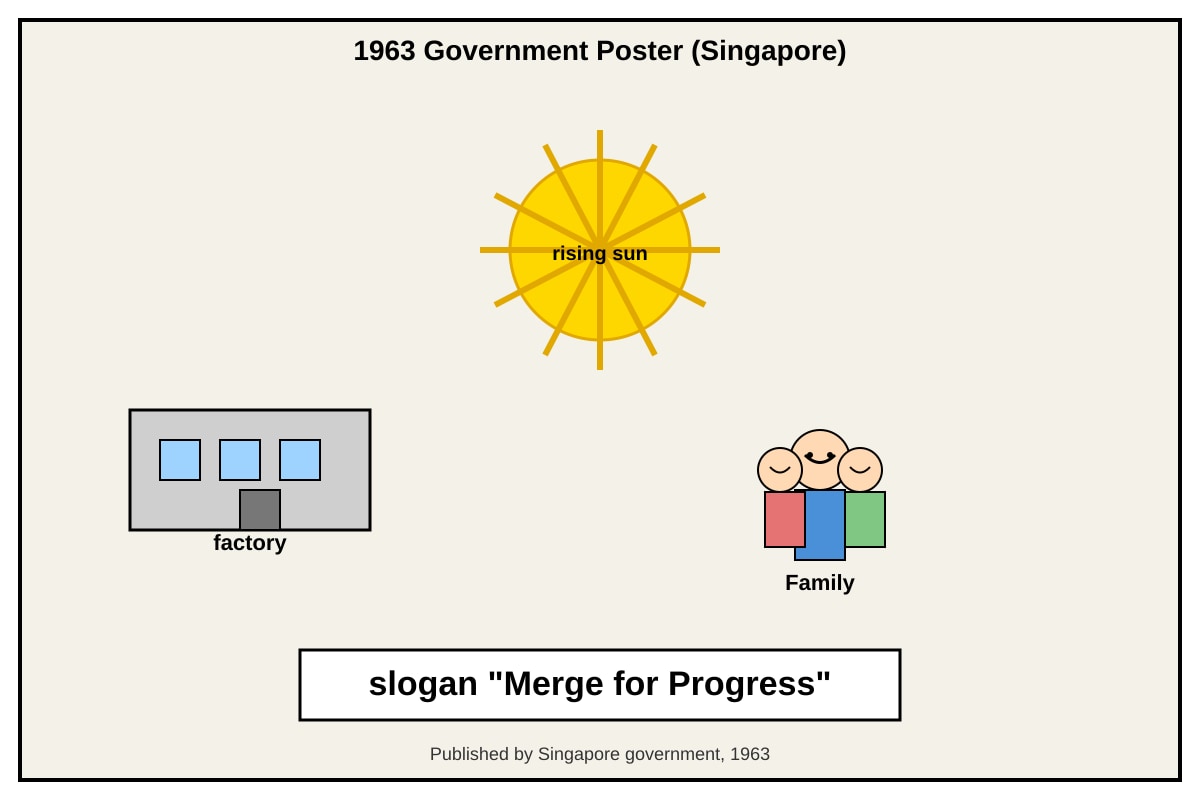
13. Poster made to persuade support for merger. [2] Not fully reliable as it is government propaganda showing only positive view. [2]
Teaching note: Source type = poster; purpose = promote; reliability limited by bias.
14. Ordinary families were divided and uncertain. [3]
Evidence: diary shows parents arguing, father for separation, mother worried about jobs.
Marking: 1 mark situation, 2 marks use of detail.
15. To check bias and accuracy. [3]
Teaching note: Author and date show perspective and context; e.g., a 1963 poster differs from a 1965 diary.
Section C: Structured Response (20 marks)
16. (1) Rise of Melaka as dominant port drew trade away. [2] (2) Portuguese/Dutch control of Melaka blocked Temasek. [2]
Marking: 2 marks each reason with explanation.
17. Free port meant no tariffs, attracted ships and trade. [2] More trade brought jobs and growth. [2]
Teaching note: British policy from Unit 2.
18. (1) Military force and screening. [2] (2) Propaganda and control of food. [2]
Marking: each method + how it controlled.
19. (1) Political disagreements (PAP vs UMNO). [2] (2) Racial riots broke harmony. [2]
Marking: as Template 2, link to 1965 separation.
20. Migrants provided labour, skills, and built communities. [4]
e.g., Chinese traders, Indian workers, Malay settlers; each group added to economy.
Marking: 2 marks per two distinct contributions with example.
End of Answer Key