AI Generated Exam Paper
Secondary 2 History Practice Paper 2
Free Sec 2 History Practice Paper 2, Nemo3 AI version, with questions, answers, and syllabus-aligned practice for Singapore students.
These static practice materials are generated from the site's syllabus and paper-generation workflow, with source and model context shown so students and parents can evaluate the material before use.
Questions
Free quiz and exam paper access
Enter your details to view this paper
Your access is remembered on this device.
Answers
TuitionGoWhere Practice Paper - History Secondary 2 (Answer Key)
Subject: History
Level: Secondary 2 (G2/G3)
Paper: Practice Paper 2 — Singapore & Southeast Asia (1942–1965)
Total Marks: 50
Section A: Source-Based Questions [25 marks]
Question 1 [4 marks]
Study Source A. What can you infer from Source A about David Marshall's view of the British colonial government's attitude towards Singapore? Support your inference with evidence from the source.
Answer:
Inference: David Marshall believed the British colonial government looked down on Singapore and its people, considering them inferior, incapable, and unworthy of self-government.
Evidence from Source A:
- The British said Singapore was "too small, too divided, too immature" for self-government.
- They treated self-government as a "reward for good behaviour" rather than a right.
- Marshall counters that Singaporeans had "built a thriving port, a multi-racial society" and "survived war and occupation", proving their capability.
Marking Notes:
- 1 mark for a valid inference about British attitude (condescending / dismissive / doubting Singapore's readiness).
- 1 mark for each piece of supporting evidence from the source (max 2 marks for evidence).
- 1 mark for clear explanation linking evidence to inference.
- Common mistake: Quoting the source without explaining what it shows about the British attitude.
- Note: Do not accept "Marshall wanted independence" as an inference about the British attitude.
Question 2 [5 marks]
Study Sources A and B. How different are Sources A and B in their views on whether Singapore was ready for self-government in the mid-1950s? Explain your answer using details from both sources.
Answer:
Sources A and B are VERY DIFFERENT in their views on Singapore's readiness for self-government.
Source A (Marshall) argues Singapore WAS ready:
- Singaporeans had "built a thriving port, a multi-racial society" and "survived war and occupation".
- Ordinary people — "merchants, workers, teachers, clerks" — had shown "responsibility and resilience".
- Self-government is a "birthright" and "right of a people to determine their own destiny", not a reward.
Source B (British Colonial Office) argues Singapore was NOT ready:
- The situation was "volatile"; Marshall's government relied on "pro-communist elements".
- The Hock Lee bus riots showed "the ease with which industrial disputes can be exploited for political ends".
- Singapore had "failed to demonstrate the capacity to maintain law and order without British military support".
- Granting self-government would risk "handing control of a strategic base to elements sympathetic to the Malayan Communist Party".
Provenance/Purpose difference (strengthens difference):
- Source A is a public speech by an elected Chief Minister rallying popular support for self-government — purpose: to persuade and legitimise the demand.
- Source B is a secret internal memorandum assessing security risks — purpose: to justify delaying self-government on grounds of stability and anti-communism.
Marking Notes:
- L1 (1–2 marks): Identifies difference(s) in content only, no provenance/purpose.
- L2 (3–4 marks): Explains difference in content with evidence from both sources; may mention provenance.
- L3 (5 marks): Explains difference in content and provenance/purpose, showing how origin shapes the view.
- Common mistake: Saying "both talk about self-government" as a similarity — the question asks for difference.
- Key concept: Difference in stance (ready vs not ready) + difference in purpose (advocacy vs risk assessment).
Question 3 [6 marks]
Study Sources B and C. Does Source C make Source B surprising? Explain your answer using details from both sources and your contextual knowledge.
Answer:
Source C does NOT make Source B surprising. (Or: Source C makes Source B expected / consistent.)
Reasoning:
Source B (1956) expresses British fear that self-government would lead to communist influence — Marshall's government relied on "pro-communist elements", and the Hock Lee riots showed political exploitation of labour disputes.
Source C (1998, recalling 1962) confirms that the communist threat was real and central to the merger debate:
- The Barisan Sosialis (pro-communist left-wing) campaigned for "Alternative B — 'complete and unconditional merger'" to split the pro-merger vote.
- Lee Kuan Yew (PAP) framed merger as a "shared defence against communism".
- The PAP designed the referendum ballot to exclude a "no merger" option, precisely because they feared a communist-led opposition would win.
Contextual Knowledge:
- The British (Source B) and the PAP (Source C) shared a common assessment: the pro-communist left was a major political force in Singapore in the 1950s–early 1960s.
- Operation Coldstore (1963) — detention of left-wing leaders — happened after the 1962 referendum, confirming the ongoing threat perceived by both British and PAP.
- Therefore, Source C corroborates Source B's concern about communist influence; it does not contradict it.
Why it might seem surprising (and why it's not):
- One might think Source C shows the PAP won a popular mandate (71% for Option A), suggesting stability — but the PAP's own memoir admits the communist threat was the reason for the ballot design. The British fear (Source B) was validated by the very political dynamics Source C describes.
Marking Notes:
- L1 (1–2 marks): Yes/No with weak or no support.
- L2 (3–4 marks): Explains using content of both sources; may use contextual knowledge.
- L3 (5–6 marks): Clear judgement ("not surprising") with detailed cross-referencing of content and contextual knowledge explaining why the British concern was consistent with later events.
- Key skill: "Surprise" questions require evaluating whether a later source contradicts an earlier one. Here, it confirms the earlier assessment.
Question 4 [5 marks]
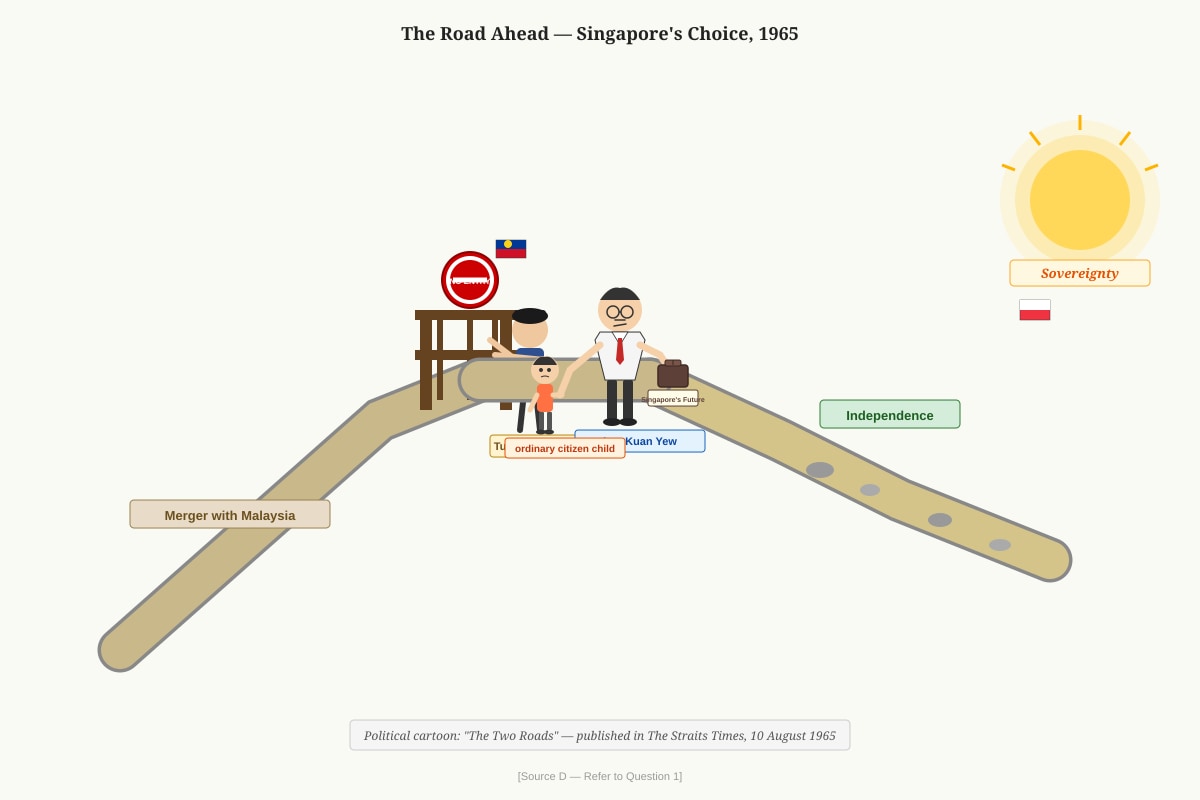
Study Source D. What is the main message of the cartoonist in Source D? Explain your answer using details from the source and your contextual knowledge.
Answer:
Main Message: Singapore's separation from Malaysia in 1965 was not a voluntary choice but a forced necessity — Kuala Lumpur blocked the merger path, leaving independence as the only viable way forward, though it would be a difficult and uncertain journey.
Support from Source D:
- The "Merger with Malaysia" path has a closed gate with a "No Entry" sign held by Tunku Abdul Rahman — showing Malaysia rejected Singapore.
- The "Independence" path is open but rugged — independence was possible but would be challenging.
- Lee Kuan Yew looks determined, carrying a briefcase labelled "Singapore's Future" — leadership committed to making independence work.
- The child (ordinary citizen) looks uncertain — the people were anxious about the sudden separation.
- The sunrise labelled "Sovereignty" — the ultimate goal and hope.
Contextual Knowledge:
- On 9 August 1965, Tunku Abdul Rahman moved the separation bill in the Malaysian Parliament; Singapore had no say in the decision.
- Lee Kuan Yew announced separation in a televised press conference, visibly emotional — reflecting the "determined but burdened" posture in the cartoon.
- The early years of independence (1965–1970s) were rugged: unemployment, housing shortages, defence vulnerability, no natural resources — matching the "rugged road" imagery.
Marking Notes:
- L1 (1–2 marks): Describes visual details without interpreting message.
- L2 (3–4 marks): Identifies a valid message (e.g., "separation was forced on Singapore") with source evidence.
- L3 (5 marks): Clear main message + detailed source evidence + contextual knowledge explaining why the cartoon depicts it this way (forced separation, difficult road ahead, leadership resolve).
- Common mistake: Saying the message is "Lee Kuan Yew chose independence" — the cartoon shows the gate was closed by Kuala Lumpur, not that Lee chose the fork freely.
Question 5 [5 marks]
Using all four sources (A, B, C, and D), explain whether you agree that the path to Singapore's independence was driven primarily by external forces rather than local agency. Support your answer with evidence from the sources and your knowledge.
Answer:
Stand: Disagree — the path to independence was driven by a combination of external pressures and strong local agency, not primarily by external forces. Local leaders and the people played a decisive role at every stage.
Evidence from Sources:
| Source | Shows External Force | Shows Local Agency |
|---|---|---|
| A | British denying self-government ("too small, too divided") | Marshall demanding self-government as a "birthright"; mobilising popular support ("Merdeka!") |
| B | British delaying self-government due to communist threat & instability | — (British perspective; but implies local political activity — Hock Lee riots, pro-communist support — forced British response) |
| C | Merger terms set by Kuala Lumpur (Option A = "our terms" vs "unacceptable" Alternative B) | PAP designed the referendum, campaigned vigorously, won 71% mandate — active political strategy |
| D | Kuala Lumpur closes the gate (Tunku says "No Entry" to merger) | Lee Kuan Yew chooses the independence path, carries "Singapore's Future", leads the people forward |
Contextual Knowledge:
- Local agency: Formation of political parties (PAP, Labour Front, Barisan), mass mobilisation (strikes, rallies, referendum), Lee Kuan Yew's strategic leadership, Rajaratnam's diplomacy, Goh Keng Swee's economic planning.
- External forces: British decolonisation policy, Cold War anti-communism, Malayan/Malaysian political dynamics (communal politics, Tunku's fears), Indonesian Confrontation.
- Synthesis: External forces shaped the context (British withdrawal, Malaysian politics), but local actors made the critical decisions — demanding self-government, negotiating merger, designing the referendum, and ultimately building a viable state after forced separation.
Marking Notes:
- L1 (1–2 marks): One-sided answer (only external or only local) with limited evidence.
- L2 (3–4 marks): Balanced answer using 2–3 sources; explains both external and local factors.
- L3 (5 marks): Nuanced judgement ("not primarily external") using all four sources + contextual knowledge; shows interplay — external constraints, local responses, local initiatives.
- Key concept: "Primarily" requires weighing relative importance. The sources show local agency responding to and shaping external conditions.
Section B: Structured Response Questions [25 marks]
Question 6 [4 marks]
Explain two reasons why the Japanese were able to capture Singapore in February 1942 despite its reputation as an "impregnable fortress".
Answer:
Reason 1: British military miscalculations and poor defences on the northern shore.
- The British expected a seaward attack from the south; heavy guns (15-inch) faced seaward and could not traverse effectively inland.
- The northern coastline (Johore Strait) was lightly defended — no fixed defences, inadequate troops, and mangrove swamps thought impassable.
- General Percival spread troops thinly along the entire 110 km coastline instead of concentrating reserves.
Reason 2: Japanese tactical superiority and speed.
- Yamashita's 25th Army used bicycle infantry and light tanks to move rapidly down the Malay Peninsula (70 days).
- Air and naval supremacy: Japanese sank HMS Prince of Wales and Repulse (Dec 1941), eliminating British naval deterrence; Zero fighters outclassed outdated British planes.
- Psychological warfare: Yamashita's "bluff" — demanding surrender while low on ammunition — exploited British low morale and overestimation of Japanese strength.
Marking Notes:
- 2 marks per well-explained reason (1 mark for identification, 1 mark for development/evidence).
- Accept other valid reasons: British underestimation of Japanese, poor inter-service coordination, lack of tanks/aircraft, surrender decision by Percival.
- Common mistake: Listing "British were unprepared" without specifics (e.g., guns facing wrong way, northern shore neglected).
Question 7 [5 marks]
Describe two ways in which the Japanese Occupation (1942–1945) changed the political consciousness of the local population in Singapore.
Answer:
Way 1: Shattered the myth of European superiority and invincibility.
- The swift British defeat (70 days) and surrender showed that white colonial rulers were not invincible.
- Asians (Japanese) had defeated Europeans — this inspired anti-colonial nationalism; locals realised self-rule was possible.
- Post-war, the British return (BMA) was met with less deference; people demanded political rights (e.g., 1948 elections, rise of political parties).
Way 2: Politicised ordinary people through suffering and resistance.
- Sook Ching massacre (systematic killing of Chinese males) and forced labour (Death Railway, Bahau) created shared trauma and anger against oppression.
- Malayan Peoples' Anti-Japanese Army (MPAJA) and Force 136 gave locals experience in organised resistance, guerrilla warfare, and political organisation — many later joined anti-colonial movements.
- Japanese propaganda ("Asia for Asians") — though insincere — introduced ideas of Asian self-determination that locals adopted for their own ends.
Marking Notes:
- 2–3 marks per way (identification + description with specific examples).
- Must link experience during Occupation to change in political thinking/action post-war.
- Common mistake: Describing hardships (food shortage, inflation) without explaining political consciousness change.
- Key concept: Political consciousness = awareness of political rights, identity, and willingness to act collectively.
Question 8 [6 marks]
"The failure of the Malayan Union (1946) was the most important factor leading to the formation of the Federation of Malaya in 1948." How far do you agree? Explain your answer.
Answer:
Stand: Agree to a large extent — the Malayan Union's failure was the immediate catalyst, but British strategic interests and the Communist insurgency were also critical factors.
Argument 1: Failure of the Malayan Union WAS the most important factor (Direct Cause).
- The Malayan Union (1 Apr 1946) centralised power, reduced Sultan's authority, and offered equal citizenship to non-Malays — seen as a betrayal by Malays.
- Massive Malay opposition: UMNO formed (May 1946) under Onn Jaafar; mass rallies, boycotts of installation ceremonies.
- British realised the Union was unworkable without Malay support — they had to replace it to restore legitimacy and order.
- The Federation of Malaya (1 Feb 1948) restored Sultan's sovereignty, tightened citizenship, and gave Malays special position — direct response to Union's flaws.
Argument 2: British strategic and economic interests (Underlying Cause).
- Britain needed a stable, pro-British Malaya to protect rubber/tin exports (dollar earnings for post-war UK recovery) and the Singapore naval base.
- A hostile Malay population threatened British military and economic interests — the Federation was designed to secure Malay cooperation.
- The Cold War context (1947 onwards): Britain wanted a reliable anti-communist partner in Southeast Asia.
Argument 3: Communist Insurgency / Emergency (Accelerating Factor).
- MCP turned to armed struggle (June 1948) — the Emergency began after the Federation was formed, but rising communist influence (trade unions, strikes 1946–47) pressured British to entrench a pro-British, anti-communist Malay elite via the Federation.
- The Federation's structure (strong central government, Malay dominance) was seen as a bulwark against communism.
Synthesis: The Malayan Union's failure was the proximate trigger — without Malay revolt, the Union would have continued. But British imperial interests (economic, strategic, Cold War) shaped the form the replacement took. The Federation was a negotiated settlement between British needs and Malay demands.
Marking Notes:
- L1 (1–2 marks): One-sided; describes Malayan Union failure only.
- L2 (3–4 marks): Explains Malayan Union failure + one other factor; limited weighing.
- L3 (5–6 marks): Clear judgement ("large extent") with balanced explanation of 2–3 factors, explicit weighing, and synthesis. Uses specific evidence (UMNO, citizenship, Sultans, rubber/tin, Emergency).
- Key concept: "Most important factor" requires comparing relative causal weight — immediate trigger vs structural causes.
Question 9 [5 marks]
Explain two reasons why the PAP government in Singapore pushed for Merger with Malaya between 1961 and 1963.
Answer:
Reason 1: Economic survival — need for a common market and hinterland.
- Singapore had no natural resources, limited land, and a growing population; its economy depended on entrepôt trade.
- The Federation offered a larger common market (no tariffs) for Singapore's manufactured goods and a hinterland for food, water, and raw materials.
- Lee Kuan Yew argued: "Without merger, Singapore faces economic stagnation and rising unemployment." The PAP's 1961 "Battle for Merger" speeches emphasised economic necessity.
Reason 2: Political legitimacy and anti-communist security.
- The PAP faced a serious challenge from the pro-communist Barisan Sosialis (formed 1961 after PAP split).
- Merger with anti-communist Malaya (Tunku's Alliance) would bring federal security forces to help suppress the communist threat (Operation Coldstore 1963).
- A successful merger would give the PAP a nationalist mandate — "we brought Singapore into Malaysia" — strengthening their position against the Barisan's "sell-out" narrative.
Marking Notes:
- 2–3 marks per reason (identification + explanation with evidence).
- Other acceptable reasons: British pressure (decolonisation condition), shared history/culture, defence against Indonesia (Konfrontasi).
- Must link to PAP's motivation — not just "benefits of merger" but why PAP specifically pushed for it (political survival, ideological struggle).
- Common mistake: Confusing PAP's reasons with Tunku's reasons (Tunku agreed to merger mainly to neutralise communist threat from Singapore).
Question 10 [5 marks]
"Economic disagreements were the main cause of Singapore's separation from Malaysia in 1965." How far do you agree? Explain your answer.
Answer:
Stand: Disagree — economic disagreements were significant but not the main cause; political and communal tensions (especially the "Malaysian Malaysia" vs "Ketuanan Melayu" clash) were the primary driver.
Argument 1: Economic disagreements WERE a major source of friction.
- Common Market not implemented: Singapore faced tariffs on goods to Malaya; Malaysia delayed/blocked common market.
- Revenue contribution: Singapore paid 40% of federal revenue but received little in return; demanded fairer revenue sharing.
- Development loans: Singapore asked for 10M (later $50M with conditions).
- Taxation: Singapore wanted to retain more tax powers; Kuala Lumpur insisted on central control.
Argument 2: Political/Communal tensions were the MAIN cause.
- "Malaysian Malaysia" (PAP) vs "Ketuanan Melayu" (UMNO): PAP campaigned in 1964 federal election for equal rights regardless of race — directly challenged UMNO's Malay supremacy.
- 1964 Race Riots (July & September): Sparked by PAP-UMNO rivalry; 36 dead, hundreds injured — showed communal politics had become violent.
- Tunku's fear: PAP's multiracial appeal threatened UMNO's Malay base; Tunku concluded Singapore must leave to preserve Malay dominance in Malaysia.
- Separation Agreement (7 Aug 1965): Negotiated in secrecy by political leaders (Lee, Goh, Rajaratnam vs Tunku, Razak, Ismail) — driven by political survival, not economics.
Argument 3: Economic issues were manageable; political trust was broken.
- Economic disputes could be negotiated (as they had been for 2 years).
- But UMNO hardliners (e.g., Syed Jaafar Albar) called for Lee's arrest; PAP leaders feared detention.
- Tunku told Lee: "I cannot control my extremists" — political relationship was irreparable.
Synthesis: Economics was the language of the dispute, but communal politics was the heart of the conflict. The separation was a political decision by Kuala Lumpur to remove a challenge to Malay dominance.
Marking Notes:
- L1 (1–2 marks): One-sided (only economics or only politics).
- L2 (3–4 marks): Explains both economic and political factors; limited weighing.
- L3 (5 marks): Clear judgement ("disagree — not main cause") with detailed evidence for both sides, explicit comparison of causal weight, and synthesis.
- Key evidence: 1964 riots, "Malaysian Malaysia", Tunku's statements, secrecy of separation talks.
- Common mistake: Listing economic grievances without explaining why they weren't the decisive factor.
End of Answer Key