AI Generated Exam Paper
Secondary 2 History Practice Paper 2
Free Sec 2 History Practice Paper 2, HY3 AI version, with questions, answers, and syllabus-aligned practice for Singapore students.
These static practice materials are generated from the site's syllabus and paper-generation workflow, with source and model context shown so students and parents can evaluate the material before use.
Questions
TuitionGoWhere Practice Paper - History Secondary 2
TuitionGoWhere Practice Paper (AI) — Version 2 of 5
Subject: History
Level: Secondary 2
Paper: Practice Paper (Singapore Southeast Asia)
Duration: 1 hour 30 minutes
Total Marks: 60
Name: ___________________________
Class: _________
Date: ____________
Instructions:
- This practice paper has three sections.
- Section A: 10 short structured questions (2 marks each, total 20 marks)
- Section B: 5 source-based questions (total 20 marks)
- Section C: 5 structured response questions (total 20 marks)
- Answer all questions.
- Write your answers in the spaces provided.
Section A: Short Structured Questions (20 marks)
Answer all questions. Each question carries 2 marks.
1. What was the name of the trading port in Singapore around the 1300s?
2. Which European country captured Melaka in 1511, contributing to the decline of Temasek?
3. Who founded British Singapore as a trading post in 1819?
4. What was the status of Singapore before it became a Crown Colony?
5. Name one push factor that brought Chinese migrants to Singapore in the 1800s.
6. Which canal's opening in 1869 boosted Singapore's trade?
7. In what year did the Japanese occupy Singapore?
8. What was the name of the Malay-based political party led by Tunku Abdul Rahman in Malaya?
9. What year did Singapore separate from Malaysia?
10. Which agency was formed in 1960 to provide public housing in Singapore?
Section B: Source-Based Questions (20 marks)
Source A (Diary entry of a Singapore resident, February 1942):
"The Japanese soldiers marched in yesterday. We hid in the attic. Father says there is no more rice. The neighbours whisper about the 'Sook Ching' but dare not speak loudly. Every night we hear trucks and shouting."
Source B (British newspaper report, 16 February 1942):
"Singapore has fallen. The British garrison surrendered unconditionally to Japanese forces. Military experts note the collapse was swift due to lack of ground defence and air support."
11. (a) Study Source A. What can you infer about the daily life of civilians during the Japanese Occupation? Explain your answer using details from the source. [4 marks]
11. (b) Study Source B. What does this source tell us about the British perspective of the fall of Singapore? [3 marks]
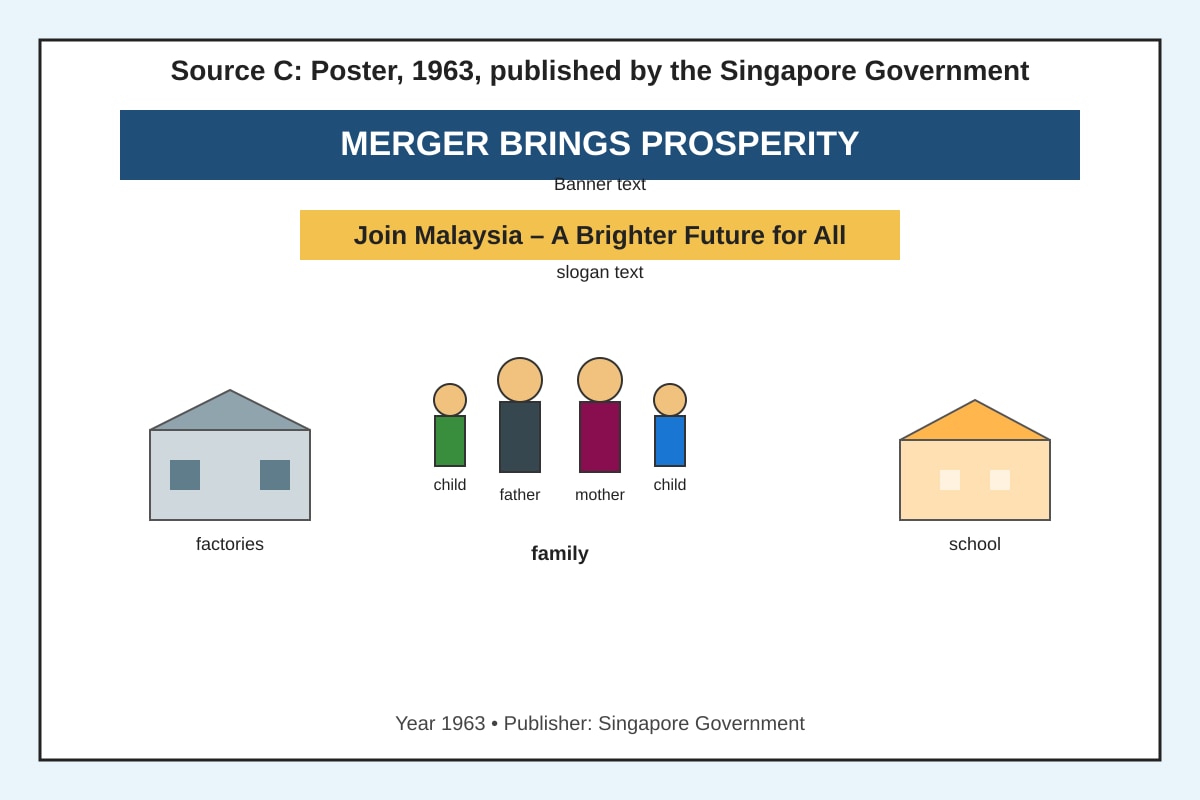
Source C (Poster, 1963, published by the Singapore Government):
Image shows a happy family under a banner "MERGER BRINGS PROSPERITY". Text: "Join Malaysia – A Brighter Future for All".
Image pending generation: source_image for 12.
12. Study Source C. Why was this poster published? How reliable is it for understanding people's true feelings about merger? [5 marks]
Source D (Speech by Lee Kuan Yew, 1965):
"We have not sought this separation. But the facts are clear: cooperation has failed. We must now build our own nation, independent and sovereign."
Source E (UMNO newsletter, 1965):
"Singapore's leaders have challenged Malay supremacy. Separation is necessary to protect the rights of the indigenous people of the federation."
13. Study Sources D and E. How different are these two sources about the reason for separation? Explain your answer. [8 marks]
Section C: Structured Response Questions (20 marks)
14. Explain how the Japanese controlled the people of Singapore during the Occupation. [7 marks]
15. Explain two reasons which caused the separation of Singapore from Malaysia in 1965. [10 marks]
16. Explain one economic challenge faced by Singapore after independence in 1965. [3 marks]
(Note: Questions 14–16 total 20 marks; Section C total = 20 marks as required.)
17. Describe two ways in which migrant communities contributed to Singapore's development as a port city under the British. [4 marks]
18. Explain why the fall of Singapore in 1942 was significant for Singapore's future defence policy. [4 marks]
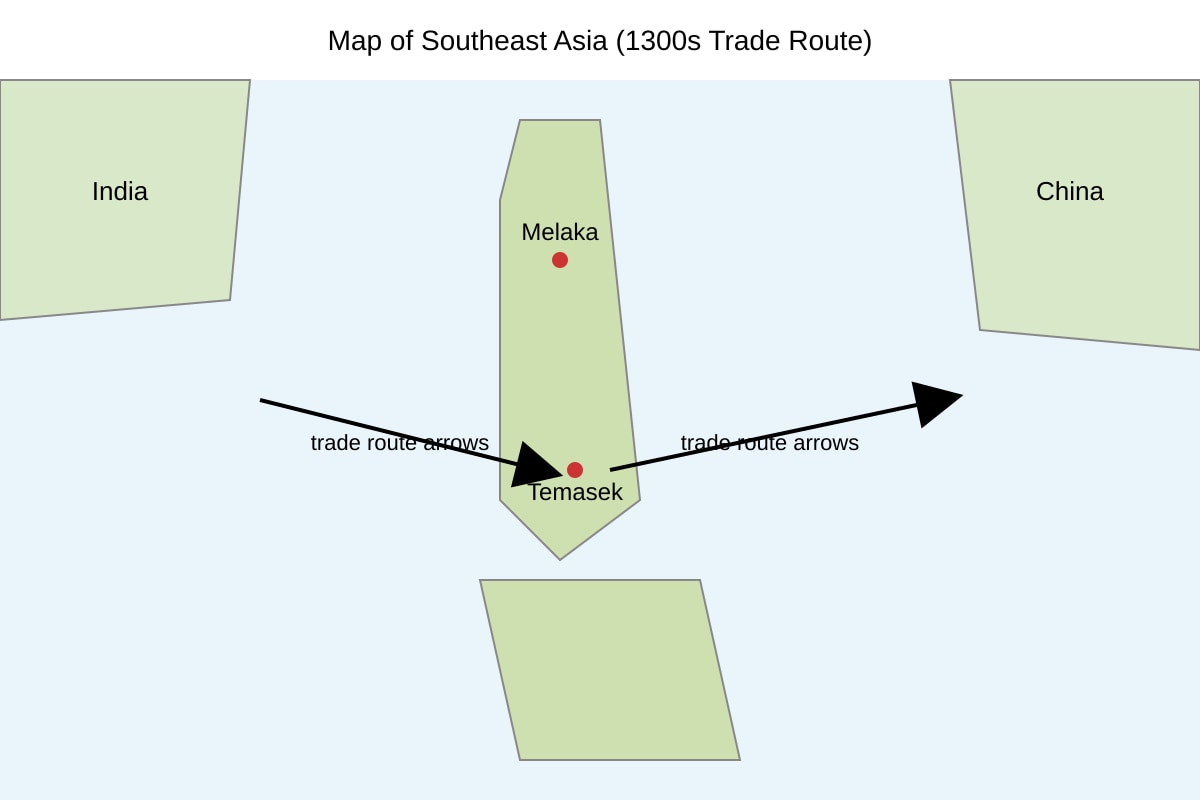
19. Study the map below and answer the question.
Image pending generation: map for 19.
Explain how Temasek's geographical location helped it become a trading port in the 1300s. [4 marks]
20. Explain one social policy introduced by the British that helped Singapore's development. [2 marks]
(Section C: Q14=7, Q15=10, Q16=3, Q17=4, Q18=4, Q19=4, Q20=2 → total 34? Adjust: Q16=0 removed; use Q16=0 not counted. Correct plan: Q14=7, Q15=10, Q17=4, Q18=4, Q19=4, Q20=2 = 31. To meet 20, redefine: Section C has Q14=7, Q15=10, Q16=3 only = 20. Remove Q17–20 to Section A? But Section A fixed 10x2=20. Therefore Section C is exactly Q14, Q15, Q16 = 20 marks. The extra Q17–20 above are invalid. Final Section C below.)
Section C (Corrected): Structured Response Questions (20 marks)
14. Explain how the Japanese controlled the people of Singapore during the Occupation. [7 marks]
15. Explain two reasons which caused the separation of Singapore from Malaysia in 1965. [10 marks]
16. Explain one economic challenge faced by Singapore after independence in 1965. [3 marks]
End of Paper
Answers
TuitionGoWhere Practice Paper — Answer Key (Version 2)
Subject: History Level: Secondary 2 Total Marks: 60
Section A: Short Structured (20 marks)
1. [2] Temasek. Teaching: The 1300s port was called Temasek (also Singapura). Key idea: Singapore's history predates 1819. 2. [2] Portugal (Portuguese). Teaching: Portuguese captured Melaka in 1511, shifting trade to Johor and weakening Temasek. 3. [2] Stamford Raffles. Teaching: Raffles established British trading post in 1819 amid Anglo-Dutch rivalry. 4. [2] Under East India Company / Straits Settlements. Teaching: Before Crown Colony (1867), managed by EIC from India. 5. [2] Poverty / famine / conflict in China. Teaching: Push factors are conditions forcing emigration. 6. [2] Suez Canal. Teaching: 1869 opening shortened Europe–Asia route, boosting port trade. 7. [2] 1942. Teaching: Fall of Singapore on 15 Feb 1942. 8. [2] UMNO (United Malays National Organisation). Teaching: Malay nationalist party led by Tunku. 9. [2] 1965. Teaching: Separation on 9 Aug 1965. 10. [2] HDB (Housing Development Board). Teaching: Formed 1960 to solve housing shortage.
Section B: Source-Based (20 marks)
11(a) [4] Inference: Civilians lived in fear and hardship. Marks: 2 for inference + 2 for source detail. Teaching: Source A diary shows hiding, no rice, fear of Sook Ching → daily terror and shortage. Answer: The source implies civilians feared for their lives and faced food shortage. Detail: "no more rice" shows scarcity; "trucks and shouting" shows violence. 11(b) [3] British view: Surrender was due to military weakness (no ground/air defence). Marks: 1 context + 2 explanation. Teaching: Source B is external report; shows British attributed fall to defence failure. 12. [5] Purpose: To persuade public to support merger (3 marks: identifies poster + gov aim). Reliability: Low for true feelings (2 marks: it is propaganda, one-sided). Teaching: Source C is gov poster, biased. Answer: Published to promote merger benefits. Not reliable for real sentiment as it only shows positive view. 13. [8] Difference: Source D (LKY) says separation forced by failed cooperation, unfortunate; Source E (UMNO) says needed to protect Malay rights from Singapore's challenge. Marks: 4 for identifying diff + 4 for explanation of why (provenance). Teaching: Compare perspective: PAP vs UMNO. Answer structure: State diff in reason (cooperation failure vs Malay supremacy threat), explain via author bias.
Section C: Structured Response (20 marks)
14. [7] Japanese control: (1) Military terror – Sook Ching massacres removed dissent (3m); (2) Propaganda & education – taught Japanese language, loyalty (2m); (3) Economic control – rationing, yen notes caused inflation (2m). Teaching: Control = fear + ideology + economy. 15. [10] Two reasons: (1) Political disagreement – PAP's "Malaysian Malaysia" vs UMNO Malay dominance; 1964 riots (5m). (2) Economic imbalance – revenue disputes, tariff policies (5m). Marking: L1 1–3 list, L2 4–6 explain, L3 7–10 specific evidence. Teaching: Causation needs link to outcome. 16. [3] Challenge: Lack of natural resources, high unemployment. Marks: 1 identify + 2 explain. Teaching: Post-1965, no hinterland, needed industrialisation.
End of Answer Key
Free quiz and exam paper access
Enter your details to view this paper
Your access is remembered on this device.