AI Generated Exam Paper
Secondary 2 History Practice Paper 1
Free Sec 2 History Practice Paper 1, Nemo3 AI version, with questions, answers, and syllabus-aligned practice for Singapore students.
These static practice materials are generated from the site's syllabus and paper-generation workflow, with source and model context shown so students and parents can evaluate the material before use.
Questions
Free quiz and exam paper access
Enter your details to view this paper
Your access is remembered on this device.
Answers
TuitionGoWhere Practice Paper - History Secondary 2 (Answer Key)
Subject: History
Level: Secondary 2
Paper: Practice Paper 1 (Version 1 of 5)
Total Marks: 50
SECTION A: SOURCE-BASED CASE STUDY [30 marks]
Question 1 [3 marks]
Question: Study Source A. What is the main message David Marshall is conveying in this speech? Support your answer with evidence from the source.
Answer:
- Main message: David Marshall is demanding self-government for Singapore as a right, not a gift, and criticising the British for delaying it with excuses. [1]
- Evidence 1: He states "We are not asking for a gift. We are demanding our right — the right of a people to govern themselves." [1]
- Evidence 2: He lists British excuses: "First they said we were not ready. Then they said we must have a 'merger' with Malaya. Now they say we must wait for 'internal security' to improve." [1]
Marking Notes:
- 1 mark for identifying the main message (demand for self-government as a right / criticism of British delays).
- 1 mark for each piece of supporting evidence from the source (max 2 marks for evidence).
- Do not award marks for own knowledge not in the source.
Question 2 [6 marks]
Question: Study Sources A and B. How different are these two sources in their views on whether Singapore was ready for self-government? Explain your answer using details from both sources.
Answer:
Difference 1: View on Singapore's readiness [2 marks]
- Source A (Marshall) argues Singapore is ready for self-government — the people have suffered enough and cannot solve problems without power to make decisions.
- Source B (British Colonial Office) argues Singapore is not ready — internal security is "far from assured" due to communist-influenced unions and students.
Difference 2: View on the communist threat [2 marks]
- Source A does not mention communists; Marshall frames the issue as British delaying tactics ("moving the goalposts").
- Source B sees the communist threat as the primary reason to withhold self-government — granting it would risk placing administration "in the hands of those sympathetic to the Malayan Communist Party".
Difference 3: Provenance/Purpose explains the difference [2 marks]
- Source A is a public speech by Marshall (Chief Minister) in 1955 — purpose is to rally public support and pressure the British.
- Source B is a secret British memorandum in 1955 — purpose is internal policy assessment, reflecting genuine British security concerns.
Marking Notes:
- Award up to 2 marks for each well-explained difference (content + provenance).
- Maximum 4 marks for content differences only; need provenance/purpose for full 6 marks.
- Common mistake: Listing content differences without explaining why the sources differ (provenance, purpose, audience).
Question 3 [5 marks]
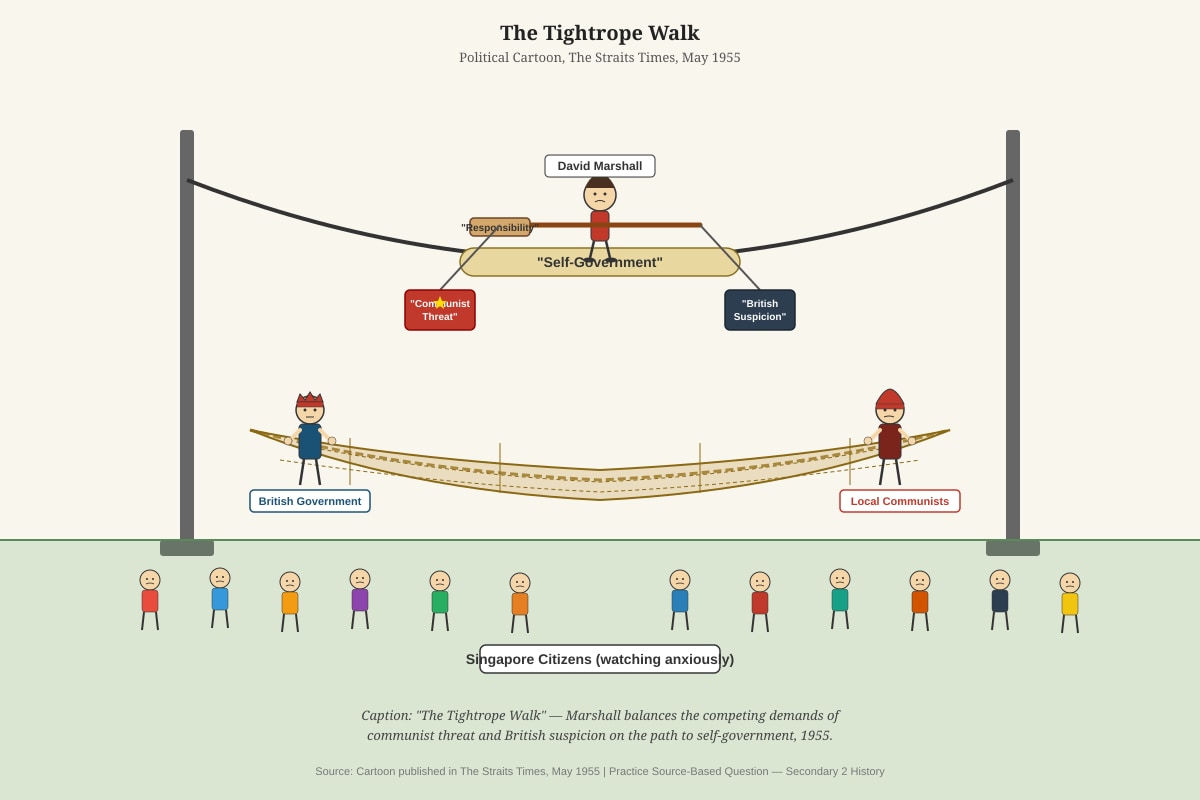
Question: Study Source C. What is the cartoonist's view of David Marshall's position in 1955? Explain your answer using details from the cartoon.
Answer:
- Cartoonist's view: Marshall is in a precarious, difficult position, caught between opposing forces and unable to satisfy either side. [1]
- Detail 1: Marshall is shown as a tightrope walker on a rope labelled "Self-Government" — suggests his position is unstable and risky. [1]
- Detail 2: He balances a pole "Responsibility" with two opposing weights: "Communist Threat" and "British Suspicion" — shows he is pulled in opposite directions by these two forces. [1]
- Detail 3: The safety net is held by both "British Government" and "Local Communists" but they are not cooperating (both looking uncertain) — suggests neither side truly supports him; he has no reliable backup. [1]
- Detail 4: The anxious crowd of "Singapore Citizens" watching — shows the stakes affect ordinary people, and Marshall's struggle is public. [1]
Marking Notes:
- 1 mark for overall view (precarious/caught between forces).
- 1 mark each for up to 4 specific details from the cartoon linked to the view.
- Must reference visual elements (labels, positions, expressions) not just caption.
Question 4 [6 marks]
Question: Study Sources C and D. Does Source D support the view of Marshall shown in Source C? Explain your answer using both sources.
Answer:
Yes, Source D supports Source C in these ways: [3 marks]
- Both show Marshall in a difficult position: Source C shows him on a tightrope; Source D says he was "sincere but naive" and his resignation was "inevitable".
- Both identify the two opposing forces: Source C shows "Communist Threat" and "British Suspicion" as weights; Source D explicitly states "the British would never surrender control of internal security while the communists were strong" and "the threat was real — the communists had infiltrated the unions and Chinese schools".
- Both suggest Marshall lacked control: Source C shows him balancing precariously; Source D says he "did not understand" British intentions and believed they would grant self-government "if he asked nicely".
However, Source D adds a critical judgment not in Source C: [2 marks]
- Source D (Lee Kuan Yew's memoir, 1998) blames Marshall's naivety — "sincere but naive", "did not understand" — while Source C portrays him more sympathetically as a figure trying to balance impossible demands.
- Source D provides hindsight analysis (written 1998) explaining why Marshall failed, while Source C (1955) captures the contemporary perception of his struggle.
Overall: Source D largely supports Source C's depiction of Marshall's predicament but adds a critical assessment of his political judgement. [1 mark for synthesis]
Marking Notes:
- 3 marks for supported similarities (must cite both sources).
- 2 marks for nuanced difference/limitation (must cite both sources).
- 1 mark for overall conclusion.
- Do not just say "yes" or "no" — must explain how and why using source details.
Question 5 [5 marks]
Question: Study Source E. Using Source E and your own knowledge, explain why the 1st and 2nd Merdeka Missions failed but the 3rd Mission succeeded.
Answer:
From Source E: [3 marks]
- 1st Mission (1956, Marshall) failed because British retained control of internal security and only offered limited self-government.
- 2nd Mission (1957, Lim Yew Hock) failed because British still retained control and demanded anti-communist action first; talks broke down.
- 3rd Mission (1958, Lim Yew Hock) succeeded because British agreed to transfer internal security to a new Internal Security Council (with British, Malayan, and Singapore representatives).
Own Knowledge: [2 marks]
- 1st Mission: Marshall refused to accept British control of internal security; his "Merdeka or bust" stance led to breakdown. He resigned after failure.
- 2nd Mission: Lim Yew Hock cracked down on communists (Operation Coldstore, 1957) but British still distrusted him; disagreements over composition of Internal Security Council (British wanted casting vote).
- 3rd Mission: Compromise reached — Internal Security Council had British Commissioner with casting vote, Malayan and Singapore representatives. British felt security assured; Singapore got substantial self-government.
Marking Notes:
- 1 mark per mission explained using Source E (max 3).
- 1 mark per mission explained using own knowledge (max 2).
- Must link Source E evidence to own knowledge for full marks.
Question 6 [10 marks]
Question: "The British were the main obstacle to Singapore achieving self-government in the 1950s." How far do you agree with this statement? Use all the sources and your own knowledge to support your answer.
Answer:
Marking Descriptors (Levels of Response Marking - LORMS):
| Level | Marks | Descriptor |
|---|---|---|
| L1 | 1–2 | General agreement/disagreement without valid source use; or describes sources without addressing question. |
| L2 | 3–5 | One-sided answer: agrees OR disagrees using sources/knowledge. Limited balance. |
| L3 | 6–8 | Balanced answer: explains both sides using sources and knowledge. Good source referencing. |
| L4 | 9–10 | Well-developed balanced argument with explicit evaluation of "main obstacle"; integrates sources and knowledge; clear judgement. |
Sample L4 Response Structure:
Introduction: State stand — British were a major obstacle but not the only one; communist threat and local political divisions also played key roles.
Argument 1: British as obstacle (Agree) [Sources A, B, E]
- Source A: Marshall accuses British of "moving the goalposts" — not ready → merger → internal security excuses.
- Source B: British memorandum shows deliberate retention of internal security control due to communist fears.
- Source E: 1st and 2nd Missions failed because British refused to transfer internal security.
- Own knowledge: British strategic interests (naval base, anti-communism, Malayan federation plans) motivated delay.
Argument 2: Other obstacles — Communist threat (Disagree) [Sources B, C, D, E]
- Source B: British cite communist-infiltrated unions/students as reason to withhold self-government.
- Source C: Cartoon shows "Communist Threat" as equal weight to "British Suspicion".
- Source D: Lee Kuan Yew confirms threat was "real" — communists infiltrated unions and Chinese schools.
- Source E: 2nd Mission failed partly because British demanded anti-communist action first.
- Own knowledge: Hock Lee Bus Riots (1955), Chinese Middle School Riots (1956), communist united front tactics.
Argument 3: Other obstacles — Local political divisions (Disagree) [Sources A, C, D]
- Source A: Marshall's confrontational approach ("demanding our right") may have hardened British stance.
- Source C: Cartoon shows Marshall isolated, with neither British nor communists fully supporting him.
- Source D: Lee criticises Marshall as "naive" — poor negotiation strategy.
- Own knowledge: Split between Marshall's Labour Front, Lim Yew Hock's SPA, and PAP; PAP's own internal split (1961) later.
Conclusion: British were the structural obstacle (held legal power), but the communist threat gave them legitimate justification, and local disunity weakened the nationalist case. The 3rd Mission succeeded only when Lim Yew Hock addressed British security concerns and a compromise formula (Internal Security Council) was found. Thus, British were the main institutional obstacle, but not the sole cause of delay.
Marking Notes:
- Must use all 5 sources (A, B, C, D, E) for L3/L4.
- Must include own knowledge beyond sources for L3/L4.
- "How far" requires a weighed judgement, not just listing factors.
- Common mistake: Treating sources as "facts" rather than perspectives; not evaluating provenance.
SECTION B: STRUCTURED ESSAY QUESTIONS [20 marks]
Question 7: The Japanese Occupation (1942–1945)
(a) Describe two methods used by the Japanese to control the local population in Singapore. [4 marks]
Answer: Method 1: Sook Ching / Mass Screening [2 marks]
- Japanese military police (Kempeitai) conducted mass screening of Chinese males aged 18–50 to identify "anti-Japanese" elements.
- Those identified were taken to remote sites (e.g., Changi Beach, Punggol, Sentosa) and executed.
- Estimated 25,000–50,000 killed. Created fear and eliminated potential resistance leaders.
Method 2: Propaganda and Education Control [2 marks]
- Established Japanese schools (e.g., Syonan Japanese School) and forced students to learn Japanese language and culture.
- Promoted "Asia for Asians" and loyalty to Emperor through propaganda (posters, radio, newspapers like Syonan Shimbun).
- Cultural activities (sports, festivals) used to win hearts and minds; Shinto shrines built for worship.
Other acceptable methods: Food rationing/control (ration cards), forced labour (Bahau/Endau settlements), Kempeitai terror/informant network, currency control (banana money).
Marking Notes:
- 2 marks per method: 1 for naming/identifying, 1 for describing with specific detail.
- Must be methods of control, not just hardships.
(b) Explain why the Japanese Occupation ended in 1945. [6 marks]
Answer:
Reason 1: Allied military victories in the Pacific [2 marks]
- US "island-hopping" campaign brought Allies closer to Japan (Philippines, Iwo Jima, Okinawa recaptured 1944–45).
- US submarines blockaded Japanese shipping, crippling supply lines and economy.
- Firebombing of Japanese cities (March 1945 onwards) devastated industry and morale.
Reason 2: Atomic bombs and Soviet entry [2 marks]
- US dropped atomic bombs on Hiroshima (6 Aug 1945) and Nagasaki (9 Aug 1945).
- Soviet Union declared war on Japan (8 Aug 1945) and invaded Manchuria.
- Emperor Hirohito announced surrender on 15 Aug 1945; formal signing 2 Sep 1945.
Reason 3: Japanese overextension and resource collapse [2 marks]
- Japan overextended across Southeast Asia and Pacific; could not defend all territories.
- Loss of oil, rubber, tin from Southeast Asia due to Allied blockade.
- Japanese military in Malaya/Singapore cut off from home islands; no reinforcements possible.
Marking Notes:
- 2 marks per well-explained reason (identification + explanation).
- Must link reasons to end of Occupation in Singapore (not just Japan's surrender generally).
- Common mistake: Only mentioning atomic bombs without context of broader Allied advance.
(c) "The Japanese Occupation was the most important factor in the rise of nationalism in Singapore." How far do you agree? Explain your answer. [10 marks]
Answer:
Marking Descriptors (LORMS):
| Level | Marks | Descriptor |
|---|---|---|
| L1 | 1–2 | General statement; describes Occupation without linking to nationalism. |
| L2 | 3–5 | One-sided: agrees OR disagrees. Limited explanation. |
| L3 | 6–8 | Balanced: explains role of Occupation AND other factors. Good historical detail. |
| L4 | 9–10 | Nuanced judgement: weighs "most important" against other factors; structured argument. |
Sample L4 Response Structure:
Introduction: The Japanese Occupation was a critical catalyst for nationalism, but not the sole or "most important" factor — pre-war developments and post-war conditions were equally vital.
Argument 1: Occupation as catalyst (Agree)
- Shattered myth of European superiority: British defeat in 7 days showed Europeans were not invincible.
- "Asia for Asians" propaganda: Awakened anti-colonial consciousness; locals saw Asians governing (even if under Japan).
- Leadership vacuum filled by locals: Japanese appointed locals to administrative roles (e.g., Mamoru Shinozaki, Dr. Paglar) — gave experience in governance.
- Shared suffering forged common identity: Multi-ethnic suffering (Sook Ching, forced labour, inflation) created solidarity against foreign rule.
- Radicalisation of youth: Chinese middle school students, Malay radicals, Indian National Army (INA) recruits — politicised a generation.
Argument 2: Pre-war nationalism existed (Disagree — Occupation not the origin)
- Pre-war organisations: Singapore Malay Union (1926), Straits Chinese British Association (1900), Indian associations.
- Anti-colonial activism: 1915 Sepoy Mutiny, 1940s trade unionism, Nanyang University movement.
- Intellectual foundations: Vernacular press, cultural nationalism (Malay bangsa, Chinese minzu) pre-dated Occupation.
Argument 3: Post-war conditions were decisive (Disagree — Occupation alone insufficient)
- British return and failures: BMA corruption, food shortages, slow reconstruction fuelled anger.
- Cold War context: British anti-communism delayed self-government; pushed moderates toward nationalism.
- Rise of political parties: PAP (1954), Labour Front, UMNO, MCA — organised mass politics.
- International trends: Decolonisation globally (India 1947, Indonesia 1949); UN anti-colonial norms.
Conclusion: The Occupation was the spark that made nationalism a mass movement, but the fuel was pre-war identity formation and post-war political mobilisation. Without the Occupation, nationalism might have remained elite-driven; without post-war organisation, it might not have achieved self-government. Thus, "most important" overstates its role — it was necessary but not sufficient.
Marking Notes:
- Must address "most important" explicitly — weigh against other factors.
- Use specific evidence: names, dates, events (Sook Ching, INA, PAP formation, BMA failures).
- Common mistake: Listing Occupation hardships without linking to nationalism.
Question 8: Post-War Singapore (1945–1959)
(a) Describe two major problems faced by the British Military Administration (BMA) in Singapore after the Japanese surrender. [4 marks]
Answer:
Problem 1: Severe Food Shortages and Malnutrition [2 marks]
- Japanese "banana money" worthless; British currency not yet circulated.
- Shipping disrupted; rice imports from Thailand/Burma cut off.
- BMA rationing inadequate; black market flourished; widespread malnutrition and disease (beriberi, malaria).
Problem 2: Unemployment and Economic Dislocation [2 marks]
- Port facilities damaged; entrepôt trade collapsed.
- Factories destroyed or stripped by Japanese; no raw materials.
- 100,000+ unemployed by 1947; returning POWs and internees added to labour surplus.
- Wages low; cost of living high — led to strikes (e.g., 1947 General Strike).
Other acceptable problems: Housing shortage (overcrowding, squatters), Law and order (secret societies, looting), Health crisis (destroyed infrastructure, disease), Education disruption (schools closed, teacher shortage), Political unrest (communist influence, demands for self-government).
Marking Notes:
- 2 marks per problem: 1 for naming, 1 for specific detail/evidence.
- Must be problems faced by BMA (1945–1946), not later periods.
(b) Explain why the Rendel Constitution (1955) was an important step towards self-government. [6 marks]
Answer:
Reason 1: First majority-elected legislature [2 marks]
- 25 out of 32 Legislative Assembly seats elected by popular vote (previously only 6 elected, rest nominated).
- First time local majority in legislature; gave elected representatives real legislative voice.
- Voter eligibility expanded (automatic registration, lowered age to 21) — electorate grew from ~23,000 to ~300,000.
Reason 2: Formation of first local-led government [2 marks]
- Leader of majority party (David Marshall, Labour Front) became Chief Minister — first local head of government.
- Council of Ministers included 6 local ministers (portfolios: Labour, Education, Health, Commerce, Communications, Local Government).
- British retained only: Internal Security, Defence, Foreign Affairs, Finance (veto power).
Reason 3: Established framework for future constitutional talks [2 marks]
- Revealed limits: British kept "reserved powers" (internal security, finance veto) — became focus of Merdeka Missions.
- Demonstrated local capacity to govern: Marshall's government passed labour laws, expanded education, housing.
- Set precedent: Self-government achievable through negotiation, not just protest.
Marking Notes:
- 2 marks per reason: 1 for identification, 1 for explanation of significance.
- Must link to "step towards self-government" — not just describe features.
(c) "The rise of political parties was the main reason for the achievement of self-government in 1959." How far do you agree? Explain your answer. [10 marks]
Answer:
Marking Descriptors (LORMS):
| Level | Marks | Descriptor |
|---|---|---|
| L1 | 1–2 | Describes parties without linking to 1959 self-government. |
| L2 | 3–5 | One-sided: parties were main reason OR not. Limited balance. |
| L3 | 6–8 | Balanced: explains party role AND other factors (British policy, international context, economic conditions). |
| L4 | 9–10 | Nuanced judgement: weighs "main reason"; integrates party agency with structural factors. |
Sample L4 Response Structure:
Introduction: Political parties were the proximate agents that won the 1959 election and negotiated self-government, but they operated within structural conditions (British policy shifts, Cold War, economic change) that made self-government possible. "Main reason" overstates party agency alone.
Argument 1: Parties as drivers (Agree)
- PAP's mass mobilisation: Founded 1954; united English-educated moderates and Chinese-educated radicals; won 43/51 seats in 1959.
- Clear manifesto: "Self-government now", anti-colonial, social reform (housing, education, jobs) — resonated with voters.
- Negotiation success: Lee Kuan Yew led 1958/1959 talks; accepted Internal Security Council compromise to secure Constitution.
- Other parties: Labour Front (1955), SPA (1957) kept pressure on British; multi-party competition forced British to engage.
Argument 2: British policy shift was enabling condition (Disagree — parties needed British willingness)
- Post-Suez (1956) rethink: Britain could not sustain empire; "wind of change" (Macmillan 1960).
- Cold War logic: Preferred stable, pro-Western elected government (PAP) over communist insurgency.
- 1958 Constitution: British granted self-government via State of Singapore Act — legal authority remained British until 1959.
Argument 3: International and economic factors (Disagree — structural forces)
- Global decolonisation: India (1947), Malaya (1957) — Singapore could not be held indefinitely.
- Economic necessity: Singapore needed self-government to attract investment, manage port, address unemployment.
- Communist threat management: British saw elected government with Internal Security Council as best bulwark against MCP.
Conclusion: Parties were the vehicle — they articulated demands, mobilised masses, and negotiated the deal. But the road was built by British imperial decline, Cold War imperatives, and economic logic. Without parties, self-government might have been delayed or imposed differently; without structural conditions, parties could not have succeeded. Thus, parties were the necessary agent but not the sufficient cause — "main reason" is too narrow.
Marking Notes:
- Must discuss 1959 specifically (not just 1955).
- Key evidence: 1959 election results, PAP manifesto, State of Singapore Act 1958.
- Common mistake: Conflating 1955 (partial self-government) with 1959 (full internal self-government).
Question 9: Merger and Separation (1961–1965)
(a) Describe two reasons why the PAP government wanted merger with Malaya. [4 marks]
Answer:
Reason 1: Economic Survival / Common Market [2 marks]
- Singapore had no natural resources, small domestic market, high unemployment.
- Merger would create a common market with Malaya (population ~6 million) — free trade, no tariffs.
- Access to Malayan rubber, tin, oil; Singapore as manufacturing/services hub.
- PAP argued: "Merger or bust" — without it, economic collapse inevitable.
Reason 2: Political Legitimacy and Anti-Colonialism [2 marks]
- British refused full self-government for Singapore alone (cited communist threat, size).
- Merger with independent Malaya (1957) would bypass British veto — automatic independence via federation.
- Lee Kuan Yew: "We cannot get independence on our own... merger is the only way."
- PAP's anti-colonial credibility depended on achieving independence; merger was the path.
Other acceptable reasons: Shared history/culture/ties; Defence against communism (joint security); Personal ties (Lee Kuan Yew, Tunku Abdul Rahman).
Marking Notes:
- 2 marks per reason: 1 for identification, 1 for explanation with specific detail.
- Must be PAP's reasons (not Tunku's or British).
(b) Explain why Singapore separated from Malaysia in 1965. [6 marks]
Answer:
Reason 1: Political Rivalry — PAP vs. Alliance (UMNO/MCA/MIC) [2 marks]
- PAP contested 1964 Federal Election in Malaya (won 1 seat, 7% vote) — Alliance saw this as betrayal of agreement to stay out of peninsula politics.
- Alliance formed Malaysian Solidarity Convention (1965) — PAP-led multi-racial coalition challenging Alliance's communal formula.
- Tunku's ultimatum: PAP must not challenge communal politics; Lee refused — "Malaysian Malaysia" vs. "Malay supremacy".
Reason 2: Economic Disagreements — Common Market and Revenue [2 marks]
- Common Market not implemented: Singapore faced tariffs on goods to Malaya; Malaya delayed free trade.
- Revenue contribution: Singapore required to contribute 40% of revenue to federal government (raised from 30%) — seen as unfair given Singapore's development needs.
- Pioneer Industries Certificate: Federal government blocked Singapore's industrialisation incentives.
Reason 3: Racial Tensions and Communal Violence [2 marks]
- 1964 Race Riots (July and September): 23 dead, hundreds injured — sparked by Malay-Chinese tensions during Prophet's birthday procession.
- UMNO extremists (e.g., Syed Jaafar Albar) inflamed Malays with claims PAP marginalised Malays.
- PAP's multi-racial stance clashed with Alliance's communal politics — Tunku feared more violence if union continued.
Marking Notes:
- 2 marks per reason: 1 for identification, 1 for explanation with evidence.
- Must cover political, economic, AND racial dimensions for full marks (3 reasons × 2 marks).
- Common mistake: Only mentioning racial riots without political/economic context.
(c) "Economic disagreements were more important than political differences in causing Separation." How far do you agree? Explain your answer. [10 marks]
Answer:
Marking Descriptors (LORMS):
| Level | Marks | Descriptor |
|---|---|---|
| L1 | 1–2 | Describes disagreements without weighing "more important". |
| L2 | 3–5 | One-sided: economic OR political more important. Limited balance. |
| L3 | 6–8 | Balanced: explains both economic and political factors with evidence. |
| L4 | 9–10 | Nuanced judgement: weighs relative importance; shows interconnection. |
Sample L4 Response Structure:
Introduction: Political differences were the fundamental cause; economic disagreements were the proximate trigger but rooted in political distrust. They cannot be cleanly separated — political rivalry created economic obstruction.
Argument 1: Political differences as root cause (Disagree with statement)
- Ideological clash: PAP's "Malaysian Malaysia" (multi-racial, meritocratic) vs. Alliance's "Ketuanan Melayu" (Malay supremacy, communal rights).
- Electoral threat: PAP's 1964 federal election challenge and 1965 Malaysian Solidarity Convention directly threatened UMNO's dominance.
- Trust breakdown: Tunku saw Lee as unreliable (broke gentleman's agreement); Lee saw Tunku as yielding to extremists.
- No political compromise possible: Unlike economic issues (negotiable), communal politics was existential for both sides.
Argument 2: Economic disagreements as manifestation of political distrust (Disagree — not independent)
- Common Market delay: Not technical — UMNO feared Singapore's economic dominance would undermine Malay economic position.
- Revenue hike (30%→40%): Political punishment for PAP's federal ambitions.
- Pioneer Certificate blockade: Federal government (UMNO) protecting peninsula industries from Singapore competition.
- Lee's admission: "They wanted to strangle us economically because they feared us politically."
Argument 3: Racial violence as political tool (Disagree — racial = political in this context)
- 1964 Riots: Instigated by UMNO extremists (Albar) for political gain — to prove Malays needed UMNO protection.
- Communal politics = political system: Economic disparities (Malay poverty vs. Chinese wealth) were politicised by Alliance.
- Tunku's statement: "I cannot have a situation where the Malays feel threatened" — political calculation.
Conclusion: Economic disagreements were real and painful, but they were weaponised by political rivalry. The Alliance used economic levers to weaken PAP politically; PAP's economic demands (common market, industrialisation) were political survival strategies. The core incompatibility was political — two competing visions of Malaysian nationhood. Thus, political differences were more important; economic issues were the battlefield, not the war.
Marking Notes:
- Must define "economic" vs "political" clearly.
- Show interconnection — not just list both.
- Key evidence: 1964 election, Malaysian Solidarity Convention, revenue %, Pioneer Certificates, 1964 riots, Tunku/Lee speeches.
- Common mistake: Treating economic and political as separate silos; not evaluating "more important".
END OF ANSWER KEY