AI Generated Exam Paper
Secondary 2 History Practice Paper 1
Free Sec 2 History Practice Paper 1, HY3 AI version, with questions, answers, and syllabus-aligned practice for Singapore students.
These static practice materials are generated from the site's syllabus and paper-generation workflow, with source and model context shown so students and parents can evaluate the material before use.
Questions
Free quiz and exam paper access
Enter your details to view this paper
Your access is remembered on this device.
Answers
TuitionGoWhere Practice Paper - History Secondary 2 (Answers)
Version 1 of 5 — Answer Key & Teaching Notes
Total Marks: 60
Section A: Short Questions (20 marks)
1. Temasek (2 marks)
Answer: Temasek. Teaching: In the 1300s, Singapore was known as Temasek and served as a trading port. Common mistake: writing "Singapore" (name came later officially).
2. Suez Canal (2 marks)
Answer: Suez Canal. Teaching: Opened in 1869, it shortened the sea route between Europe and Asia, boosting Singapore's port trade.
3. Poverty / conflict / famine in China (2 marks)
Answer: Any one push factor (e.g., poverty, war). Teaching: Push factors are conditions that drive people to leave their homeland.
4. Stamford Raffles (2 marks)
Answer: Sir Stamford Raffles. Teaching: He established the British trading post in 1819 during Anglo-Dutch rivalry.
5. Srivijaya (2 marks)
Answer: Srivijaya. Teaching: Its fall created a power vacuum, allowing Temasek to rise as a trading centre.
6. Under East India Company (2 marks)
Answer: East India Company control / settlement. Teaching: Before Crown Colony status, Singapore was run by the East India Company.
7. Rubber / tin (2 marks)
Answer: Rubber or tin. Teaching: These commodities drove trade and industry in early 1900s Singapore.
8. 1942 (2 marks)
Answer: 1942. Teaching: Japan captured Singapore in Feb 1942, marking the fall of British Malaya.
9. Johor Sultanate (2 marks)
Answer: Johor Sultanate. Teaching: It emerged after Melaka's decline under Portuguese/Dutch control.
10. Free port status (2 marks)
Answer: Free port policy (no tariffs). Teaching: Attracted merchants globally, growing the economy.
Section B: Source-Based Questions (25 marks)
11. (5 marks)
Marking: 1 mark inference of hardship + 2 marks from source details + 2 marks explanation of daily fear/control.
Answer: Source A shows daily life was full of fear and scarcity. The diary says they queued for rice (food shortage) and soldiers watched with rifles (military control). Neighbours disappearing implies repression. This implies occupation life was unsafe and controlled.
Teaching: Personal accounts show emotional experience; use details to infer, not assume.
12. (5 marks)
Marking: 2 marks purpose + 3 marks reliability with reason.
Answer: Published to persuade citizens to support merger and vote yes. It is less reliable for public opinion because as a newspaper likely aligned with government, it shows bias, not true feelings.
Teaching: Purpose = intent; reliability lowered by bias and being official media.
13. (5 marks)
Marking: 2 marks similarity + 3 marks explanation with both sources.
Answer: Both show racial tension was a serious problem. Source C (photo) shows damaged shops from riot; Source D (report) states tension threatened unity. They agree violence and division existed.
Teaching: Compare content and provenance; photo gives visual proof, report gives official view.
14. (5 marks)
Marking: 2 marks purpose + 3 marks use of details.
Answer: Purpose: encourage workers to contribute to nation-building. Details: image of worker and text "hard work" show call to labour for progress.
Teaching: Posters use symbols and words to send message; link visual to text.
15. (5 marks)
Marking: 2 marks location + 3 marks explanation of trade benefit.
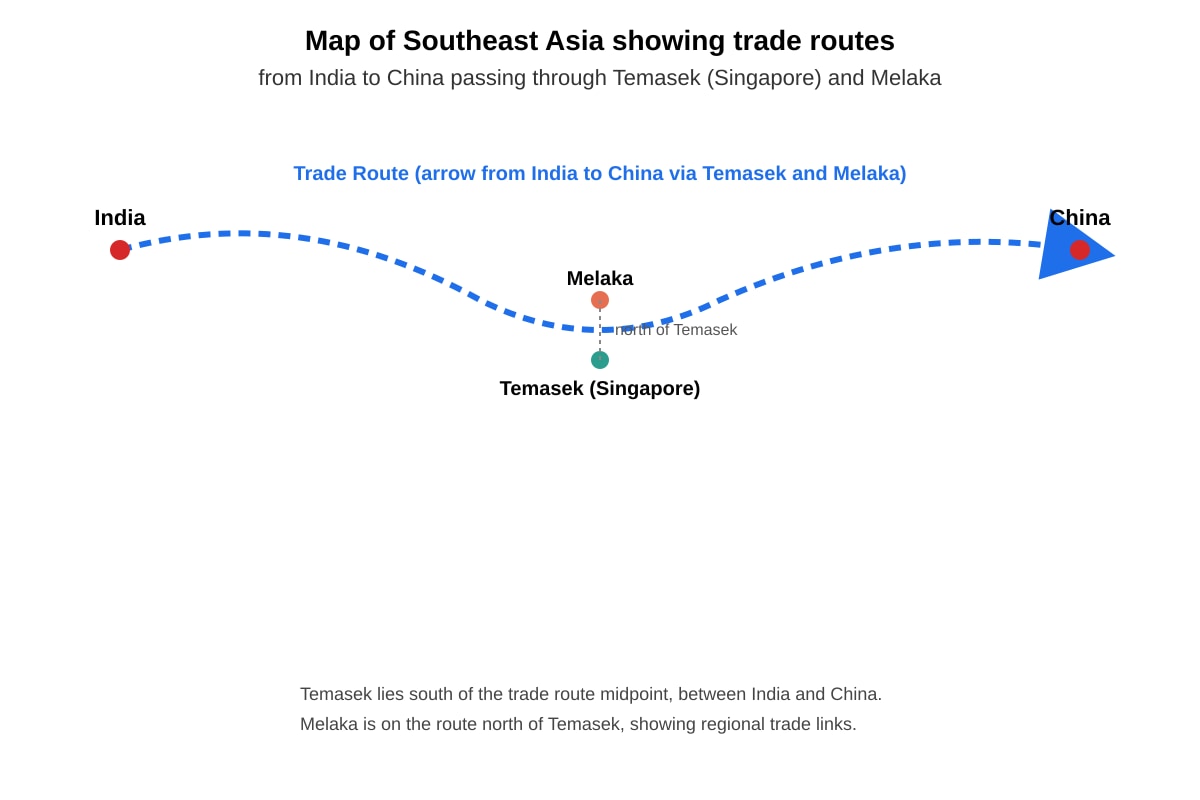
Answer: Temasek was on the route between India and China. Map shows it lay on the arrow trade route, so ships stopped there to trade. Its position allowed it to become a port.
Teaching: Geography = destiny; map must show route through Temasek.
Section C: Structured Response (15 marks)
16. (3 marks)
Answer: Srivijaya's fall removed a dominant rival, so Temasek could attract traders. Explanation: with no major power, local ports thrived.
Teaching: Causation — one event enables another.
17. (3 marks)
Answer: British set up police and courts to reduce crime/piracy. This brought order for trade.
Teaching: Law and order is foundation for economy.
18. (3 marks)
Answer: Great Depression caused unemployment as trade fell. People suffered economically.
Teaching: Global events hit port cities hard.
19. (3 marks)
Answer: Indians came for jobs (pull) or due to poverty (push). Example: railways needed workers.
Teaching: Migration has push and pull factors.
20. (3 marks)
Answer: Occupation showed British could not protect Singapore, leading to desire for self-rule.
Teaching: Significance — event changed political attitude.
End of Answer Key