From Real Exams Exam Paper
Secondary 2 History Semestral Assessment 2 (End of Year) Paper 5
Free Sec 2 History SA2 Paper 5, Nemo3 Exam version, with questions, answers, and syllabus-aligned practice for Singapore students.
These static practice materials are generated from the site's syllabus and paper-generation workflow, with source and model context shown so students and parents can evaluate the material before use.
Questions
Free quiz and exam paper access
Enter your details to view this paper
Your access is remembered on this device.
Answers
TuitionGoWhere Practice Paper - History Secondary 2: Answer Key
SA2 Practice Paper Version 5
Total Marks: 50
SECTION A: SOURCE-BASED CASE STUDY [25 marks]
Question 1: Message of Source A [3 marks]
Answer: The message of David Marshall's speech is that Singaporeans are ready for self-government and deserve the right to govern themselves after 136 years of British colonial rule.
Marking breakdown:
- 1 mark: Identifies the core message (Singapore deserves self-government / is ready for self-government)
- 1 mark: Supports with evidence from source ("we have been crawling for 136 years" / "it is time to stand up and walk")
- 1 mark: Explains the rhetorical purpose (challenging British excuses about lack of experience/maturity)
Teaching notes:
- A "message" question asks for the main idea the author wants to convey to the audience, not just a summary of content.
- Always quote directly from the source to support your answer.
- Marshall uses the metaphor of "crawling for 136 years" to argue that colonial rule has delayed Singapore's political development, and that responsibility itself creates maturity.
Common mistake: Stating only "Marshall wants self-government" without explaining the reasoning in the source (the 136 years metaphor, the rebuttal of British arguments).
Question 2: Difference between Sources A and B [6 marks]
Answer: Sources A and B are very different in their views on Singapore's readiness for self-government.
Source A (Marshall) argues that Singapore is ready for self-government. He claims the British excuses about "lack of experience, maturity, stability" are invalid because a people cannot gain experience without responsibility. He uses the metaphor of "crawling for 136 years" to say it is time to "stand up and walk."
Source B (British Colonial Office) argues that Singapore is not ready for self-government. It cites the Labour Front government's "inability to control communist infiltration" and the Hock Lee Bus Riots as evidence of "fragility of law and order." It warns that granting self-government would risk "Singapore falling under communist control."
Difference in provenance/purpose: Source A is a public speech by a local leader rallying popular support for immediate self-government (purpose: persuade, mobilise). Source B is a secret internal memorandum assessing security risks (purpose: inform British decision-makers, justify withholding power).
Marking breakdown:
- 1 mark: Clear statement of difference (very different / different)
- 2 marks: Explains Source A's view with evidence
- 2 marks: Explains Source B's view with evidence
- 1 mark: Compares provenance/purpose (public vs. secret; persuasive vs. analytical)
Teaching notes:
- For "How different/similar" questions, you must: (1) state the extent of difference, (2) explain each source's view with evidence, (3) compare provenance/purpose to explain why they differ.
- Provenance comparison earns the top marks: Marshall as Chief Minister advocating for his people vs. British officials protecting strategic interests.
Common mistake: Listing content differences without explaining why the sources differ (provenance, purpose, audience).
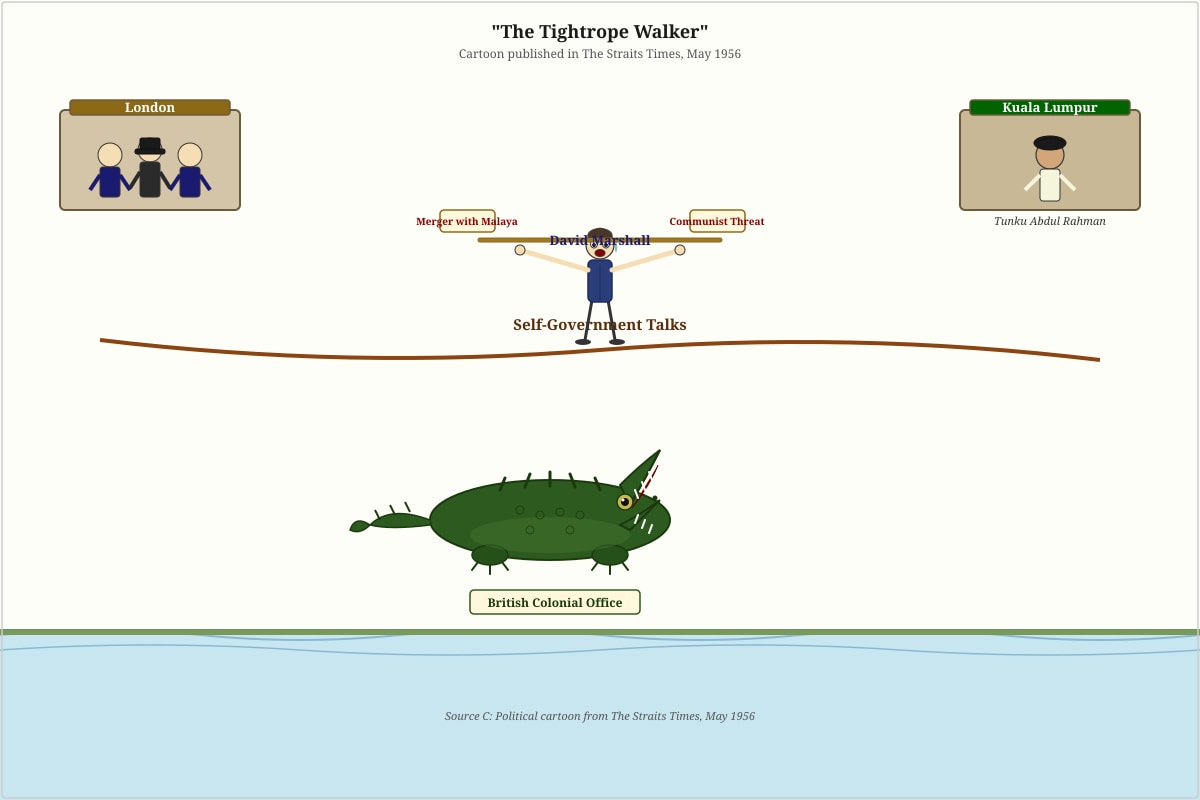
Question 3: Cartoonist's view in Source C [5 marks]
Answer: The cartoonist portrays David Marshall as in a precarious, vulnerable position — attempting to balance conflicting demands (merger with Malaya vs. communist threat) while under threat from the British (crocodile) and watched by both London and Kuala Lumpur. The cartoonist suggests Marshall's mission is unlikely to succeed — he looks "anxious and unsteady" on a tightrope, implying the 1956 Merdeka Mission was doomed.
Marking breakdown:
- 1 mark: Identifies overall view (precarious / vulnerable / unlikely to succeed)
- 2 marks: Explains using visual details (tightrope = delicate negotiations; balancing pole = two opposing forces; crocodile = British threat; grandstands = external observers)
- 2 marks: Interprets the cartoonist's judgement (anxious expression, unsteady = mission likely to fail)
Teaching notes:
- For cartoon analysis: describe → interpret → evaluate.
- The crocodile represents the British Colonial Office as a lethal threat waiting for Marshall to fall.
- The two grandstands show Marshall had to satisfy both British (London) and Malayan (Kuala Lumpur) leaders simultaneously.
- The balancing pole labelled "Merger with Malaya" and "Communist Threat" shows the two impossible choices Marshall faced.
Common mistake: Only describing the cartoon without interpreting the cartoonist's view or judgement.
Question 4: Does Source D support Source C? [5 marks]
Answer: Yes, Source D supports the view in Source C that Marshall's position in 1956 was precarious and his mission likely to fail.
Supporting evidence:
- Source C shows Marshall as an anxious tightrope walker balancing "Merger with Malaya" and "Communist Threat" while threatened by the British crocodile — implying his mission was precarious and doomed.
- Source D confirms this: it states Marshall's 1956 Merdeka Mission "failed because he insisted on immediate self-government without accepting British conditions on internal security" and that "Marshall resigned".
- Both sources agree the British would not yield control of internal security while the communist threat remained.
Marking breakdown:
- 1 mark: Clear "Yes" / "Supports" judgement
- 2 marks: Evidence from Source C (precarious position, likely failure)
- 2 marks: Evidence from Source D (mission failed, Marshall resigned, British refused internal security control)
Teaching notes:
- "Does Source X support Source Y?" requires: (1) direct Yes/No, (2) evidence from BOTH sources, (3) explicit link showing how they agree/disagree.
- Source D is a memoir written in 1998 (hindsight), Source C is a contemporary 1956 cartoon — the fact that they agree strengthens the support.
Common mistake: Saying "Yes" but only quoting one source, or not explaining how the specific details match.
Question 5: Why 1957 Mission succeeded where 1956 failed [6 marks]
Answer: The 1957 Merdeka Mission succeeded because Lim Yew Hock accepted British conditions that Marshall had rejected in 1956, specifically British control of internal security for a transitional period.
From Source E:
- 1956 Mission: Marshall demanded full internal self-government; British refused control over internal security → Rejected; Marshall resigned.
- 1957 Mission: Lim Yew Hock accepted British control of internal security for 3 years in exchange for full internal self-government after → Accepted; Constitution enacted 1958.
Own knowledge:
- Lim Yew Hock's government took tough anti-communist measures in 1956–1957 (e.g., arrests under the Preservation of Public Security Ordinance, banning of pro-communist organisations, crackdown on Chinese middle school protests).
- These actions convinced the British that a non-communist, stable government could maintain internal security, making them willing to transfer power.
- The 1958 State of Singapore Constitution granted full internal self-government with a Yang di-Pertuan Negara and Singapore citizenship, leading to the 1959 general election.
Marking breakdown:
- 2 marks: Uses Source E to contrast the two missions (Marshall rejected British conditions vs. Lim accepted transitional arrangement)
- 2 marks: Own knowledge — Lim Yew Hock's anti-communist actions (specific examples)
- 2 marks: Explains the causal link — British needed assurance on internal security/communist threat before granting self-government
Teaching notes:
- "Using Source X and your own knowledge" questions require explicit use of the source PLUS additional contextual knowledge.
- Key concept: The British priority was security/communist containment, not just constitutional theory. Lim Yew Hock delivered that assurance; Marshall did not.
Common mistake: Only using Source E without own knowledge, or only giving own knowledge without referencing the source table.
SECTION B: STRUCTURED RESPONSE QUESTIONS [25 marks]
Question 6: The Japanese Occupation (1942–1945)
6(a) Two methods of Japanese control [2 marks]
Answer (any two, 1 mark each):
- Sook Ching / Mass screening — systematic purge of anti-Japanese elements, especially Chinese males aged 18–50.
- Propaganda and education — forced Japanese language (Nippon-go) in schools, radio broadcasts, newspapers; promotion of "Asia for Asians" / Greater East Asia Co-Prosperity Sphere.
- Kempeitai (military police) terror — arbitrary arrests, torture, informer network, public executions to instil fear.
- Forced labour / labour battalions — locals forced to work on military projects (e.g., airfield construction, Burma-Thailand Railway).
- Food rationing and control — "Peace Living Certificates" required for rice rations; used to control movement and behaviour.
- Cultural assimilation — Shinto shrines, Japanese calendar, bowing to the Emperor, renaming places (Syonan-to).
Teaching notes: Any two distinct methods accepted. Avoid overlapping answers (e.g., "Kempeitai terror" and "fear" are the same point).
6(b) Why the Japanese carried out Sook Ching [4 marks]
Answer: The Japanese carried out the Sook Ching operation ("purge through cleansing") to eliminate anti-Japanese elements within the Chinese community in Singapore and Malaya.
Reasons (any two well-explained for 4 marks, or four distinct points):
- Remove resistance leaders — Target Chinese community leaders, volunteers, communists, and those who supported the China Relief Fund or anti-Japanese boycotts before the war.
- Instil fear and deter resistance — Public executions and mass killings served as a warning to the population against opposing Japanese rule.
- Secure rear areas for military expansion — With the Japanese advancing into Southeast Asia, they needed a compliant population and could not afford guerrilla warfare in their rear.
- Racial/ideological suspicion — The Japanese viewed the overseas Chinese as loyal to China (Chongqing government) and potential supporters of anti-Japanese resistance.
Marking breakdown:
- 1 mark per valid reason, up to 2 marks per reason if well-explained with context.
- Maximum 4 marks.
Teaching notes:
- Sook Ching (Feb–Mar 1942) targeted Chinese males 18–50 at screening centres; estimated 25,000–50,000 killed.
- Connect to broader Japanese strategy: "killing chickens to scare monkeys" — terror tactic.
Common mistake: Vague answers like "to kill Chinese people" without explaining the strategic purpose (anti-Japanese elements, deterrence, security).
6(c) "Japanese Occupation was the main reason for rise of nationalism" [8 marks]
Answer: Thesis: The Japanese Occupation was a major catalyst for post-war nationalism, but not the sole reason — pre-war nationalist sentiments, British post-war policies, and global decolonisation trends also played significant roles.
Argument FOR (Japanese Occupation as main reason):
- Shattered the myth of European superiority — Japanese victory over British in 1942 showed Asians could defeat Europeans, destroying the psychological foundation of colonial legitimacy.
- "Asia for Asians" propaganda — Fostered anti-colonial consciousness and the idea that Asians should govern themselves.
- Power vacuum and political awakening — During occupation, local leaders (e.g., Lim Boon Keng, E.J.H. Corner) gained administrative experience; resistance movements (Force 136, MPAJA) provided organisational experience.
- Post-war expectations — People who suffered under Japanese rule expected better governance and rights from the returning British; disappointment fuelled nationalist demands.
Argument AGAINST (other factors):
- Pre-war nationalism existed — Chinese community support for China Relief Fund (1930s), Malay nationalist groups (Kesatuan Melayu Singapura, 1938), Indian Independence League — shows nationalism pre-dated occupation.
- British post-war failures — BMA corruption, food shortages, unemployment, slow reconstruction (1945–1947) alienated locals and pushed them toward anti-colonial politics.
- Global decolonisation wave — India's independence (1947), Indonesian revolution (1945–1949), Cold War context — Singapore was part of a worldwide trend.
- Rise of political parties — PAP (1954), Labour Front, UMNO, MCA — organised political competition channelled nationalist energy into constitutional demands.
Conclusion: The Japanese Occupation was the critical catalyst that made mass nationalism possible by destroying colonial prestige and raising political consciousness, but structural factors (British failures, global trends, local organisation) determined its form and trajectory.
Marking breakdown (Levels of Response):
- L1 (1–2 marks): General assertions, no specific evidence, one-sided.
- L2 (3–5 marks): One-sided explanation with some evidence (either FOR or AGAINST), or weak two-sided with limited support.
- L3 (6–7 marks): Balanced two-sided argument with specific evidence on both sides, clear reasoning.
- L4 (8 marks): L3 + nuanced conclusion weighing relative significance (catalyst vs. structural causes), explicit answer to "how far".
Teaching notes:
- "How far do you agree?" requires a two-sided argument with a reasoned conclusion.
- Use specific evidence: names, dates, events (Sook Ching, BMA, India 1947, PAP 1954).
- The "catalyst vs. cause" distinction is a sophisticated historical argument — the Occupation created the conditions for mass nationalism; other factors shaped its direction.
Common mistake: Only arguing one side, or listing events without explaining how they caused nationalism.
Question 7: Post-War Challenges and Road to Self-Government
7(a) Two problems faced by BMA (1945) [2 marks]
Answer (any two, 1 mark each):
- Severe food shortages and malnutrition — disrupted supply lines, Japanese "banana money" worthless, rice rationing inadequate.
- Rampant inflation and currency collapse — Japanese banana money invalid; British Military Administration notes introduced but distrusted; black markets flourished.
- Mass unemployment — port facilities damaged, trade disrupted, returning prisoners of war and internees needed jobs.
- Housing crisis and overcrowding — bomb damage, population influx, squatter settlements, poor sanitation.
- Law and order breakdown — looting, secret society activity, communist-led strikes, revenge killings of collaborators.
- Corruption and inefficiency in BMA — "Black Market Administration" nickname; officials profiteering, slow relief distribution.
- Health crises — malaria, cholera, tuberculosis; medical facilities destroyed or overwhelmed.
Teaching notes: BMA lasted Sept 1945 – Apr 1946. Its failures directly fuelled anti-British sentiment.
7(b) Why Maria Hertogh riots broke out (1950) [4 marks]
Answer: The Maria Hertogh riots (11–13 Dec 1950) erupted due to a custody dispute over a Dutch-Eurasian girl raised as a Muslim, which became a flashpoint for Muslim grievances against colonial insensitivity.
Reasons (any two well-explained for 4 marks):
- Custody ruling perceived as anti-Muslim — Court awarded custody to her biological Dutch parents (Catholic) over her Malay foster mother (Che Aminah) who had raised her as Muslim (Nadra binte Ma'arof) since 1942. Muslims saw this as the colonial legal system privileging Christian/Western rights over Muslim customary rights.
- Insensitive media coverage — The Straits Times published photos of Maria in a convent with nuns, and at a Christian wedding — seen as deliberate provocation / humiliation of Muslim community.
- Colonial government mishandling — Police failed to anticipate unrest; Maria was moved to a convent (seen as Christian territory) rather than neutral ground; no effort to engage Muslim leaders.
- Underlying Muslim grievances — Perception that British favoured non-Muslims; earlier controversies (e.g., 1946 ban on Muslim marriages under 16) fuelled resentment.
- Political exploitation — Malay nationalist and pro-independence groups (e.g., PKMM, API) used the case to mobilise anti-colonial sentiment.
Marking breakdown:
- 1 mark per valid reason, up to 2 marks per reason if well-explained with context.
- Maximum 4 marks.
Teaching notes:
- 18 killed, 173 injured; lasted 3 days; curfew imposed; British troops deployed.
- Key concept: Religious/ethnic sensitivity + colonial legal insensitivity = violent unrest. This pattern recurs in Singapore history (e.g., 1964 racial riots).
Common mistake: Only describing the custody dispute without explaining why it triggered riots (religious sensitivity, media provocation, colonial mishandling).
7(c) "Rendel Constitution was a significant step towards self-government" [7 marks]
Answer: Thesis: The Rendel Constitution (1955) was a significant but limited step — it introduced local electoral politics and a Chief Minister, but retained British control over key powers (defence, foreign affairs, internal security), making it a partial, transitional arrangement rather than true self-government.
Argument FOR (significant step):
- First elections with automatic voter registration — 1955 election saw 52.7% turnout (vs. 20% in 1948); expanded electorate from ~23,000 to ~300,000.
- Majority elected Legislative Assembly — 25 elected vs. 7 nominated/unofficial members; locals could now debate and vote on domestic policies (education, health, labour).
- Chief Minister and Council of Ministers — David Marshall became first local head of government; locals controlled 7 of 10 ministries (finance, commerce, communications, etc.).
- Political party development — Labour Front, PAP, UMNO-MCA Alliance, SPA contested — birth of modern party politics.
Argument AGAINST (limitations):
- British retained "reserved powers" — Governor controlled defence, foreign affairs, internal security, public service, finance (via Financial Secretary).
- No control over internal security — Critical during Emergency; British could override elected government on "security" grounds (used to reject Marshall's 1956 demands).
- Governor's veto and casting vote — Could block legislation; British officials sat in Assembly.
- Limited to domestic affairs — No say in external relations, defence, or citizenship.
Conclusion: It was a significant constitutional advance — first time locals held executive office and controlled domestic policy — but fell short of self-government because the British kept the "keys to the house" (internal security). It was a necessary stepping stone that exposed the limits of partial power, leading to the 1956–1957 Merdeka Missions.
Marking breakdown (Levels of Response):
- L1 (1–2 marks): General statements, no specific features of Rendel Constitution.
- L2 (3–4 marks): One-sided (only significance OR only limitations) with some evidence.
- L3 (5–6 marks): Two-sided with specific evidence (elected majority, Chief Minister, reserved powers, internal security).
- L4 (7 marks): L3 + nuanced conclusion: "significant step but incomplete" with explicit weighing — it created the institutions and experience for self-government but withheld the substance of sovereignty.
Teaching notes:
- "How far do you agree?" at 7 marks expects a developed two-sided argument with a conclusion.
- Key evidence: 25 elected vs 7 nominated; 7 local ministries vs 3 British reserved portfolios; Marshall's 1956 failure proves the limitation.
- The Rendel Constitution is best understood as power-sharing, not self-government.
Common mistake: Calling it "self-government" (it wasn't — that came in 1959) or ignoring the reserved powers that made it incomplete.
END OF ANSWER KEY