From Real Exams Exam Paper
Secondary 2 History Semestral Assessment 2 (End of Year) Paper 5
Free Sec 2 History SA2 Paper 5, HY3 Exam version, with questions, answers, and syllabus-aligned practice for Singapore students.
These static practice materials are generated from the site's syllabus and paper-generation workflow, with source and model context shown so students and parents can evaluate the material before use.
Questions
TuitionGoWhere Exam Practice (AI) — SA2 History Secondary 2 (Version 5)
School: TuitionGoWhere Secondary School (AI)
Subject: History
Level: Secondary 2
Paper: SA2 Practice Paper (Version 5 of 5)
Duration: 60 minutes
Total Marks: 60
Name: ___________________________
Class: ________
Date: ____________
Instructions:
- Answer all questions in the spaces provided.
- Section A: Source-Based Questions (20 marks)
- Section B: Structured Response Questions (25 marks)
- Section C: Short Answer and Recall (15 marks)
- Use clear handwriting. Support answers with historical evidence where asked.
Section A: Source-Based Questions (20 marks)
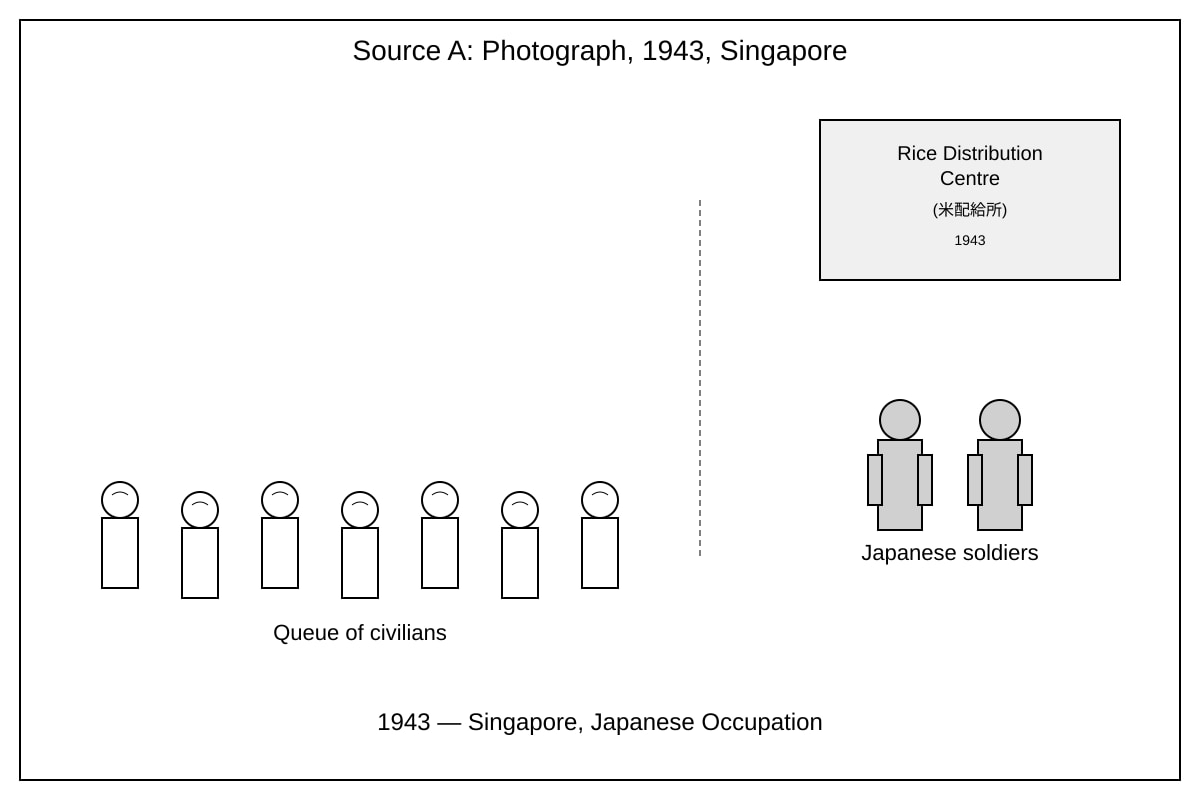
1. Study Source A below. (4 marks)
Source A is a photograph taken in 1943 showing a long queue of people waiting outside a rice distribution centre in Singapore during the Japanese Occupation.
Image pending generation: source_image for Q1.
What can you infer about the daily life of ordinary people in Singapore during the Japanese Occupation from Source A? Explain your answer using details from the source.
2. Study Source B below. (5 marks)
Source B is an extract from a speech by a Malay nationalist leader in 1961 opposing the merger of Singapore with Malaysia.
"We fear that the entry of Singapore's large Chinese population into Malaysia will upset the balance and threaten our community's rights. Merger must not come at the cost of our voice."
What can you infer about the attitudes of some Malay leaders towards merger in 1961? Explain your answer.
3. Study Sources C and D. (6 marks)
Source C: A British colonial report from 1950 stating that communist infiltration among workers was a serious threat to law and order in Singapore.
Source D: A cartoon published in 1952 showing a worker being led by a hidden hand labelled "communist" towards a strike banner.
How different are Sources C and D in showing the communist threat in post-war Singapore? Explain your answer.
4. Study Source E below. (5 marks)
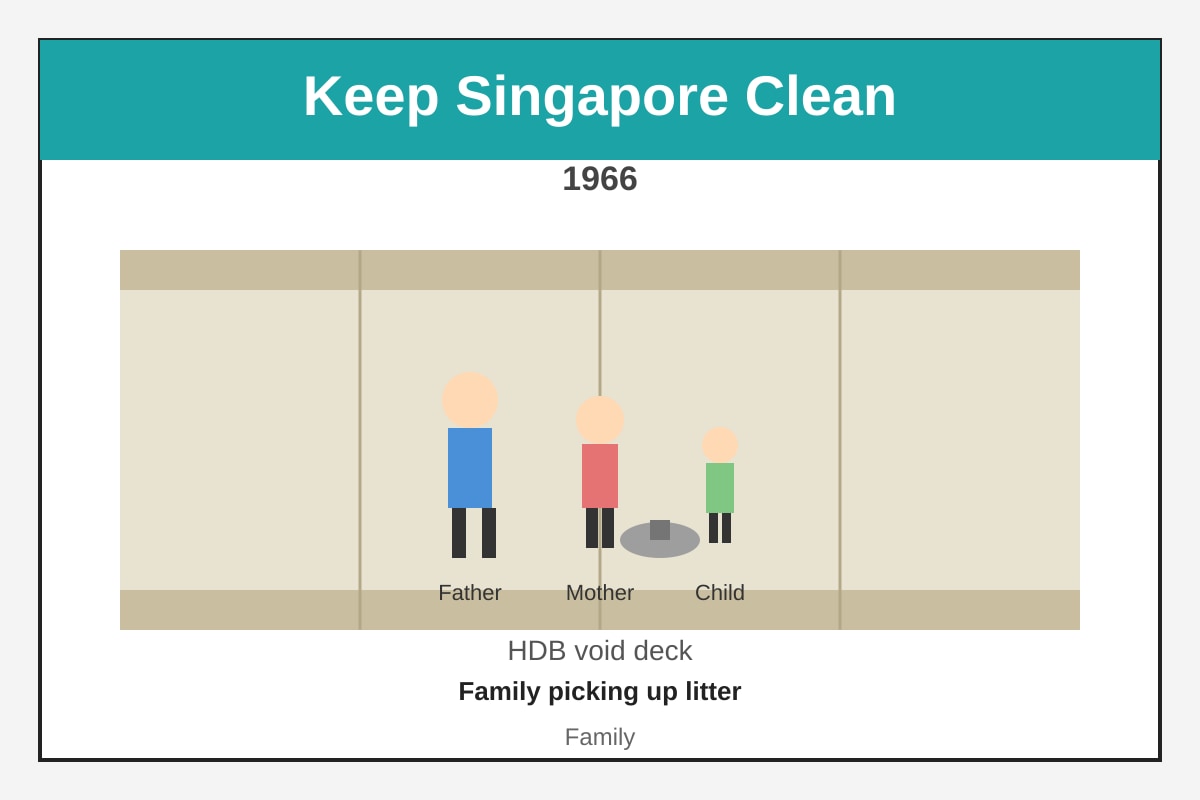
Source E is a government poster from 1966 encouraging citizens to keep their neighbourhoods clean after independence.
Image pending generation: source_image for Q4.
What can you infer about the government's priorities for nation-building from Source E? Explain your answer.
Section B: Structured Response Questions (25 marks)
5. Explain how the Japanese controlled the people of Singapore during the Japanese Occupation. (7 marks)
6. Explain two reasons which caused the separation of Singapore from Malaysia in 1965. (10 marks)
7. Explain how the British development of Singapore as a free port attracted migrant communities in the 1800s. (8 marks)
Section C: Short Answer and Recall (15 marks)
8. Name one push factor that brought Chinese migrants to Singapore in the 19th century. (1 mark)
9. What year did Raffles establish a British trading post in Singapore? (1 mark)
10. State one economic policy the British used to develop Singapore as a port city. (1 mark)
11. What was the name of the Sultanate that controlled the region after the decline of Melaka? (1 mark)
12. Give one example of a social challenge faced by Singapore after independence in 1965. (1 mark)
13. What event in 1942 marked the start of Japanese rule in Singapore? (1 mark)
14. Name one industry that grew in Singapore after the opening of the Suez Canal in 1869. (1 mark)
15. What was the main purpose of the Housing Development Board (HDB) formed in 1960? (1 mark)
16. State one effect of the Great Depression on Singapore in the 1930s. (1 mark)
17. Who were the local rulers that signed the treaty with Raffles in 1819? (1 mark)
18. Give one reason why Temasek declined as a trading port in the 1400s. (1 mark)
19. What was the Cold War context that affected post-war Singapore's decolonisation? (1 mark)
20. Name one community group that contributed to building Singapore under British rule. (1 mark)
Answers
TuitionGoWhere Exam Practice (AI) — SA2 History Secondary 2 (Version 5) Answer Key
Total Marks: 60
Section A: Source-Based Questions
Q1 (4 marks)
- Inference: Daily life was difficult; people faced food shortages and had to queue for rations under Japanese watch.
- Source detail: Long queue outside rice centre shows scarcity; soldiers show control.
- Mark breakdown: 2 marks for valid inference, 2 marks for using source details.
- Teaching note: During Occupation, rice was rationed. The photo proves civilians depended on distribution centres and lived under military presence.
Q2 (5 marks)
- Inference: Some Malay leaders were worried merger would reduce their political power due to Chinese majority in Singapore.
- Evidence: "upset the balance", "threaten our community's rights".
- Mark breakdown: 2 marks inference, 3 marks explanation with quote.
- Teaching note: This reflects communal tensions; merger was not supported by all groups.
Q3 (6 marks)
- Difference: Source C is official report (factual, administrative), Source D is cartoon (visual satire, emotional).
- C sees communists as real threat to order; D shows hidden manipulation of workers.
- Mark breakdown: 3 marks for identifying difference in type/purpose, 3 marks for content explanation.
- Teaching note: Different source types present same threat differently; report = data, cartoon = propaganda.
Q4 (5 marks)
- Inference: Government prioritised cleanliness and public hygiene for national identity.
- Evidence: Poster text and HDB setting show state-led social campaign.
- Mark breakdown: 2 marks inference, 3 marks link to nation-building.
- Teaching note: Post-independence campaigns built civic pride in new HDB towns.
Section B: Structured Response
Q5 (7 marks)
- Military: Kempeitai enforced fear; arrests of dissidents.
- Propaganda: Schools taught Japanese language; banned English media.
- Economic: Rice rationing controlled supply.
- Mark descriptors: L1 1-3 list methods; L2 4-5 explain one; L3 6-7 explain multiple with effect.
- Teaching note: Control was total – military, mind, and food.
Q6 (10 marks)
- Reason 1: Political disagreement – PAP and UMNO clashed over Malay rights and equality.
- Reason 2: Economic dispute – revenue sharing and common market failed.
- Mark descriptors: L1 1-3 identify; L2 4-6 explain one; L3 7-10 both with evidence.
- Teaching note: Separation was multi-causal, not sudden.
Q7 (8 marks)
- Free port = no taxes on trade → merchants came → jobs → migrants pulled by opportunity.
- Push from China poverty, pull from Singapore port.
- Mark breakdown: 4 marks for free port mechanism, 4 for migrant link.
- Teaching note: British policy shaped multicultural inflow.
Section C: Short Answer
Q8 (1): Poverty / famine / war in China.
Q9 (1): 1819.
Q10 (1): Free port status.
Q11 (1): Johor Sultanate.
Q12 (1): Housing shortage / unemployment.
Q13 (1): Fall of Singapore.
Q14 (1): Rubber / tin.
Q15 (1): Build public housing.
Q16 (1): Unemployment / trade drop.
Q17 (1): Sultan Hussein / Temenggong.
Q18 (1): Rise of Melaka.
Q19 (1): Communist threat / decolonisation.
Q20 (1): Chinese / Indian / Malay / European.
Free quiz and exam paper access
Enter your details to view this paper
Your access is remembered on this device.