From Real Exams Exam Paper
Secondary 2 History Semestral Assessment 2 (End of Year) Paper 4
Free Sec 2 History SA2 Paper 4, Nemo3 Exam version, with questions, answers, and syllabus-aligned practice for Singapore students.
These static practice materials are generated from the site's syllabus and paper-generation workflow, with source and model context shown so students and parents can evaluate the material before use.
Questions
Free quiz and exam paper access
Enter your details to view this paper
Your access is remembered on this device.
Answers
TuitionGoWhere Practice Paper - History Secondary 2 (SA2 Version 4) - Answer Key
Total Marks: 50
SECTION A: SOURCE-BASED CASE STUDY [30 marks]
1. Study Source A. What is the main message David Marshall is conveying in this speech? Support your answer with evidence from the source.
[3 marks]
Answer:
David Marshall's main message is that Singapore deserves full independence/self-government (Merdeka) and the British are making unfair excuses to delay it.
Mark breakdown:
- 1 mark: Identifies main message (Singapore deserves independence / British are delaying unfairly)
- 1 mark: Evidence from source — "We in Singapore want freedom. We want the right to govern ourselves."
- 1 mark: Evidence from source — "They say we are not ready... But look at India, look at Burma — they got their independence. Why not Singapore?"
Teaching note: For "main message" questions, state the central argument in one sentence, then provide two distinct pieces of textual evidence (direct quotes or close paraphrases). Do not just summarise — explain what the source is arguing.
2. Study Sources A and B. How different are Sources A and B in their views on Singapore's readiness for self-government? Explain your answer.
[6 marks]
Answer:
Sources A and B are very different in their views on Singapore's readiness for self-government.
Similarity (1 mark):
Both sources acknowledge that self-government/independence is being discussed for Singapore.
Differences (up to 5 marks, need at least 2 well-explained differences):
| Aspect | Source A (Marshall) | Source B (British Colonial Office) |
|---|---|---|
| View on readiness | Singapore is ready — compares to India and Burma which already gained independence | Singapore is not ready — government is "inexperienced", relies on "left-wing elements" |
| Attitude to British conditions | Rejects conditions as excuses ("half-measures") | Sees conditions (retaining defence, security, external affairs) as "appropriate" and necessary |
| View on communist threat | Not mentioned / implied as British excuse | Serious concern — "communist subversion" must be "under control" before self-government |
| Provenance/Purpose | Public speech by Chief Minister to rally support for Merdeka | Secret memorandum to justify delaying full self-government |
Mark breakdown:
- 1 mark: Clear overall judgement ("very different" / "largely different")
- 1 mark: Identifies a similarity
- Up to 4 marks: Explains two differences with evidence from both sources (2 marks per difference: 1 for point, 1 for evidence from each source)
- Bonus for provenance reasoning (can lift to full 6): Explains why they differ based on authorship/purpose (Marshall as nationalist leader vs. British officials protecting colonial interests)
Common mistake: Listing content differences without explaining why the sources differ (provenance, purpose, perspective). Always mention who wrote it, when, and why.
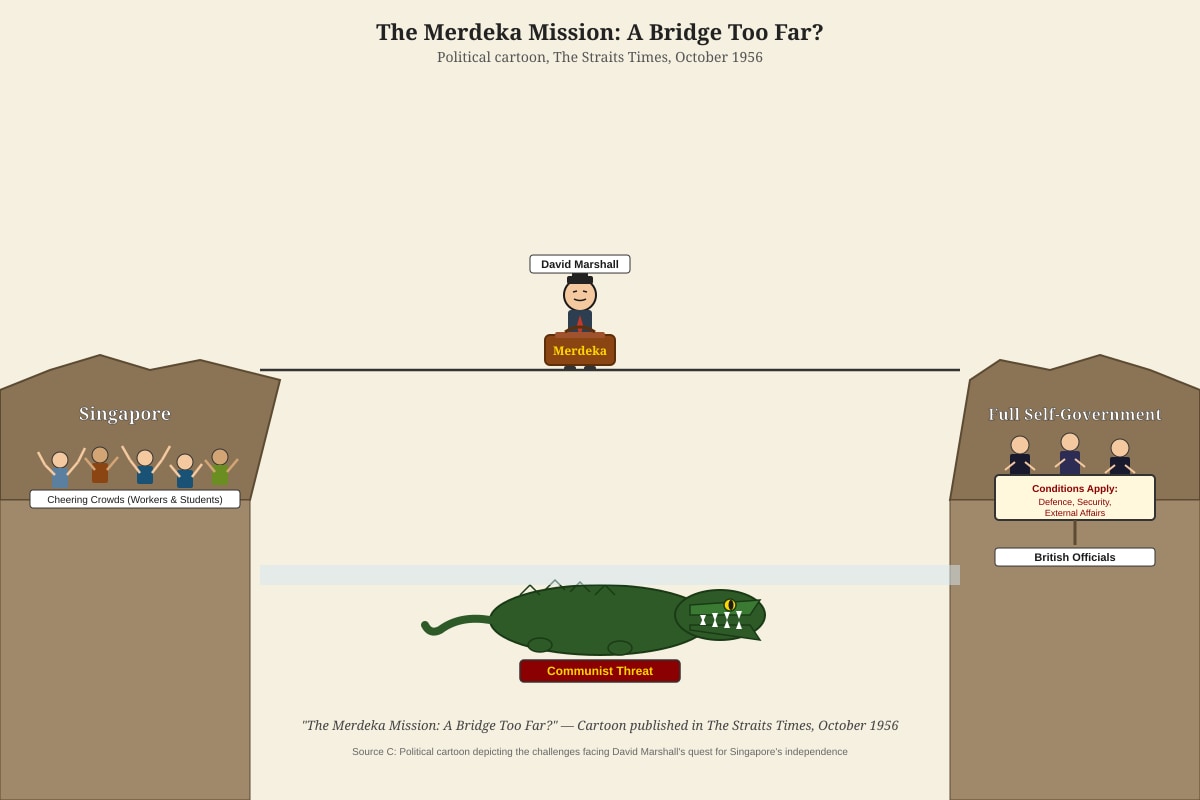
3. Study Source C. What is the cartoonist's view of David Marshall's 1956 Merdeka Mission? Explain your answer using details from the cartoon.
[5 marks]
Answer:
The cartoonist portrays Marshall's Merdeka Mission as ambitious but precarious and unlikely to succeed due to British conditions and the communist threat.
Supporting details (need 2–3 for full marks):
- Marshall as a tightrope walker — suggests the mission is risky, requires delicate balance, and could easily fail
- Suitcase labelled "Merdeka" — shows his goal, but he carries it alone
- Gap between cliffs — the distance between "Singapore" and "Full Self-Government" is wide; not easily bridged
- British officials holding "Conditions Apply" sign — British retention of defence, security, external affairs blocks the path
- Crocodile "Communist Threat" below — failure means falling to communist danger; the threat is ever-present
- Cheering crowds on Singapore side — local support exists, but doesn't help him cross
Mark breakdown:
- 1 mark: States cartoonist's overall view (precarious / risky / unlikely to succeed / determined but facing huge obstacles)
- Up to 4 marks: Explains 2–3 visual details and what they represent (1 mark per detail + interpretation)
Teaching note: For cartoons, always: (1) Identify symbols, (2) Explain what each symbol represents, (3) Link to the cartoonist's message/view. Don't just describe — interpret.
4. Study Sources C and D. Does Source D support the impression of the Merdeka Mission given in Source C? Explain your answer.
[6 marks]
Answer:
Yes, Source D largely supports the impression in Source C, though it provides more political context.
Supporting points (agreement):
- Precariousness: Source C shows Marshall on a tightrope; Source D says Marshall "refused to accept" British terms and resigned — mission failed for him.
- British conditions: Source C shows British holding "Conditions Apply" sign; Source D confirms British "kept control of internal security" and "would only transfer power to a government that could guarantee stability on their terms."
- Communist threat: Source C shows crocodile; Source D describes Lim Yew Hock cracking down on communists (students, unions) to satisfy the British.
Nuance / Additional insight from Source D (not in C):
- Source D reveals the political cost: "The left-wing had been decimated. The PAP was split." — shows the mission's success (under Lim Yew Hock) came at a high price not visible in the cartoon.
- Source D clarifies the outcome: 1957 talks succeeded where 1956 failed, but only after anti-communist crackdown.
Mark breakdown:
- 1 mark: Clear judgement ("Yes, largely supports" / "Yes, but adds...")
- Up to 5 marks: Explains 2–3 points of agreement with evidence from both sources, and 1 point of additional insight/nuance from Source D
Teaching note: "Does Source X support Source Y?" questions need: (1) Overall judgement, (2) Specific agreements with evidence from both, (3) Any disagreements or additional insights. Don't just say "yes" — prove it.
5. Study Source E. Using Source E and your own knowledge, explain why the 1957 Merdeka Talks succeeded where the 1956 talks had failed.
[5 marks]
Answer:
The 1957 talks succeeded because Lim Yew Hock's government took strong action against communist elements, satisfying British conditions for internal security, whereas Marshall refused to compromise in 1956.
From Source E:
- 1956: "Marshall demands full internal self-government; British refuse; Marshall resigns"
- 1957: "Lim Yew Hock secures full internal self-government; British retain defence and external affairs only"
Own knowledge (need at least 1–2 points):
- Lim Yew Hock used the Preservation of Public Security Ordinance to arrest left-wing activists, Chinese middle school students, and trade unionists (e.g., 1956 Chinese Middle School riots crackdown)
- This convinced the British that internal security was under control — their key condition
- Lim Yew Hock was willing to accept British retention of defence and external affairs (compromise), unlike Marshall who demanded full internal self-government including security
- The political landscape shifted: left-wing opposition weakened, making the British more confident in a stable transfer
Mark breakdown:
- 1 mark: Identifies key reason (Lim Yew Hock's anti-communist crackdown satisfied British)
- 1 mark: Evidence from Source E (contrast between 1956 failure and 1957 success)
- Up to 3 marks: Own knowledge points (1–2 marks per point, max 3) — must be specific (names, events, policies)
Common mistake: Only using Source E without own knowledge. The question explicitly says "Using Source E and your own knowledge."
6. "The British were the main obstacle to Singapore achieving self-government in the 1950s."
How far do you agree with this statement? Use all the sources and your own knowledge to support your answer.
[10 marks]
Answer:
Balanced argument required. A strong answer argues that the British were a major obstacle but not the only one — internal divisions, communist threat, and political inexperience also hindered self-government.
Structure for 10-mark "How far do you agree?" question:
- Introduction (1 mark): Clear stand — "I agree to a large extent, but other factors were also significant."
- Argument FOR British as main obstacle (3–4 marks): Use sources + own knowledge
- Argument AGAINST / Other obstacles (3–4 marks): Use sources + own knowledge
- Conclusion with synthesis (1–2 marks): Weighs relative importance
Points supporting "British were main obstacle" (use Sources A, B, C, D, E):
- Source A: Marshall accuses British of "putting conditions in our way" — defence, security, external affairs retained
- Source B: British explicitly state they "cannot grant full internal self-government until... communist subversion is under control" — they set the conditions
- Source C: Cartoon shows British officials blocking the path with "Conditions Apply" sign"
- Defence, Security, External Affairs
- Source D: British "would only transfer power to a government that could guarantee stability on their terms"
- Source E: 1956 talks failed because British refused; 1957 succeeded only after British conditions met
- Own knowledge: Rendel Constitution (1955) kept key powers with British; British used "communist threat" to justify delay; controlled pace of constitutional advance
Points supporting "Other obstacles were also significant" (use sources + own knowledge):
- Source B: Notes Labour Front government was "inexperienced" and relied on "left-wing elements" — internal weakness
- Source D: "The left-wing had been decimated. The PAP was split." — internal political divisions weakened nationalist unity
- Source D: Lim Yew Hock had to crack down on own supporters (students, unions) to satisfy British — shows internal conflict
- Own knowledge:
- Communist insurgency (Malayan Emergency context) made British cautious
- Communal tensions (e.g., 1964 racial riots later, but also 1950s Malay-Chinese tensions)
- Political fragmentation: Multiple parties (Labour Front, PAP, UMNO, MCA, etc.) with different visions
- Economic dependence on British military spending and trade
- Lack of administrative experience among local leaders
Synthesis for conclusion:
- British controlled the timeline and conditions — they held the keys (defence, security, external affairs)
- But local leaders' inability to unite and communist threat gave British legitimate reasons to delay
- Ultimately, self-government came only when British conditions were met (1957), suggesting British were the gatekeepers — but local agency (Lim Yew Hock's actions) determined when those conditions were met
Mark breakdown (typical LORMS — Level of Response Mark Scheme):
| Level | Marks | Descriptor |
|---|---|---|
| L1 | 1–2 | General assertions, no source use, no balance |
| L2 | 3–4 | One-sided argument, uses sources but no own knowledge / no balance |
| L3 | 5–6 | Balanced argument, uses sources + some own knowledge, but limited explanation |
| L4 | 7–8 | Well-developed balanced argument, good use of sources + own knowledge, clear explanation |
| L5 | 9–10 | Sophisticated balanced argument, excellent source integration, own knowledge, nuanced synthesis, clear judgement |
Teaching note: For 10-mark questions, always use a clear structure: Stand → Evidence for → Evidence against → Weighed conclusion. Use all sources explicitly (cite "Source A shows...", "Source E indicates..."). Include specific own knowledge (names, dates, events). Time management: ~12–15 minutes.
SECTION B: STRUCTURED RESPONSE QUESTIONS [20 marks]
7. The Japanese Occupation (1942–1945)
(a) Identify two methods used by the Japanese to control the local population in Singapore during the Occupation.
[2 marks]
Answer (any two, 1 mark each):
- Sook Ching / Mass screening — targeting anti-Japanese elements, especially Chinese males aged 18–50
- Propaganda and education — e.g., Nippon-go (Japanese language) compulsory in schools, Dawn Exercise (radio calisthenics), promotion of "Asia for Asians" / Greater East Asia Co-Prosperity Sphere
- Surveillance and informers — Kempeitai (military police) network, local informers, neighbourhood associations (Tonarigumi)
- Forced labour — Kinzou (labour battalions) for construction, dock work, Burma-Thailand Railway
- Rationing and economic control — "Banana money" currency, price controls, ration cards for rice/essentials
- Cultural suppression — banning English/Chinese publications, promoting Japanese culture, Shinto shrine worship
Teaching note: Be specific. "Violence" is too vague — name Sook Ching. "Propaganda" is acceptable but better with examples (Nippon-go, Dawn Exercise).
(b) Explain why the Japanese carried out the Sook Ching operation.
[4 marks]
Answer:
The Japanese carried out Sook Ching to eliminate anti-Japanese resistance and intimidate the Chinese community into submission.
Reasons (2 marks each, need two well-explained reasons):
-
Remove anti-Japanese elements: The Chinese community in Singapore had supported China's war effort against Japan (e.g., China Relief Fund, boycotts of Japanese goods). The Kempeitai targeted those suspected of anti-Japanese activities — volunteers, teachers, journalists, clan leaders — to decapitate resistance leadership.
-
Instil fear and deterrence: By conducting mass screening and arbitrary executions (estimates 5,000–25,000 killed), the Japanese sent a brutal message that opposition would be crushed. This terrorised the population into compliance and discouraged future resistance.
-
Racial policy / "China-centric" view: The Japanese viewed the Chinese as inherently hostile due to the Second Sino-Japanese War (1937–1945). Sook Ching was a pre-emptive purge based on ethnicity and perceived loyalty to China.
Mark breakdown:
- 2 marks per reason: 1 for identifying reason, 1 for explanation/development
- Maximum 4 marks
Common mistake: Just describing what happened (screening, executions) without explaining why (purpose/intent). Focus on Japanese motives.
(c) "The Japanese Occupation was the main reason for the rise of nationalism in Singapore after the war."
How far do you agree? Explain your answer.
[8 marks]
Answer:
Balanced argument. The Japanese Occupation was a major catalyst but not the only reason — British post-war policies, global decolonisation, and local leadership also drove nationalism.
Structure for 8-mark "How far do you agree?" (similar to 10-mark but shorter):
- Stand (1 mark)
- Factor 1: Japanese Occupation (2–3 marks)
- Factor 2: Other factors (2–3 marks)
- Conclusion (1 mark)
Factor 1: Japanese Occupation as catalyst (agree)
- Shattered myth of European superiority: Japanese defeated British in 70 days — showed Asians could defeat Europeans. Locals realised colonial rule was not permanent or invincible.
- Political awakening: Occupation gave locals administrative experience (e.g., Japanese-appointed councils, Hokokai). Leaders like Lee Kuan Yew, Goh Keng Swee gained experience.
- Hardship forged collective identity: Shared suffering (rationing, Sook Ching, forced labour) created a sense of "we" vs. "they" — not just Chinese/Malay/Indian, but "Singaporeans" under occupation.
- Power vacuum (1945): Japanese surrender created brief period of uncertainty (Aug–Sept 1945) where local groups (e.g., MPAJA, People's Committees) attempted self-governance — preview of self-rule.
Factor 2: Other reasons (disagree / additional factors)
- British post-war failures: British Military Administration (BMA, 1945–1946) was corrupt, inefficient, unresponsive — food shortages, inflation, unemployment. Locals lost faith in British competence.
- Global decolonisation wave: India (1947), Burma (1948), Indonesia (1949) gained independence — international momentum made colonial rule illegitimate.
- Rise of political parties & leaders: PAP (1954), Labour Front, UMNO, MCA — organised mass politics channelled nationalist energy into elections and demands.
- Education & media growth: English and vernacular press, radio, expanding education created politically aware public.
- Labour & student activism: Trade unions (e.g., GLU, SFSWU) and Chinese middle school students mobilised for rights and self-government — grassroots pressure.
Synthesis/Conclusion:
- Occupation was the spark — it broke the psychological hold of colonialism and gave locals a taste of self-organisation.
- But sustained nationalism required post-war conditions: British weakness, global trends, and organised local leadership.
- Without Occupation, nationalism might have emerged later; without post-war factors, it might not have succeeded.
Mark breakdown (LORMS):
| Level | Marks | Descriptor |
|---|---|---|
| L1 | 1–2 | General statements, no specific evidence, one-sided |
| L2 | 3–4 | One-sided with some evidence / balanced but undeveloped |
| L3 | 5–6 | Balanced, specific evidence for both sides, clear explanation |
| L4 | 7–8 | Well-argued, nuanced, specific evidence, clear synthesis/judgement |
Teaching note: For 8-mark questions, aim for 2 developed points per side (Occupation + 2 other factors). Use specific examples (BMA failures, India 1947, PAP formation). Conclusion must weigh, not just summarise.
8. Merger and Separation (1961–1965)
(a) State two reasons why the PAP government wanted merger with Malaya in 1961.
[2 marks]
Answer (any two, 1 mark each):
- Economic survival — Singapore had no natural resources, small market, high unemployment; merger would create a common market with Malaya, allowing free trade and industrial expansion.
- Independence through merger — British refused full independence for Singapore alone (too small, communist threat); merger with anti-communist Malaya was the only path to independence acceptable to Britain.
- Political legitimacy / PAP survival — PAP faced internal left-wing challenge (Barisan Sosialis formed 1961); merger referendum would secure mandate and marginalise pro-communist opposition.
- Security — Shared defence against external threats and internal communism; Malaya had stronger military and anti-communist stance.
Teaching note: "Economic survival" and "independence through merger" are the two classic textbook reasons. Mention both for a complete picture.
(b) Explain why tensions arose between the PAP and the Alliance government in Kuala Lumpur after merger.
[4 marks]
Answer:
Tensions arose due to fundamental political, economic, and ideological differences between the PAP's vision of a "Malaysian Malaysia" and the Alliance's communal-based politics.
Reasons (2 marks each, need two well-explained):
-
Political ideology — "Malaysian Malaysia" vs. Communalism:
PAP advocated multi-racial, non-communal politics ("Malaysian Malaysia" — equal rights regardless of race). The Alliance (UMNO-MCA-MIC) was based on communal representation — UMNO for Malays, MCA for Chinese, MIC for Indians. PAP's participation in 1964 Federal Election (challenging MCA in Chinese seats) and formation of Malaysian Solidarity Convention (1965) threatened UMNO's monopoly on Malay support. -
Economic disagreements — Common Market & Taxation:
- Common Market delay: Alliance delayed implementing the common market promised in merger terms; Singapore's exports to Malaya faced tariffs.
- Revenue contribution: Singapore was required to contribute 40% of its revenue to federal government (increased from agreed 30%), seen as unfair given Singapore's smaller population.
- Pioneer Certificate / Industrialisation: KL controlled pioneer status; Singapore felt its industrialisation was hindered.
-
Racial politics & communal tensions:
- UMNO extremists (e.g., Syed Jaafar Albar) accused PAP of marginalising Malays in Singapore.
- PAP's welfare policies for Malays (e.g., Mendaki precursor, education) were portrayed as insufficient.
- 1964 Racial Riots (July & September) — inflamed by communal rhetoric from both sides; KL blamed PAP, PAP blamed UMNO extremists.
-
Leadership clash — Lee Kuan Yew vs. Tunku Abdul Rahman:
Personal and ideological clash: Lee's meritocratic, centralising style vs. Tunku's consensus-based, communal-balance approach. Lee's speeches in Federal Parliament challenged Malay special rights (Article 153), alarming UMNO.
Mark breakdown:
- 2 marks per reason: 1 for identification, 1 for explanation with specific detail
- Maximum 4 marks
Teaching note: Always link to specific events/policies (1964 Federal Election, Malaysian Solidarity Convention, 40% revenue, 1964 riots). Avoid vague "they disagreed."
(c) "Economic disagreements were the main cause of Singapore's separation from Malaysia in 1965."
How far do you agree? Explain your answer.
[8 marks]
Answer:
Disagree to a large extent. Economic disagreements were significant but not the main cause — political/ideological conflict over racial politics was the primary driver, with economic issues as a contributing factor.
Structure: Stand → Economic factors → Political/racial factors (main) → Other factors → Weighed conclusion.
Economic disagreements (supporting statement):
- Common Market not implemented: Singapore expected free access to Malayan market (300+ mile hinterland); Alliance delayed, kept tariffs — hurt Singapore's industrialisation plans.
- Revenue contribution hike: Singapore's contribution to federal revenue raised from 30% to 40% (1964) without consultation — seen as economic exploitation.
- Development funds: Federal government withheld/delayed development loans for Singapore projects (e.g., port expansion, industrial estates).
- Pioneer Certificate control: KL controlled tax incentives for industries; Singapore felt it couldn't attract investment autonomously.
Political / Racial factors (main cause — disagree with statement):
- "Malaysian Malaysia" vs. Ketuanan Melayu: PAP's Malaysian Solidarity Convention (May 1965) — "Malaysian Malaysia" slogan directly challenged UMNO's Malay supremacy (Article 153, special rights). This was existential threat to UMNO's political base.
- 1964 Federal Election: PAP contested in Peninsula (won 1 seat, Bangsar) — UMNO saw this as declaration of war on communal politics.
- Communal rhetoric & 1964 Riots: UMNO extremists (Syed Jaafar Albar) used Utusan Melayu to accuse PAP of anti-Malay policies → July & September 1964 racial riots (36 dead, 500+ injured). Created atmosphere where separation became "only way to avoid bloodshed" (Tunku's words).
- Tunku's decision: Tunku Abdul Rahman concluded PAP could not be accommodated in Alliance framework; separation was political necessity to preserve Malay dominance and national unity.
Other factors:
- Personality clash: Lee Kuan Yew's confrontational style vs. Tunku's consensual style — mutual distrust.
- Security concerns: KL feared Singapore's left-wing (Barisan Sosialis) would destabilise Federation; Singapore felt KL didn't protect Chinese during riots.
- Water & defence: Unresolved agreements on water supply and defence coordination.
Synthesis/Conclusion:
- Economic issues were negotiable (could be resolved via talks, as later proven by 1962 Water Agreement, trade ties).
- Racial politics was non-negotiable — UMNO's legitimacy depended on Malay special rights; PAP's legitimacy depended on multi-racial equality. No compromise possible.
- Tunku's statement (9 Aug 1965): "There is no other way... to avoid bloodshed" — confirms political survival, not economics, drove the decision.
Mark breakdown (LORMS):
| Level | Marks | Descriptor |
|---|---|---|
| L1 | 1–2 | General, one-sided, no specific evidence |
| L2 | 3–4 | One-sided with evidence / balanced but list-like |
| L3 | 5–6 | Balanced, specific evidence, clear explanation of both sides |
| L4 | 7–8 | Nuanced, prioritises causes, strong synthesis, clear judgement |
Teaching note: This is a classic "main cause" question. The historiographical consensus (and syllabus emphasis) is that political/racial differences were primary. Economic issues were real but secondary. Show you understand this hierarchy. Use specific evidence: Malaysian Solidarity Convention, 1964 riots, 40% revenue, Article 153, Tunku's separation speech.
END OF ANSWER KEY