From Real Exams Exam Paper
Secondary 2 History Semestral Assessment 2 (End of Year) Paper 3
Free Sec 2 History SA2 Paper 3, Nemo3 Exam version, with questions, answers, and syllabus-aligned practice for Singapore students.
These static practice materials are generated from the site's syllabus and paper-generation workflow, with source and model context shown so students and parents can evaluate the material before use.
Questions
Free quiz and exam paper access
Enter your details to view this paper
Your access is remembered on this device.
Answers
TuitionGoWhere Practice Paper - History Secondary 2 (SA2 Version 3) - Answer Key
Total Marks: 50
SECTION A: SOURCE-BASED CASE STUDY [25 marks]
Question 1 [4 marks]
Inference: David Marshall was critical of the British colonial government but willing to work within the constitutional framework to achieve self-government.
Evidence from Source A:
- "We have been given a Constitution which is not a Constitution of independence, but a Constitution of partnership" — shows he viewed the British offer as inadequate/not true independence.
- "The British have retained control over defence, foreign affairs, and internal security" — highlights his awareness of British unwillingness to cede real power.
- "We must work within this framework to prove that we are capable of self-government" — shows his pragmatic willingness to cooperate despite limitations.
- "We will not be intimidated by the colonial government" — demonstrates his defiant stance against British authority.
Marking Notes:
- 1 mark for a valid inference about Marshall's attitude (critical/pragmatic/defiant).
- 1 mark for each piece of supporting evidence (max 3 marks for evidence).
- Award 0 marks if no inference is made or if evidence does not support the inference.
Question 2 [6 marks]
Answer: Sources A and B are very different in their views on Singapore's readiness for self-government.
Similarity (1 mark): Both sources acknowledge that self-government is a goal being discussed — Source A states "Merdeka is our goal" and Source B mentions "Marshall's demand for immediate self-government".
Differences (max 5 marks):
| Aspect | Source A (Marshall) | Source B (British Colonial Office) |
|---|---|---|
| View on readiness | Believes Singapore is ready; wants to "prove that we are capable" | Believes conditions "are not yet ripe"; self-government is "premature" |
| View on British control | Critical: British retained key powers (defence, foreign affairs, internal security) | Justifies British control: "must retain control of internal security to prevent communist subversion" |
| View on Marshall/Labour Front | Presents himself as fighting for workers' rights, not intimidated | Suspicious: "worrying tendencies", "left-wing elements sympathetic to the Malayan Communist Party" |
| Provenance/Purpose | Public speech to rally support; portrays Labour Front as reasonable and constitutional | Secret memorandum; reflects British security concerns and desire to maintain control |
Explanation of difference: The sources differ fundamentally because of their provenance and purpose. Marshall (Source A) is a newly elected Chief Minister giving a public speech to gain popular support and legitimise his government. The British Colonial Office (Source B) is an internal secret assessment focused on security risks and maintaining colonial authority. Their different roles and audiences shape their opposing views.
Marking Notes:
- 1 mark for identifying similarity.
- Up to 3 marks for well-explained content differences with evidence.
- Up to 2 marks for provenance/purpose analysis explaining why they differ.
- Maximum 6 marks. Do not award full marks without provenance analysis.
Question 3 [5 marks]
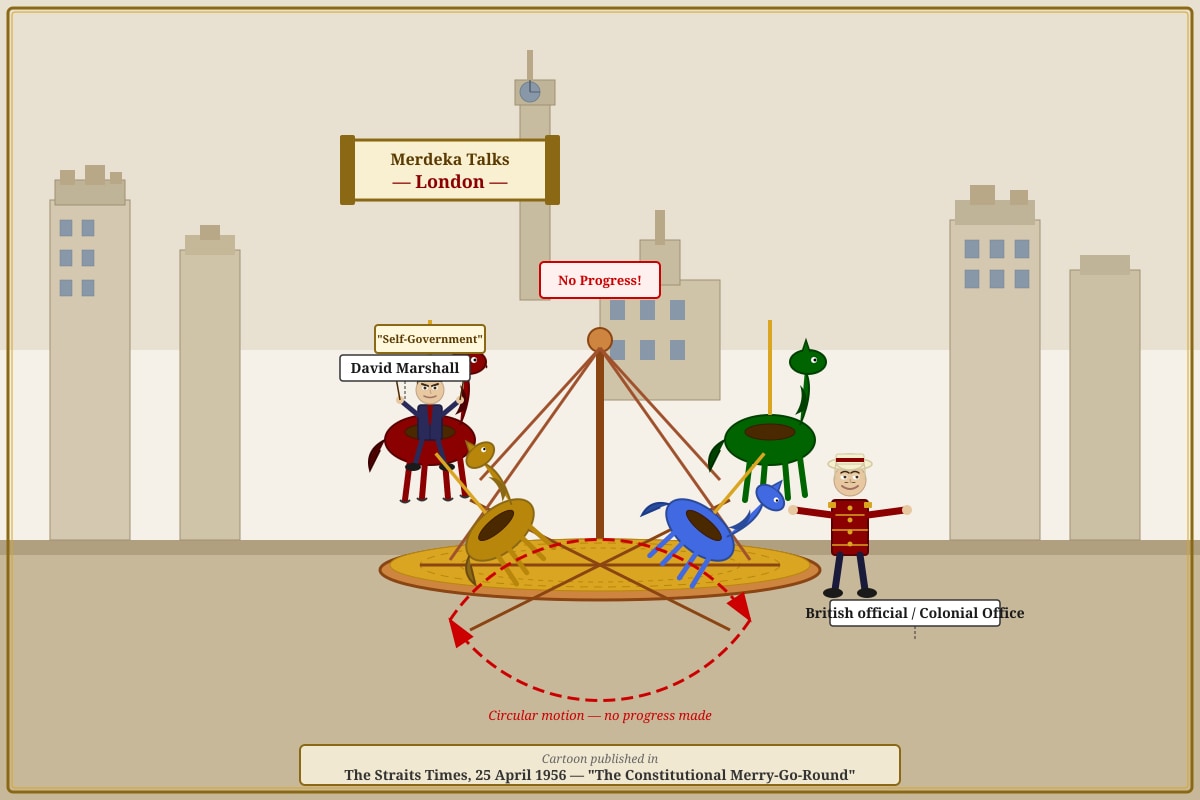
Message: The cartoonist is criticising the Merdeka talks as a futile exercise where the British give the appearance of negotiating self-government but actually prevent real progress, keeping Singapore going in circles.
Supporting details from the cartoon:
- Merry-go-round metaphor: The "Self-Government" horse goes in circles but does not move forward — symbolising the lack of real progress despite ongoing talks.
- British official pushing the merry-go-round: The Colonial Office controls the motion, showing British dominance over the process.
- Marshall's frustrated expression vs. British official's smug smile: Marshall is powerless and frustrated; the British official is in control and satisfied with the status quo.
- Sign "Merdeka Talks - London": Indicates the talks are held in London on British terms, not in Singapore.
- Caption "The Constitutional Merry-Go-Round": Explicitly labels the process as circular and pointless.
Marking Notes:
- 1 mark for identifying the main message (futility/British control/no real progress).
- Up to 4 marks for explaining how specific visual details support the message.
- Award marks only if details from the cartoon are explicitly referenced.
Question 4 [6 marks]
Answer: Source D is useful to a limited extent as evidence of why Marshall failed.
Useful aspects (max 3 marks):
- Insider perspective: Lee Kuan Yew was a key political rival and later Prime Minister; he witnessed events firsthand.
- Explains strategic difference: Highlights the PAP's alternative strategy ("build a mass base, win elections convincingly, negotiate from strength") which succeeded where Marshall's failed.
- Identifies key constraint: Confirms the British would not cede internal security due to the "communist threat" — a crucial structural factor.
Limitations (max 3 marks):
- Hindsight bias: Written in 1998, over 40 years later; Lee had reason to justify his own success and criticise rivals.
- Political rivalry: Lee and Marshall were opponents; the memoir serves to legitimise the PAP's narrative.
- Oversimplification: Attributes failure mainly to Marshall's "flawed approach" and overpromising, downplaying British intransigence and communist threat (which Sources A and B highlight).
- Self-serving: The PAP's "negotiate from strength" strategy worked because they won the 1959 election decisively — but this was not guaranteed in 1955–56.
Conclusion: Source D provides valuable insight into the PAP's perspective and the structural constraint of internal security, but must be cross-referenced with Sources A and B for a balanced view. It is not fully reliable as an objective explanation.
Marking Notes:
- 1 mark for overall judgement (useful to limited extent / useful but with limitations).
- Up to 3 marks for well-explained usefulness with evidence.
- Up to 3 marks for well-explained limitations with evidence (provenance, purpose, hindsight, bias).
- No marks for "useful" or "not useful" without explanation.
Question 5 [4 marks]
Answer: I partially agree. Marshall's mistakes contributed to his resignation, but external factors were equally important.
Supporting Marshall's mistakes (from sources/own knowledge):
- Source A/D: Marshall overpromised ("Merdeka now") and used brinkmanship (threatening resignation) which backfired when the British called his bluff.
- Source D: His approach was "fundamentally flawed" — he negotiated from weakness without a strong electoral mandate.
- Own knowledge: He failed to control labour unrest (Hock Lee Bus Riots, 1955) and student protests (Chinese Middle School Riots, 1956), undermining British confidence in his ability to maintain order.
Supporting external factors (from sources/own knowledge):
- Source B: British were determined to retain internal security due to "communist subversion" — a structural constraint Marshall could not overcome.
- Source A: The 1955 Constitution deliberately withheld key powers (defence, foreign affairs, internal security).
- Source C: Cartoon shows British controlling the process — the "merry-go-round" was designed not to reach independence.
- Own knowledge: The Cold War context and Malayan Emergency made the British extremely cautious about communist influence in Singapore.
Conclusion: Marshall's tactical errors (resignation threat, confrontational style) were the immediate trigger, but the British refusal to transfer internal security and the communist insurgency context made failure highly likely regardless.
Marking Notes:
- 1 mark for clear stand (agree/disagree/partially agree).
- Up to 2 marks for well-supported arguments from sources.
- Up to 1 mark for own knowledge contextualisation.
- Award 0 marks for one-sided answers without balance.
SECTION B: STRUCTURED RESPONSE QUESTIONS [25 marks]
Question 6 [12 marks]
6(a) [2 marks]
Any two of the following (1 mark each):
- Sook Ching operation — mass screening and execution of anti-Japanese Chinese males.
- Propaganda and education — forced Japanese language (Nippon-go), culture, and values in schools; censorship of media.
- Kempeitai (military police) surveillance — informer network, arbitrary arrests, torture to suppress resistance.
- Forced labour — locals compelled to work on military projects (e.g., Changi Airport extension, Burma-Thailand Railway).
- Food rationing and price controls — strict control of essential supplies to ensure compliance.
- Renaming of places — Syonan-to ("Light of the South"), streets renamed in Japanese.
6(b) [4 marks]
Reasons for Sook Ching (any two well-explained reasons, 2 marks each):
- Eliminate anti-Japanese elements: The Chinese community had supported the China Relief Fund and anti-Japanese boycotts before the war. The Japanese viewed them as hostile and a threat to their rule.
- Instil fear and deter resistance: Public executions and mass screening were intended to terrorise the population into submission and discourage any opposition to the Japanese Military Administration.
- Target communist influence: The Malayan Communist Party (MCP) and Dalforce (Singapore Overseas Chinese Anti-Japanese Volunteer Army) had resisted during the invasion. The Japanese wanted to destroy this organised resistance network.
- Assert Japanese sovereignty: Demonstrated that the Japanese were the new masters and resistance was futile — part of the "Asia for Asians" propaganda that masked brutal reality.
Marking Notes:
- 1 mark for identification of reason, 1 mark for explanation/development.
- Maximum 4 marks. Simple listing without explanation gets 1 mark per reason max.
6(c) [6 marks]
Stand: I agree to a large extent that the Chinese community suffered the greatest impact, but other communities were also significantly affected.
Arguments for Chinese community bearing greatest impact (max 4 marks):
- Sook Ching massacre: Estimated 25,000–50,000 Chinese males killed — targeted specifically at Chinese community.
- Forced contributions: Chinese community forced to donate $50 million "gift" to Japanese war effort (1942).
- Discriminatory policies: Chinese schools closed or forced to teach Japanese; Chinese leaders arrested/tortured by Kempeitai.
- Economic targeting: Chinese businesses confiscated or placed under Japanese control; Chinese merchants pressured to cooperate.
Arguments for impact on other communities (max 3 marks):
- Malays: Some collaborated (e.g., Malay volunteers in Japanese auxiliary police), but many suffered food shortages, forced labour, and loss of livelihood. Japanese promoted "Malay nationalism" as divide-and-rule tactic.
- Indians: Indian National Army (INA) recruitment; some joined willingly for Indian independence, others coerced. Many sent to Burma-Thailand Railway as forced labour (high death rates).
- Eurasians: Suspected of pro-British loyalty; many interned, interrogated, or forced to relocate to Bahau (Negri Sembilan) for farming — high mortality from disease/malnutrition.
- All communities: Shared suffering from hyperinflation ("banana money" collapse), severe food shortages, malnutrition, disease (beriberi, malaria), and loss of freedom.
Balanced conclusion: The Chinese community was specifically targeted for extermination and extraction, making the impact uniquely severe and genocidal in nature. However, the Occupation was a collective trauma — all communities endured economic collapse, hunger, and loss of dignity.
Marking Notes:
- 1 mark for clear stand.
- Up to 3 marks for developed arguments on Chinese community impact (specific evidence required).
- Up to 2 marks for developed arguments on other communities.
- 1 mark for balanced conclusion/synthesis.
- Maximum 6 marks. Do not award full marks without specific evidence.
Question 7 [13 marks]
7(a) [2 marks]
Any two of the following (1 mark each):
- Severe food shortages — disruption of shipping, Japanese "banana money" inflation, collapse of entrepôt trade.
- Mass unemployment — port facilities destroyed, factories closed, trade links severed.
- Hyperinflation — Japanese "banana money" became worthless; savings wiped out; barter economy emerged.
- Housing destruction — bombing raids and fighting damaged/destroyed thousands of homes.
- Breakdown of utilities — water, electricity, sanitation systems damaged or non-functional.
- Health crisis — spread of diseases (cholera, malaria, beriberi) due to malnutrition and poor sanitation.
7(b) [4 marks]
Reasons for 1948 Constitution (any two well-explained, 2 marks each):
- Respond to post-war political awakening: War shattered the myth of British invincibility; locals demanded political participation. The Constitution provided limited elected representation (6 unofficial members in 22-member Legislative Council) to channel demands constitutionally.
- Counter communist influence: Malayan Communist Party (MCP) was gaining strength through trade unions and strikes (e.g., 1947 general strike). British wanted a moderate, pro-British political class to emerge as alternative to communism.
- Maintain British control: The Constitution retained British veto power — Governor had reserved powers over defence, foreign affairs, internal security, finance. Only 6 of 22 Legislative Council seats were elected; rest were official/ nominated members.
- Gradual constitutional advance: Part of British policy of "guided democracy" — prepare locals for self-government slowly while retaining ultimate authority.
Marking Notes:
- 1 mark for identification, 1 mark for explanation per reason.
- Maximum 4 marks.
7(c) [7 marks]
Stand: I agree that the 1955 Election was a major turning point, though it had limitations.
Arguments for turning point (max 4 marks):
- First election with automatic voter registration and expanded franchise: Electorate grew from ~23,000 (1948) to ~300,000 (1955) — mass politics began.
- Labour Front victory (10/25 elected seats): First time a local party formed government; David Marshall became first Chief Minister — shift from British-appointed to locally-elected leadership.
- Emergence of PAP as major force: PAP won 3/4 seats contested (Lee Kuan Yew, Lim Chin Siong, Fong Swee Suan) — announced arrival of new political generation.
- Constitutional significance: Rendel Constitution (1955) created Chief Minister post and gave locals control over 7 of 10 ministries (except defence, foreign affairs, internal security) — real, though limited, self-government.
- Political mobilisation: Campaigning mobilised workers, students, Chinese-educated — politics moved beyond English-educated elite.
Arguments for limitations/continuities (max 3 marks):
- British retained key powers: Internal security, defence, foreign affairs remained under British control — Marshall's resignation (1956) proved these limits.
- Communal/communalist politics persisted: Labour Front relied on Malay/union support; PAP had Chinese-educated left wing — ethnic/ideological divisions continued.
- Instability: Labour Front coalition fragile; Marshall's confrontational style led to failed Merdeka talks and resignation after 14 months.
- Not yet full self-government: 1959 Election (full internal self-government) was the true turning point; 1955 was a step towards it.
Synthesis: The 1955 Election transformed Singapore from a colony ruled by British officials to one with an elected local government controlling most domestic affairs. It launched the political careers of both Marshall and Lee Kuan Yew. However, the British "reserved powers" meant it was an incomplete turning point — the struggle for full internal self-government continued until 1959.
Marking Notes:
- 1 mark for clear stand.
- Up to 4 marks for well-developed "turning point" arguments with specific evidence.
- Up to 2 marks for well-developed limitations.
- 1 mark for synthesis/balanced conclusion.
- Maximum 7 marks.
Question 8 [12 marks]
8(a) [2 marks]
Any two of the following (1 mark each):
- Economic survival: Singapore had no natural resources, declining entrepôt trade, and needed access to Malaya's larger market and resources (rubber, tin, water).
- Employment for growing population: Rapid post-war population growth required industrialisation and job creation — merger promised a common market.
- Political legitimacy/anti-colonialism: Merger was seen as the path to independence — British would not grant independence to tiny Singapore alone but would to a larger Federation.
- Counter communist threat: PAP leaders (Lee Kuan Yew) believed merger with anti-communist Malaya (Tunku Abdul Rahman) would help suppress the pro-communist left wing in Singapore (Barisan Sosialis).
- Shared history/culture: Close economic, social, and family ties across the Causeway; many Singaporeans had roots in Malaya.
8(b) [4 marks]
Reasons merger was short-lived (any two well-explained, 2 marks each):
- Political rivalry — PAP vs. Alliance: PAP's participation in 1964 Federal Election (challenging MCA in Malay seats) and formation of Malaysian Solidarity Convention (1965) advocating "Malaysian Malaysia" threatened Alliance's communal-based politics. Tunku saw PAP as existential threat.
- Communal politics and racial tensions: UMNO extremists (e.g., Syed Jaafar Albar) inflamed Malay fears of Chinese dominance; PAP's "Malaysian Malaysia" seen as challenging Malay special rights (Article 153). Led to 1964 racial riots (July and September).
- Economic disagreements: Singapore expected common market but faced trade restrictions; Kuala Lumpur demanded Singapore contribute 40% of federal revenue (vs. 15% population) and imposed new taxes. Singapore's development budget cut.
- Fundamental ideological clash: PAP's multiracial, meritocratic vision vs. Alliance's communal, Malay-dominance model — irreconcilable in long term.
Marking Notes:
- 1 mark for identification, 1 mark for explanation per reason.
- Maximum 4 marks.
8(c) [6 marks]
Stand: I agree to a large extent that separation was a blessing in disguise, though it came with severe immediate challenges.
Arguments for "blessing in disguise" (max 4 marks):
- Political sovereignty: Singapore gained full control over defence, foreign affairs, internal security — no longer subject to Kuala Lumpur's veto or communal politics.
- Freedom to pursue meritocratic, multiracial nation-building: Could implement policies based on "regardless of race, language, religion" without UMNO opposition (e.g., bilingual education, housing integration, National Service).
- Economic restructuring forced innovation: Loss of common market pushed Singapore to pursue export-oriented industrialisation, attract MNCs, develop financial services, port/airport hub — became "Global City".
- National identity forged through adversity: The trauma of separation (Lee Kuan Yew's televised tears) galvanised a distinct Singaporean identity and survival mentality.
- Security autonomy: Could build own defence force (NS introduced 1967) and pursue independent foreign policy (founding ASEAN 1967, UN membership 1965).
Arguments for challenges/costs (max 2 marks):
- Immediate economic crisis: Loss of hinterland, Indonesian Confrontation (1963–66) hurt trade, British military withdrawal (1968) removed 20% of GDP and 30,000 jobs.
- Water/food vulnerability: Dependence on Malaysia for water (1961/1962 agreements) and food imports — strategic vulnerability.
- Small domestic market: No hinterland meant survival depended entirely on global trade — high risk.
- Psychological trauma: Sudden expulsion; uncertainty about survival; Lee's "moment of anguish".
Synthesis: The immediate costs were severe and existential. However, separation forced Singapore to develop the resilient, pragmatic, globally-connected system that underpins its success today. Without separation, Singapore would likely have remained a marginalised state within a communal federation, unable to pursue its distinctive multiracial meritocratic path. The "blessing" was not obvious in 1965 but proved true over decades.
Marking Notes:
- 1 mark for clear stand.
- Up to 3 marks for well-developed "blessing" arguments with specific evidence.
- Up to 2 marks for well-developed challenges.
- 1 mark for synthesis/long-term perspective.
- Maximum 6 marks.
END OF ANSWER KEY