From Real Exams Exam Paper
Secondary 2 History Semestral Assessment 2 (End of Year) Paper 3
Free Sec 2 History SA2 Paper 3, HY3 Exam version, with questions, answers, and syllabus-aligned practice for Singapore students.
These static practice materials are generated from the site's syllabus and paper-generation workflow, with source and model context shown so students and parents can evaluate the material before use.
Questions
Free quiz and exam paper access
Enter your details to view this paper
Your access is remembered on this device.
Answers
Answer Key – TuitionGoWhere Exam Practice (AI) SA2 History Secondary 2 (Version 3)
Total Marks: 60
Section A (20 marks)
Q1 (4 marks)
- Inference: The relationship was tense / unequal; Singapore (PAP) was trying to move Malaysia forward but federal (UMNO) obstructed based on Malay rights. (2 marks for inference)
- Use of cartoon detail: "PAP pulling cart" shows effort; "UMNO blocking road" shows obstruction; sign shows priority of Malay rights over joint progress. (2 marks)
- Teaching note: Source type is cartoon (satirical). Inference must come from visual, not just say "bad". Common mistake: describing only what is drawn without inferring tension.
Q2 (5 marks)
- View: Writer was disillusioned / felt merger failed to deliver promised benefits. (2 marks)
- Evidence: "prosperity and security" vs "riots, trade barriers" shows broken promises; "our survival depends on our own decisions" shows loss of faith in KL. (3 marks)
- Marking: L1 1-2 marks list words; L2 3-4 explain with some detail; L3 5 full explanation with link to merger context.
Q3 (6 marks)
- Difference: Source C (photo) shows public, outward calm/patrol; Source D (diary) shows fear, night terror, personal loss. (2 marks)
- Explanation: Photo is official/observed daytime; diary is private emotional experience. Type and purpose differ. (2 marks)
- Provenance: C unknown photographer 1942; D teen 1943 personal. (2 marks)
- Note: Do not say one is "true" and other "false"; both valid different perspectives.
Q4 (5 marks)
- Purpose: To promote HDB flats as part of nation-building and gain public support for housing programme. (2 marks)
- Details: "home of your own" appeals to stability; "nation building starts here" links housing to country. (3 marks)
- Poster = propaganda/education tool by govt.
Section B (25 marks)
Q5 (7 marks) Mark descriptors:
- Military: kempeitai, patrols, arrests (2m)
- Propaganda: Japanese education, banned English, lifted "Asia for Asians" (2m)
- Economic: rationing, hyperinflation, banana money (2m)
- Link to control outcome (1m) Teaching: Explain each method and how it controlled people. Common trap: only list military.
Q6 (10 marks) Reason 1: Political disagreements – PAP vs UMNO on Malay rights, equality, leadership. Explain with examples (Bangsa Malaysia, 1964 riots). (5m) Reason 2: Economic conflicts – tariff barriers, dispute over common market. Explain effect on Singapore survival. (5m) Must link both to 1965 separation. L1 1-3 id; L2 4-6 explain; L3 7-10 specific evidence.
Q7 (8 marks)
- Free port attracted trade (2m)
- Law and order reduced piracy (2m)
- Infrastructure/education (2m)
- Diverse migrant labour built economy (2m) Teaching: British policies laid base of port city.
Section C (15 marks)
Q8 (1m) B. Poverty in southern China
Q9 (1m) B. Faster sea route to Europe
Q10 (1m) Temasek (or Singapura)
Q11 (2m) Example: public health (sanitation); education (English schools). 1m id, 1m brief explain.
Q12 (2m) To overthrow British/establish communist state via armed struggle (Malayan Emergency).
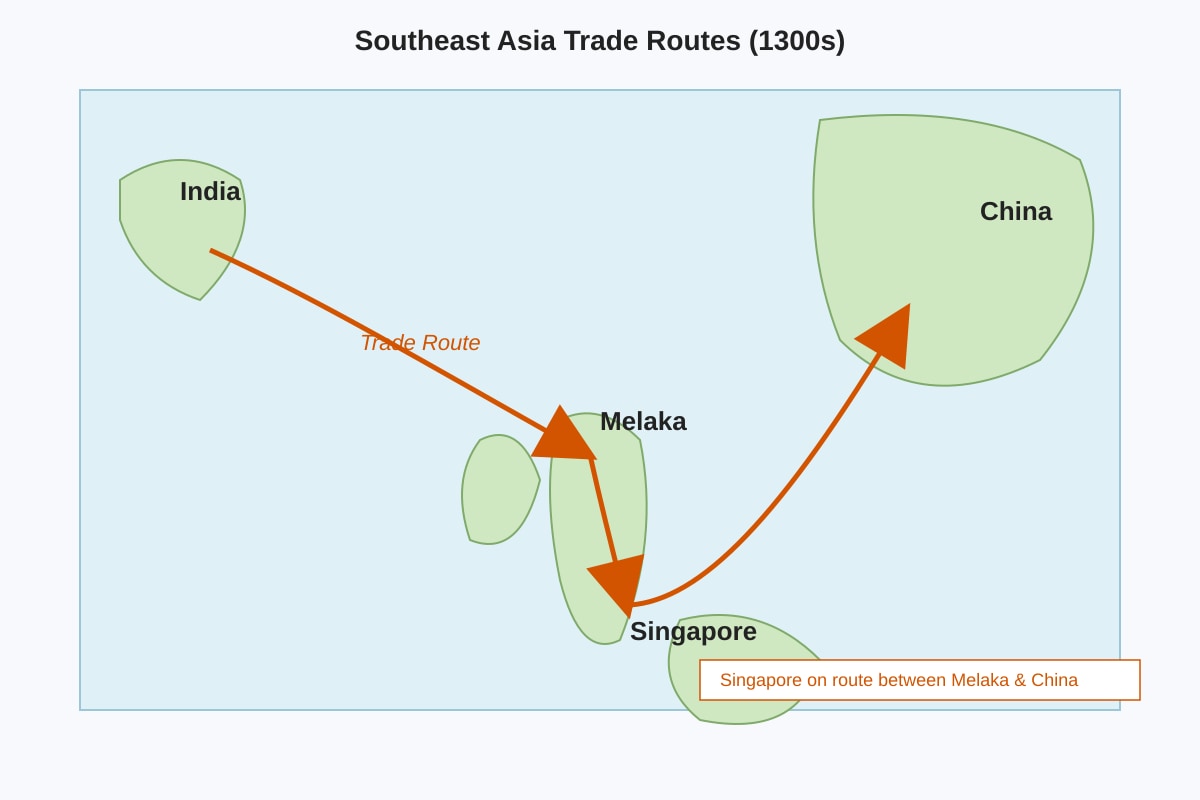
Q13 (3m) Map shows Singapore on India–China route; between Melaka and China; strategic stopover. 1m location, 2m explain trade benefit. Image must show route arrows and labels.
Q14 (2m) E.g., high unemployment, lack of industry. 1m+1m.
Q15 (2m) Understanding people's actions in their own context, not by today's standards.
Q16 (1m) B
Q17 (2m) E.g., unemployment rose, trade fell. Explain 1+1.
Q18 (1m) A
Q19 (1m) E.g., built railways, legal system, police.
Q20 (2m) Shows history has perspectives; avoids single biased view. 1+1.