From Real Exams Exam Paper
Secondary 2 History Semestral Assessment 2 (End of Year) Paper 2
Free Sec 2 History SA2 Paper 2, Nemo3 Exam version, with questions, answers, and syllabus-aligned practice for Singapore students.
These static practice materials are generated from the site's syllabus and paper-generation workflow, with source and model context shown so students and parents can evaluate the material before use.
Questions
Free quiz and exam paper access
Enter your details to view this paper
Your access is remembered on this device.
Answers
TuitionGoWhere Practice Paper - History Secondary 2 (SA2 Version 2) - Answer Key
Total Marks: 50
SECTION A: SOURCE-BASED CASE STUDY [25 marks]
1. Study Source A. What is the main message David Marshall is conveying in this speech? Support your answer with evidence from the source. [3]
Answer: David Marshall's main message is that Singapore deserves and is ready for immediate internal self-government, and that the British are unfairly delaying this right by imposing unreasonable standards of "readiness".
Evidence from Source A:
- "We are demanding our birthright — the right to govern ourselves" — frames self-government as an inherent right, not a privilege to be granted.
- "We have a population that is literate, industrious, and politically aware. We have a civil service that is efficient and honest." — cites concrete evidence of Singapore's readiness.
- "What more 'readiness' do they require?" — challenges the British criteria as arbitrary and excessive.
- "We want internal self-government now" — demands immediate action, not further delay.
Marking Notes:
- 1 mark for identifying the main message (demand for immediate self-government / Singapore is ready).
- 1 mark for relevant evidence from the source.
- 1 mark for explaining how the evidence supports the message.
- Common mistake: Paraphrasing the source without identifying the main message (e.g., just listing what Marshall says without synthesising his central argument).
2. Study Sources A and B. How different are Sources A and B in their views on whether Singapore was ready for self-government? Explain your answer. [6]
Answer: Sources A and B are very different in their views on Singapore's readiness for self-government.
Source A (Marshall) argues Singapore IS ready:
- Claims Singapore has a "literate, industrious, and politically aware" population.
- States the civil service is "efficient and honest".
- Demands self-government "now" as a "birthright".
Source B (British Colonial Office) argues Singapore is NOT ready:
- Describes the situation as "volatile" and the Labour Front government as "weak".
- Warns the government "depends on support from pro-communist elements".
- States internal security must remain in British hands until a "reliably anti-communist government is in place".
Provenance/Purpose Difference:
- Source A is a public speech by the Chief Minister, intended to mobilise public support and pressure the British — hence the rhetorical, rights-based language.
- Source B is a classified internal memorandum, intended to justify British policy to officials in London — hence the candid assessment of communist threat and strategic concerns.
Marking Notes:
- 1–2 marks: Identifies content differences only (e.g., "A says ready, B says not ready").
- 3–4 marks: Explains content differences with evidence from both sources.
- 5–6 marks: Explains content differences and provenance/purpose differences (why the sources differ — different audiences, purposes, perspectives).
- Key discriminator: Higher marks require explicit reference to source type, author, date, or purpose to explain why the views differ, not just what the differences are.
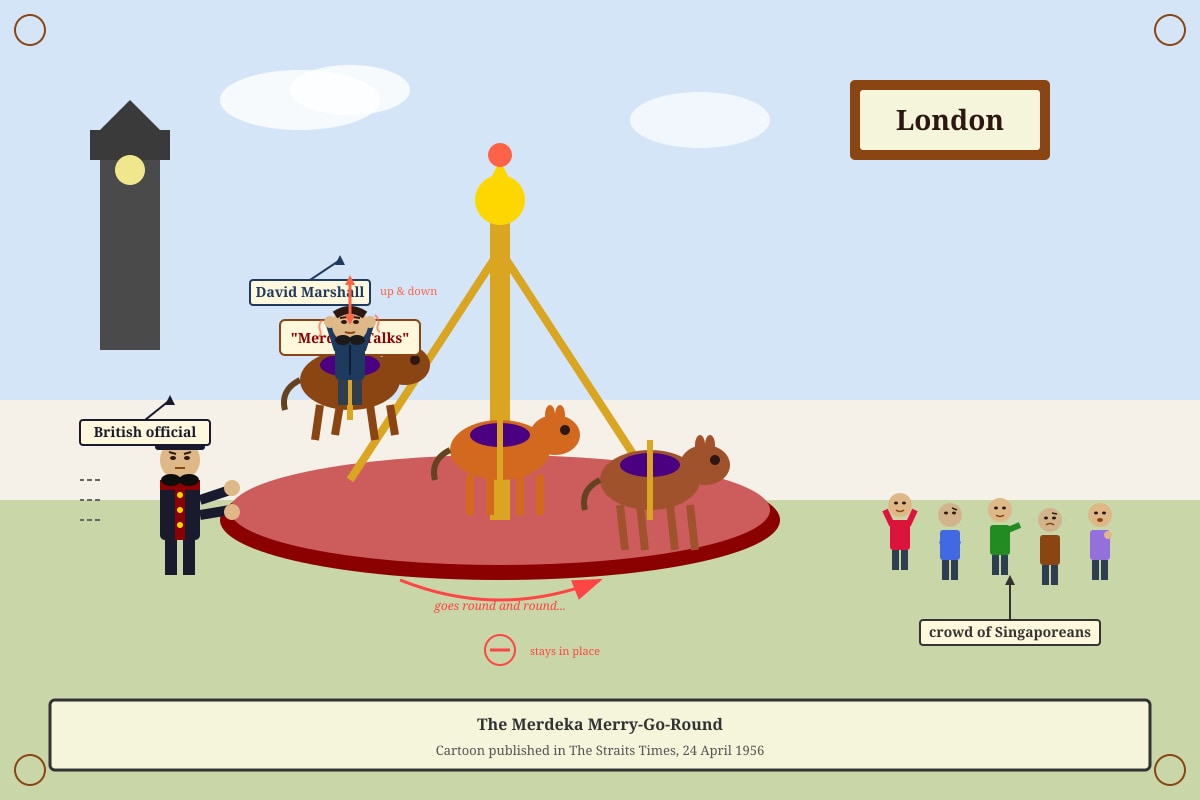
3. Study Source C. What is the cartoonist's view of the Merdeka Talks? Explain your answer using details from the cartoon. [5]
Answer: The cartoonist's view is that the Merdeka Talks were futile and going nowhere — a lot of motion but no real progress, with Marshall being manipulated by the British while the Singapore public watches uncertainly.
Details from the cartoon supporting this view:
- Merry-go-round metaphor: The "Merdeka Talks" horse goes "up and down" but the merry-go-round "stays in place" — symbolising repetitive negotiations without substantive advancement.
- British official pushing: The British are in control of the process (pushing the ride), suggesting they dictate the pace and outcome.
- Marshall looks "determined but dizzy": He is earnest but disoriented, implying his efforts are ineffective or he is being spun around.
- "London" sign in background: The talks are physically and politically centred in London, not Singapore — highlighting the power imbalance.
- Crowd with "mixed expressions — some hopeful, some sceptical": Reflects divided public opinion and uncertainty about whether the talks will achieve real self-government.
Marking Notes:
- 1–2 marks: Describes the cartoon without interpreting the view (e.g., "shows Marshall on a horse").
- 3–4 marks: Identifies the view (futile/no progress) with some supporting details.
- 5 marks: Clear statement of the cartoonist's view with specific visual details linked to the interpretation (metaphor, character portrayals, setting, crowd reaction).
- Common mistake: Listing visual details without explaining what they represent or symbolise in relation to the Merdeka Talks.
4. Study Sources B and D. Does Source D make Source B surprising? Explain your answer. [5]
Answer: No, Source D does not make Source B surprising. In fact, Source D corroborates Source B's assessment.
Explanation:
- Source B (1956, British internal memo) states the Labour Front government is "weak and depends on support from pro-communist elements" and that the MCP is using "Merdeka as a cover to infiltrate constitutional organisations". The British therefore refuse to hand over internal security.
- Source D (1998, Lee Kuan Yew's memoir) confirms that "the British were never going to hand over internal security to a government that included pro-communist ministers" and that Marshall "should have accepted the British offer... and worked to build trust".
- Both sources agree on the core reason for British refusal: the perceived communist influence in Marshall's government and the resulting distrust over internal security.
- Source D, written decades later by a political rival of Marshall, validates the British perspective in Source B rather than contradicting it.
Marking Notes:
- 1–2 marks: Yes/No answer with weak or no explanation.
- 3–4 marks: Correct answer (No) with explanation using content from one or both sources.
- 5 marks: Clear "No" with cross-referencing — explicitly showing how Source D's content aligns with/confirms Source B's reasoning (communist threat → British retention of internal security).
- Key concept: "Surprising" in source-based questions means contradicted or unexpected given the other source. Corroboration = not surprising.
5. Study all the sources. "The failure of the first Merdeka Talks was mainly due to David Marshall's poor negotiation skills." How far do the sources support this view? Explain your answer. [6]
Answer: The sources partially support but largely challenge the view that Marshall's poor negotiation skills were the main reason for the failure.
Sources SUPPORTING the view (Marshall's approach/skills):
- Source D (Lee Kuan Yew): Explicitly criticises Marshall's approach as "emotional and confrontational", treating talks as a "moral crusade rather than a negotiation". Notes his resignation was a "tactical error".
- Source C (Cartoon): Portrays Marshall as "determined but dizzy" on a merry-go-round going nowhere — suggesting ineffective strategy.
- Source A (Marshall himself): Reveals an uncompromising, rhetorical stance ("We want internal self-government now, and we will not accept...") — consistent with poor diplomatic flexibility.
Sources CHALLENGING the view (Structural/British factors):
- Source B (British memo): Shows the British never intended to grant internal security regardless of negotiation style — their position was fixed due to "communist subversion" fears and "strategic interests".
- Source D (Lee Kuan Yew): States "The British were never going to hand over internal security to a government that included pro-communist ministers" — implying the outcome was predetermined.
- Source E (Election results): The 1955 election produced a fragmented legislature (Labour Front only 10/25 seats), weakening Marshall's mandate — a structural constraint, not a skill issue.
- Source A + B together: The fundamental clash was over internal security control, a non-negotiable British red line (Source B), not Marshall's negotiation technique.
Conclusion: While Marshall's confrontational style (Sources A, C, D) didn't help, the primary obstacle was the British refusal to transfer internal security due to communist fears (Sources B, D), which no negotiation skill could overcome. The failure was mainly due to irreconcilable positions on internal security, not Marshall's skills.
Marking Notes:
- 1–2 marks: One-sided answer (only supports OR only challenges) with limited evidence.
- 3–4 marks: Balanced answer using 2–3 sources, but explanation lacks depth or clear "how far" judgement.
- 5–6 marks: Clear "partially/limited support" judgement, with evidence from at least 3 sources on both sides, and a reasoned conclusion weighing the relative importance of Marshall's skills vs. structural British intransigence.
- Marking descriptor for 6 marks: Sustained evaluation with explicit source referencing, clear criteria for "mainly due to", and a nuanced conclusion.
SECTION B: STRUCTURED RESPONSE QUESTIONS [25 marks]
6. Explain two reasons why the British were reluctant to grant full internal self-government to Singapore in the 1950s. [4]
Answer:
Reason 1: Fear of communist subversion
The British believed the Malayan Communist Party (MCP) was infiltrating constitutional organisations (trade unions, Chinese middle schools, political parties) under the cover of demanding "Merdeka". They feared that granting internal self-government — especially control of internal security — to a government with pro-communist elements (like Marshall's Labour Front, which relied on pro-communist support) would allow communists to seize power legally. This threatened British strategic interests and the security of the Federation of Malaya.
Reason 2: Strategic military and economic interests
Singapore was a critical British military base ("Gibraltar of the East") and a major commercial hub in Southeast Asia. The British wanted to retain control over defence and foreign affairs to protect their military presence and economic investments in the region. They were unwilling to cede full sovereignty until they were confident a pro-Western, anti-communist government would safeguard these interests.
Marking Notes:
- 1 mark per reason identified + 1 mark per reason explained (2 × 2 = 4 marks).
- Acceptable alternative reasons: Lack of a unified "Malayan" national identity; concern over Singapore's viability as an independent state; desire to manage decolonisation gradually to avoid instability.
- Common mistake: Vague answers like "British wanted to keep power" without specific historical context (communist threat, strategic interests).
7. Describe two methods used by the British to maintain control over Singapore after World War II. [4]
Answer:
Method 1: Constitutional reforms with reserved powers
The British introduced a series of constitutions (1948, 1955, 1958) that gradually increased local representation (e.g., elected seats in the Legislative Council/Assembly) but retained key powers — defence, foreign affairs, and crucially internal security — in the hands of the British Governor/High Commissioner. This allowed controlled political development while safeguarding British interests.
Method 2: Use of emergency regulations and security laws
Under the Emergency Regulations (extended from the Malayan Emergency) and later the Preservation of Public Security Ordinance (PPSO), the British detained political activists, trade unionists, and students suspected of communist links without trial. They also banned organisations (e.g., Singapore Federation of Trade Unions) and restricted publications. This suppressed opposition and maintained order.
Marking Notes:
- 1 mark per method identified + 1 mark per description/detail (2 × 2 = 4 marks).
- Other acceptable methods: Retaining the Governor's veto power; controlling the civil service and police; limiting the franchise (initially only British subjects could vote); using the Special Branch for intelligence.
- Note: "Deploying British troops" is less relevant post-1948 as the focus shifted to political control.
8. Explain why the 1955 Legislative Assembly Election was a turning point in Singapore's political development. [5]
Answer:
The 1955 election was a turning point for three key reasons:
-
First election with automatic voter registration and a significantly expanded electorate — The electorate grew from ~23,000 (1948) to ~300,000 (1955) due to the Rendel Constitution, bringing in working-class Chinese voters. This shifted politics from elite, English-educated circles to mass-based, Chinese-speaking politics.
-
Emergence of new political forces — The Labour Front (led by David Marshall) won the most seats (10), forming a minority government. The People's Action Party (PAP), newly formed in 1954, won 3 seats (including Lee Kuan Yew in Tanjong Pagar), announcing its arrival as a major player. The old conservative parties (Progressive Party) declined.
-
Beginning of the "Merdeka" era — The Labour Front campaigned on "Merdeka" (immediate self-government). Marshall became Chief Minister and led the first Merdeka Mission to London in 1956. The election made self-government the central political issue, forcing the British to negotiate.
Marking Notes:
- 1–2 marks: Describes the election (who won, numbers) without explaining why it was a turning point.
- 3–4 marks: Identifies 1–2 valid reasons with some explanation.
- 5 marks: Three distinct reasons clearly explained, linking the election to structural political change (expanded franchise, new parties, shift to mass politics, Merdeka demand).
- Key concept: "Turning point" requires showing a before/after contrast — politics changed fundamentally after 1955.
9. "The main reason for the failure of the Merdeka Talks in 1956 was the issue of internal security." How far do you agree with this statement? Explain your answer. [6]
Answer:
I agree to a large extent that the issue of internal security was the main reason for the failure, though other factors contributed.
Internal security as the MAIN reason (Agree):
- Core disagreement: The British insisted on retaining control of internal security (Source B: "safety of the Federation... require that we retain control of internal security"). Marshall demanded full internal self-government including internal security (Source A: "denying us control over our own internal security").
- Non-negotiable British position: Source B (classified memo) reveals this was a fixed policy based on communist threat assessment, not a bargaining stance. Source D confirms: "The British were never going to hand over internal security to a government that included pro-communist ministers."
- Talks collapsed specifically on this issue: Historical record shows the Merdeka Mission broke down when the British refused to budge on internal security, and Marshall refused to accept the compromise.
Other contributing factors (Partial disagreement):
- Marshall's negotiation style: Source D criticises his "emotional and confrontational" approach and "moral crusade" mindset. Source A shows his uncompromising public rhetoric, which boxed him in.
- Communist threat perception: The British distrust of Marshall's government (Source B: "depends on support from pro-communist elements") made them unwilling to concede any ground on security. This was a structural condition, not just a negotiation issue.
- Marshall's weak political position: Source E shows Labour Front had only 10/25 seats in 1955 — a minority government dependent on pro-communist support, undermining British confidence.
Conclusion: Internal security was the substantive, non-negotiable issue on which the talks foundered. While Marshall's style and weak mandate worsened the situation, even a more skilled negotiator could not have overcome the British refusal to transfer internal security while the communist threat persisted. Thus, internal security was the main reason.
Marking Notes:
- 1–2 marks: One-sided answer; mere assertion without evidence.
- 3–4 marks: Balanced argument with evidence, but limited evaluation of "main reason".
- 5–6 marks: Clear stance ("large extent"), structured argument (agree/disagree paragraphs), specific evidence (sources or historical knowledge), weighing of factors, and reasoned conclusion on relative importance.
- Marking descriptor for 6 marks: Sustained evaluation with clear criteria for "main reason", explicit linkage to the question, and nuanced judgement.
10. Study the extract below and answer the question that follows.
"The PAP's victory in the 1959 election was not just a win for Lee Kuan Yew. It was a victory for the idea that Singapore could govern itself — and govern itself well. But the PAP inherited a city with massive problems: unemployment, housing shortages, labour unrest, and a communist threat that had not disappeared."
Explain two challenges the PAP government faced immediately after winning the 1959 election, and how they attempted to address one of these challenges. [6]
Answer:
Challenge 1: Mass unemployment and economic stagnation
Singapore faced severe unemployment (estimated 14–15% of the workforce) due to rapid population growth, decline of entrepôt trade, and lack of industrialisation. The PAP addressed this by launching an industrialisation programme led by the Economic Development Board (EDB), established in 1961 under Hon Sui Sen. The EDB attracted foreign multinational corporations (MNCs) through tax incentives, infrastructure development (Jurong Industrial Estate), and a stable labour environment. This shifted Singapore from entrepôt trade to export-oriented manufacturing, creating jobs.
Challenge 2: Acute housing shortage and squatter settlements
Over 250,000 people lived in overcrowded shophouses or squatter kampongs with poor sanitation. The PAP addressed this by expanding the Housing and Development Board (HDB), established in 1960. Under Lim Kim San, HDB built low-cost public housing flats rapidly (e.g., 21,000 units in 3 years, far exceeding the colonial SIT's 23,000 in 32 years). The Home Ownership for the People Scheme (1964) allowed citizens to use Central Provident Fund (CPF) savings to buy flats, giving them a stake in the nation.
Challenge 3 (alternative): Labour unrest and communist influence in unions
Pro-communist unions organised frequent strikes (e.g., 1959–1961). The PAP addressed this by consolidating unions under the National Trades Union Congress (NTUC, 1961) and passing the Trade Unions Act (1959) and Industrial Relations Act (1960) to regulate strikes, promote tripartism, and align unions with national development goals.
Detailed explanation of how ONE challenge was addressed (e.g., Housing): The PAP tackled the housing crisis through three coordinated strategies:
- Institutional reform: Strengthened HDB with powers to acquire land compulsorily (Land Acquisition Act 1966) and streamlined building approvals.
- Mass construction: Adopted industrialised building methods (prefabrication) to build flats quickly and cheaply — over 50,000 units by 1965.
- Affordability & ownership: The Home Ownership Scheme (1964) let families use CPF savings for down payments and mortgages, making flats affordable. This created a property-owning citizenry with a vested interest in stability.
Marking Notes:
- 1 mark each for identifying two distinct challenges (2 marks).
- 1 mark for identifying a specific policy/action for one challenge.
- 3 marks for detailed explanation of how that challenge was addressed (specific agency, law, method, outcome).
- Total: 2 + 1 + 3 = 6 marks.
- Common mistake: Listing challenges without explaining how they were addressed, or giving vague answers like "built houses" without HDB, CPF, Land Acquisition Act details.
- Note: Any two valid challenges + detailed explanation of one = full marks.
END OF ANSWER KEY