From Real Exams Exam Paper
Secondary 2 History Semestral Assessment 2 (End of Year) Paper 1
Free Sec 2 History SA2 Paper 1, Nemo3 Exam version, with questions, answers, and syllabus-aligned practice for Singapore students.
These static practice materials are generated from the site's syllabus and paper-generation workflow, with source and model context shown so students and parents can evaluate the material before use.
Questions
Free quiz and exam paper access
Enter your details to view this paper
Your access is remembered on this device.
Answers
TuitionGoWhere Practice Paper - History Secondary 2 (SA2 Version 1) - Answer Key
Subject: History
Level: Secondary 2 (G2/G3)
Paper: SA2 Version 1
Total Marks: 50
SECTION A: SOURCE-BASED CASE STUDY [25 marks]
Question 1 [3 marks]
Study Source A. What can you infer about David Marshall's view of the Rendel Constitution? Support your inference with evidence from the source.
Answer:
- Inference: David Marshall viewed the Rendel Constitution as inadequate and unsatisfactory / a sham / not genuine self-government. (1 mark)
- Evidence 1: He describes it as "neither fish nor fowl" — a mixed, incomplete arrangement. (1 mark)
- Evidence 2: He states the British "retained control over defence, foreign affairs, and internal security" and asks "How can we govern effectively when the real power remains in the hands of the Colonial Secretary?" (1 mark)
Marking Notes:
- Award 1 mark for a valid inference.
- Award up to 2 marks for relevant supporting evidence from the source (1 mark per distinct piece of evidence).
- Do not award marks for evidence without an inference, or inference without evidence.
- Common mistake: Paraphrasing the source without making an inference (e.g., "He thinks the British kept power" — this is comprehension, not inference).
Question 2 [6 marks]
Study Sources A and B. How different are Sources A and B in their views on the Rendel Constitution? Explain your answer using both sources.
Answer:
Difference in View (Content):
- Source A (Marshall) sees the Rendel Constitution as inadequate and unacceptable — it denies Singapore real power ("neither fish nor fowl", "real power remains in the hands of the Colonial Secretary").
- Source B (British Colonial Office) sees it as a necessary transitional framework that provides "constitutional progress" while safeguarding against "subversive forces" — it is a prudent, staged approach.
Difference in Provenance/Purpose (Why they differ):
- Source A is a public speech by the Chief Minister (April 1955), intended to mobilise public support and pressure the British by portraying the Constitution as a betrayal of the people's mandate ("The people of Singapore voted for change").
- Source B is a classified internal memorandum (June 1955), intended to justify British policy to officials in London by emphasising the communist threat and the need for gradual transfer of power ("premature transfer of internal security powers would endanger the anti-communist struggle").
Similarity (for balance):
- Both acknowledge the Rendel Constitution as the current framework and that the key dispute centres on internal security powers.
Marking Descriptors:
| Level | Marks | Descriptor |
|---|---|---|
| L1 | 1–2 | Identifies differences in content only (e.g., "A says it's bad, B says it's good") without explaining why they differ (provenance/purpose). |
| L2 | 3–4 | Explains differences in content and identifies provenance/purpose differences, but explanation of why they differ is implicit or partial. |
| L3 | 5–6 | Clearly explains differences in content and explicitly links provenance/purpose to the differing views (e.g., "A is a public speech to rally support, so he criticises it; B is a secret memo to justify retaining control, so it defends the Constitution"). |
Common Mistakes:
- Listing content differences without explaining why the sources differ (provenance, purpose, audience).
- Treating "both mention internal security" as a difference.
- Failing to use specific evidence from both sources.
Question 3 [5 marks]
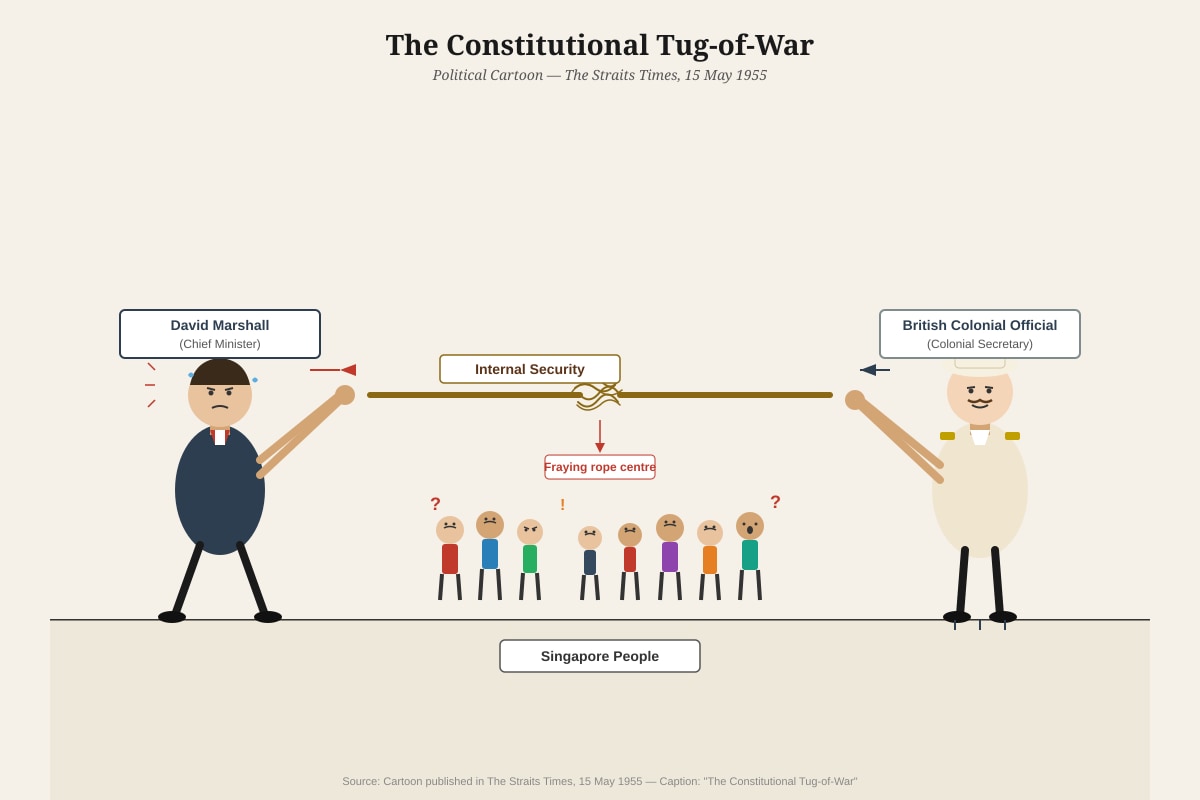
Study Source C. What is the cartoonist's message about the constitutional situation in 1955? Explain your answer using details from the cartoon.
Answer:
- Message: The constitutional negotiations over internal security were a deadlocked struggle between Marshall and the British, with Singapore's people caught anxiously in the middle and the situation risking breakdown (the fraying rope). (2 marks for message)
- Supporting Details (any 3 for 3 marks):
- The tug-of-war depicts a direct confrontation between Marshall ("Chief Minister") and the British ("Colonial Secretary") over the rope labelled "Internal Security".
- Marshall appears strained and determined, the British official calm and firmly planted — suggesting unequal leverage and British intransigence.
- The rope is fraying in the middle — symbolising the risk of the constitutional process snapping / talks collapsing.
- The anxious crowd of Singapore citizens watching — shows the people are affected by the deadlock but have no control.
Marking Descriptors:
| Level | Marks | Descriptor |
|---|---|---|
| L1 | 1–2 | Describes surface details only (e.g., "two men pulling a rope") without interpreting the message. |
| L2 | 3–4 | Identifies a valid message (e.g., "struggle over internal security") but supports with only 1–2 details, or message is partially accurate. |
| L3 | 5 | Clear, accurate message fully supported by 3+ specific visual details from the cartoon. |
Common Mistakes:
- Describing the cartoon without stating a message.
- Giving a message not supported by the visual (e.g., "Marshall will win" — the cartoon shows deadlock, not victory).
- Missing the fraying rope or anxious crowd as key symbols.
Question 4 [5 marks]
Study Sources C and D. Does Source D prove that the cartoonist in Source C was correct? Explain your answer.
Answer: No, Source D does not prove the cartoonist was correct. (1 mark for clear stance)
Reasoning:
- Source D is Lee Kuan Yew's retrospective memoir (1998), written over 40 years later. It offers a hindsight interpretation that Marshall's approach failed and a phased approach worked.
- Source C is a contemporary cartoon (May 1955) depicting the situation at that moment — a deadlocked tug-of-war with an uncertain outcome (fraying rope).
- Source D confirms the outcome (Marshall failed, phased approach succeeded later) but does not prove the cartoonist's depiction of the 1955 situation was "correct" — the cartoon shows a snapshot of tension, not a prediction of failure. The cartoonist may have been highlighting the risk of breakdown, not asserting it was inevitable.
- Provenance matters: A memoir written by a political rival (Lee vs. Marshall) with the benefit of hindsight and a desire to justify the PAP's own strategy is not objective proof of a 1955 cartoon's accuracy.
Marking Descriptors:
| Level | Marks | Descriptor |
|---|---|---|
| L1 | 1 | Simple "Yes" or "No" with weak/no support, or asserts proof based on content match only. |
| L2 | 2–3 | "No" with some reasoning (e.g., "different time", "hindsight") but lacks clear provenance analysis or confuses confirmation with proof. |
| L3 | 4–5 | Clear "No" with strong provenance-based reasoning: explains difference in nature (contemporary cartoon vs. retrospective memoir), purpose (depicting tension vs. justifying later strategy), and why confirmation ≠ proof. |
Common Mistakes:
- Saying "Yes, because Lee says Marshall failed" — confuses historical outcome with proof of a cartoon's message.
- Not addressing provenance (date, author, purpose) at all.
- Treating Source D as an objective factual record rather than a political memoir.
Question 5 [6 marks]
Study Source E. Using Source E and your own knowledge, explain why the 1957 Merdeka Talks succeeded where the 1956 talks failed.
Answer:
From Source E:
- 1956 Talks: Marshall demanded full internal security control → British refused → talks broke down, Marshall resigned. (1–2 marks)
- 1957 Talks: Lim Yew Hock led delegation → accepted a compromise: internal self-government by 1959 with internal security under a council with British casting vote → agreement reached. (1–2 marks)
Own Knowledge (any 2–3 developed points):
- Lim Yew Hock's anti-communist credentials: His toughened British trust. His crackdown on communist-linked unions and the Chinese Middle School Riots (1956) convinced the British he could be trusted with internal security — unlike Marshall, who was seen as soft on communists.
- Phased / pragmatic approach: The 1957 delegation accepted internal self-government first, full independence later — a realistic staged strategy (as Lee Kuan Yew notes in Source D).
- British strategic shift: By 1957, Britain was accelerating decolonisation globally (Suez Crisis 1956 weakened imperial prestige; focus shifted to Malaya's independence 1957). They needed a stable, anti-communist Singapore government.
- Internal Security Council compromise: The formula — Singapore ministers + British officials + British casting vote — gave Singapore operational control while preserving British ultimate veto, satisfying both sides.
Marking Descriptors:
| Level | Marks | Descriptor |
|---|---|---|
| L1 | 1–2 | Only uses Source E (describes table differences) without own knowledge. |
| L2 | 3–4 | Uses Source E + 1–2 own knowledge points, but explanation is descriptive not analytical (lists factors without linking to why they led to success/failure). |
| L3 | 5–6 | Integrates Source E and own knowledge to explain causally: contrasts Marshall's maximalist demand vs. Lim's compromise; links Lim's anti-communist actions to British trust; explains the Internal Security Council as the key institutional compromise. |
Common Mistakes:
- Only paraphrasing Source E without adding own knowledge.
- Listing own knowledge points without connecting to the contrast between 1956 and 1957.
- Confusing Lim Yew Hock with Lee Kuan Yew (Lee led the 1958 talks, not 1957).
SECTION B: STRUCTURED RESPONSE QUESTIONS [25 marks]
Question 6 [5 marks]
Explain why the British introduced the Rendel Constitution in 1955.
Answer:
Reason 1: Rising local demand for political participation
Post-WWII, the British failure to defend Singapore destroyed the myth of British superiority. Local leaders (e.g., SPP, Labour Front) and the public demanded a say in governance. The 1948 and 1951 elections (limited franchise) showed growing political consciousness.
Reason 2: Need to legitimise colonial rule / counter communist influence
The Malayan Emergency (1948–1960) and rising trade union militancy (e.g., 1952 Hock Lee Bus Riots precursors) made the British fear communist infiltration. A controlled constitution could channel demands into constitutional politics and isolate radicals.
Reason 3: British policy of gradual decolonisation
The Labour Government (UK, 1945–51) and later Conservatives accepted decolonisation as inevitable. The Rendel Commission (1953) recommended a "transitional" constitution to prepare Singapore for self-government — part of a managed withdrawal.
Reason 4: International pressure / Cold War context
US anti-colonial stance and the need to present Britain as a democratic ally in Southeast Asia (vs. communist expansion) pushed Britain to show constitutional progress.
Marking Descriptors:
| Marks | Descriptor |
|---|---|
| 1–2 | 1–2 valid reasons stated but not explained (e.g., "people wanted vote", "British wanted to stop communists"). |
| 3–4 | 2–3 reasons explained with specific context (e.g., links to post-WWII loss of legitimacy, Malayan Emergency, Rendel Commission). |
| 5 | 3+ reasons clearly explained with specific historical context, showing understanding of British motivations (not just events). |
Common Mistakes:
- Confusing Rendel Constitution (1955) with later constitutions (1958 State Constitution).
- Listing features of the Constitution (e.g., "25 elected seats") instead of reasons for introducing it.
- Vague answers like "to give people more rights" without historical context.
Question 7 [8 marks]
"The main reason for the failure of the First Merdeka Talks in 1956 was David Marshall's refusal to compromise." How far do you agree with this statement? Explain your answer.
Answer:
Agree (Marshall's refusal to compromise was a key reason):
- Marshall insisted on full control of internal security as a non-negotiable demand ("Merdeka or bust").
- He rejected the British offer of a transitional Internal Security Council with a British casting vote.
- His all-or-nothing stance left no room for negotiation; the British could not concede without appearing to abandon anti-communist responsibilities.
- His resignation after failure showed he treated it as a personal mandate, not a negotiable process.
Disagree (Other factors were equally/more important):
- British intransigence: The British refused to yield on internal security due to the Malayan Emergency and fear of communist takeover. They viewed Singapore as a security liability.
- Marshall's weak political position: His Labour Front coalition was fracturing; he lacked a strong mandate. The British doubted his ability to deliver stability.
- Communist threat perception: The 1955 Hock Lee Bus Riots and ongoing labour unrest convinced the British that transferring internal security to Marshall would endanger the anti-communist struggle.
- Lack of preparation: Marshall went to London without a clear fallback plan or broad-based delegation (unlike Lim Yew Hock in 1957 who included PAP and other leaders).
Synthesis / Judgement: While Marshall's refusal to compromise was the immediate cause of the breakdown, it was not the sole or "main" reason in isolation. The failure resulted from a structural mismatch: Marshall's maximalist demand for sovereignty clashed with the British structural imperative to retain security control in a Cold War context. A more pragmatic leader (Lim Yew Hock) with stronger anti-communist credentials achieved a compromise a year later — suggesting the British willingness to negotiate depended on who was asking and under what conditions. Thus, Marshall's style mattered, but the British security calculus was the deeper constraint.
Marking Descriptors:
| Level | Marks | Descriptor |
|---|---|---|
| L1 | 1–2 | One-sided answer; lists reasons for failure without addressing "how far" or weighing factors. |
| L2 | 3–4 | Identifies factors on both sides (Marshall's stance + British concerns) but treats them as a list; limited weighing or synthesis. |
| L3 | 5–6 | Balanced explanation with developed arguments on both sides, supported by specific evidence (Hock Lee Riots, Malayan Emergency, Internal Security Council). |
| L4 | 7–8 | Nuanced judgement that integrates both sides: explains why Marshall's refusal was pivotal in context of British imperatives, and concludes with a reasoned assessment of relative significance (e.g., "necessary but not sufficient cause"). |
Common Mistakes:
- Writing a narrative of the talks instead of an argument.
- Ignoring the British perspective entirely.
- Asserting "Marshall was too emotional" without evidence.
- Not reaching a clear "how far" conclusion.
Question 8 [6 marks]
Explain how the Labour Front government's handling of the Hock Lee Bus Riots (1955) and the Chinese Middle School Riots (1956) affected its political position.
Answer:
Hock Lee Bus Riots (May 1955):
- Perceived as soft on communists: Marshall's government negotiated with the strikers (including pro-communist unions) and appeared to concede to demands. The British and right-wing critics saw this as weakness / appeasement.
- Damaged British confidence: The Colonial Office (Source B) cited this as evidence that Marshall could not control "subversive forces" — undermining his credibility in Merdeka Talks.
- Internal coalition strain: The Labour Front's alliance with pro-communist unions (e.g., SBWU) became a liability; moderate members grew uneasy.
Chinese Middle School Riots (Oct 1956):
- Occurred under Lim Yew Hock (Marshall had resigned), but rooted in Labour Front era policies: The riots erupted over the deregistration of the Singapore Chinese Middle School Students' Union (SCMSSU) — a move initiated by Lim as Chief Minister but reflecting the government's hardening line against communist front organisations.
- Paradoxical effect: The harsh suppression (police action, 13 deaths) alienated Chinese-educated voters but convinced the British that Lim was serious about internal security — directly enabling the 1957 Merdeka Talks success.
- For the Labour Front legacy: The riots destroyed the Labour Front's Chinese-educated support base, which shifted to the PAP. The party was wiped out in the 1959 election (won only 4 seats).
Overall Impact:
- Short-term (1955): Hock Lee Riots → loss of British trust, weakened Marshall's negotiating position.
- Medium-term (1956): Chinese Middle School Riots (under Lim) → British trust gained but popular support lost among Chinese-educated.
- Long-term: Labour Front collapsed as a political force; PAP emerged as the dominant anti-colonial, pro-independence party by capturing both the anti-British and Chinese-educated vote.
Marking Descriptors:
| Marks | Descriptor |
|---|---|
| 1–2 | Describes the riots only; no link to political position. |
| 3–4 | Links riots to political consequences but only one riot explained well, or consequences listed without explanation (e.g., "lost support"). |
| 5–6 | Clearly explains impact of both riots on multiple dimensions: British confidence, internal coalition, electoral support, and long-term party survival. Uses specific details (negotiation vs. suppression, SCMSSU, 1959 election outcome). |
Common Mistakes:
- Attributing the Chinese Middle School Riots to Marshall (he had resigned).
- Confusing the Labour Front with the PAP.
- Not distinguishing between British reaction and local voter reaction.
Question 9 [6 marks]
"The achievement of internal self-government in 1959 was mainly due to the PAP's effective leadership." How far do you agree with this statement? Explain your answer.
Answer:
Agree (PAP's effective leadership was crucial):
- Electoral dominance: PAP won 43 of 51 seats in the 1959 election with a clear mandate — result of effective organisation, grassroots mobilisation, and bilingual appeal (Lee Kuan Yew, Goh Keng Swee, Toh Chin Chye + Lim Chin Siong, Fong Swee Suan bridging English- and Chinese-educated).
- Strategic pragmatism: Unlike Marshall, PAP accepted phased independence (1957/1958 talks) — "independence in stages" — showing political maturity the British trusted.
- Governance credibility: After 1959, PAP delivered tangible results (housing, education, industrialisation) — but even before 1959, their 1955–58 opposition role (exposing corruption, advocating for workers) built a reputation for competence.
- Uniting anti-colonial forces: PAP absorbed/co-opted the anti-colonial narrative, marginalising Labour Front and other parties.
Disagree (Other factors were equally/more decisive):
- British strategic withdrawal: By 1957–58, Britain wanted to decolonise (Suez Crisis, Malayan independence 1957, focus on Europe). The 1958 State of Singapore Constitution was a British initiative to transfer power to a reliable partner — the PAP was the beneficiary, not the sole cause.
- Lim Yew Hock's groundwork: The 1957 Merdeka Talks success (Internal Security Council compromise) was achieved by Lim Yew Hock, not the PAP. Without this, the 1958 Constitution and 1959 election would not have happened.
- Communist threat / Cold War context: The British transferred power to a strong anti-communist government (PAP's 1957–58 purge of pro-communists like Lim Chin Siong before the election reassured Britain). The PAP's leadership alone didn't create this condition — the geopolitical context did.
- Constitutional evolution: The Rendel Constitution (1955) started the process; each step (1955, 1957, 1958) built incrementally. The PAP inherited a moving train.
Synthesis / Judgement: The PAP's leadership was necessary but not sufficient. They provided the electoral vehicle, strategic pragmatism, and post-1959 governance record that made self-government work. However, the structural conditions — British willingness to leave, Lim Yew Hock's 1957 breakthrough, and the Cold War imperative for a stable anti-communist state — created the opening. The PAP seized the moment effectively, but did not create the moment alone. Thus, "mainly due to" overstates the PAP's role; it was a convergence of PAP agency and structural opportunity.
Marking Descriptors:
| Level | Marks | Descriptor |
|---|---|---|
| L1 | 1–2 | One-sided; lists PAP achievements without weighing other factors. |
| L2 | 3–4 | Identifies PAP role + 1–2 other factors (British, Lim Yew Hock) but limited weighing; "agree/disagree" not clearly argued. |
| L3 | 5–6 | Balanced, evidence-based argument on both sides with specific details (1959 election results, 1957 talks, 1958 Constitution, communist purges, Suez context). Clear, nuanced conclusion addressing "mainly due to". |
Common Mistakes:
- Attributing the 1957 Merdeka Talks to the PAP (it was Lim Yew Hock).
- Ignoring the British perspective entirely.
- Confusing "internal self-government (1959)" with "full independence (1965)".
- Vague praise ("Lee Kuan Yew was a great leader") without specific historical evidence.
END OF ANSWER KEY