From Real Exams Exam Paper
Secondary 2 History Semestral Assessment 2 (End of Year) Paper 1
Free Sec 2 History SA2 Paper 1, HY3 Exam version, with questions, answers, and syllabus-aligned practice for Singapore students.
These static practice materials are generated from the site's syllabus and paper-generation workflow, with source and model context shown so students and parents can evaluate the material before use.
Questions
TuitionGoWhere Practice Paper - History Secondary 2
TuitionGoWhere Secondary School (AI)
Subject: History
Level: Secondary 2
Paper: SA2 Practice Paper (Version 1 of 5)
Duration: 60 minutes
Total Marks: 60
Name: ___________________________
Class: _________
Date: _____________
Instructions:
- This paper contains 20 questions across three sections.
- Section A: Source-Based Questions (Questions 1–8)
- Section B: Structured Response Questions (Questions 9–15)
- Section C: Mixed Application Questions (Questions 16–20)
- Write your answers in the spaces provided.
- Use clear sentences and historical terms where appropriate.
Section A: Source-Based Questions (24 marks)
Study the sources carefully and answer the questions that follow.
Question 1 (3 marks)
Study Source A below.
Source A: A photograph taken in 1942 showing Japanese soldiers patrolling a street in Singapore with local civilians bowing as they pass.
What can you infer about the behaviour expected of locals during the Japanese Occupation? Explain your answer using details from the photograph.
Question 2 (3 marks)
Study Source B below.
Source B: An extract from a 1961 speech by a Malaysian politician: "Singapore's leaders are too focused on their own survival and do not share our vision for a united Malaya."
What can you infer about the politician's attitude towards Singapore's leaders? Explain your answer.
Question 3 (4 marks)
Study Sources C and D.
Source C: A British report from 1950 stating that communist activities in Singapore were a serious threat to law and order.
Source D: A newspaper article from 1952 claiming that most Singapore workers supported the communist cause for better wages.
How different are Sources C and D in their views of communism in Singapore? Explain your answer.
Question 4 (3 marks)
Study Source E below.
Source E: A poster from 1960 encouraging Singaporeans to save water and keep their neighbourhoods clean, with the words "Build a Clean Nation".
What was the likely purpose of this poster? Explain your answer.
Question 5 (4 marks)
Study Sources F and G.
Source F: A 1959 PAP rally poster promising "Jobs for All and Homes for the People".
Source G: A 1963 government report showing that 300,000 people still lived in crowded squatter settlements.
How similar are Sources F and G in what they reveal about housing in Singapore? Explain your answer.
Question 6 (3 marks)
Study Source H below.
Source H: A cartoon from 1946 showing a tired British soldier handing a key of Singapore back to a local leader.
What can you infer about the change in British role in Singapore after the war? Explain your answer.
Question 7 (2 marks)
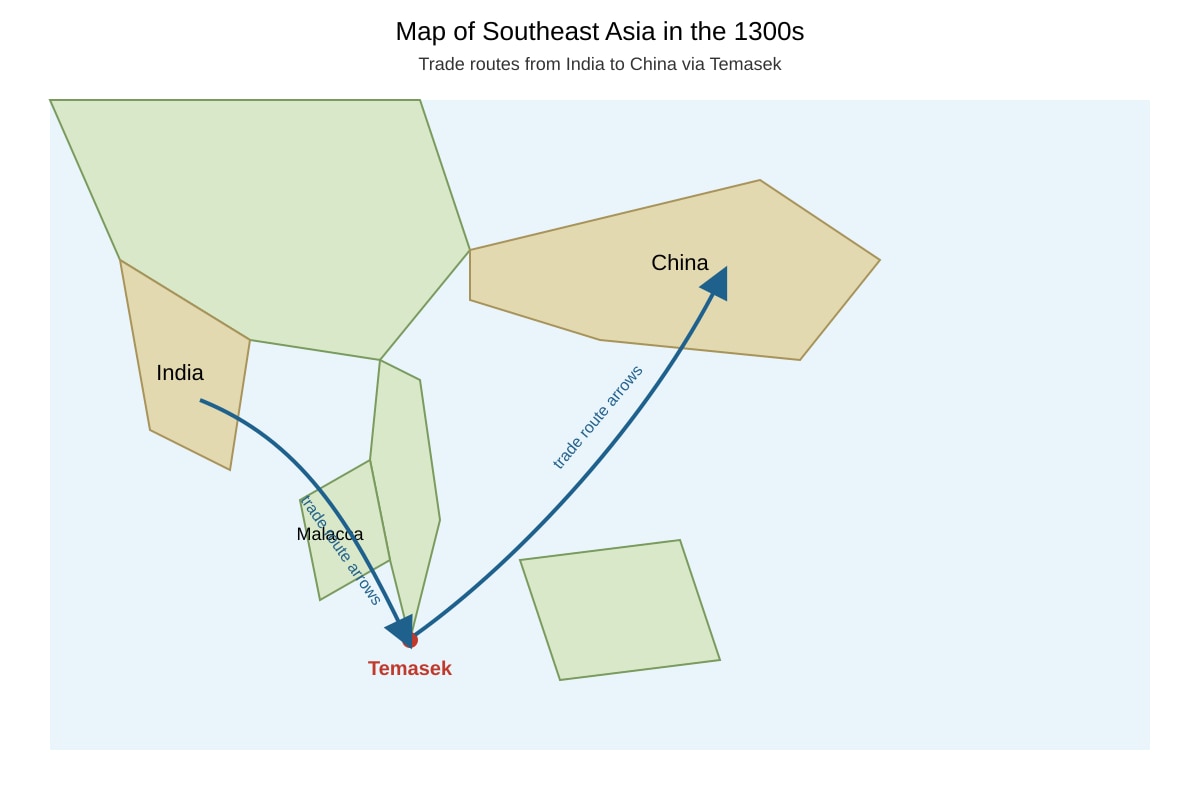
Study the map in the image placeholder below.
Image pending generation: map for Q7.
Based on the map, why was Temasek well placed for trade?
Question 8 (2 marks)
Using Source H (Q6) and your own knowledge, name one reason why the British returned to Singapore after 1945.
Section B: Structured Response Questions (24 marks)
Question 9 (7 marks)
Explain how the Japanese controlled the people of Singapore during the Japanese Occupation. Use at least two methods in your answer.
Question 10 (4 marks)
Describe two push factors that brought Chinese migrants to Singapore in the 1800s.
Question 11 (4 marks)
Explain how the free port status helped Singapore grow under British rule.
Question 12 (10 marks)
Explain two reasons which caused the separation of Singapore from Malaysia in 1965.
Question 13 (3 marks)
What was the significance of the founding of British Singapore in 1819? Give one point.
Question 14 (3 marks)
Name one economic challenge Singapore faced after independence in 1965.
Question 15 (3 marks)
How did the opening of the Suez Canal in 1869 affect Singapore's trade? Give one effect.
Section C: Mixed Application Questions (12 marks)
Question 16 (3 marks)
Study the table below.
| Year | Event |
|---|---|
| 1819 | Raffles establishes trading post |
| 1942 | Fall of Singapore to Japanese |
| 1963 | Merger with Malaysia |
| 1965 | Separation from Malaysia |
Which event in the table happened first? ___________
Question 17 (3 marks)
A student says: "The Japanese Occupation was good because it taught Singapore to be self-reliant." Do you agree? Give one reason for your view.
Question 18 (2 marks)
What is the term for the historical concept of understanding people's actions in their own time and context? ________________________
Question 19 (2 marks)
Name one Southeast Asian sultanate that rose after the decline of Temasek. ________________________
Question 20 (2 marks)
Which group of people formed the largest migrant community in Singapore in the 1800s? ________________________
Answers
TuitionGoWhere Practice Paper - History Secondary 2 (Version 1) Answer Key
Total Marks: 60
Section A: Source-Based Questions (24 marks)
Q1 (3 marks)
- Inference: Locals were expected to show submission/respect to Japanese soldiers. (1 mark)
- Explanation with detail: The photograph shows civilians bowing as soldiers patrol, which suggests bowing was demanded as a sign of obedience. (2 marks)
Teaching note: A source inference must use the source detail (bowing) to support the claim. Do not just say "they were controlled" without referencing the photo.
Q2 (3 marks)
- Inference: The politician was distrustful/critical of Singapore's leaders. (1 mark)
- Explanation: The words "too focused on their own survival" and "do not share our vision" show he felt they were selfish and not aligned with Malaya. (2 marks)
Teaching note: Speech extracts reveal attitude through word choice. Link the exact phrase to the inferred attitude.
Q3 (4 marks)
- Source C view: Communism as a serious threat/lawless (British report). (1 mark)
- Source D view: Communism as supported by workers for fair wages (news article). (1 mark)
- Difference explained: C is an official British report focused on security, so it frames communists as dangerous; D is a newspaper article highlighting worker support, so it presents them positively. Different purposes and authors explain the contrast. (2 marks)
Teaching note: Compare by source type and provenance, not just content.
Q4 (3 marks)
- Purpose: To encourage public cleanliness and nation-building. (1 mark)
- Explanation: Words "Clean Nation" and "save water" show a campaign to build civic responsibility. (2 marks)
Q5 (4 marks)
- Similarity: Both show housing was a key issue. (1 mark)
- F source shows promise of homes; G shows many still in squatter settlements. (1 mark)
- Explanation: Both reveal a gap between promise and reality of housing needs in Singapore. (2 marks)
Q6 (3 marks)
- Inference: British role changed from ruler to returning power to locals. (1 mark)
- Explanation: Cartoon of soldier handing key back implies transfer of control after 1945. (2 marks)
Q7 (2 marks)
- Answer: Temasek was on the trade route between India and China. (2 marks)
Visual check: Map must show Temasek at southern tip with route arrows from India to China.
Q8 (2 marks)
- Answer: To restore colonial administration / counter communist threat. (any 1 valid, 2 marks)
Section B: Structured Response (24 marks)
Q9 (7 marks)
Mark descriptors:
- L1 (1–3): Names methods (military, propaganda) with little explanation.
- L2 (4–5): Explains 1–2 methods with some effect.
- L3 (6–7): Explains 2+ methods clearly with Singapore-specific effect.
Sample: Japanese used military control (kempeitai, arrests) to create fear (3m). They used propaganda (schools, media) to promote loyalty to Japan (3m). Economic control via rationing weakened resistance (1m).
Q10 (4 marks)
- Push factor 1: Poverty in China (2m)
- Push factor 2: Conflict/war in homeland (2m)
Teaching: Push = reasons to leave home.
Q11 (4 marks)
- Free port meant no taxes on goods (2m), attracted traders, increased trade and port growth (2m).
Q12 (10 marks)
L1 (1–3): Lists reasons. L2 (4–6): Some explanation. L3 (7–10): Detailed with evidence.
Reason 1: Political disagreements (PAP vs UMNO on racial policy) caused strain (5m).
Reason 2: Economic clashes over revenue and Malay rights led to separation (5m).
Teaching: Must link reason to 1965 outcome.
Q13 (3 marks)
- One point: Started British colonial period / made Singapore a trading post (3m).
Q14 (3 marks)
- e.g., high unemployment, lack of industries (3m).
Q15 (3 marks)
- e.g., faster trade with Europe, more ships (3m).
Section C: Mixed (12 marks)
Q16 (3 marks)
- 1819 (3m)
Q17 (3 marks)
- Agree/Disagree with reason: e.g., Disagree – occupation brought suffering (3m).
Mark: 1 for stance, 2 for reason.
Q18 (2 marks)
- Historical empathy (2m)
Q19 (2 marks)
- Johor Sultanate (2m)
Q20 (2 marks)
- Chinese (2m)
Audit: 20 questions, total 60 marks (24+24+12), duration 60 min feasible, level Sec 2 language, syllabus-aligned.
Free quiz and exam paper access
Enter your details to view this paper
Your access is remembered on this device.