AI Generated Quiz
Secondary 2 Higher Chinese Comprehension Quiz
Free Sec 2 HCL Comprehension quiz, AI version, with questions, answers, and syllabus-aligned practice for Singapore students.
These static practice materials are generated from the site's syllabus and paper-generation workflow, with source and model context shown so students and parents can evaluate the material before use.
Questions
Free quiz and exam paper access
Enter your details to view this paper
Your access is remembered on this device.
Answers
Secondary 2 Higher Chinese Quiz - Comprehension (Answer Key)
Total Marks: 50
Section 1: Reading Comprehension 1 (Multiple Choice, 2 marks each, 40 marks total)
| Question | Answer | Analysis & Teaching Notes |
|---|---|---|
| 1 | B | Analysis: The first sentence "Singapore is a multi-racial society where different ethnic groups live harmoniously" directly states the main idea. Options A, C, and D are specific examples, not the main point. Teaching Point: Guide students to identify topic sentences, often at the beginning or end of a paragraph. |
| 2 | C | Analysis: The passage clearly states "In Chinatown, you can see traditional Chinese shophouses and temples." Options A and D are features of Little India, and B is a feature of Kampong Glam. Teaching Point: Train students to locate keywords (e.g., "Chinatown") and find corresponding descriptions. |
| 3 | B | Analysis: "Kampung" in Malay means "village." This is a common loanword in Singapore; students should be familiar with local multicultural vocabulary. Teaching Point: Encourage students to accumulate vocabulary related to local culture. |
| 4 | C | Analysis: The last sentence of the passage directly states, "This tolerance and respect are the cornerstone of Singapore's social stability." "Cornerstone" means foundation. Teaching Point: Teach students to pay attention to concluding sentences and metaphorical expressions. |
| 5 | D | Analysis: The passage mentions Chinatown, Little India, and Kampong Glam but not Orchard Road, which is a shopping district, not a specific ethnic cultural enclave. Teaching Point: Train students to carefully verify information in the text and eliminate distractors. |
| 6 | C | Analysis: The first half of the passage discusses the benefits of technology, and the second half discusses the problems. Option C is the most comprehensive. A and B only cover one side. D is not mentioned. Teaching Point: Teach students to distinguish between "main ideas" and "supporting details." |
| 7 | C | Analysis: The passage explicitly mentions, "In the past, people could only correspond with distant friends and relatives through letters." Teaching Point: Train students to identify comparative information between "past" and "present." |
| 8 | D | Analysis: The problems mentioned include "addiction to phones and computers," "reduced face-to-face communication," and "affected health." "Improved work efficiency" is not mentioned; in fact, addiction might decrease it. Teaching Point: Teach students to use the process of elimination and find unmentioned options. |
| 9 | C | Analysis: The author mentions both benefits and problems, and concludes by pondering how to "use technology well," indicating a neutral, dialectical stance. Teaching Point: Teach students to infer the author's attitude through tone and conclusion. |
| 10 | A | Analysis: Literally "as close as within arm's reach," describing a very short distance. In the context, it means video calls make distant people feel very close. Teaching Point: Encourage students to understand idioms based on context. |
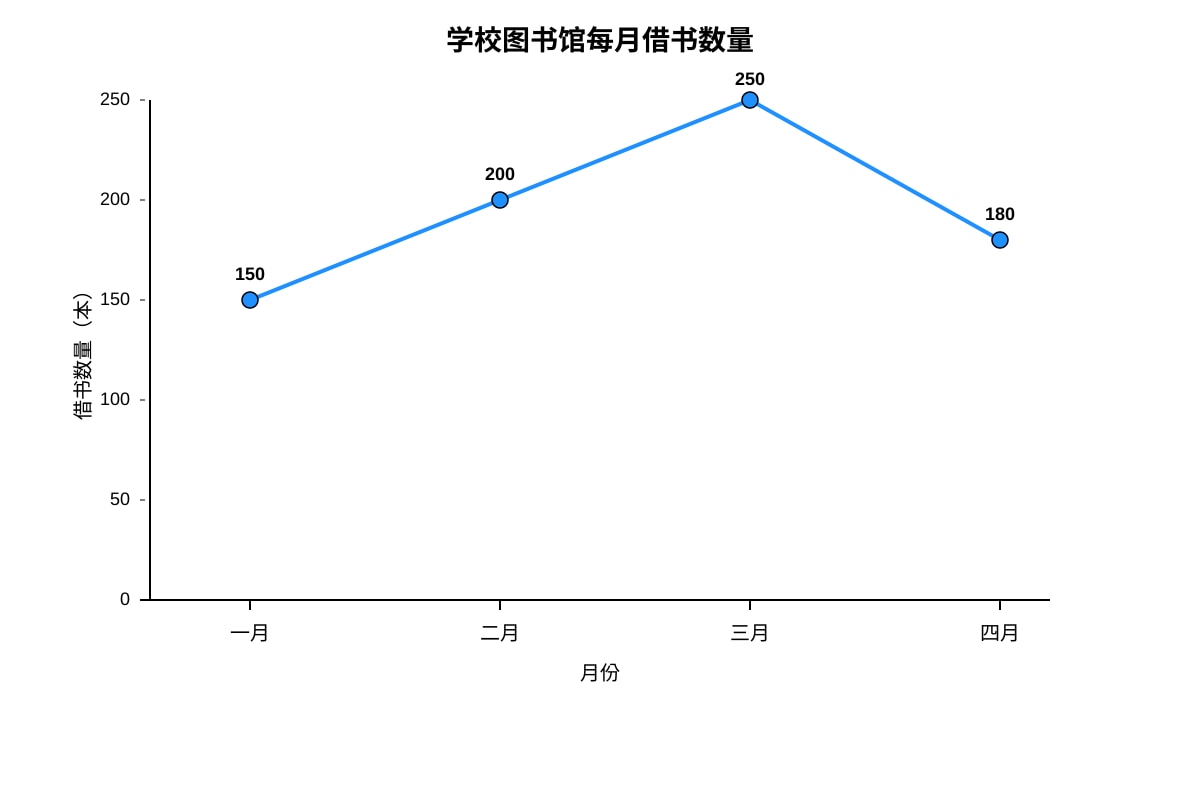
| 11 | C | Analysis: According to the chart, March has the highest bar, corresponding to 250 books. Teaching Point: Train students to read simple charts and find maximum values. |
| 12 | B | Analysis: From January (150) to February (200) to March (250), the numbers consistently increase. Teaching Point: Teach students vocabulary to describe data trends, such as "gradually increasing," "gradually decreasing," or "remaining stable." |
| 13 | C | Analysis: March: 250 books, April: 180 books. The difference is 250 - 180 = 70 books. Teaching Point: Train students in simple data calculation and comparison. |
| 14 | B | Analysis: The passage explains the saying by stating that "reading and traveling are both important ways to gain knowledge" and that they "complement each other and are indispensable." Option B is the most accurate. A is literal; B captures the deeper meaning in context. Teaching Point: Teach students to understand the meaning of proverbs within a specific context. |
| 15 | B | Analysis: The passage clearly states, "A person who only reads but does not travel may lack practical experience." Teaching Point: Train students to locate contrasting statements in the text. |
| 16 | B | Analysis: "Complement each other" means two things work together and support each other. In the text, reading and travel complement each other. Teaching Point: Teach students to infer word meaning from context (e.g., the phrase "indispensable"). |
| 17 | B | Analysis: The passage mentions, "He and his classmates went to the beach to pick up trash," which is a beach clean-up activity. Teaching Point: Train students to identify key action descriptions. |
| 18 | B | Analysis: Li Hua says, "I realized everyone can do their part to protect the environment." Teaching Point: Guide students to focus on the character's speech to reveal their changed thinking. |
| 19 | B | Analysis: The passage's end states, "he decided to pay more attention to environmental protection, such as reducing the use of plastic bags." Teaching Point: Train students to locate the character's future plans or decisions. |
| 20 | C | Analysis: The passage uses Li Hua's personal experience to show that personal participation deepens understanding of environmental protection's importance. A and B are surface details; D is too broad. Teaching Point: Teach students to distinguish the story's main message from its details. |
~ End of Answer Key ~