AI Generated Quiz
Secondary 2 Geography Resources Sustainability Quiz
Free Sec 2 Geography Resources Sustainability quiz, AI version, with questions, answers, and syllabus-aligned practice for Singapore students.
These static practice materials are generated from the site's syllabus and paper-generation workflow, with source and model context shown so students and parents can evaluate the material before use.
Questions

Free quiz and exam paper access
Enter your details to view this paper
Your access is remembered on this device.
Answers
Secondary 2 Geography Quiz - Resources Sustainability: Answer Key
Total Marks: 40
Section A: Multiple Choice and Short Answer (Questions 1–5)
1. Which of the following best describes a renewable resource?
- Correct Answer: B) A resource that can be replenished naturally over time
- Marks: 2
- Explanation: Renewable resources, such as solar energy, wind, and water, can be naturally replenished over a short period of time. Option A describes a non-renewable resource. Option C is not a defining characteristic. Option D is incorrect because renewable resources are naturally occurring.
- Common Mistake: Students may confuse renewable with non-renewable resources. Remember: if it can be used again and again naturally, it's renewable.
2. State one example of a non-renewable resource and explain why it is classified as non-renewable.
- Acceptable Answers:
- Example: Coal. Explanation: It is formed over millions of years from the remains of ancient plants and animals, and once used, it cannot be replenished within a human lifetime.
- Example: Crude oil. Explanation: It is a fossil fuel that takes millions of years to form and is being used much faster than it can be replaced.
- Marks: 2 (1 mark for correct example, 1 mark for correct explanation)
- Explanation: Non-renewable resources exist in a fixed amount and are consumed far faster than they can be naturally replenished. Fossil fuels (coal, oil, natural gas) and minerals are key examples.
- Common Mistake: Giving an example without explaining why it is non-renewable. The explanation must mention the timescale of formation.
3. What is the main purpose of the "Reduce, Reuse, Recycle" (3Rs) approach in resource management?
- Acceptable Answer: To minimize the amount of waste sent to landfills, conserve natural resources, and reduce the environmental impact of resource consumption.
- Marks: 2
- Explanation: The 3Rs hierarchy prioritizes reducing consumption first, then reusing items, and finally recycling materials. This approach aims to use resources more efficiently and sustainably.
- Common Mistake: Only mentioning one aspect (e.g., "to recycle things"). The answer should encompass the broader goal of waste and resource management.
4. Which of the following is a sustainable way to manage water resources?
- Correct Answer: C) Using water-efficient appliances and fixtures
- Marks: 2
- Explanation: Water-efficient appliances (e.g., low-flow showerheads, dual-flush toilets) reduce water consumption without sacrificing functionality, making it a sustainable practice. Options A, B, and D are unsustainable and harmful.
- Common Mistake: Choosing B (building dams) without considering the negative environmental and social impacts of large dams.
5. Define the term "sustainable development."
- Acceptable Answer: Sustainable development is development that meets the needs of the present without compromising the ability of future generations to meet their own needs.
- Marks: 2
- Explanation: This definition comes from the Brundtland Report. It emphasizes balancing economic growth, social equity, and environmental protection.
- Common Mistake: Only mentioning "protecting the environment" without the intergenerational aspect (future generations).
Section B: Structured Response (Questions 6–15)
6. Explain two ways in which deforestation can lead to a loss of biodiversity.
- Acceptable Answer:
- Habitat Destruction: Deforestation directly destroys the habitats of countless plant and animal species. When forests are cleared, species lose their homes, food sources, and breeding grounds, leading to population decline and extinction.
- Fragmentation: Deforestation often creates isolated patches of forest. This fragmentation prevents species from moving between areas to find food, mates, or new habitats, making populations more vulnerable to local extinction.
- Marks: 3 (1 mark for each clear explanation, 1 mark for using specific terminology or examples)
- Explanation: Biodiversity refers to the variety of life in an area. Forests are incredibly biodiverse ecosystems. Removing them has a direct and devastating impact on the species that depend on them.
- Marking Notes: Award marks for any two well-explained points. Accept other valid points like disruption of food webs or loss of genetic diversity.
7. Describe how the use of fossil fuels contributes to the enhanced greenhouse effect.
- Acceptable Answer: When fossil fuels (coal, oil, natural gas) are burned for energy, they release large amounts of carbon dioxide () and other greenhouse gases into the atmosphere. These gases trap heat from the sun, preventing it from escaping back into space. This extra trapped heat causes the Earth's average temperature to rise, leading to the enhanced greenhouse effect and global warming.
- Marks: 3 (1 mark for identifying the source, 1 mark for explaining the process, 1 mark for linking to the enhanced greenhouse effect)
- Explanation: The greenhouse effect is a natural process that keeps the Earth warm. The enhanced greenhouse effect is the problem caused by human activities adding extra greenhouse gases, trapping more heat.
- Common Mistake: Confusing the natural greenhouse effect with the enhanced greenhouse effect. The answer must focus on the enhanced part caused by human activity.
8. Based on the data, suggest one reason why Country X might face water scarcity in the future.
- Acceptable Answer: The data shows that agriculture uses 70% of the water. If the population grows or if there is a drought, the demand for food (and thus water for irrigation) will increase. If the water supply cannot keep up, the country will face water scarcity. Alternatively, if industrial development increases, the 20% used by industry could rise, putting further strain on the water supply.
- Marks: 3 (1 mark for identifying a sector from the data, 1 mark for explaining a plausible future scenario, 1 mark for linking it to water scarcity)
- Explanation: This question tests the ability to interpret data and make a logical prediction. The high percentage for agriculture is a key vulnerability.
- Marking Notes: Accept any well-reasoned answer that uses the data. The key is to connect the current usage pattern to a future risk.
9. Explain how the use of solar panels can help reduce the consumption of non-renewable energy resources.
- Acceptable Answer: Solar panels convert sunlight directly into electricity. This electricity can be used to power homes and businesses, reducing the amount of electricity that needs to be generated by burning fossil fuels (like coal or natural gas) in power plants. By replacing fossil fuel-generated electricity with solar power, we conserve non-renewable resources and reduce pollution.
- Marks: 3 (1 mark for explaining how solar panels work, 1 mark for linking to reduced fossil fuel use, 1 mark for explaining the benefit)
- Explanation: This is a direct substitution effect. Solar energy is a renewable resource; using it reduces our reliance on finite, non-renewable resources.
- Common Mistake: Only saying "solar panels are good for the environment" without explaining the mechanism of substitution.
10. Describe two strategies that can be used to manage solid waste sustainably.
- Acceptable Answer:
- Composting: Organic waste (food scraps, garden waste) can be composted to create nutrient-rich fertilizer for plants. This reduces the amount of waste sent to landfills and creates a useful product.
- Waste-to-Energy (Incineration): Non-recyclable waste can be burned in specialized incinerators to generate electricity. This reduces the volume of waste going to landfills while producing energy.
- Marks: 3 (1 mark for each strategy described, 1 mark for explaining how it is sustainable)
- Explanation: Sustainable waste management moves beyond just disposal. It focuses on reducing the environmental impact of waste.
- Marking Notes: Accept other valid strategies like recycling, reducing packaging, or implementing a deposit-return scheme for bottles.
11. Explain why tropical rainforests are considered important for global climate regulation.
- Acceptable Answer: Tropical rainforests act as a massive "carbon sink." They absorb huge amounts of carbon dioxide () from the atmosphere during photosynthesis and store it in their trees and vegetation. This helps to regulate the global climate by reducing the amount of , a major greenhouse gas, in the atmosphere. They also release oxygen and influence rainfall patterns through evapotranspiration.
- Marks: 3 (1 mark for identifying the role as a carbon sink, 1 mark for explaining the process of absorption, 1 mark for linking to climate regulation)
- Explanation: The Amazon rainforest is often called the "lungs of the planet" because of its role in absorbing and producing oxygen.
- Common Mistake: Only mentioning oxygen production. The key role in climate regulation is carbon storage.
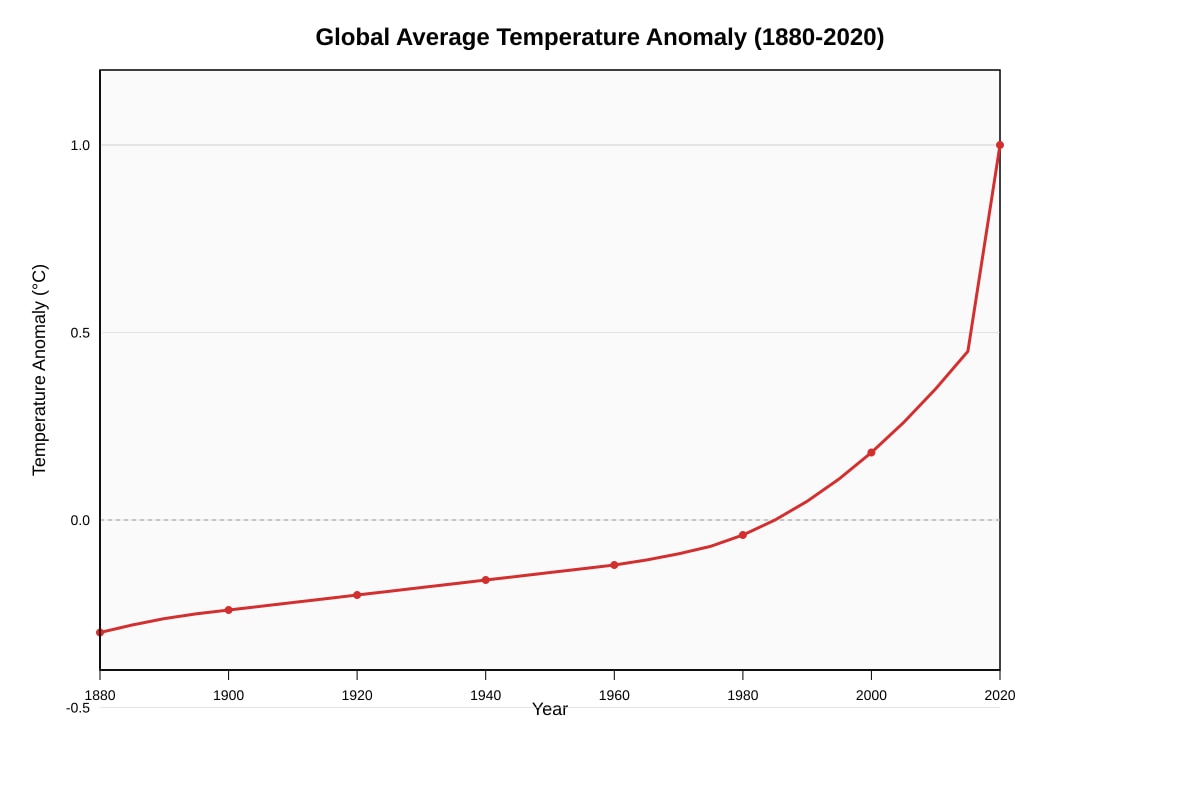
12. Describe the trend shown in the graph and suggest one reason for this trend.
- Acceptable Answer:
- Trend: The graph shows a clear overall upward trend in global average temperature anomaly from 1880 to 2020. The increase is gradual until around 1980, after which it becomes much steeper, indicating a rapid acceleration in warming.
- Reason: This trend is primarily due to the increased burning of fossil fuels (coal, oil, and natural gas) since the Industrial Revolution. This releases large amounts of greenhouse gases, like carbon dioxide, which trap heat and cause the planet to warm.
- Marks: 3 (1 mark for correctly describing the overall trend, 1 mark for noting the acceleration after 1980, 1 mark for a valid reason)
- Explanation: This question tests graph interpretation skills. The key is to describe how the trend changes over time, not just state that it is increasing.
- Marking Notes: Accept other valid reasons like deforestation or industrial agriculture. The reason must be a plausible cause of the observed warming.
13. Explain how the concept of "ecological footprint" can be used to measure the sustainability of a population.
- Acceptable Answer: The ecological footprint measures the amount of biologically productive land and water area required to produce the resources a population consumes and to absorb its waste. If a population's ecological footprint is larger than the available biocapacity (the area's ability to regenerate resources), it means the population is living unsustainably, consuming resources faster than they can be replenished. A smaller footprint indicates a more sustainable lifestyle.
- Marks: 3 (1 mark for defining the concept, 1 mark for explaining how it is measured, 1 mark for linking it to sustainability)
- Explanation: The ecological footprint is a powerful tool for visualizing resource consumption. It allows for a direct comparison between demand and supply.
- Common Mistake: Confusing ecological footprint with carbon footprint. The ecological footprint is a broader measure that includes carbon, food, water, and other resources.
14. Describe two ways in which individuals can reduce their water footprint at home.
- Acceptable Answer:
- Taking shorter showers: Reducing shower time by a few minutes can save a significant amount of water per day.
- Fixing leaks: A dripping tap can waste a large volume of water over time. Promptly fixing leaks prevents this waste.
- Marks: 3 (1 mark for each action described, 1 mark for explaining how it reduces water use)
- Explanation: A water footprint is the total volume of freshwater used to produce the goods and services consumed by an individual. Reducing direct water use at home is one part of this.
- Marking Notes: Accept other valid actions like turning off the tap while brushing teeth, using a watering can instead of a hose, or running the washing machine only when full.
15. Explain why the conservation of mangroves is important for coastal communities.
- Acceptable Answer: Mangroves provide crucial protection for coastal communities. Their dense root systems act as a natural buffer, absorbing the energy of waves and storm surges, which reduces coastal erosion and flooding. They also serve as nurseries for many fish species, supporting local fisheries and the livelihoods of fishing communities.
- Marks: 3 (1 mark for identifying a protective function, 1 mark for identifying a livelihood function, 1 mark for explaining the importance to the community)
- Explanation: Mangroves are a vital ecosystem that provides both protection and resources. Their conservation is essential for the resilience of coastal communities.
- Common Mistake: Only mentioning one function (e.g., "they stop erosion"). A good answer will show an understanding of multiple benefits.
Section C: Extended Response (Questions 16–20)
16. Evaluate the effectiveness of using recycling as a strategy to manage waste. Provide one advantage and one disadvantage.
- Acceptable Answer:
- Advantage: Recycling reduces the amount of waste sent to landfills, conserving valuable land space and reducing pollution from landfill sites.
- Disadvantage: Recycling processes can be energy-intensive and costly. Not all materials are easily recyclable, and the quality of recycled materials can be lower than virgin materials, limiting their use.
- Marks: 2 (1 mark for a valid advantage, 1 mark for a valid disadvantage)
- Explanation: "Evaluate" means to weigh the pros and cons. This question requires a balanced view.
- Marking Notes: Accept other valid points like "reduces the need for raw material extraction" (advantage) or "contamination of recyclables can make the process inefficient" (disadvantage).
17. Explain how the use of public transport can contribute to sustainable urban living.
- Acceptable Answer: Using public transport (buses, trains) reduces the number of private cars on the road. This leads to lower traffic congestion, reduced air pollution (as fewer cars emit exhaust fumes), and lower consumption of fossil fuels. This makes cities cleaner, healthier, and more resource-efficient.
- Marks: 2 (1 mark for identifying a benefit, 1 mark for explaining the link to sustainability)
- Explanation: Sustainable urban living aims to minimize the environmental impact of city life. Public transport is a key strategy for achieving this.
- Common Mistake: Only saying "it's good for the environment" without explaining the mechanism (reducing car use).
18. Describe one way in which the government can encourage the use of renewable energy.
- Acceptable Answer: The government can offer subsidies or tax rebates to households and businesses that install solar panels or other renewable energy systems. This reduces the upfront cost, making it more affordable and encouraging adoption.
- Marks: 2 (1 mark for a clear action, 1 mark for explaining how it encourages use)
- Explanation: Governments have many policy tools to promote renewable energy, including financial incentives, regulations, and public investment.
- Marking Notes: Accept other valid actions like setting a national target for renewable energy, investing in research and development, or implementing a carbon tax that makes fossil fuels more expensive.
19. Explain how the loss of forests can affect the water cycle.
- Acceptable Answer: Forests play a key role in the water cycle. Trees absorb water from the soil and release it into the atmosphere through transpiration. This process contributes to cloud formation and rainfall. When forests are cleared, less water is transpired, which can lead to reduced rainfall in the region. Deforestation also reduces the land's ability to absorb water, increasing surface runoff and the risk of flooding.
- Marks: 2 (1 mark for explaining the role of trees in transpiration/rainfall, 1 mark for explaining the impact on runoff/flooding)
- Explanation: This question tests understanding of the interconnectedness of Earth's systems.
- Common Mistake: Only saying "there will be less rain" without explaining the process of transpiration.
20. Suggest one reason why it is important to manage resources sustainably for future generations.
- Acceptable Answer: It is important to manage resources sustainably so that future generations have access to the same resources we enjoy today. If we deplete non-renewable resources and damage ecosystems, future generations will face shortages of essential resources like clean water, fertile soil, and energy, limiting their ability to meet their own needs and maintain a good quality of life.
- Marks: 2 (1 mark for identifying the concept of intergenerational equity, 1 mark for explaining the consequence of not doing so)
- Explanation: This is the core principle of sustainable development. It is about fairness and responsibility across time.
- Common Mistake: Giving a vague answer like "to save the planet." The answer should focus on the needs and well-being of future people.
End of Answer Key