AI Generated Quiz
Secondary 2 Geography Resources Sustainability Quiz
Free Sec 2 Geography Resources Sustainability quiz, AI version, with questions, answers, and syllabus-aligned practice for Singapore students.
These static practice materials are generated from the site's syllabus and paper-generation workflow, with source and model context shown so students and parents can evaluate the material before use.
Questions
Free quiz and exam paper access
Enter your details to view this paper
Your access is remembered on this device.
Answers
Secondary 2 Geography Quiz - Resources Sustainability: Answer Key
Total Marks: 50
Section A: Multiple-Choice Questions (10 marks)
1. A) A resource that can be replaced naturally at the same rate it is used [1 mark]
Explanation: A renewable resource is one that can be replenished naturally over time at a rate that keeps pace with human consumption. Examples include solar energy, wind energy, and timber from sustainably managed forests. Option C is incorrect because even renewable resources can be depleted if used faster than they are replenished. Option D is incorrect because renewable resources exist naturally; they are not created by technology.
2. B) Evaporation [1 mark]
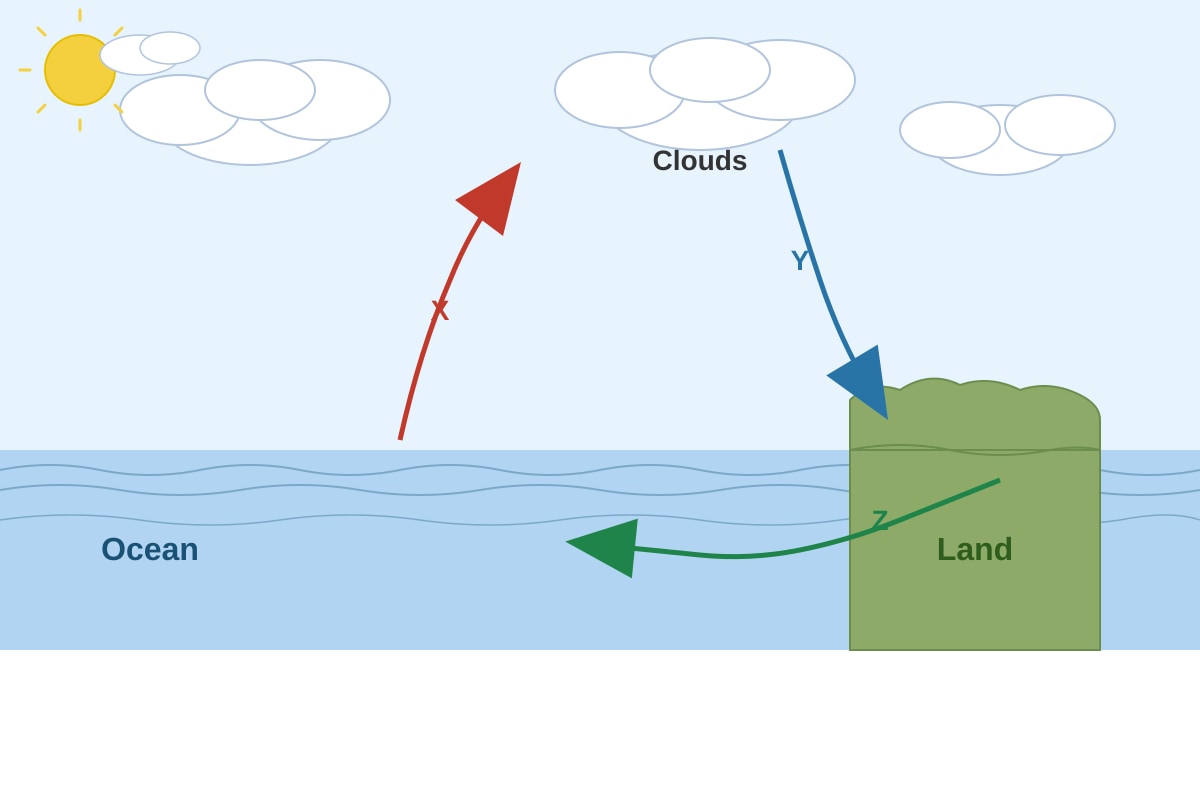
Explanation: In the water cycle diagram, Arrow X points from the ocean surface upward toward the clouds. This represents evaporation, the process where solar energy heats water in the ocean, turning it from liquid into water vapour that rises into the atmosphere. Condensation (A) is the process where water vapour cools and forms clouds. Precipitation (C) is when water falls from clouds as rain or snow. Transpiration (D) is the release of water vapour from plants.
3. C) Natural gas [1 mark]
Explanation: Natural gas is a fossil fuel formed from the remains of ancient organisms over millions of years. It is considered non-renewable because it cannot be replenished within a human timescale. Solar power (A), wind power (B), and hydropower (D) are all renewable energy sources that are naturally replenished.
4. D) Groundwater from underground aquifers [1 mark]
Explanation: Singapore's Four National Taps are: (1) Local catchment water from reservoirs, (2) Imported water from Malaysia, (3) NEWater (high-grade reclaimed water), and (4) Desalinated water. Groundwater from underground aquifers is not a significant source of water for Singapore due to its small land area and geology.
5. B) An increase in the concentration of greenhouse gases in the atmosphere [1 mark]
Explanation: The enhanced greenhouse effect refers to the additional warming caused by human activities that increase the concentration of greenhouse gases (such as carbon dioxide, methane, and nitrous oxide) in the atmosphere. These gases trap more heat, leading to global warming. The natural greenhouse effect is essential for life on Earth, but the enhanced effect is causing climate change.
6. C) Practising selective logging and replanting [1 mark]
Explanation: Selective logging involves carefully choosing which trees to cut down, leaving most of the forest intact. Replanting involves planting new trees to replace those that were cut down. This approach allows the forest to regenerate and maintain its biodiversity and ecosystem functions. Clear-cutting (A), converting forests to plantations (B), and unrestricted mining (D) are all unsustainable practices that cause severe environmental damage.
7. C) Salty coastal waters [1 mark]
Explanation: Mangroves are specially adapted to survive in the intertidal zone of tropical and subtropical coastlines, where they are regularly flooded by salt water. Their adaptations include aerial roots for gas exchange in waterlogged soil and salt-secreting leaves to remove excess salt.
8. A) The total area of land needed to support a population's resource consumption and waste absorption [1 mark]
Explanation: Ecological footprint measures the demand humans place on the environment. It calculates the area of biologically productive land and water needed to produce the resources a population consumes and to absorb its waste. If a population's ecological footprint exceeds the biocapacity of the area, it is living unsustainably.
9. B) To minimise the amount of waste generated and disposed of [1 mark]
Explanation: The 3Rs approach aims to reduce waste at its source (Reduce), use items multiple times (Reuse), and convert waste into new products (Recycle). The ultimate goal is to minimise the amount of waste that ends up in landfills or incinerators, conserving resources and reducing environmental pollution.
10. B) Discharging untreated industrial waste into rivers [1 mark]
Explanation: Untreated industrial waste often contains harmful chemicals, heavy metals, and other pollutants that contaminate water bodies. This directly causes water pollution, harming aquatic ecosystems and potentially affecting human health if the water is used for drinking or recreation. The other options are all environmentally beneficial activities.
Section B: Structured Questions (20 marks)
11. (a) December [1 mark]
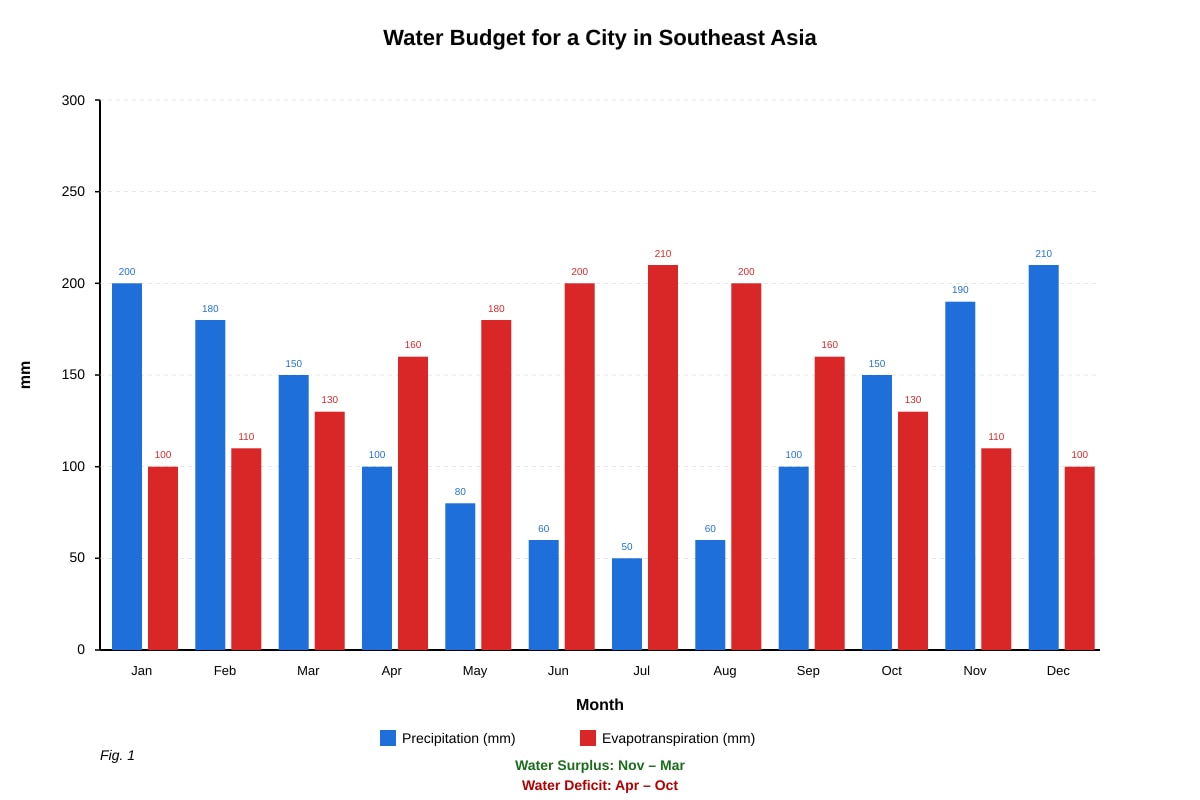
Explanation: Water surplus occurs when precipitation exceeds evapotranspiration. In December, precipitation is 210 mm and evapotranspiration is 100 mm, giving the largest surplus of 110 mm.
(b) Water deficit = Evapotranspiration - Precipitation = 200 mm - 60 mm = 140 mm [2 marks]
Marking scheme:
- 1 mark for correct formula or method (evapotranspiration minus precipitation)
- 1 mark for correct answer with units (140 mm)
Explanation: Water deficit occurs when evapotranspiration exceeds precipitation. In June, evapotranspiration is 200 mm and precipitation is only 60 mm, so the deficit is 140 mm. This means the city loses more water to the atmosphere than it receives from rainfall.
(c) One way the city could manage the water deficit is by using desalination. Desalination removes salt from seawater to produce fresh water, providing an additional water source when rainfall is low. This helps meet water demand during dry months when natural water sources are insufficient. [2 marks]
Marking scheme:
- 1 mark for identifying a suitable strategy (e.g., desalination, water recycling, water conservation, importing water)
- 1 mark for explaining how it helps manage the deficit
Acceptable alternatives: Implementing water conservation measures (e.g., water rationing, public education campaigns), using NEWater (recycled water), or importing water from neighbouring regions.
12. Two characteristics:
- Tropical rainforests have a layered structure (emergent, canopy, understorey, forest floor), which creates many different habitats for different species.
- They have a warm and wet climate year-round, which provides ideal conditions for plant growth and supports a wide variety of plant and animal life. [2 marks]
Marking scheme: 1 mark for each correctly described characteristic (max 2 marks)
Other acceptible answers: High rainfall (over 2000 mm per year), constant high temperatures (around 27°C), high biodiversity of plant species, dense vegetation.
13. Deforestation contributes to the enhanced greenhouse effect in two main ways:
- When trees are cut down and burned or left to decompose, the carbon stored in them is released into the atmosphere as carbon dioxide (CO2), a greenhouse gas.
- Fewer trees remain to absorb CO2 from the atmosphere through photosynthesis, so more CO2 stays in the atmosphere.
The increased concentration of CO2 traps more heat, strengthening the greenhouse effect and causing global warming. [3 marks]
Marking scheme:
- 1 mark for explaining that deforestation releases stored carbon as CO2
- 1 mark for explaining that fewer trees means less CO2 absorption
- 1 mark for linking increased CO2 to the enhanced greenhouse effect and global warming
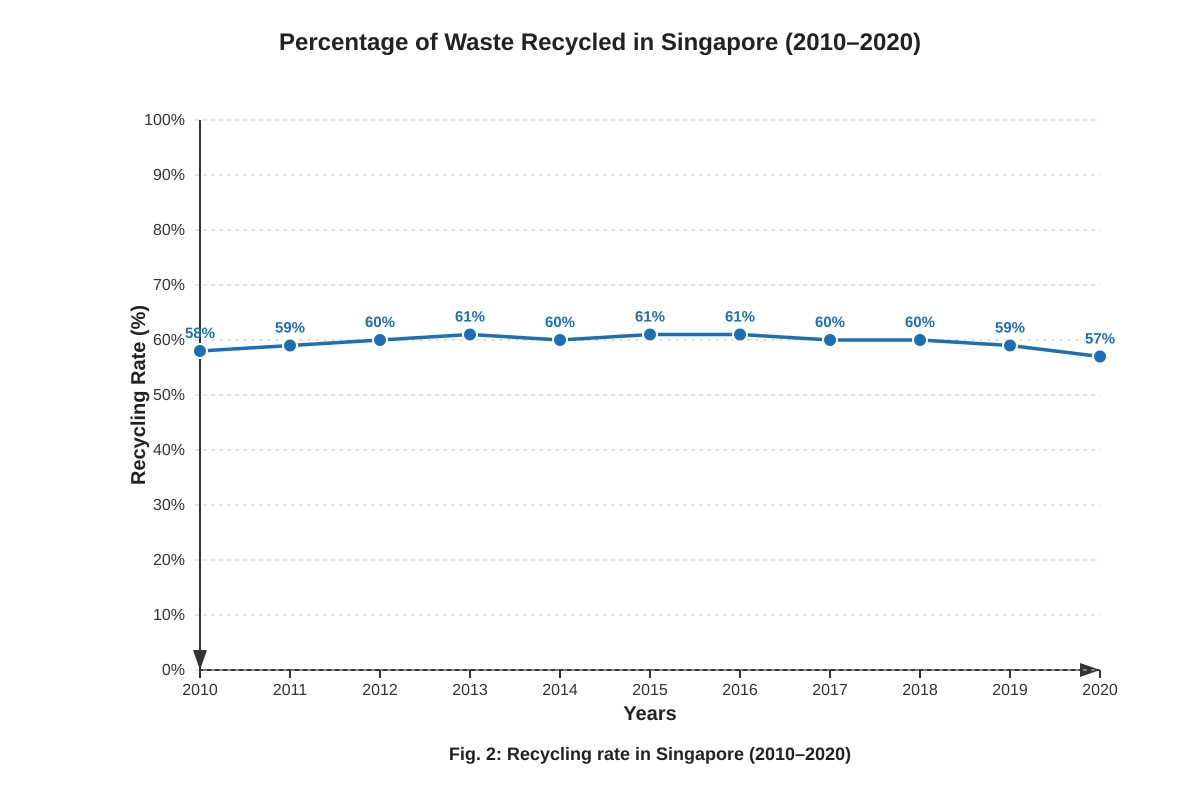
14. (a) Singapore's recycling rate increased slightly from 58% in 2010 to 61% in 2013. It then plateaued at around 60-61% from 2013 to 2018. After 2018, the rate decreased slightly to 57% in 2020. [2 marks]
Marking scheme:
- 1 mark for describing the overall trend (increase then plateau then slight decrease)
- 1 mark for citing specific statistics from the graph
(b) One reason could be that after initial improvements, it became harder to increase recycling rates further because people may have already been recycling most of their easily recyclable waste, and the remaining waste was more difficult to recycle (e.g., food waste, contaminated plastics). [1 mark]
Explanation: This is a common pattern where initial improvements are easier to achieve, but further progress requires more significant changes in behaviour, infrastructure, or technology.
15. Two ways mangroves protect coastlines:
- Their dense network of roots traps sediment and stabilises the soil, reducing erosion from waves and currents.
- Mangrove forests act as a natural barrier that absorbs wave energy, reducing the impact of storms and tsunamis on coastal communities. [2 marks]
Marking scheme: 1 mark for each correctly explained way (max 2 marks)
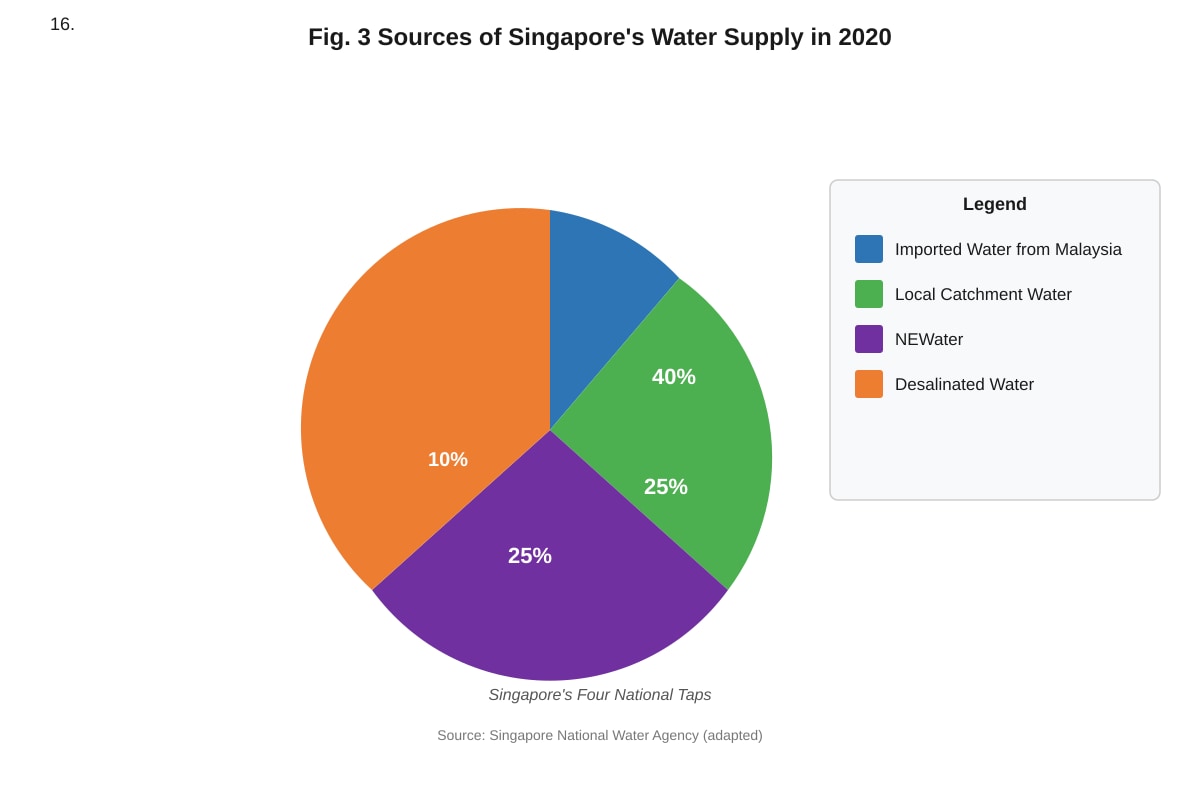
16. (a) Imported water from Malaysia [1 mark]
Explanation: The pie chart shows that imported water contributed 40% of Singapore's water supply in 2020, the largest share among the four sources.
(b) Singapore needs to diversify its water sources because:
- It has limited natural freshwater resources (no large rivers or lakes) and relies heavily on imported water, which is subject to political agreements that may not be renewed.
- Diversification ensures water security by reducing dependence on any single source, making Singapore more resilient to droughts, pollution events, or supply disruptions. [2 marks]
Marking scheme:
- 1 mark for explaining the limitation of relying on one source
- 1 mark for explaining the benefit of diversification
17. One way individuals can reduce their ecological footprint is by reducing food waste. When food is wasted, all the resources used to produce, transport, and package it are also wasted. By planning meals and only buying what is needed, individuals can reduce their demand on resources. [1 mark]
Other acceptible answers: Using public transport instead of private cars, reducing electricity consumption, buying fewer new products, recycling waste, eating less meat, using reusable bags and containers.
Section C: Data-Based and Extended Response Questions (20 marks)
18. (a) Ecological deficit = Ecological footprint - Biocapacity = 6.5 - 2.0 = 4.5 hectares per person [2 marks]
Marking scheme:
- 1 mark for correct formula or method (footprint minus biocapacity)
- 1 mark for correct answer with units (4.5 hectares per person)
Explanation: Country A has an ecological deficit because its footprint (6.5 ha/person) is larger than its biocapacity (2.0 ha/person). This means the country is consuming resources faster than its ecosystems can regenerate.
(b) One reason is that Country A likely has a higher level of economic development and consumption. People in wealthier countries tend to consume more resources per person, including more energy, meat, packaged goods, and imported products, all of which increase their ecological footprint. In contrast, Country B may have a more sustainable lifestyle with lower consumption levels. [2 marks]
Marking scheme:
- 1 mark for identifying a plausible reason
- 1 mark for explaining the link to ecological footprint
Other acceptible answers: Country A may rely more on fossil fuels for energy, have more car ownership, or have a more resource-intensive diet.
(c) Country A could reduce its ecological footprint by investing in renewable energy sources like solar or wind power to reduce its carbon footprint. [1 mark]
Other acceptible answers: Reducing meat consumption, improving public transport, implementing stricter recycling policies, promoting energy efficiency.
19. (a) The Amazon rainforest is described as the 'lungs of the Earth' because it produces about 20% of the world's oxygen through photosynthesis. During photosynthesis, trees absorb carbon dioxide and release oxygen, which is essential for human and animal life. [2 marks]
Marking scheme:
- 1 mark for mentioning oxygen production
- 1 mark for explaining the process (photosynthesis) or the percentage (20%)
(b) Two environmental consequences:
- Loss of biodiversity - deforestation destroys the habitats of countless plant and animal species, many of which are found nowhere else on Earth.
- Climate change - the release of stored carbon from burning or decomposing trees contributes to the enhanced greenhouse effect and global warming. [2 marks]
Marking scheme: 1 mark for each correctly described consequence (max 2 marks)
Other acceptible answers: Soil erosion, disruption of the water cycle, loss of indigenous peoples' livelihoods.
(c) One sustainable management strategy is establishing protected areas or national parks where logging and farming are prohibited. This preserves large areas of intact forest and allows ecosystems to function naturally. [1 mark]
Other acceptible answers: Promoting sustainable certification schemes for timber and agricultural products, supporting ecotourism that provides economic incentives for conservation, enforcing stricter laws against illegal logging, promoting reforestation programmes.
20. Discuss two strategies that Singapore could adopt to become more sustainable in its use of resources. For each strategy, explain how it would help Singapore become more sustainable. [10 marks]
Indicative answer:
Strategy 1: Increasing the use of renewable energy
Singapore currently relies heavily on natural gas for electricity generation, which is a non-renewable fossil fuel that produces carbon emissions. To become more sustainable, Singapore could invest more in solar energy by installing solar panels on HDB rooftops, industrial buildings, and floating solar farms on reservoirs. This would reduce Singapore's dependence on imported fossil fuels and lower its carbon footprint. Solar energy is renewable and produces no greenhouse gases during operation, making it a cleaner alternative. However, Singapore faces challenges such as limited land for solar panels and variable weather conditions, so energy storage solutions would also be needed.
Strategy 2: Promoting a circular economy for waste management
Singapore currently incinerates most of its waste and sends the ash to Semakau Landfill, which is expected to run out of space by 2035. To become more sustainable, Singapore could adopt a circular economy approach where waste is minimised and materials are kept in use for as long as possible. This could involve designing products that are easier to repair and recycle, expanding the national recycling programme, and encouraging businesses to use recycled materials. This would reduce the amount of waste sent to the landfill, conserve natural resources by reducing the need for raw materials, and lower the environmental impact of production and disposal.
Marking scheme (Levels-based):
| Level | Marks | Description |
|---|---|---|
| 3 | 8-10 | Discusses two strategies in depth, with clear explanation of how each contributes to sustainability. Uses relevant geographical terminology and specific examples. Shows understanding of sustainability concepts. |
| 2 | 4-7 | Discusses two strategies but explanation may be less detailed or one strategy is weaker. Some use of geographical terminology. |
| 1 | 1-3 | Identifies one or two strategies but with limited explanation. Little use of geographical terminology. |
| 0 | 0 | No relevant content. |
Key points that should be covered for full marks:
- Clear identification of two distinct strategies
- Explanation of how each strategy works
- Link to sustainability (reducing resource consumption, minimising waste, protecting the environment)
- Use of specific examples relevant to Singapore
- Understanding of challenges or limitations (bonus for higher levels)
Common mistakes to flag:
- Describing only one strategy in detail
- Not explaining the link to sustainability
- Using generic examples not specific to Singapore
- Confusing sustainability with simply "being green" without understanding resource management
End of Answer Key