AI Generated Quiz
Secondary 2 Geography Resources Sustainability Quiz
Free Sec 2 Geography Resources Sustainability quiz, Claude AI version, with questions, answers, and syllabus-aligned practice for Singapore students.
These static practice materials are generated from the site's syllabus and paper-generation workflow, with source and model context shown so students and parents can evaluate the material before use.
Questions

Free quiz and exam paper access
Enter your details to view this paper
Your access is remembered on this device.
Answers
Secondary 2 Geography Quiz - Resources Sustainability (Answer Key)
Total Marks: 60 marks
Section A: Short Answer Questions (Questions 1-8) [20 marks]
1. State TWO physical states of water found in the hydrological cycle. [2 marks]
Answer: (i) Liquid (1 mark) (ii) Gas/water vapour (1 mark) Also accept: Solid/ice
Marking notes: Award 1 mark for each correct physical state. Do not accept "steam" as this is not a physical state.
2. Define the term 'water budget'. [2 marks]
Answer: The balance between water inputs (precipitation) and water outputs (evaporation and transpiration) in a catchment area over a specific time period. (2 marks)
Marking notes: Award 1 mark for mentioning inputs and outputs, 1 mark for reference to balance/relationship between them. Accept "evapotranspiration" for outputs.
3. Name ONE adaptation of mangrove trees to saltwater conditions. [1 mark]
Answer: Salt-secreting leaves / Aerial roots / Salt-filtering roots / Pneumatophores (1 mark)
Marking notes: Accept any valid adaptation to saltwater/coastal conditions.
4. State the four-figure grid reference for the water treatment plant shown in the map extract. [1 mark]
Answer: [Sample answer: 2435] (1 mark)
Marking notes: Award 1 mark for correct four-figure grid reference. Deduct marks if only two figures given per coordinate or if easting/northing reversed.
5. Calculate the population density of Region A using the data below: [2 marks]
Answer: Population density = Population ÷ Area = 2,400,000 ÷ 800 = 3,000 people per km² (2 marks)
Marking notes: Award 1 mark for correct formula/working, 1 mark for correct answer with units.
6. List TWO environmental functions of tropical rainforests. [2 marks]
Answer: (i) Carbon storage/absorption (1 mark) (ii) Habitat for biodiversity/wildlife (1 mark) Also accept: Oxygen production, Climate regulation, Soil protection
Marking notes: Award 1 mark for each correct environmental function.
7. Name ONE type of water pollution caused by human activities. [1 mark]
Answer: Chemical pollution / Sewage pollution / Industrial waste / Agricultural runoff / Plastic pollution (1 mark)
Marking notes: Accept any valid type of water pollution with human cause.
8. State what NEWater is in Singapore's water management strategy. [1 mark]
Answer: Recycled/treated wastewater / High-grade reclaimed water (1 mark)
Marking notes: Must indicate it is recycled/treated water. Do not accept just "recycled water" without context.
Section B: Structured Response Questions (Questions 9-15) [28 marks]
9. (a) Describe the trend in Singapore's water consumption shown in Figure 1. [3 marks]
Answer: Singapore's water consumption increased steadily from 400 million gallons per day in 2010 to 480 million gallons per day in 2020, representing a 20% increase over the decade. The growth was consistent with no major fluctuations. (3 marks)
Marking notes: 1 mark for overall trend (increase), 1 mark for specific statistics, 1 mark for describing rate/pattern of change.
**(b) Explain TWO reasons for this trend in water consumption. [4 marks]
Answer: Reason 1: Population growth - Singapore's population increased due to immigration and natural increase, leading to more people requiring water for domestic use. (2 marks)
Reason 2: Economic development - Industrial expansion and more businesses require water for manufacturing processes and commercial activities. (2 marks)
Marking notes: Award 2 marks per reason (1 for identification, 1 for explanation). Accept urbanization, lifestyle changes, tourism growth.
10. (a) Describe TWO characteristics of the tropical rainforest visible in Photograph A. [2 marks]
Answer: Characteristic 1: Dense canopy layer with continuous tree cover (1 mark) Characteristic 2: Multiple vegetation layers/stratification visible (1 mark)
Marking notes: Award 1 mark per characteristic. Accept evergreen vegetation, high biodiversity, tall trees.
**(b) Explain how the characteristic you described helps the rainforest ecosystem function effectively. [3 marks]
Answer: The dense canopy layer intercepts most sunlight, creating different microclimates below that support diverse species adapted to different light levels. This maximizes the use of available space and resources, allowing the ecosystem to support high biodiversity and maintain complex food webs. (3 marks)
Marking notes: Award marks for clear explanation linking characteristic to ecosystem function. Accept explanations about nutrient cycling, habitat provision.
11. Explain how deforestation contributes to the enhanced greenhouse effect. [4 marks]
Answer: Trees normally absorb CO2 from the atmosphere during photosynthesis and store carbon in their biomass. When forests are cleared, this stored carbon is released back into the atmosphere as CO2 through burning or decomposition. Additionally, fewer trees remain to absorb CO2 from the atmosphere. This increases atmospheric CO2 concentrations, strengthening the greenhouse effect and contributing to global warming. (4 marks)
Marking notes: Award 1 mark each for: carbon storage function, carbon release process, reduced absorption capacity, link to enhanced greenhouse effect.
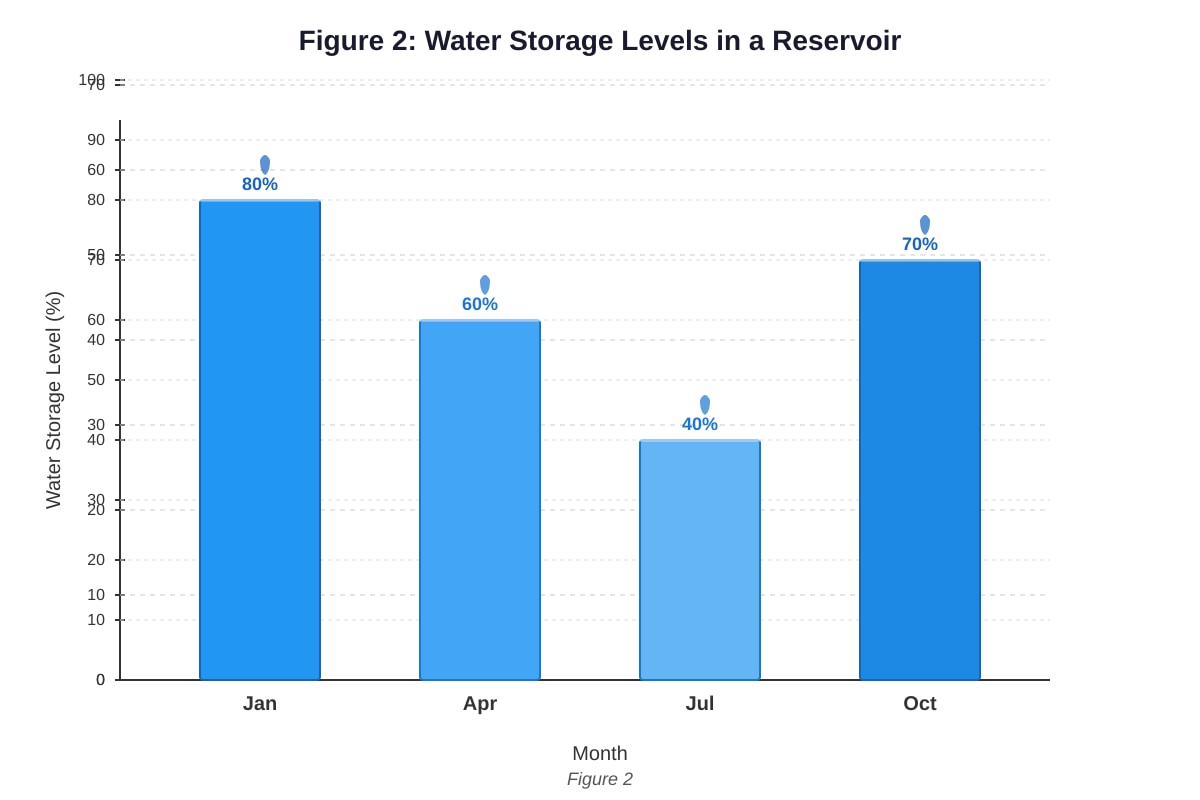
12. (a) Identify the month with the lowest water storage level. [1 mark]
Answer: July (1 mark)
**(b) Suggest TWO reasons why water storage levels vary throughout the year. [2 marks]
Answer: Reason 1: Seasonal rainfall patterns - dry seasons have less precipitation to replenish reservoirs (1 mark) Reason 2: Varying water demand - higher consumption during hot/dry periods (1 mark)
Marking notes: Accept evaporation rates, monsoon patterns, agricultural demand cycles.
13. Describe TWO ways mangroves protect coastal environments. [4 marks]
Answer: Way 1: Wave energy reduction - Mangrove roots and vegetation slow down wave action, reducing coastal erosion and protecting shorelines from storm damage. (2 marks)
Way 2: Sediment trapping - Mangrove roots trap sediments carried by water, helping to build up coastal land and prevent soil loss. (2 marks)
Marking notes: Award 2 marks per way (1 for process, 1 for environmental benefit). Accept flood protection, habitat provision.
14. Explain how Singapore's desalination plants help ensure water security. [3 marks]
Answer: Desalination plants convert seawater into freshwater by removing salt, providing Singapore with a weather-independent water source. This reduces dependence on rainfall and imported water, ensuring continuous water supply even during droughts or supply disruptions from neighboring countries. (3 marks)
Marking notes: Award marks for process explanation, independence from weather/imports, contribution to water security.
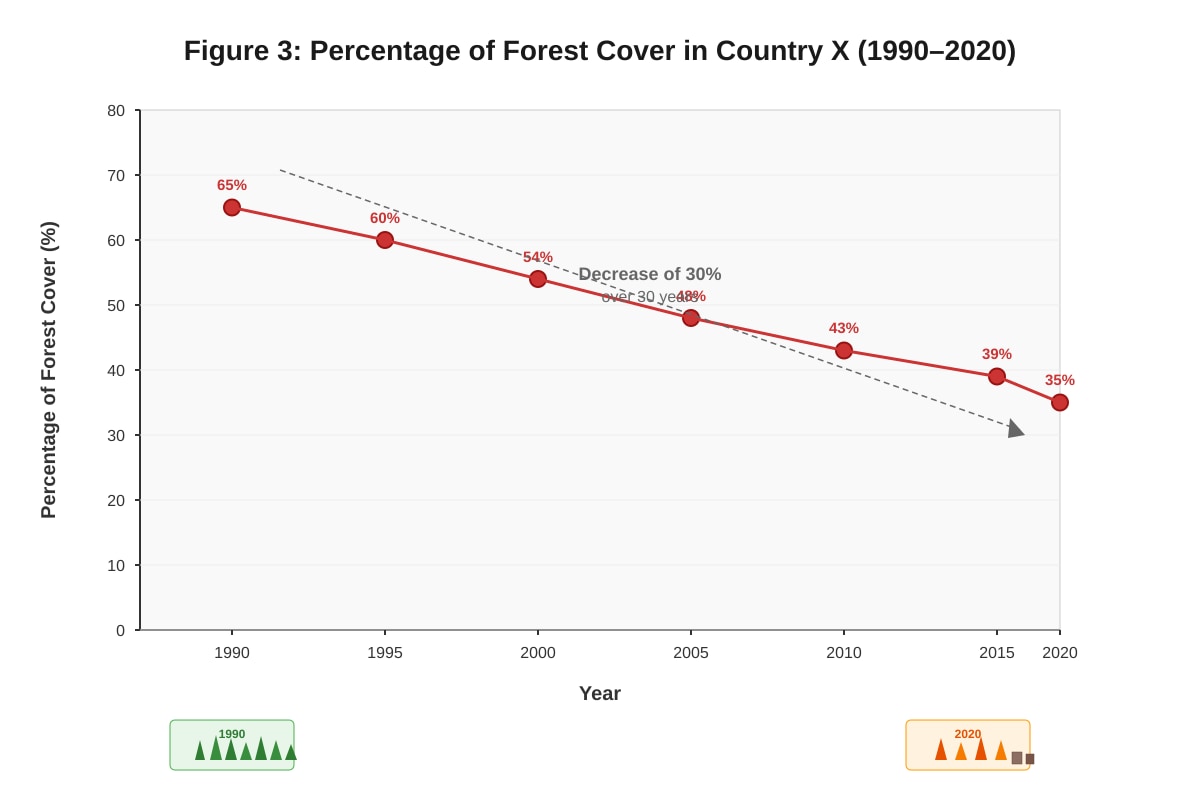
15. Describe the change in forest cover and suggest ONE environmental consequence. [2 marks]
Answer: Change: Forest cover declined from 65% in 1990 to 35% in 2020, a decrease of 30 percentage points over 30 years. (1 mark)
Environmental consequence: Loss of biodiversity as habitats are destroyed / Increased soil erosion / Enhanced greenhouse effect from carbon release. (1 mark)
Marking notes: 1 mark for accurate description with statistics, 1 mark for valid environmental consequence.
Section C: Extended Response Questions (Questions 16-20) [12 marks]
16. Evaluate the effectiveness of water conservation measures in managing water resources sustainably. [6 marks]
Sample Answer: Water conservation measures are highly effective in managing water resources sustainably. Singapore's water conservation campaigns have successfully reduced per capita consumption from 165 liters per day in 2003 to 141 liters in 2020, demonstrating their effectiveness. Measures like water-efficient appliances, public education, and pricing policies encourage responsible use while maintaining quality of life.
However, conservation alone has limitations. In rapidly growing cities, population increase may offset conservation gains. Singapore addresses this through diversification - combining conservation with NEWater, desalination, and imported water as the "Four National Taps" strategy.
Conservation is most effective when combined with supply-side measures and strong enforcement. While highly effective for demand management, sustainable water resource management requires integrated approaches that include both conservation and alternative supply sources. (6 marks)
Marking scheme:
- Arguments supporting effectiveness with examples (2 marks)
- Arguments showing limitations with examples (2 marks)
- Balanced evaluation and conclusion (2 marks)
17. "Protecting tropical rainforests is more important than using them for economic development." To what extent do you agree? [6 marks]
Sample Answer: I agree to a large extent that protecting rainforests is more important than economic development, but with some reservations.
Rainforest protection is crucial because these ecosystems provide irreplaceable environmental services. They store massive amounts of carbon - the Amazon alone stores 15-20% of global carbon. Their destruction contributes significantly to climate change, affecting the entire planet. Additionally, rainforests contain 50% of global biodiversity, and species extinction is irreversible.
However, economic development cannot be completely ignored, especially in developing countries where local communities depend on forest resources for survival. Complete protection without alternatives may drive illegal logging and worsen poverty.
The most effective approach combines protection with sustainable development - ecotourism, sustainable logging, and payment for ecosystem services can provide economic benefits while preserving forests. Therefore, while protection should be prioritized, it must include sustainable economic opportunities for local communities. (6 marks)
Marking scheme:
- Arguments supporting the statement (2 marks)
- Arguments against/showing limitations (2 marks)
- Balanced conclusion addressing "to what extent" (2 marks)
18. Suggest an appropriate sampling method and justify your choice. [3 marks]
Answer: Sampling method: Systematic sampling - collecting water samples at regular intervals (e.g., every 100 meters) along the river. (1 mark)
Justification: This method provides good spatial coverage of the entire river while being practical to implement. It reduces bias compared to convenience sampling and ensures representative data from different parts of the river including upstream, midstream, and downstream areas where water quality may vary due to different pollution sources. (2 marks)
Marking notes: Award 1 mark for appropriate method, 2 marks for clear justification linking method to investigation needs.
19. Explain TWO ways human activities can lead to water pollution. [4 marks]
Answer: Way 1: Industrial discharge - Factories release chemicals and heavy metals into water bodies through waste pipes, contaminating water and making it unsafe for drinking or aquatic life. (2 marks)
Way 2: Agricultural runoff - Fertilizers and pesticides used in farming are washed into rivers and lakes by rainfall, causing eutrophication and killing fish through oxygen depletion. (2 marks)
Marking notes: Award 2 marks per way (1 for activity, 1 for pollution mechanism/impact). Accept sewage discharge, urban runoff, oil spills.
20. Calculate the water surplus or deficit and explain what this means for water availability. [3 marks]
Answer: Calculation: Water balance = Rainfall - Evaporation = 1200mm - 800mm = +400mm (1 mark)
Water surplus/deficit = 400mm surplus (1 mark)
Explanation: This surplus means water availability is good as precipitation exceeds losses through evaporation. The excess water can recharge groundwater stores and maintain river flows, supporting both human needs and ecosystems. (1 mark)
Marking notes: Award 1 mark each for correct calculation, identifying surplus/deficit, and explaining implications for water availability.
Total: 60 marks
Grade Boundaries:
- A: 54-60 marks (90-100%)
- B: 48-53 marks (80-89%)
- C: 42-47 marks (70-79%)
- D: 36-41 marks (60-69%)
- E: 30-35 marks (50-59%)
- F: Below 30 marks (<50%)