AI Generated Quiz
Secondary 2 Geography Physical Geography Quiz
Free Sec 2 Geography Physical Geography quiz, AI version, with questions, answers, and syllabus-aligned practice for Singapore students.
These static practice materials are generated from the site's syllabus and paper-generation workflow, with source and model context shown so students and parents can evaluate the material before use.
Questions
Free quiz and exam paper access
Enter your details to view this paper
Your access is remembered on this device.
Answers
Secondary 2 Geography Quiz - Physical Geography: ANSWER KEY
Total Marks: 50
Section A: Physical Environments and Water (Questions 1–5)
1. State the four main spheres that make up the physical environment. [1 mark]
Answer: The lithosphere (rock/land), atmosphere (air), hydrosphere (water), and biosphere (living things). (Accept any clear naming of these four spheres.)
Marking: 1 mark for all four correct. (0 marks if any missing or incorrect.)
2. Explain how the hydrological cycle ensures that water is a renewable resource. [2 marks]
Answer: The hydrological cycle continuously circulates water between the atmosphere, land, and oceans through processes like evaporation, condensation, precipitation, and runoff. This means water is constantly being replenished and is not used up permanently.
Marking:
- 1 mark for stating that water is continuously circulated/recycled.
- 1 mark for mentioning a key process (e.g., evaporation, precipitation) that shows how it is replenished.
3. Study the simplified water budget data below for a tropical location in January.
| Month | Precipitation (mm) | Evapotranspiration (mm) |
|---|---|---|
| January | 280 | 100 |
Calculate the water surplus for January and explain what this means for the local water supply. [3 marks]
Answer:
Calculation: Water surplus = Precipitation − Evapotranspiration = 280 mm − 100 mm = 180 mm
Explanation: A water surplus of 180 mm means that there is more water available from precipitation than is lost to the atmosphere through evaporation and transpiration. This excess water can recharge groundwater supplies, increase river flow, and provide ample water for human and ecosystem needs during this month.
Marking:
- 1 mark for correct calculation (180 mm).
- 1 mark for stating that precipitation exceeds evapotranspiration.
- 1 mark for explaining a positive impact on water supply (e.g., groundwater recharge, increased river flow).
4. Explain two ways in which the water stored in oceans is different from the water stored in glaciers. [2 marks]
Answer: (Any two of the following or similar valid differences)
- (i) Ocean water is salty/saline, while glacier water is fresh.
- (ii) Ocean water is in liquid form, while glacier water is in solid (ice) form.
- (iii) Oceans store water on the Earth's surface, while glaciers store water on land (often in high latitudes or mountainous regions).
Marking: 1 mark for each valid difference (up to 2 marks).
5. Describe how condensation is important in the water cycle for the formation of clouds. [2 marks]
Answer: Condensation is the process where water vapor in the air cools and changes back into liquid water droplets. These tiny water droplets gather around particles in the atmosphere (like dust) and come together to form clouds.
Marking:
- 1 mark for stating that condensation is the change from water vapor to liquid water.
- 1 mark for explaining that this process leads to the formation of cloud droplets.
Section B: Tropical Rainforests and Mangroves (Questions 6–10)
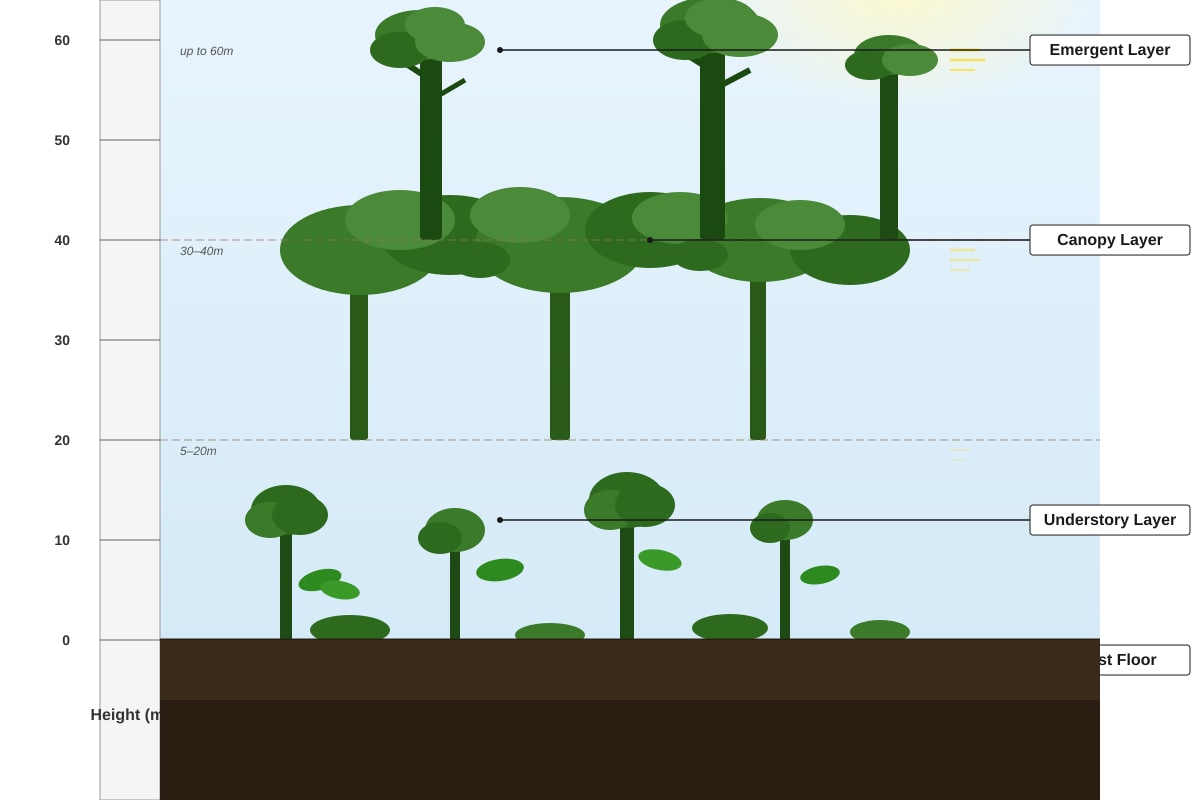
6. Using Fig. 1, name the layer of the tropical rainforest that receives the least sunlight and explain one adaptation of plants found in this layer. [2 marks]
Answer:
Layer: Forest Floor
Adaptation: Plants in this layer (e.g., seedlings, small shrubs) have large, broad leaves to capture as much of the limited sunlight that filters through the canopy as possible. (Accept other valid adaptations such as: ability to survive in very low light, dark green leaves to absorb more light, or growing quickly when a gap in the canopy appears.)
Marking:
- 1 mark for correctly naming the Forest Floor.
- 1 mark for a valid adaptation with a clear explanation.
7. Explain why the Canopy Layer is considered the most important layer for supporting biodiversity in a tropical rainforest. Give two reasons. [2 marks]
Answer: (Any two of the following or similar valid reasons)
- (i) It receives the most sunlight, which supports the greatest amount of plant growth (leaves, flowers, fruits), providing food for many animals.
- (ii) It provides a complex habitat with many niches (e.g., branches, vines, epiphytes) that support a huge variety of insects, birds, mammals, and reptiles.
Marking: 1 mark for each valid reason (up to 2 marks).
8. Mangrove trees have special adaptations to survive in their environment. Describe two adaptations of mangrove trees and explain how each adaptation helps them survive. [4 marks]
Answer: (Any two of the following or similar valid adaptations)
-
(i) Adaptation 1: Prop roots / stilt roots that grow from the trunk and branches into the mud. Explanation: These roots provide stability and support in the soft, waterlogged mud and help anchor the tree against tides and waves. They also have pores that allow the tree to breathe (take in oxygen) even when the roots are submerged.
-
(ii) Adaptation 2: Salt-excreting leaves / salt glands on the leaves. Explanation: Mangroves live in saltwater. These glands remove excess salt from the water they absorb, allowing them to survive in a saline environment that would kill most other trees.
-
(iii) Adaptation 3: Viviparous seeds / propagules that germinate while still attached to the parent tree. Explanation: This allows the seedling to grow a long, heavy root before it drops into the water, enabling it to anchor quickly in the mud rather than being washed away by tides.
Marking: 1 mark for each adaptation (2 marks) and 1 mark for each corresponding explanation (2 marks).
9. Explain one environmental function of tropical rainforests related to the water cycle. [3 marks]
Answer: (Any one of the following or similar valid functions)
-
Function: Tropical rainforests act as a giant water pump / transpiration engine. Explanation: Trees absorb water from the soil through their roots and release it into the atmosphere as water vapor through transpiration. This process creates a lot of moisture in the air, which leads to high rainfall. This rainfall is then recycled back into the forest, maintaining the local and even global water cycle.
-
Function: They help to regulate water flow and prevent flooding. Explanation: The dense vegetation and deep root systems of the rainforest absorb heavy rainfall and slow down runoff. This allows water to soak into the ground, recharging groundwater supplies and releasing water slowly into rivers, preventing both flash floods and droughts.
Marking:
- 1 mark for identifying a valid function.
- 2 marks for a clear explanation of how it works.
10. State two reasons why tropical rainforests are mostly found near the Equator. [2 marks]
Answer: (Any two of the following or similar valid reasons)
- (i) The Equator receives direct, intense sunlight all year round, providing the high temperatures needed for rainforest growth.
- (ii) The Equator experiences high rainfall due to the convergence of trade winds and high evaporation rates, creating the wet conditions rainforests need.
Marking: 1 mark for each valid reason (up to 2 marks).
Section C: The Enhanced Greenhouse Effect and Deforestation (Questions 11–15)
11. Define the enhanced greenhouse effect. [2 marks]
Answer: The enhanced greenhouse effect is the additional warming of the Earth's atmosphere caused by human activities that increase the concentration of greenhouse gases (like carbon dioxide, methane). This traps more of the sun's heat than natural processes would, leading to global warming and climate change.
Marking:
- 1 mark for stating it is an increase in the natural greenhouse effect / additional warming.
- 1 mark for linking it to human activities that release extra greenhouse gases.
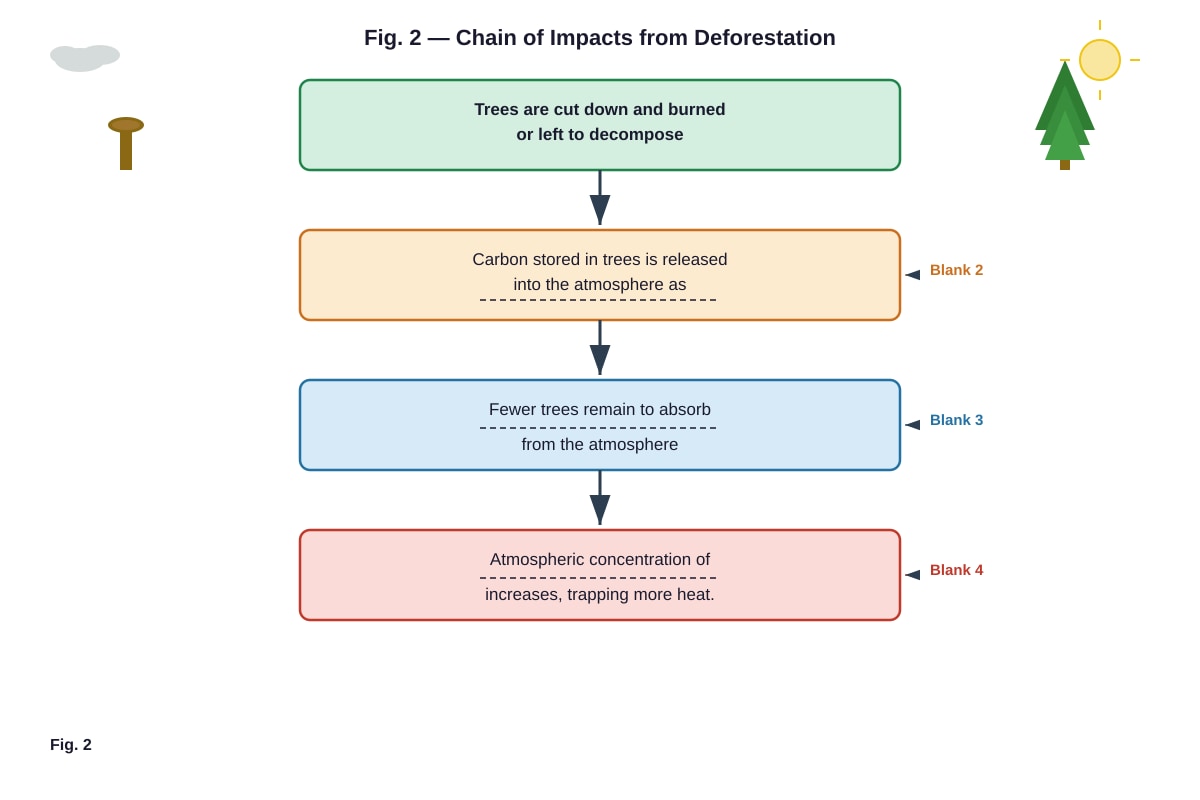
12. Study Fig. 2 below which shows a chain of impacts from deforestation.
Using Fig. 2, complete the flow chart by filling in the three blanks to show how deforestation contributes to the enhanced greenhouse effect. [3 marks]
Answer:
Blank 2: carbon dioxide (CO₂)
Blank 3: carbon dioxide (CO₂)
Blank 4: carbon dioxide (CO₂)
Marking: 1 mark for each correct blank (all three must be "carbon dioxide" or "CO₂").
13. Name one greenhouse gas (other than carbon dioxide) that is released by human activities. [1 mark]
Answer: Methane (CH₄), Nitrous oxide (N₂O), or Water vapor (H₂O). (Accept any valid greenhouse gas other than CO₂.)
Marking: 1 mark for a correct gas name.
14. Explain one way in which deforestation can lead to biodiversity loss in tropical rainforests. [3 marks]
Answer: (Any one of the following or similar valid explanations)
-
Way: Deforestation destroys and fragments habitats. Explanation: When large areas of forest are cut down, the animals and plants that lived there lose their homes and food sources. Fragmentation isolates populations, making it harder for them to find mates, food, and shelter. Many species cannot survive in the small, degraded patches that remain, leading to a decline in population and even extinction.
-
Way: Deforestation disrupts ecological relationships. Explanation: Rainforests have complex food webs and mutualistic relationships (e.g., between pollinators and plants). Removing trees can break these connections. For example, if a key tree species that provides fruit for many animals is removed, those animals may starve, and the plants that depend on those animals for seed dispersal will also decline.
Marking:
- 1 mark for identifying a valid way.
- 2 marks for a clear explanation of how it leads to biodiversity loss.
15. Evaluate whether reducing deforestation alone is enough to stop the enhanced greenhouse effect. Provide a reason for your answer. [2 marks]
Answer:
Evaluation: No, reducing deforestation alone is not enough.
Reason: While deforestation is a major source of CO₂ emissions, the enhanced greenhouse effect is caused by many other human activities. For example, burning fossil fuels (for electricity, transport, industry) and agriculture (releasing methane and nitrous oxide) also release huge amounts of greenhouse gases. We need to address all these sources to effectively stop the enhanced greenhouse effect.
Marking:
- 1 mark for a clear evaluation (e.g., "No, it is not enough").
- 1 mark for a valid reason that explains why other factors also need to be addressed.
Section D: Sustainable Management of Physical Environments (Questions 16–20)
16. Describe one strategy that can be used to manage water pollution sustainably. [2 marks]
Answer: (Any one of the following or similar valid strategies)
-
Strategy: Treating wastewater before it is released into rivers or oceans. Description: Using sewage treatment plants to remove pollutants (e.g., chemicals, bacteria, nutrients) from domestic and industrial wastewater so that the water returned to the environment is clean.
-
Strategy: Reducing the use of chemical fertilizers and pesticides in agriculture. Description: Using organic farming methods or precision agriculture to minimize the runoff of harmful chemicals into water bodies, preventing eutrophication and contamination.
Marking:
- 1 mark for naming a valid strategy.
- 1 mark for a brief description of how it works.
17. Explain how selective logging can help to manage tropical rainforests more sustainably compared to clear-cutting. [3 marks]
Answer: Selective logging involves cutting down only a few mature, valuable trees at a time, leaving the rest of the forest largely intact. This is more sustainable than clear-cutting (which removes all trees) because:
- It preserves the forest structure and biodiversity (most species can survive).
- It allows the forest to regenerate naturally as the canopy gaps are small.
- It protects soil from erosion and maintains the water cycle.
- It provides a long-term source of timber as the forest can be logged again in the future.
Marking:
- 1 mark for defining selective logging.
- 2 marks for explaining at least two ways it is more sustainable than clear-cutting.
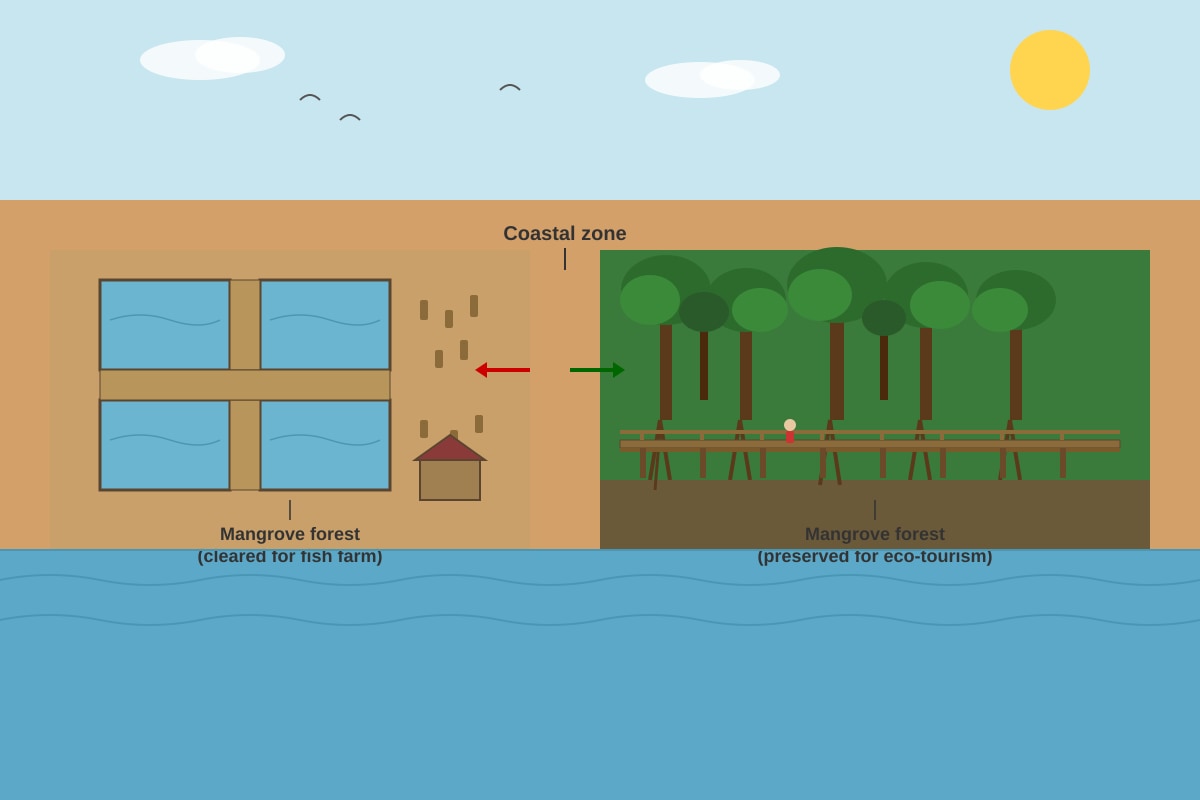
18. Study Fig. 3 below.
Using Fig. 3, compare the sustainable and unsustainable use of mangrove areas shown. Explain which use is better for long-term environmental health. [4 marks]
Answer:
Comparison:
- Unsustainable use (left): The mangrove forest is cleared to build a fish farm. This destroys the natural habitat, removes the protective buffer against storms and erosion, and can lead to water pollution from fish waste and chemicals.
- Sustainable use (right): The mangrove forest is preserved for eco-tourism (e.g., a boardwalk for visitors). This allows people to enjoy and learn about the mangrove ecosystem without destroying it. It also provides economic benefits (tourism revenue) while maintaining all the environmental services of the mangroves (e.g., coastal protection, nursery for fish, carbon storage).
Which is better: The sustainable use (eco-tourism) is better for long-term environmental health because it protects the ecosystem's functions and biodiversity for future generations, while the unsustainable use (fish farm) provides short-term economic gain but destroys the natural resource.
Marking:
- 1 mark for describing the unsustainable use.
- 1 mark for describing the sustainable use.
- 1 mark for clearly stating which is better.
- 1 mark for explaining why it is better for long-term environmental health.
19. Suggest one way that individuals at home can help to conserve water. Explain how this action helps. [2 marks]
Answer: (Any one of the following or similar valid suggestions)
-
Action: Taking shorter showers (e.g., 5 minutes instead of 10). Explanation: This directly reduces the amount of water used per shower, saving hundreds of liters of water per month.
-
Action: Fixing leaking taps. Explanation: A slow drip can waste many liters of water per day. Fixing leaks prevents this unnecessary loss of clean water.
-
Action: Turning off the tap while brushing teeth. Explanation: This simple habit can save several liters of water each time, as water is not wasted while not being used.
Marking:
- 1 mark for a valid action.
- 1 mark for a clear explanation of how it conserves water.
20. Explain why it is important to manage both tropical rainforests and mangroves as part of a global strategy to combat climate change. [4 marks]
Answer: Both tropical rainforests and mangroves are incredibly important carbon sinks that absorb and store large amounts of carbon dioxide (CO₂) from the atmosphere.
-
Tropical rainforests store vast amounts of carbon in their trees and soil. When they are destroyed, this carbon is released, accelerating climate change. Protecting them keeps this carbon locked away and allows them to continue absorbing CO₂.
-
Mangroves are even more efficient at storing carbon per hectare than rainforests. They store carbon in their biomass and, crucially, in the deep, waterlogged sediments below them, where it can remain for centuries. Their destruction releases this stored carbon and removes a vital coastal defense against sea-level rise.
Managing both ecosystems is a global strategy because they are major global carbon stores. Their protection and restoration are essential for reducing atmospheric CO₂ levels and mitigating the impacts of climate change. They also provide other benefits like coastal protection and biodiversity, which help ecosystems adapt to climate change.
Marking:
- 1 mark for stating that both are carbon sinks.
- 1 mark for explaining the role of rainforests in carbon storage.
- 1 mark for explaining the role of mangroves in carbon storage.
- 1 mark for concluding that managing both is a vital global strategy.
— End of Answer Key —