AI Generated Quiz
Secondary 2 Geography Map Graph Data Skills Quiz
Free Sec 2 Geography Map Graph Data Skills quiz, Nemo3 AI version, with questions, answers, and syllabus-aligned practice for Singapore students.
These static practice materials are generated from the site's syllabus and paper-generation workflow, with source and model context shown so students and parents can evaluate the material before use.
Questions
Free quiz and exam paper access
Enter your details to view this paper
Your access is remembered on this device.
Answers
Secondary 2 Geography Quiz - Map Graph Data Skills (Answer Key)
Total Marks: 40
Section A: Map Reading Skills (12 marks)
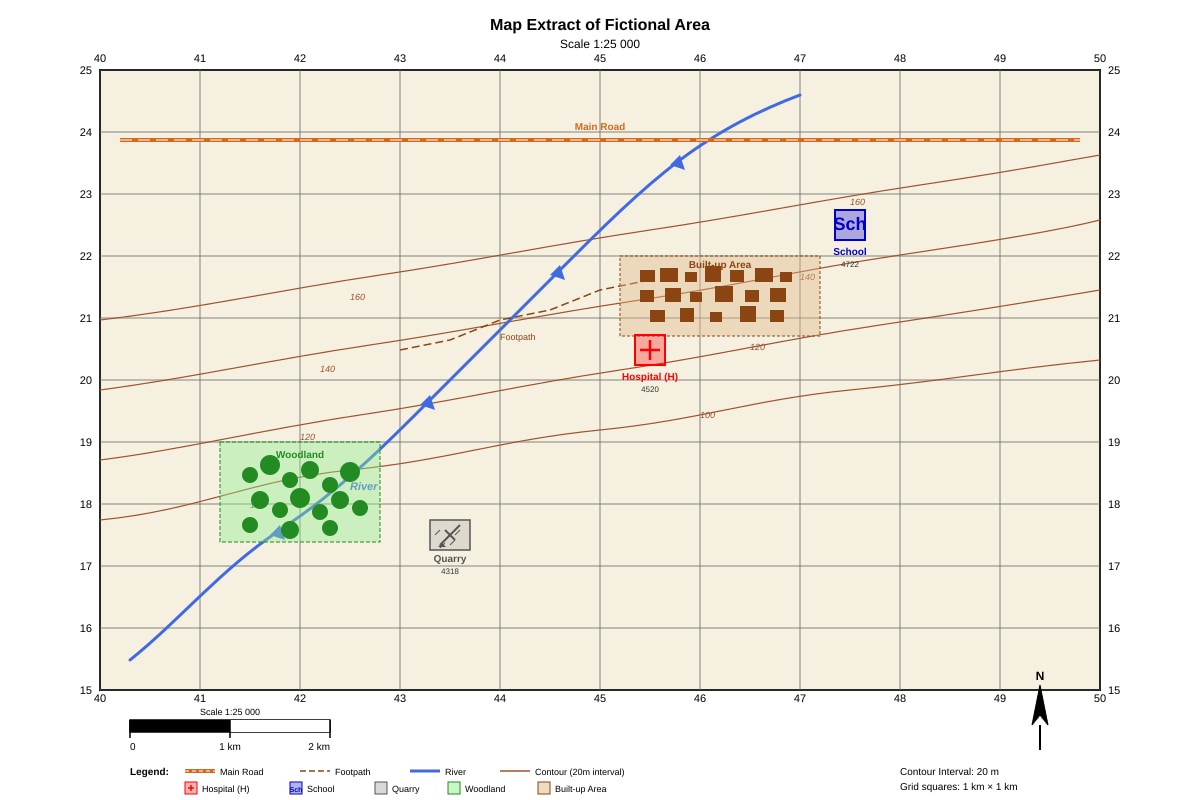
1. Four-figure grid reference of the hospital [1]
Answer: 4520
Explanation: Four-figure grid references are read by giving the easting (vertical grid line) first, then the northing (horizontal grid line). The hospital is located in the grid square where easting 45 meets northing 20.
Common mistake: Writing the northing first (2045) or giving a six-figure reference when only four figures are asked.
2. Six-figure grid reference of the school [1]
Answer: 472224 (or 472225 depending on exact position within the square)
Explanation: For a six-figure reference, divide the grid square into 10 equal parts horizontally and vertically. The school is at easting 47.2 (2/10 across the square) and northing 22.4 (4/10 up the square), giving 472224.
Marking note: Accept 472224 or 472225 if the school symbol is centred slightly differently. Must have 6 digits with easting first.
3. Direction of the quarry from the hospital [1]
Answer: South-west (SW)
Explanation: The hospital is at 4520, the quarry at 4318. The quarry is to the west (lower easting) and south (lower northing) of the hospital, so the direction is south-west.
Common mistake: Giving the direction from quarry to hospital (north-east) or using only cardinal points (south or west).
4. Straight-line distance between hospital and school [2]
Answer: 2.8 km (accept 2.7–2.9 km)
Working:
- Hospital at 4520, school at 4722
- Difference in eastings: 47 – 45 = 2 km
- Difference in northings: 22 – 20 = 2 km
- Straight-line distance = √(2² + 2²) = √8 ≈ 2.83 km ≈ 2.8 km
Alternative method: Measure with ruler on map (1 cm = 0.25 km at 1:25,000 scale). Distance on map ≈ 11.3 cm × 0.25 = 2.8 km.
Mark breakdown: 1 mark for correct method (Pythagoras or scale measurement), 1 mark for correct answer with units.
5. Height of the highest contour line [1]
Answer: 160 m
Explanation: Contour lines are labelled at 20 m intervals (100, 120, 140, 160). The highest labelled contour on the map extract is 160 m.
6. Relief around the quarry [2]
Answer: The area around the quarry is hilly/undulating with steep slopes. Contour lines are closely spaced (e.g., 100 m, 120 m, 140 m contours close together), indicating steep gradients. The quarry itself is located on a hillside between the 120 m and 140 m contours.
Mark breakdown: 1 mark for describing relief (hilly/steep), 1 mark for using contour evidence (close spacing, specific heights).
Key concept: Closely spaced contours = steep slope; widely spaced contours = gentle slope.
Section B: Graph and Data Interpretation (14 marks)
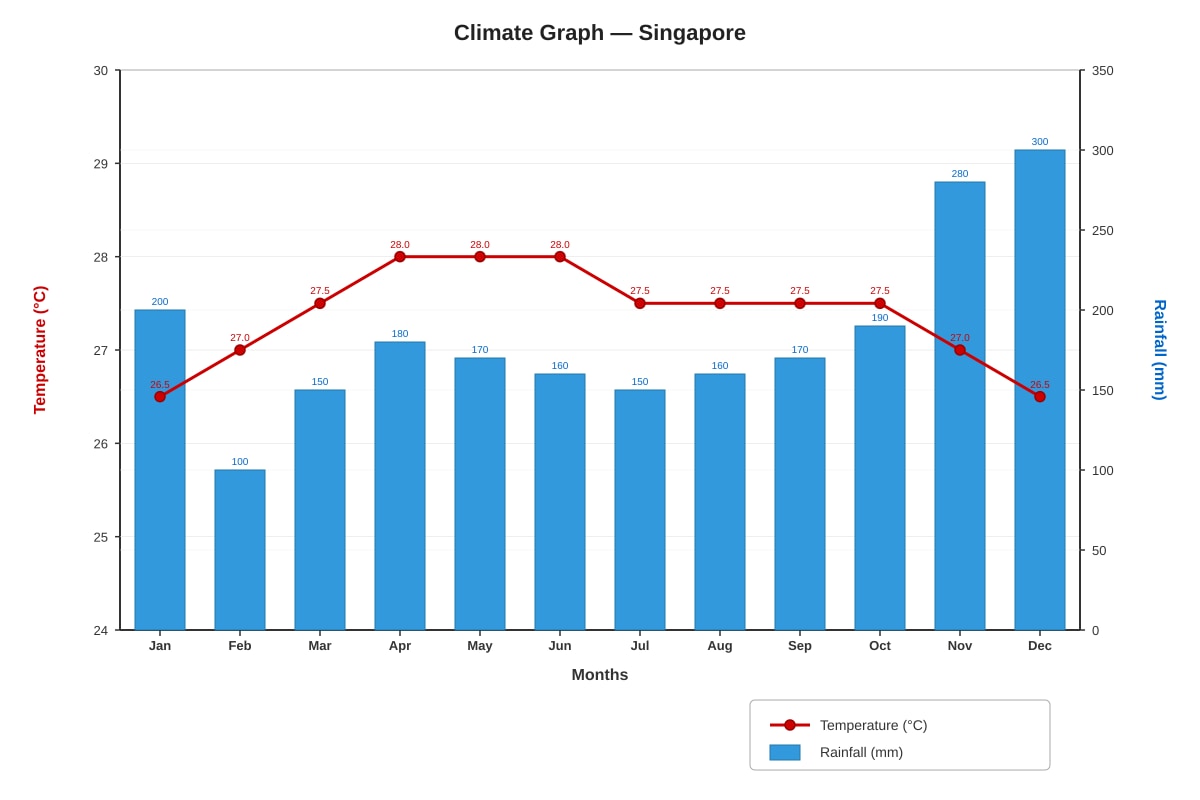
7. Month with highest rainfall [1]
Answer: December
Explanation: The rainfall bar for December reaches 300 mm, which is the highest on the graph.
8. Annual temperature range [2]
Answer: 1.5°C
Working:
- Highest temperature: 28°C (April, May, June)
- Lowest temperature: 26.5°C (January, December)
- Range = 28 – 26.5 = 1.5°C
Mark breakdown: 1 mark for identifying correct highest and lowest values, 1 mark for correct calculation with units.
9. Rainfall pattern throughout the year [3]
Answer: Rainfall is high throughout the year with no distinct dry month (all months >100 mm). There are two peaks: a smaller peak in April (180 mm) and a major peak in November–December (280–300 mm). The lowest rainfall occurs in February (100 mm). Rainfall generally increases from June to December.
Mark breakdown: 1 mark for "high rainfall all year / no dry month", 1 mark for identifying two peaks (April and Nov–Dec) with data, 1 mark for noting lowest in February with data.
Key concept: Equatorial climate – convectional rainfall year-round with monsoon influences causing peaks.
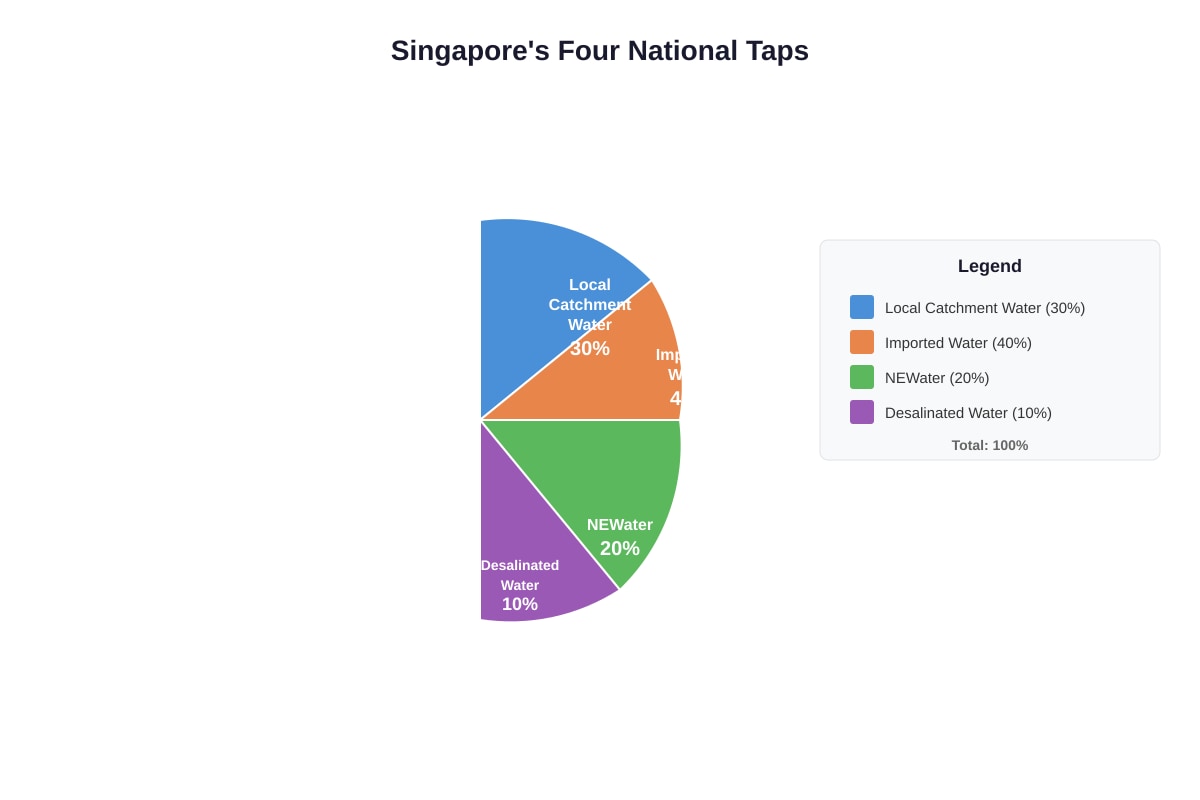
10. Largest water source from pie chart [1]
Answer: Imported Water (40%)
Explanation: The pie chart segment for Imported Water is the largest at 40%.
11. Combined percentage of NEWater and Desalinated Water [1]
Answer: 30%
Working: NEWater (20%) + Desalinated Water (10%) = 30%.
12. Advantage of NEWater over imported water [2]
Answer: NEWater is a locally produced, weather-resilient source that reduces Singapore's dependence on imported water from Malaysia, which is subject to political agreements and potential supply disruptions. NEWater is produced from treated used water, making it a sustainable, closed-loop supply.
Mark breakdown: 1 mark for identifying local production/self-reliance, 1 mark for explaining weather-resilience or sustainability compared to imported water vulnerability.
Key concept: Water security – diversification of sources reduces risk.
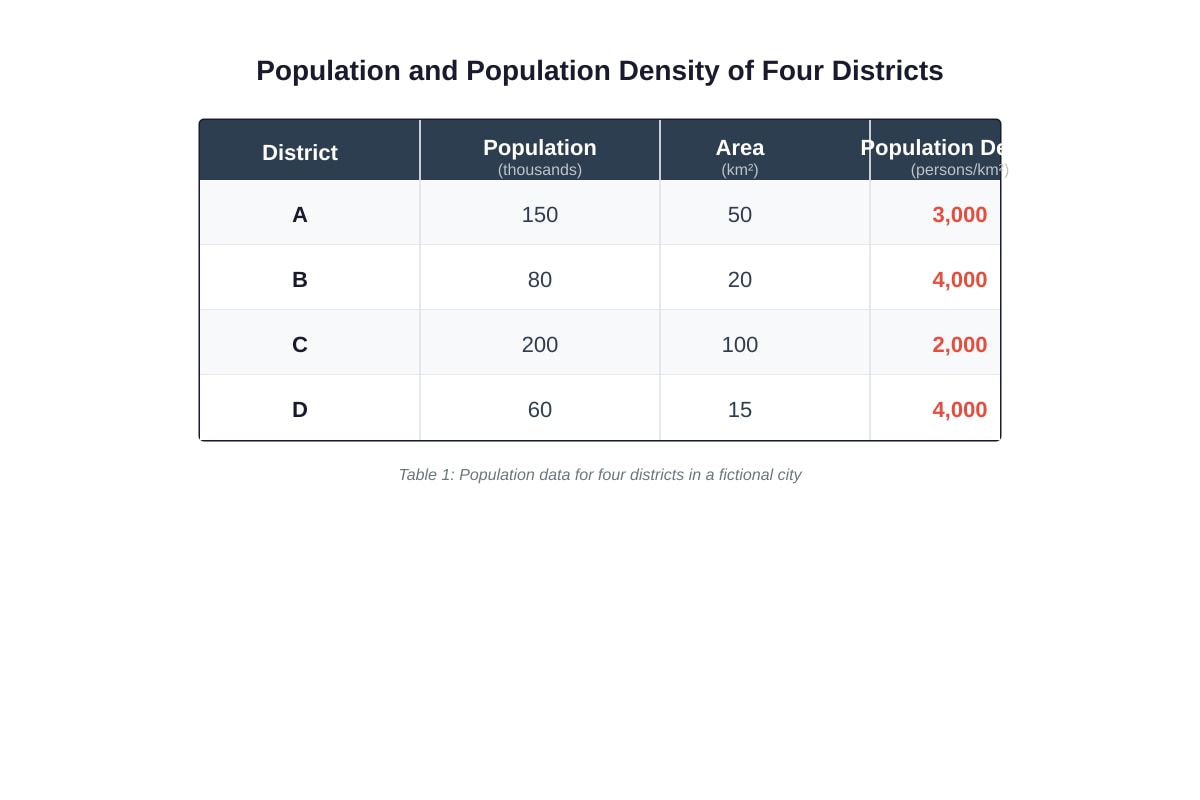
13. Two districts with same population density [1]
Answer: District B and District D (both 4,000 persons/km²)
Explanation: From the table, District B has density 4,000 and District D has density 4,000 persons/km².
Section C: Data Analysis and Application (14 marks)
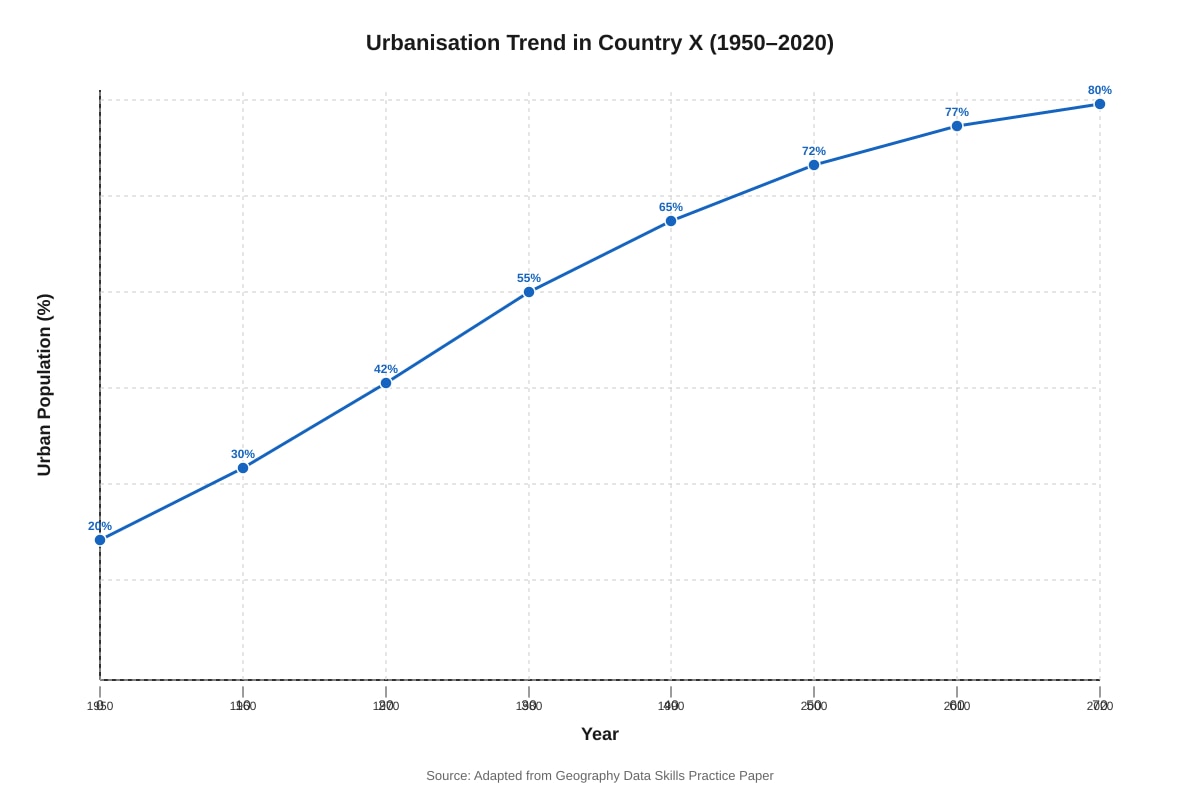
14. Urban population trend for Country X [2]
Answer: The urban population percentage increased steadily from 20% in 1950 to 80% in 2020, a total increase of 60 percentage points over 70 years. The rate of increase was fastest between 1970 and 1990 (13% per decade) and has slowed since 2000.
Mark breakdown: 1 mark for overall trend (steady increase), 1 mark for supporting with data (start/end values or rate change).
15. Average rate of increase per decade [2]
Answer: 8.6% per decade (or 8.57%)
Working:
- Total increase = 80% – 20% = 60%
- Number of decades = (2020 – 1950) / 10 = 7 decades
- Average rate = 60% / 7 = 8.57% ≈ 8.6% per decade
Mark breakdown: 1 mark for correct method (total increase ÷ number of decades), 1 mark for correct answer with units.
16. Reason for rapid increase 1970–1990 [2]
Answer: Rapid industrialisation and economic development in Country X during this period created many urban jobs, attracting rural migrants (rural-urban migration). Government policies may have also encouraged urban growth through infrastructure investment.
Mark breakdown: 1 mark for valid reason (industrialisation / rural-urban migration / job opportunities), 1 mark for linking to the time period/context.
Key concept: Push-pull factors of urbanisation.
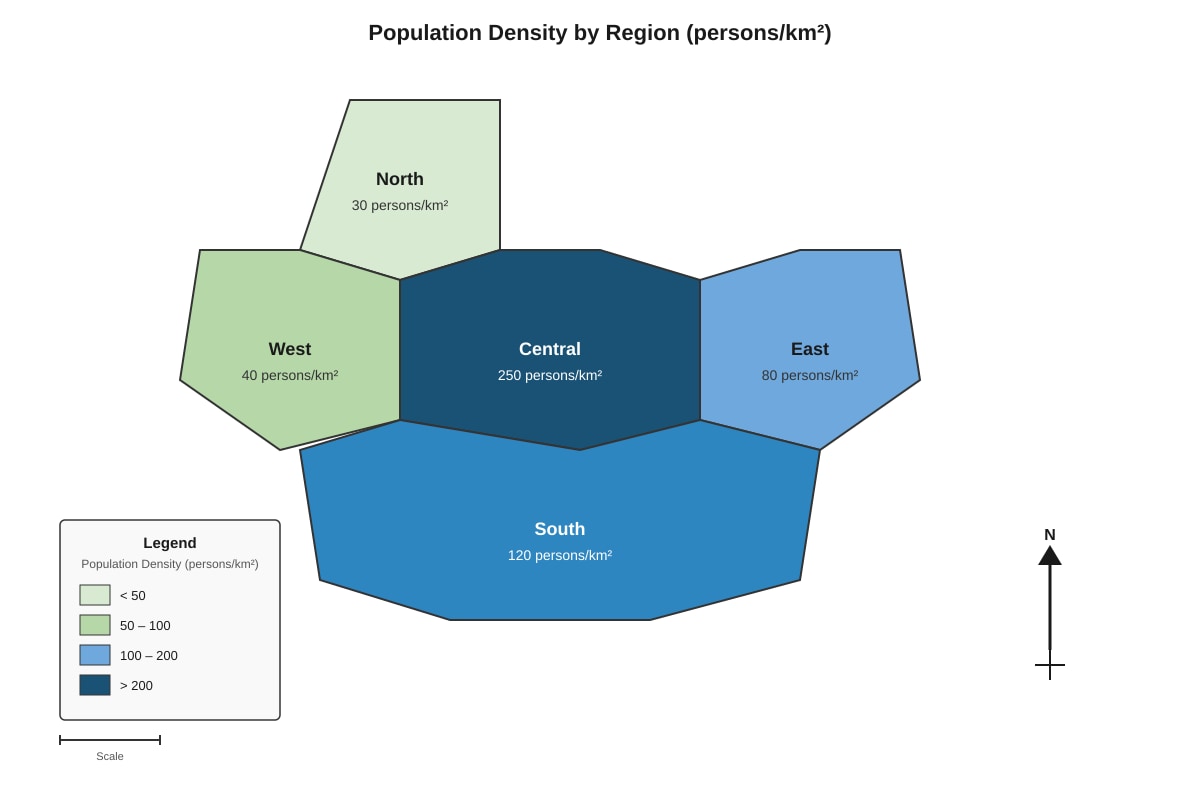
17. Region with highest population density [1]
Answer: Central region
Explanation: The Central region has the darkest shading on the choropleth map, corresponding to the highest density class (>200 persons/km²), confirmed by the value 250 persons/km².
18. Total population of Central region [2]
Answer: 125,000 people
Working:
- Population density = 250 persons/km²
- Area = 500 km²
- Total population = Density × Area = 250 × 500 = 125,000
Mark breakdown: 1 mark for correct formula, 1 mark for correct calculation with units.
19. Physical and human factors for high density in Central region [4]
Answer:
Physical factor: Flat, low-lying land in the Central region makes it easy to build housing, transport networks, and industries. Fertile soil and access to fresh water (rivers) historically supported agriculture and settlement.
Human factor: The Central region is likely the administrative and commercial capital, with concentrated job opportunities, better infrastructure (transport, healthcare, education), and government investment, attracting people to live and work there.
Mark breakdown: 1 mark for valid physical factor + 1 mark for explanation; 1 mark for valid human factor + 1 mark for explanation.
Key concepts: Site factors (physical) vs. situation factors (human) influencing settlement distribution.
20. Traffic flow fieldwork [5 marks total]
(a) Advantage of systematic sampling [1]
Answer: Systematic sampling at regular intervals ensures even coverage of the entire 2-hour period, capturing variations at different times (e.g., peak vs. off-peak) without bias from the researcher choosing when to count.
Alternative: Easy to implement and replicate; reduces clustering of data points.
(b) Mean number of vehicles per interval [2]
Answer: 41.5 vehicles
Working:
- Sum = 42 + 38 + 45 + 40 + 44 + 39 + 41 + 43 = 332
- Number of intervals = 8
- Mean = 332 / 8 = 41.5
Mark breakdown: 1 mark for correct sum/count, 1 mark for correct mean with units.
(c) Limitation and improvement [2]
Answer:
Limitation: 15-minute intervals may miss short-term fluctuations (e.g., traffic light cycles, sudden congestion) and the 2-hour period may not represent daily patterns (e.g., missing morning/evening rush hours if done at midday).
Improvement: Extend data collection to cover peak hours (e.g., 7–9 am, 5–7 pm) and/or use continuous video recording for more precise counts.
Mark breakdown: 1 mark for valid limitation, 1 mark for feasible improvement linked to the limitation.
End of Answer Key