AI Generated Quiz
Secondary 2 Geography Human Geography Quiz
Free Sec 2 Geography Human Geography quiz, AI version, with questions, answers, and syllabus-aligned practice for Singapore students.
These static practice materials are generated from the site's syllabus and paper-generation workflow, with source and model context shown so students and parents can evaluate the material before use.
Questions
Free quiz and exam paper access
Enter your details to view this paper
Your access is remembered on this device.
Answers
Secondary 2 Geography Quiz - Human Geography: Answer Key
Total Marks: 40
Section A: Housing in Cities (Questions 1–5)
Question 1
Marks: 2 (1 mark for each correct characteristic)
Answers (any two): (a) Formal housing is planned and built by the government or private developers. (b) Formal housing is built with proper building materials (e.g., concrete, bricks). (c) Formal housing has access to basic services such as clean water, electricity, and sanitation. (d) Formal housing is legally recognised and residents have legal ownership or tenancy rights.
Teaching Note: Formal housing refers to housing that is officially planned, constructed, and recognised by authorities. It is the opposite of informal housing (squatter settlements). Key features include legal status, proper construction materials, and access to services.
Common Mistake: Students sometimes confuse "formal" with "expensive." Formal housing can be affordable (e.g., HDB flats in Singapore), but it is always legally recognised and properly built.
Question 2
Marks: 2 (1 mark for each correct characteristic)
Answers (any two): (a) Informal housing is built using makeshift or low-quality materials (e.g., wood, corrugated metal, cardboard). (b) Informal housing is built without official planning permission. (c) Informal housing often lacks access to basic services such as clean water, electricity, and proper sanitation. (d) Informal housing is often overcrowded and densely built.
Teaching Note: Informal housing, also known as squatter settlements, develops when people build homes on land they do not legally own. These settlements are unplanned and often lack basic infrastructure. They are a common feature of rapidly urbanising cities in developing countries.
Common Mistake: Students sometimes think informal housing only exists in developing countries. While more common there, informal housing can exist in developed countries too, though on a smaller scale.
Question 3
Marks: 2 (1 mark for a valid reason, 1 mark for explanation)
Model Answer: Squatter settlements often develop on the outskirts of cities because land there is cheaper or unoccupied. [1] This means that poor migrants who cannot afford housing in the city centre can settle there without paying high rents or purchase prices. [1]
Alternative Answer: Squatter settlements develop on the outskirts because there is more available land that is not already developed. [1] This allows new migrants to build homes without being evicted immediately, as the land is less valuable to developers. [1]
Teaching Note: The key idea is that squatter settlements form where land is available and affordable (or free). City centres have expensive, developed land, so the urban fringe becomes the only option for low-income residents.
Marking Note: Award 1 mark for identifying a reason (e.g., cheaper land, available space) and 1 mark for explaining how that reason leads to settlement development.
Question 4
Marks: 2 (1 mark for each correct way)
Answers (any two): (a) The government builds HDB flats and sells them at subsidised prices to eligible citizens. (b) The government provides housing grants to help first-time buyers afford their homes. (c) The government offers rental flats at low rates for low-income families. (d) The government uses a Central Provident Fund (CPF) system to help citizens pay for their housing.
Teaching Note: Singapore's public housing system is a key case study in the syllabus. The HDB (Housing and Development Board) builds and manages public housing for over 80% of the population. The government uses subsidies, grants, and CPF savings to make housing affordable.
Common Mistake: Students sometimes say "the government gives free houses." This is incorrect—HDB flats are sold at subsidised prices, not given for free.
Question 5
Marks: 2 (1 mark for identifying a problem, 1 mark for explanation)
Model Answer: Residents of squatter settlements may face the problem of poor sanitation. [1] Without proper sewage systems, human waste can contaminate water sources, leading to the spread of diseases such as cholera and dysentery. [1]
Alternative Answer: Residents may face the risk of eviction. [1] Because they do not legally own the land, authorities or developers can force them to leave at any time, leaving them homeless. [1]
Teaching Note: Squatter settlement residents face multiple challenges: lack of clean water, poor sanitation, no electricity, fire risk (due to makeshift materials), eviction, and limited access to healthcare and education. Any one of these is acceptable.
Marking Note: Award 1 mark for naming a problem and 1 mark for explaining the consequence or how the problem affects residents.
Section B: Transport Systems in Cities (Questions 6–10)
Question 6
Marks: 2 (1 mark for each correct type)
Answers (any two): (a) Mass Rapid Transit (MRT) / metro / underground train (b) Bus (c) Light Rail Transit (LRT) (d) Tram (e) Ferry
Teaching Note: Public transport systems are shared transport services available to the general public. They are a key feature of sustainable cities because they reduce the number of private cars on the road.
Common Mistake: Students sometimes list "taxi" or "private car." Taxis are technically public transport (available to the public), but in this context, the syllabus focuses on mass transit systems. Private cars are not public transport.
Question 7
Marks: 2 (1 mark for a valid reason, 1 mark for explanation)
Model Answer: Cities build MRT systems to reduce traffic congestion. [1] MRT trains can carry thousands of passengers at once, which means fewer people need to drive cars, reducing the number of vehicles on the roads. [1]
Alternative Answer: Cities build MRT systems to reduce air pollution. [1] Trains run on electricity rather than petrol or diesel, so they produce less air pollution per passenger compared to cars. [1]
Teaching Note: MRT systems are expensive to build but provide high-capacity, efficient transport. The main reasons for building them are: reducing congestion, reducing pollution, providing affordable transport, and supporting economic growth.
Marking Note: Award 1 mark for a valid reason and 1 mark for explaining how the MRT achieves this outcome.
Question 8
Marks: 2 (1 mark for describing the mechanism, 1 mark for linking to reduced congestion)
Model Answer: Congestion pricing charges drivers a fee to enter busy areas during peak hours. [1] This makes driving more expensive, which discourages people from driving into the city centre, encouraging them to use public transport instead, thus reducing the number of cars on the road. [1]
Teaching Note: Congestion pricing is a demand-management strategy. It uses price signals to change behaviour. Singapore's Electronic Road Pricing (ERP) system is a well-known example. The key idea is that when driving becomes more expensive, some people will switch to public transport, carpool, or travel at different times.
Marking Note: Award 1 mark for explaining how congestion pricing works and 1 mark for explaining how it reduces congestion.
Question 9
Marks: 2 (1 mark for each correct benefit)
Answers (any two): (a) Public transport produces less air pollution per passenger compared to private cars. (b) Public transport reduces carbon dioxide (CO₂) emissions, helping to reduce the enhanced greenhouse effect. (c) Public transport reduces traffic congestion, which means less fuel is wasted in traffic jams. (d) Public transport takes up less road space per passenger, reducing the need for new roads.
Teaching Note: The key concept is that public transport is more efficient—it carries more people using less energy and space per person. This leads to lower emissions and less congestion.
Common Mistake: Students sometimes say "public transport produces no pollution." This is incorrect—buses still burn fuel. The correct idea is that it produces less pollution per passenger.
Question 10
Marks: 2 (1 mark for identifying a disadvantage, 1 mark for explanation)
Model Answer: One disadvantage is that private cars cause traffic congestion. [1] When too many people drive cars, roads become jammed, which wastes time and fuel and slows down the movement of goods and people. [1]
Alternative Answer: Private cars cause air pollution. [1] Cars burn petrol or diesel, releasing harmful gases such as carbon dioxide and nitrogen oxides, which contribute to air pollution and the enhanced greenhouse effect. [1]
Teaching Note: The disadvantages of private car reliance include: congestion, air pollution, noise pollution, high infrastructure costs (roads, parking), and inefficient land use (roads take up space that could be used for housing or green spaces).
Marking Note: Award 1 mark for naming a disadvantage and 1 mark for explaining the consequence.
Section C: Population and Urbanisation (Questions 11–15)
Question 11
Marks: 2
Model Answer: Urbanisation is the process by which an increasing percentage of a country's population lives in towns and cities. [2]
Teaching Note: Urbanisation has two key components: (1) the movement of people from rural to urban areas, and (2) the growth of urban areas themselves. The definition should capture the idea of an increasing proportion of people living in urban areas.
Marking Note: Award 2 marks for a complete definition that includes both the idea of population movement AND the growth of urban areas. Award 1 mark for a partial definition (e.g., only "people moving to cities").
Question 12
Marks: 2 (1 mark for each correct reason)
Answers (any two): (a) To find better job opportunities (cities have more jobs, especially in manufacturing and services). (b) To access better education and healthcare facilities. (c) To escape poverty or lack of opportunities in rural areas (e.g., due to poor harvests or limited farmland). (d) To enjoy better amenities and entertainment (e.g., shopping malls, cinemas).
Teaching Note: The reasons for rural-to-urban migration can be divided into "push factors" (things that drive people away from rural areas, e.g., lack of jobs, poor harvests) and "pull factors" (things that attract people to cities, e.g., jobs, education, healthcare). Students should be familiar with both types.
Common Mistake: Students sometimes only give push factors or only pull factors. The question asks for reasons people move, so either type is acceptable, but a mix shows better understanding.
Question 13
Marks: 3
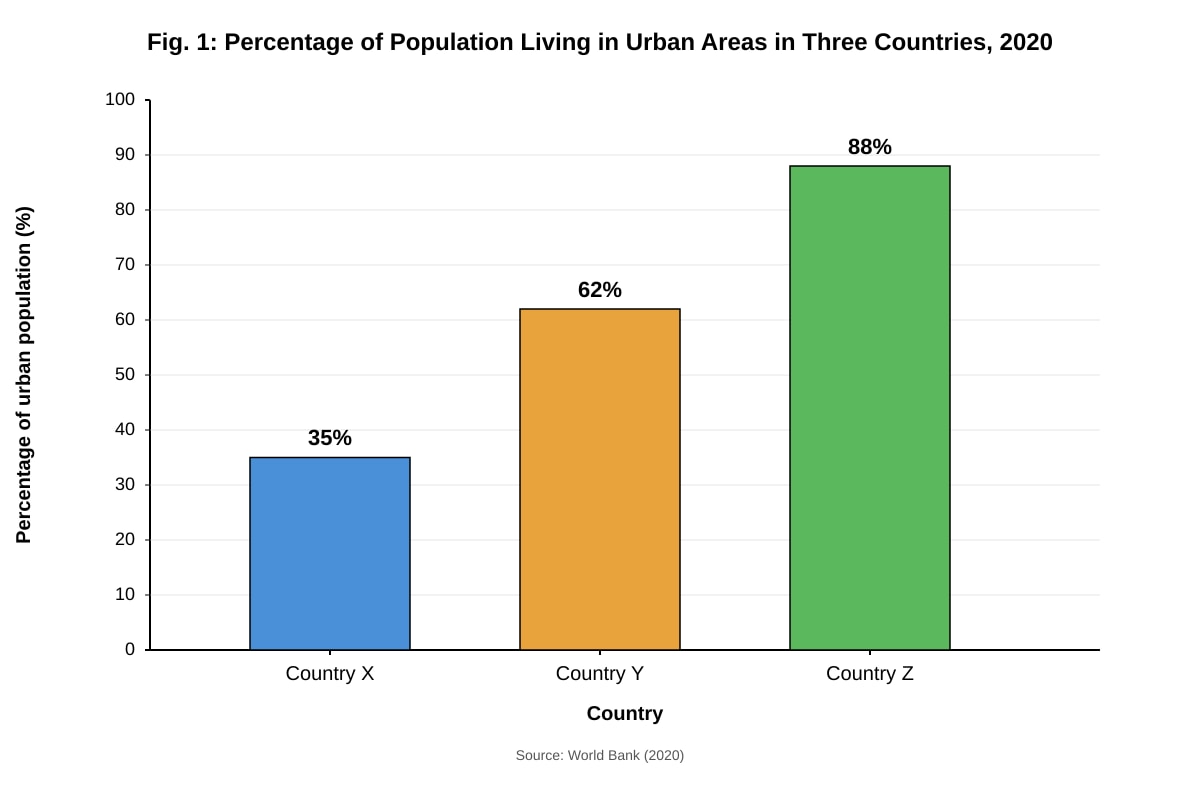
Model Answer: The bar chart shows that the percentage of urban population varies significantly among the three countries. Country Z has the highest percentage of urban population at 88%, followed by Country Y at 62%. [1] Country X has the lowest percentage at only 35%. [1] This shows that Country Z is the most urbanised, while Country X is the least urbanised. [1]
Teaching Note: This question tests the ability to describe data from a graph. Students should:
- State the overall pattern (variation/uneven distribution).
- Cite specific statistics for each country.
- Make a comparative statement (highest/lowest, more/less).
Marking Note: Award 1 mark for each of the following:
- Identifying the overall pattern (e.g., "the level of urbanisation varies between countries")
- Citing at least two specific statistics (e.g., "88% for Country Z, 35% for Country X")
- Making a comparative statement (e.g., "Country Z is the most urbanised")
Common Mistake: Students sometimes describe the chart without using statistics. The question explicitly says "refer to statistics in your answer," so specific numbers are required.
Question 14
Marks: 2 (1 mark for a valid reason, 1 mark for explanation)
Model Answer: Urbanisation is happening faster in developing countries because of rapid population growth combined with rural-to-urban migration. [1] Developing countries often have high birth rates, and at the same time, people move to cities seeking better jobs and services, causing cities to grow very quickly. [1]
Alternative Answer: Urbanisation is faster in developing countries because industrialisation is happening rapidly. [1] As factories and businesses set up in cities, they attract workers from rural areas, causing urban populations to grow quickly. [1]
Teaching Note: The key idea is that developing countries are experiencing rapid economic and demographic changes simultaneously. High birth rates + rural-to-urban migration = rapid urbanisation. Developed countries went through this process earlier and more slowly, and their urbanisation rates have now stabilised.
Marking Note: Award 1 mark for a valid reason and 1 mark for explanation.
Question 15
Marks: 2 (1 mark for identifying a problem, 1 mark for explanation)
Model Answer: Rapid urbanisation can cause housing shortages. [1] When too many people move to a city too quickly, the government and private developers cannot build enough houses, leading to overcrowding and the growth of squatter settlements. [1]
Alternative Answer: Rapid urbanisation can cause traffic congestion. [1] The rapid increase in population means more vehicles on the roads, leading to traffic jams, longer travel times, and increased air pollution. [1]
Teaching Note: Other acceptable problems include: unemployment, strain on public services (water, electricity, healthcare), pollution, and crime. The key is to name a problem and explain how rapid urbanisation causes it.
Marking Note: Award 1 mark for naming a problem and 1 mark for explaining how rapid urbanisation leads to this problem.
Section D: Sustainable Cities (Questions 16–20)
Question 16
Marks: 2
Model Answer: A sustainable city is a city that meets the needs of its current residents without compromising the ability of future generations to meet their own needs. [2]
Teaching Note: The concept of sustainability has three pillars: environmental (protecting the environment), social (meeting people's needs), and economic (supporting economic growth). A sustainable city balances all three. The definition should capture the idea of meeting present needs without harming the future.
Marking Note: Award 2 marks for a complete definition that includes both the idea of meeting current needs AND protecting future generations. Award 1 mark for a partial definition (e.g., only "a city that is environmentally friendly").
Question 17
Marks: 2 (1 mark for each correct feature)
Answers (any two): (a) Green spaces (parks, gardens, rooftop gardens) that improve air quality and provide recreation. (b) Efficient public transport systems that reduce reliance on private cars. (c) Use of renewable energy sources (solar, wind, hydroelectric power). (d) Effective waste management systems, including recycling and waste-to-energy plants. (e) Water conservation measures (e.g., NEWater, rainwater harvesting). (f) Energy-efficient buildings (e.g., green buildings with solar panels).
Teaching Note: A sustainable city is designed to minimise its environmental impact while providing a good quality of life for residents. Features can be environmental (green spaces, renewable energy), social (affordable housing, good public services), or economic (efficient infrastructure).
Common Mistake: Students sometimes list features that are not specific to sustainability (e.g., "tall buildings"). The features should clearly relate to environmental protection, resource efficiency, or quality of life.
Question 18
Marks: 2 (1 mark for describing the mechanism, 1 mark for linking to sustainability)
Model Answer: Green spaces help to make a city more sustainable by improving air quality. [1] Plants absorb carbon dioxide and release oxygen, and they also trap dust and pollutants, making the air cleaner for residents. [1]
Alternative Answer: Green spaces help to reduce the urban heat island effect. [1] Trees and plants provide shade and release water vapour through transpiration, which cools the surrounding area and reduces the need for air conditioning. [1]
Teaching Note: Green spaces contribute to sustainability in multiple ways: improving air quality, reducing heat, providing habitats for wildlife, managing stormwater, providing recreational spaces, and improving mental health. Any one of these is acceptable.
Marking Note: Award 1 mark for explaining how green spaces work (the mechanism) and 1 mark for linking this to sustainability (the outcome).
Question 19
Marks: 2 (1 mark for describing the method, 1 mark for explaining how it promotes sustainability)
Model Answer: Singapore manages its waste by using waste-to-energy incineration plants. [1] Non-recyclable waste is burned to generate electricity, which reduces the amount of waste sent to landfills and provides a source of energy. [1]
Alternative Answer: Singapore promotes recycling through the National Recycling Programme. [1] Households are provided with recycling bins, and recyclable materials are collected and processed, reducing the amount of waste sent to landfills and conserving natural resources. [1]
Teaching Note: Singapore's waste management strategy includes: (1) reducing waste at the source, (2) recycling, (3) incinerating non-recyclable waste to generate energy, and (4) sending only a small amount of ash to Semakau Landfill. This is a good example of sustainable waste management.
Marking Note: Award 1 mark for describing the waste management method and 1 mark for explaining how it promotes sustainability.
Question 20
Marks: 2 (1 mark for identifying a challenge, 1 mark for explanation)
Model Answer: One challenge is the high cost of implementing sustainable technologies. [1] Building green infrastructure such as solar panels, efficient public transport systems, and waste treatment plants requires large investments, which may be difficult for cities with limited budgets. [1]
Alternative Answer: One challenge is balancing economic growth with environmental protection. [1] Cities need to attract businesses and create jobs, but industrial activities often cause pollution and resource depletion, making it difficult to achieve sustainability goals. [1]
Teaching Note: Other acceptable challenges include: resistance from residents (e.g., unwillingness to change behaviour), lack of political will, rapid population growth outpacing sustainable development, and the difficulty of retrofitting existing buildings and infrastructure.
Marking Note: Award 1 mark for identifying a challenge and 1 mark for explaining why it is difficult to overcome.
END OF ANSWER KEY