From Real Exams Quiz
Secondary 2 Geography Resources Sustainability Quiz
Free Sec 2 Geography Resources Sustainability quiz, Exam version, with questions, answers, and syllabus-aligned practice for Singapore students.
These static practice materials are generated from the site's syllabus and paper-generation workflow, with source and model context shown so students and parents can evaluate the material before use.
Questions
Free quiz and exam paper access
Enter your details to view this paper
Your access is remembered on this device.
Answers
Secondary 2 Geography Quiz - Resources Sustainability: ANSWER KEY
Total Marks: 40
Section A: Multiple Choice and Short Answer Questions (15 marks)
1. Which of the following is an example of a renewable natural resource?
- Answer: C) Solar energy [1 mark]
Explanation: Renewable resources are those that can be replenished naturally over a short period of time. Solar energy comes from the sun and is continuously available, making it renewable. Crude oil, natural gas, and coal are all fossil fuels that take millions of years to form, so they are non-renewable.
Common mistake: Students may confuse "renewable" with "abundant." Even if a resource is abundant, it may not be renewable if it takes a very long time to form.
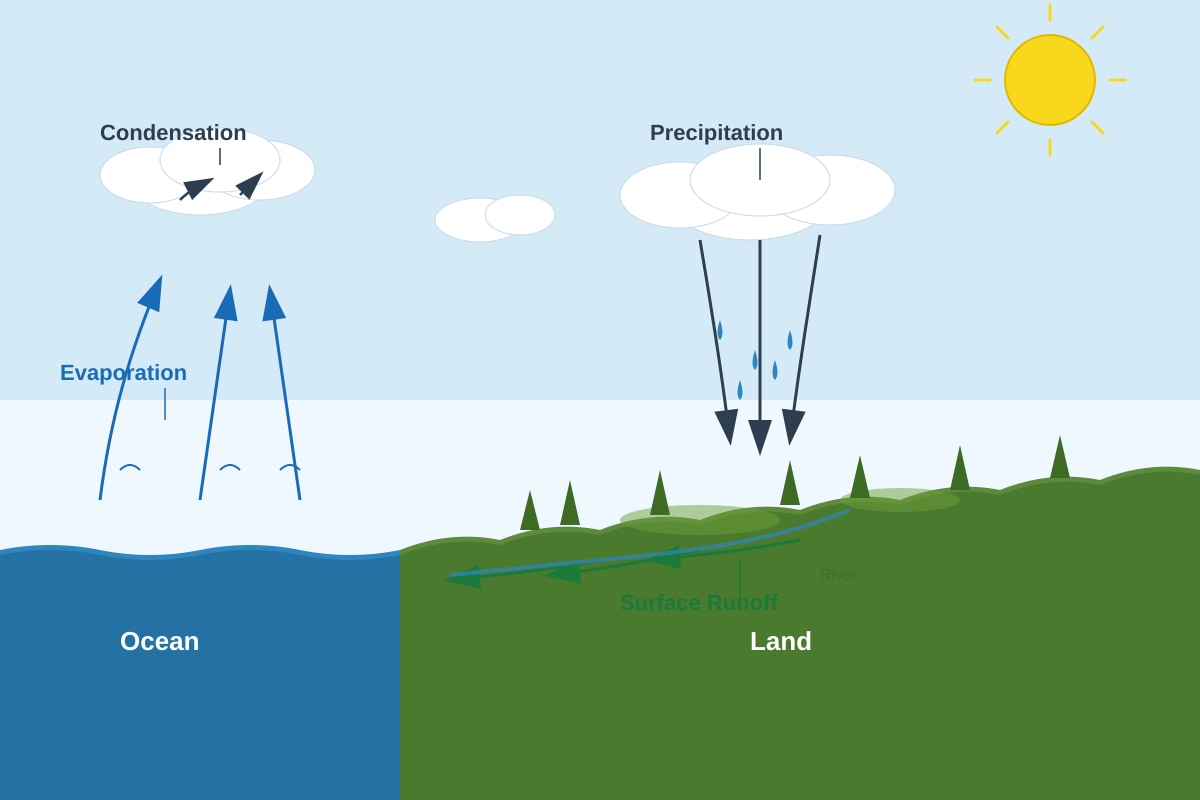
2. State the process by which water vapour turns into liquid water in the atmosphere.
- Answer: Condensation [1 mark]
Explanation: Condensation is the process where water vapour (gas) changes into liquid water. This happens when warm, moist air rises and cools, causing the water vapour to lose energy and turn into tiny water droplets that form clouds.
Common mistake: Students sometimes confuse condensation with evaporation (liquid to gas) or precipitation (water falling from clouds).
3. Which of the following is NOT a strategy used by Singapore to manage its water resources?
- Answer: C) Increasing the use of groundwater [1 mark]
Explanation: Singapore's "Four National Taps" are: Local Catchment Water, Imported Water from Malaysia, NEWater, and Desalinated Water. Groundwater is not a significant source of water for Singapore because the island has limited groundwater reserves and the geology does not support large-scale groundwater extraction.
Common mistake: Students may think all options are strategies used by Singapore. It is important to know the specific "Four National Taps."
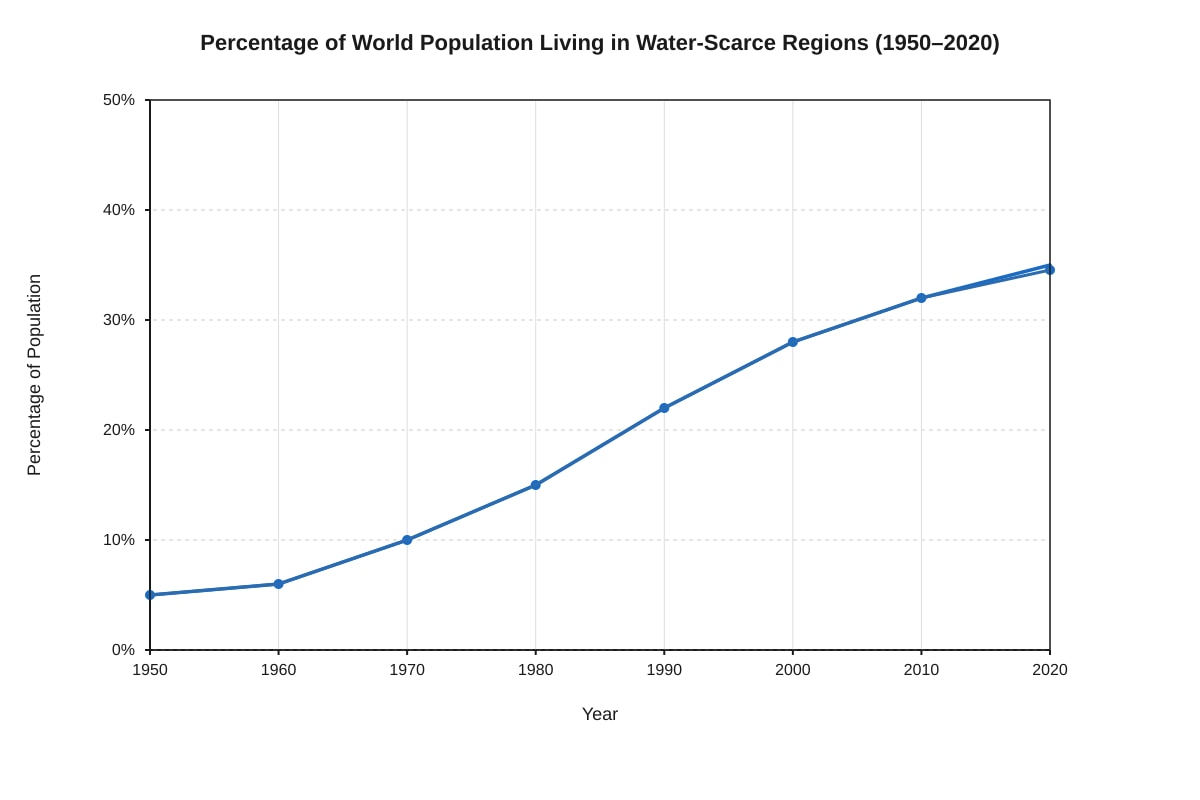
4. Describe the trend shown in the graph.
- Answer: The graph shows that the percentage of the world's population living in water-scarce regions has increased overall from 1950 to 2020. [1 mark] The increase was gradual from 1950 (5%) to 1980 (10%), but then became much steeper, reaching about 35% in 2020. [1 mark] [2 marks total]
Explanation: When describing a trend, you should:
- State the overall direction (increase, decrease, or fluctuation).
- Use specific data points from the graph to support your description.
- Note any changes in the rate of change (e.g., gradual then steep).
Marking notes:
- 1 mark for stating the overall upward trend.
- 1 mark for including specific data points or describing the change in rate.
5. Which of the following is a characteristic of tropical rainforests?
- Answer: C) They have high biodiversity. [1 mark]
Explanation: Tropical rainforests are known for having the highest biodiversity of any terrestrial ecosystem. They have multiple layers of vegetation (not a single layer), they experience rainfall year-round (not a long dry season), and while the soil is often nutrient-poor due to rapid decomposition, the ecosystem as a whole is incredibly rich in species.
Common mistake: Option D (thin, nutrient-poor soil) is actually true for many tropical rainforests, but it is not the best answer because the question asks for a "characteristic" and high biodiversity is the most defining feature.
6. Mangrove trees have adapted to survive in coastal environments. Which adaptation helps mangroves obtain oxygen in waterlogged soil?
- Answer: B) Aerial roots (pneumatophores) [1 mark]
Explanation: Mangroves grow in waterlogged, oxygen-poor soil. Aerial roots (pneumatophores) stick up out of the mud and water, allowing the tree to absorb oxygen from the air. Salt-secreting leaves help remove excess salt, thick waxy leaves reduce water loss, and deep taproots provide anchorage, but only aerial roots help with oxygen intake.
Common mistake: Students may confuse the function of different adaptations. Remember: aerial roots = oxygen; salt-secreting leaves = salt removal.
7. State one environmental function of tropical rainforests.
- Answer: Any one of the following: [1 mark]
- They absorb carbon dioxide and produce oxygen (carbon storage/oxygen production).
- They provide habitat for a huge variety of plant and animal species (biodiversity).
- They help regulate the global climate.
- They prevent soil erosion.
- They influence rainfall patterns.
Explanation: Environmental functions are the roles an ecosystem plays in the natural environment. Tropical rainforests are often called the "lungs of the Earth" because they produce oxygen and absorb carbon dioxide.
8. Name one human activity that releases large amounts of carbon dioxide into the atmosphere.
- Answer: Any one of the following: [1 mark]
- Burning of fossil fuels (coal, oil, natural gas) for energy, transport, or industry.
- Deforestation (burning or clearing of forests).
- Industrial processes (e.g., cement production).
Explanation: Carbon dioxide is the main greenhouse gas contributing to the enhanced greenhouse effect. Human activities have significantly increased the amount of CO₂ in the atmosphere since the Industrial Revolution.
9. Which of the following is a sustainable way to manage tropical rainforests?
- Answer: C) Practising selective logging [1 mark]
Explanation: Selective logging means cutting down only certain mature trees while leaving the rest of the forest intact. This allows the forest to regenerate naturally. Clear-cutting, converting forests to plantations, and unrestricted mining all cause permanent damage and are not sustainable.
Common mistake: Students may think any form of logging is unsustainable. Selective logging, when done properly, can be a sustainable practice.
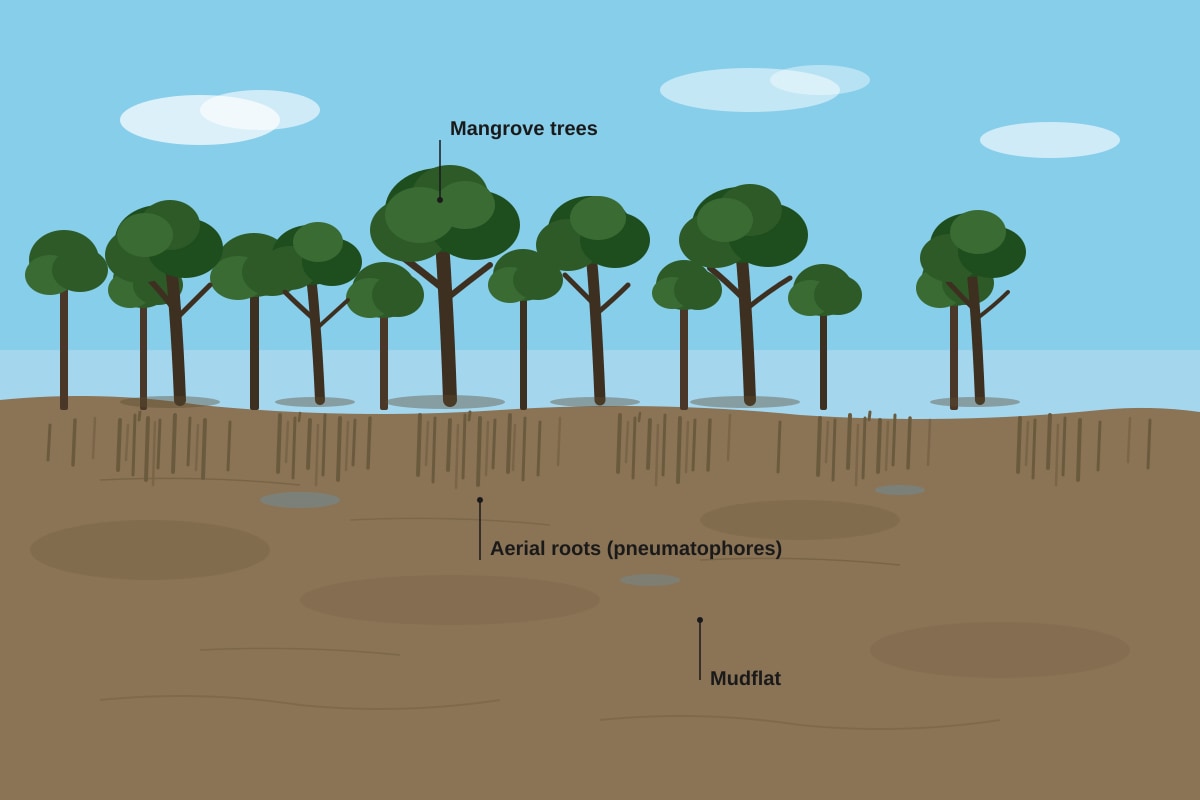
10. Identify one adaptation of mangrove trees visible in the photograph and explain how it helps the tree survive in its environment.
- Answer: The adaptation visible is the aerial roots (pneumatophores). [1 mark] These roots stick up out of the mud and allow the mangrove tree to obtain oxygen from the air, which is necessary because the waterlogged soil has very little oxygen. [1 mark] [2 marks total]
Explanation: Mangroves live in coastal areas where the soil is waterlogged and low in oxygen. Aerial roots are a key adaptation that allows them to "breathe" air directly.
Marking notes:
- 1 mark for correctly identifying the adaptation (aerial roots/pneumatophores).
- 1 mark for explaining how it helps the tree survive (obtains oxygen from air).
Section B: Structured Response Questions (15 marks)
11. Explain two ways in which deforestation contributes to the enhanced greenhouse effect.
- Answer: [4 marks]
Way 1: When forests are cut down and burned, the carbon stored in the trees is released into the atmosphere as carbon dioxide (CO₂). [1 mark] This increases the concentration of CO₂, a greenhouse gas, which traps more heat in the atmosphere. [1 mark]
Way 2: Trees absorb CO₂ from the atmosphere through photosynthesis. [1 mark] When forests are removed, there are fewer trees to absorb CO₂, so more CO₂ remains in the atmosphere, enhancing the greenhouse effect. [1 mark]
Explanation: The enhanced greenhouse effect is the additional warming caused by human activities that increase greenhouse gas levels. Deforestation contributes in two ways: (1) it releases stored carbon, and (2) it reduces the Earth's capacity to absorb CO₂.
Marking notes:
- 1 mark for each correct way identified (2 marks total).
- 1 mark for each clear explanation linking the way to the enhanced greenhouse effect (2 marks total).
- Accept other valid explanations, such as: deforestation reduces evapotranspiration, which can affect cloud cover and climate.
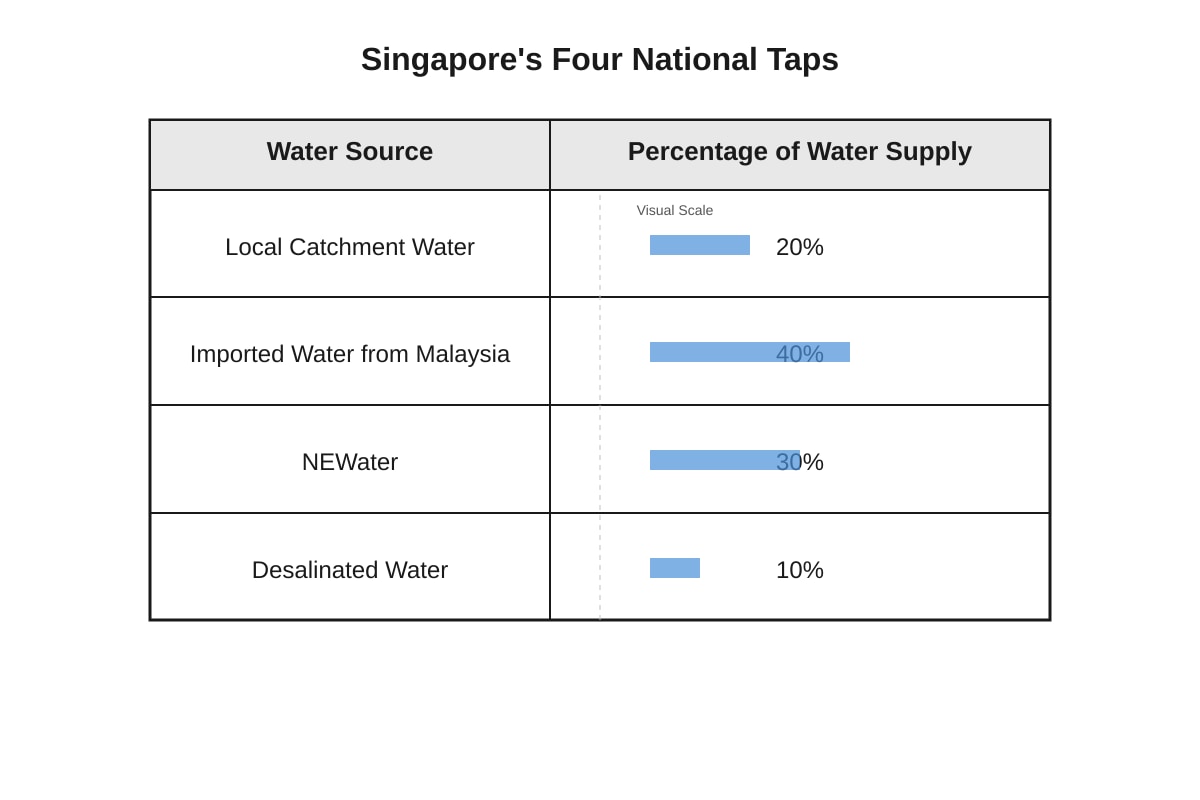
12. Study the table below showing the water sources for Singapore (the "Four National Taps").
(a) Identify the largest source of water for Singapore.
- Answer: Imported Water from Malaysia [1 mark]
Explanation: According to the table, Imported Water provides 40% of Singapore's water supply, which is the largest share.
(b) Explain why Singapore needs to have multiple sources of water.
- Answer: [3 marks]
Singapore has limited land area to collect and store rainwater, and it has no natural aquifers or large rivers. [1 mark] Relying on a single source of water would be risky because if that source is disrupted (e.g., drought affecting local catchment, or a disruption in water imports), Singapore would face a water shortage. [1 mark] Having multiple sources (the Four National Taps) ensures water security and resilience, as Singapore can rely on other sources if one is affected. [1 mark]
Explanation: Water security means having a reliable and sustainable supply of water. For a small island city-state like Singapore, diversification of water sources is a key strategy to reduce vulnerability.
Marking notes:
- 1 mark for stating Singapore's physical limitations (small land area, no natural water sources).
- 1 mark for explaining the risk of relying on a single source.
- 1 mark for explaining how multiple sources provide security/resilience.
13. Describe two ways in which water pollution can affect human health and the environment.
- Answer: [4 marks]
Effect 1 (Human health): Polluted water can contain harmful chemicals, bacteria, or viruses. [1 mark] When people drink or use this water, they can contract waterborne diseases such as cholera, typhoid, or diarrhoea, which can be fatal. [1 mark]
Effect 2 (Environment): Water pollution can kill aquatic plants and animals. [1 mark] For example, excess nutrients from fertilisers can cause algal blooms, which deplete oxygen in the water and create "dead zones" where fish and other organisms cannot survive. [1 mark]
Explanation: Water pollution has serious consequences for both people and ecosystems. It is important to give one effect on human health and one on the environment, or two distinct effects covering both areas.
Marking notes:
- 1 mark for each correctly described effect (2 marks total).
- 1 mark for each clear explanation or example (2 marks total).
- Accept other valid effects, such as: pollution of groundwater, destruction of coral reefs, bioaccumulation of toxins in food chains.
14. State one way in which individuals can help to conserve water at home.
- Answer: Any one of the following: [1 mark]
- Taking shorter showers.
- Turning off the tap while brushing teeth.
- Using a bucket instead of a hose to wash the car.
- Fixing leaking taps promptly.
- Using water-efficient appliances.
Explanation: Water conservation at the individual level involves small changes in daily habits that collectively make a big difference.
15. Explain how the use of NEWater helps Singapore to manage its water resources sustainably.
- Answer: NEWater is treated used water (wastewater) that has been purified using advanced membrane technologies. [1 mark] By recycling used water into clean, safe water, Singapore reduces its reliance on imported water and local catchment, making its water supply more self-sufficient and sustainable. [1 mark] [2 marks total]
Explanation: Sustainability means meeting current needs without compromising the ability of future generations to meet their needs. NEWater is a sustainable solution because it reuses water that would otherwise be wasted, reducing demand on natural water sources.
Marking notes:
- 1 mark for explaining what NEWater is (treated/recycled used water).
- 1 mark for explaining how it contributes to sustainability (reduces reliance on other sources, increases self-sufficiency).
Section C: Data-Based and Evaluation Questions (10 marks)
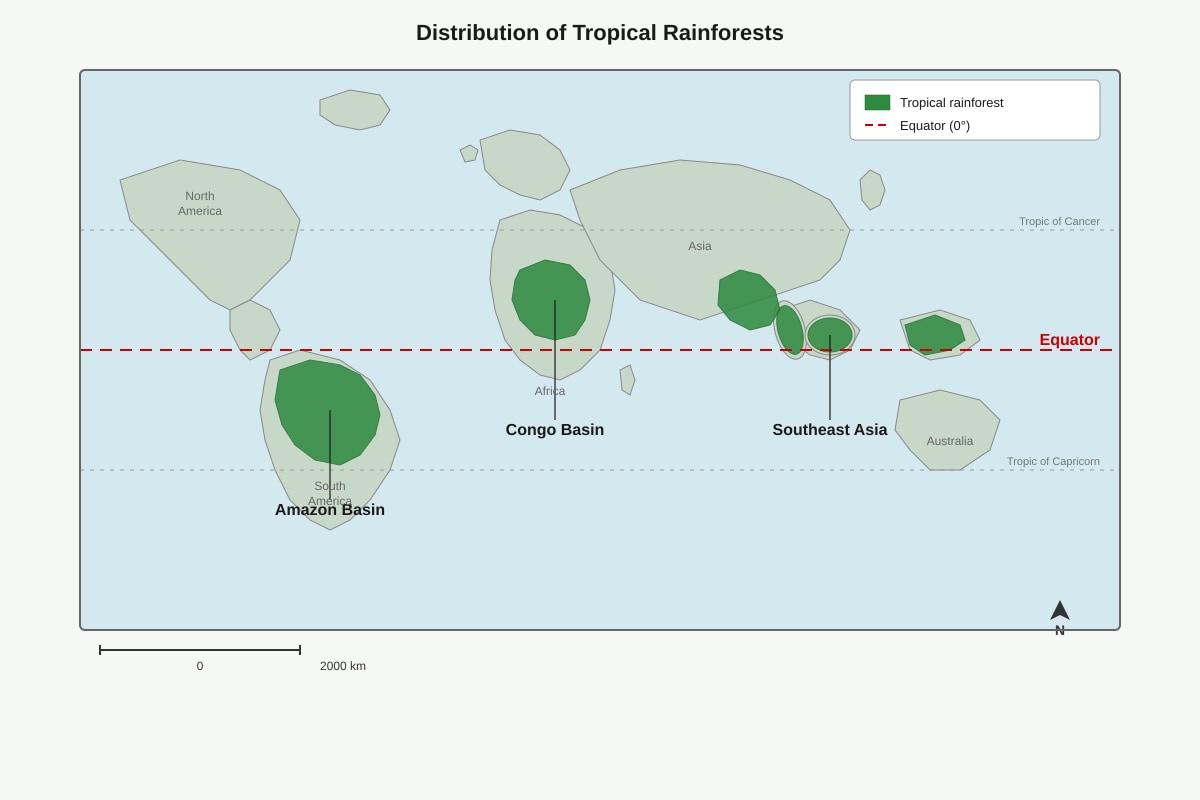
16. Describe the global distribution of tropical rainforests.
- Answer: Tropical rainforests are found in a band around the equator, between the Tropic of Cancer and the Tropic of Capricorn. [1 mark] The three main regions are: the Amazon Basin in South America, the Congo Basin in Central Africa, and Southeast Asia (including Indonesia, Malaysia, and parts of Thailand and Myanmar). [1 mark] [2 marks total]
Explanation: Distribution refers to where something is found on Earth. Tropical rainforests are concentrated near the equator because of the warm, wet climate there.
Marking notes:
- 1 mark for stating the general location (near the equator/between the tropics).
- 1 mark for naming at least two of the three main regions.
17. Explain one reason why tropical rainforests are found near the equator.
- Answer: The equator receives direct sunlight all year round, which means temperatures are consistently high (around 25–30°C). [1 mark] This high temperature causes a lot of evaporation, leading to high rainfall throughout the year (over 2000 mm annually). Tropical rainforests need these warm and wet conditions to grow. [1 mark] [2 marks total]
Explanation: Climate is the main factor controlling the distribution of tropical rainforests. They require high temperatures and high rainfall, both of which are found near the equator.
Marking notes:
- 1 mark for explaining the temperature/ sunlight factor.
- 1 mark for linking it to rainfall and the needs of the rainforest.
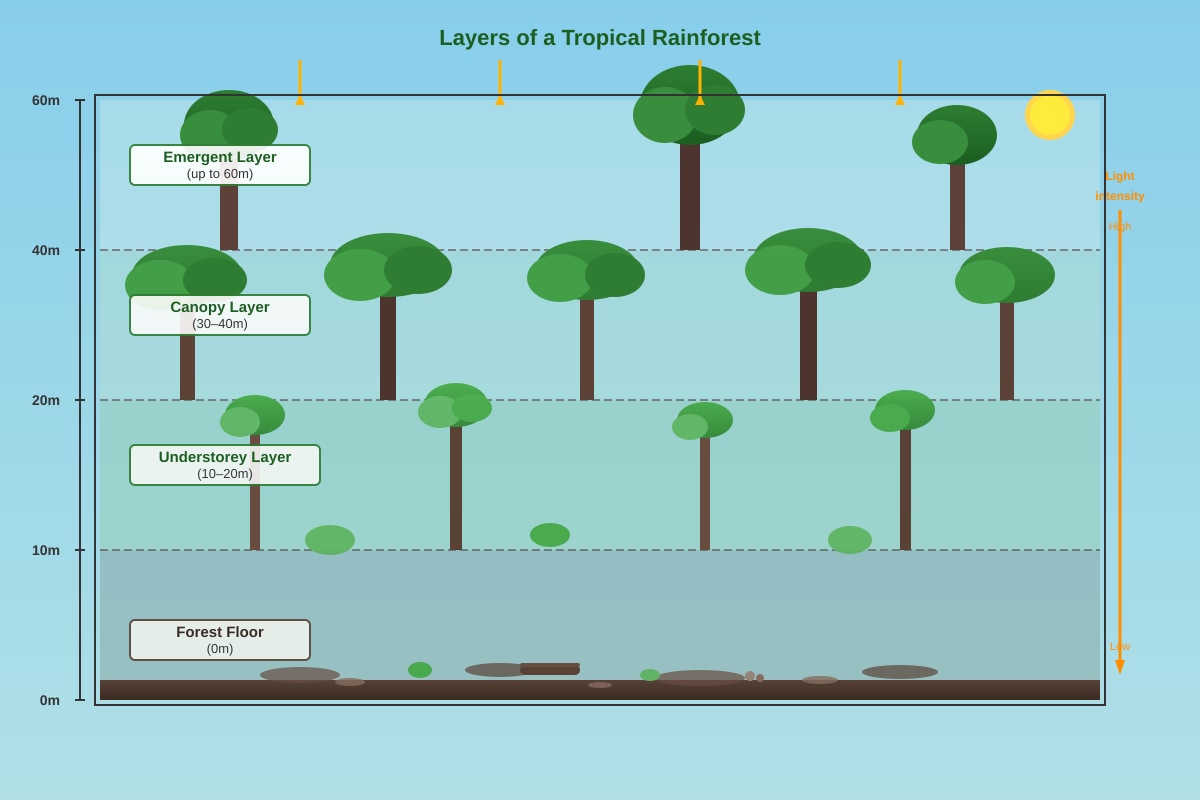
18. Identify the layer of the rainforest that receives the most sunlight.
- Answer: The Emergent Layer [1 mark]
Explanation: The emergent layer consists of the tallest trees that rise above the main canopy. These trees are exposed to direct sunlight, while the layers below are increasingly shaded.
19. Explain why the forest floor of a tropical rainforest has very little plant growth.
- Answer: The dense canopy and emergent layers above block most of the sunlight from reaching the forest floor. [1 mark] Without sufficient sunlight, plants cannot photosynthesise effectively, so very few plants can grow on the forest floor. [1 mark] [2 marks total]
Explanation: Sunlight is essential for photosynthesis. In a tropical rainforest, the upper layers are so dense that less than 2% of sunlight may reach the forest floor.
Marking notes:
- 1 mark for stating that sunlight is blocked by upper layers.
- 1 mark for explaining the consequence (limited photosynthesis, little plant growth).
20. "Sustainable management of natural resources is the responsibility of governments, not individuals." Do you agree with this statement? Explain your answer.
- Answer: [3 marks]
Sample answer (disagree): I disagree with this statement. While governments have a major role to play in sustainable resource management through policies, laws, and regulations, individuals also have an important responsibility. [1 mark]
Governments can implement large-scale measures such as building water treatment plants, protecting forests through national parks, and setting emission targets. However, these measures are more effective when individuals also do their part. [1 mark]
For example, individuals can conserve water at home, reduce waste, recycle, and make environmentally friendly choices. If individuals waste resources, government efforts alone cannot achieve sustainability. Therefore, sustainable management requires the cooperation of both governments and individuals. [1 mark]
Explanation: This is an evaluation question that requires you to take a position and justify it. A good answer will:
- State your position clearly (agree or disagree).
- Give reasons for your position.
- Provide examples to support your argument.
- Consider the other side of the argument (optional but strengthens the answer).
Marking notes:
- 1 mark for stating a clear position (agree or disagree).
- 1 mark for providing a reasoned argument with at least one example.
- 1 mark for showing understanding that both governments and individuals have roles (even if the student agrees with the statement, they should acknowledge the other perspective).
Alternative answer (agree): A student could argue that governments have more power and resources to implement large-scale changes, such as building infrastructure and passing laws. This would also be acceptable if well-explained, but the strongest answers typically recognise that both levels of action are needed.
END OF ANSWER KEY