From Real Exams Quiz
Secondary 2 Geography Resources Sustainability Quiz
Free Sec 2 Geography Resources Sustainability quiz, Exam version, with questions, answers, and syllabus-aligned practice for Singapore students.
These static practice materials are generated from the site's syllabus and paper-generation workflow, with source and model context shown so students and parents can evaluate the material before use.
Questions

Free quiz and exam paper access
Enter your details to view this paper
Your access is remembered on this device.
Answers
Secondary 2 Geography Quiz - Resources Sustainability: Answer Key
Total Marks: 40
Section A: Water Resources (Questions 1–5)
1. State the four-figure grid reference of the reservoir shown on the map extract.
[1]
Answer: 4567 (or similar, depending on the map used in the actual exam)
Marking Notes:
- 1 mark for correct four-figure grid reference (easting first, northing second).
- Common mistake: reversing the order (northing first). Remind students: "Along the corridor and up the stairs" – read easting (horizontal) first, then northing (vertical).
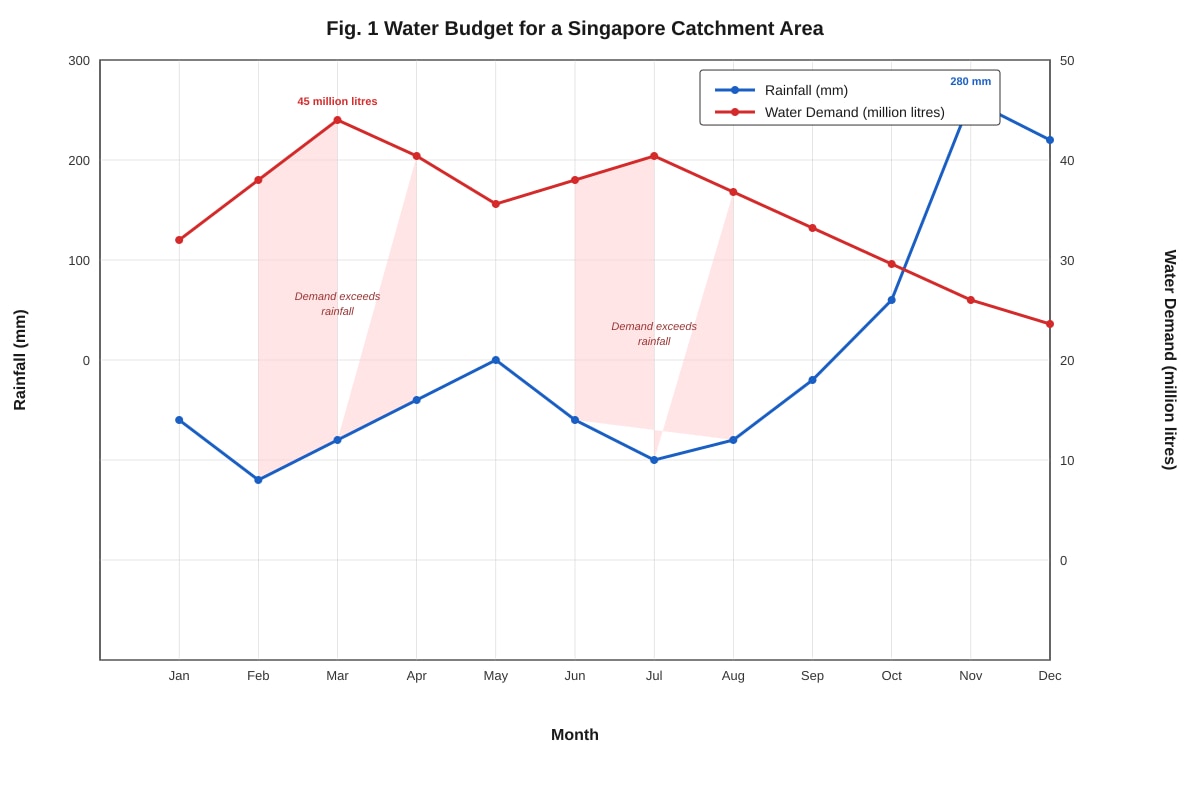
2. Fig. 1 shows the water budget for a catchment area in Singapore.
(a) Describe the relationship between rainfall and water demand shown in Fig. 1. Refer to statistics in your answer.
[2]
Answer: The relationship is inverse (or opposite). When rainfall is high, water demand is low, and vice versa. For example, in November, rainfall is highest at 280 mm, while water demand is lowest at 28 million litres. In contrast, in March, rainfall is low at 110 mm, but water demand peaks at 45 million litres.
Marking Notes:
- 1 mark for identifying the inverse relationship.
- 1 mark for citing specific statistics from the graph.
- Accept any valid data pair that demonstrates the relationship.
Teaching Note: A water budget shows the balance between water inputs (rainfall) and outputs (demand/use). When demand exceeds rainfall, there is a water deficit, and water must be drawn from storage or other sources.
(b) Explain one reason why water demand is higher in some months.
[2]
Answer: Water demand is higher in hotter months (e.g., March and July) because people use more water for cooling and personal hygiene, such as taking more showers or using air conditioning. Additionally, there may be increased water use for outdoor activities like watering plants or washing cars.
Marking Notes:
- 1 mark for identifying a valid reason (e.g., higher temperatures, increased tourism, school holidays).
- 1 mark for explaining the link between the reason and increased water consumption.
Teaching Note: Water demand is not constant throughout the year. Seasonal factors like temperature, holidays, and economic activity can cause fluctuations. In Singapore, the hotter months (March–April and June–August) typically see higher water demand.
3. Explain how the hydrological cycle makes water a renewable resource.
[3]
Answer: The hydrological cycle continuously circulates water between the atmosphere, land, and oceans. Water evaporates from oceans and land surfaces, forms clouds through condensation, and falls back to Earth as precipitation (rain, snow). This precipitation replenishes rivers, lakes, and groundwater, making water available for human use again. Because this cycle is driven by solar energy and is continuous, water is naturally replenished and is therefore considered a renewable resource.
Marking Notes:
- 1 mark for mentioning evaporation and condensation.
- 1 mark for mentioning precipitation that replenishes water sources.
- 1 mark for explaining that the continuous nature of the cycle makes water renewable.
Teaching Note: A renewable resource is one that can be replenished naturally over time. Water is renewable because the hydrological cycle is continuous, but it is also finite – the total amount of water on Earth is constant. The key is that it is constantly being recycled.
4. Study Fig. 2, which shows Singapore's "Four National Taps" strategy.
(a) Identify the two sources of water that are weather-dependent.
[1]
Answer: Local Catchment Water and Imported Water from Johor.
Marking Notes:
- 1 mark for identifying both sources correctly.
- Accept "local catchment" and "imported water" as sufficient.
Teaching Note: Local catchment water depends on rainfall, which can vary with weather patterns and climate change. Imported water from Johor is also affected by rainfall in the Johor River catchment area. NEWater and desalinated water are weather-independent because they use technology to treat water.
(b) Explain how NEWater helps Singapore to be more self-sufficient in water.
[2]
Answer: NEWater is high-grade reclaimed water produced by treating used water using advanced membrane technologies (microfiltration, reverse osmosis, and ultraviolet disinfection). It provides a reliable, weather-independent source of water that can be used for industrial and air-con cooling purposes, as well as for indirect potable use (added to reservoirs). This reduces Singapore's dependence on imported water and local catchment, making the country more self-sufficient.
Marking Notes:
- 1 mark for explaining what NEWater is (treated used water).
- 1 mark for explaining how it reduces dependence on other sources.
Teaching Note: Self-sufficiency means being able to meet your own needs without relying on others. NEWater is a key part of Singapore's strategy to achieve water security. It currently meets about 40% of Singapore's water demand, with plans to increase this to 55% by 2060.
5. Suggest two ways in which individuals can reduce water consumption at home.
[2]
Answer: Any two of the following:
- Taking shorter showers instead of baths.
- Turning off the tap while brushing teeth or soaping hands.
- Using a washing machine only when it is full.
- Fixing leaking taps and pipes promptly.
- Using a water-efficient toilet or placing a water-saving device in the cistern.
- Collecting rainwater for watering plants.
Marking Notes:
- 1 mark for each valid suggestion (max 2).
- Accept any reasonable, specific suggestion.
Teaching Note: Water conservation at the individual level is important because domestic water use accounts for a significant portion of total water demand. Small changes in daily habits can add up to substantial savings.
Section B: Tropical Rainforests and Mangroves (Questions 6–10)
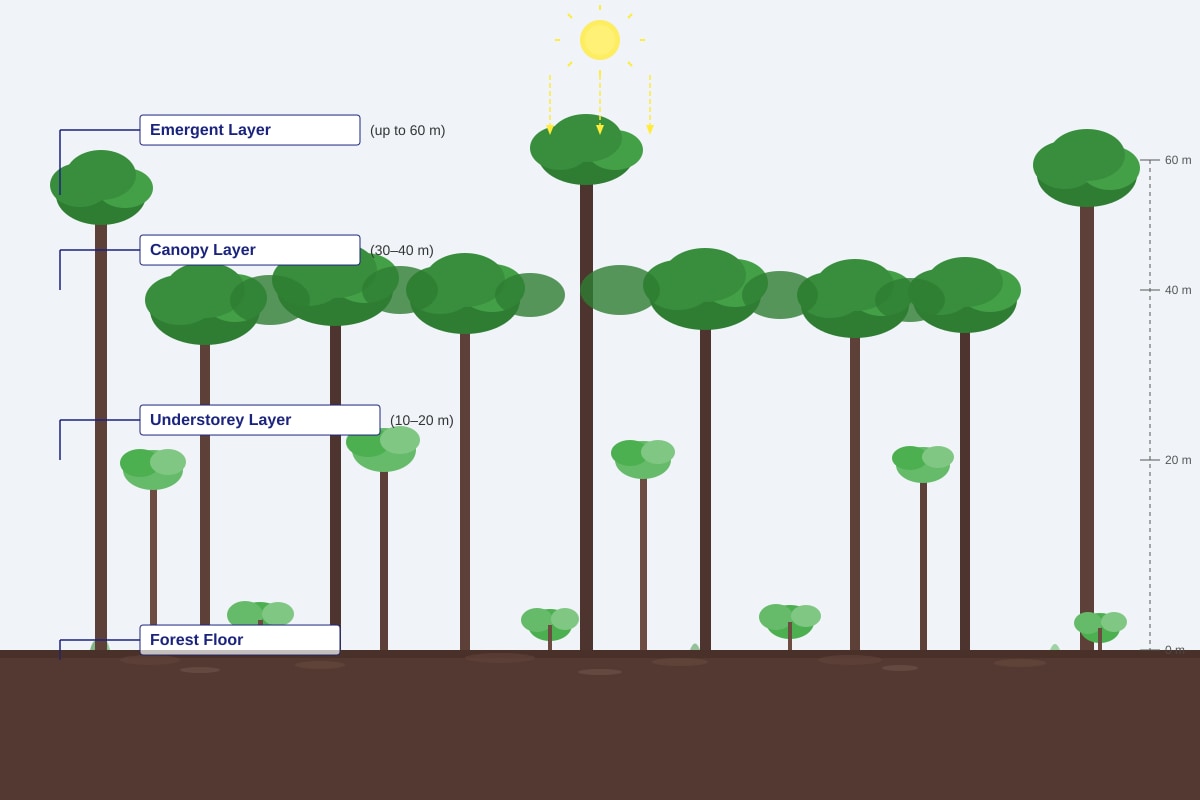
6. Fig. 3 shows the structure of a tropical rainforest.
(a) Name the layer of the rainforest that receives the most sunlight.
[1]
Answer: Emergent layer.
Marking Notes:
- 1 mark for correct answer.
- Do not accept "canopy" as the emergent layer is the highest.
Teaching Note: The emergent layer consists of the tallest trees (up to 60m) that rise above the canopy. These trees receive direct sunlight throughout the day. The canopy layer also receives a lot of sunlight, but the emergent layer gets the most.
(b) Describe one adaptation of plants in the understorey layer to the low light conditions.
[2]
Answer: Plants in the understorey layer have large, broad leaves to capture as much sunlight as possible. The large surface area of the leaves allows them to absorb the limited light that filters through the canopy above. Some plants also have dark green leaves that are more efficient at photosynthesis in low light conditions.
Marking Notes:
- 1 mark for identifying a valid adaptation (e.g., large leaves, dark green leaves, ability to grow in shade).
- 1 mark for explaining how the adaptation helps the plant survive.
Teaching Note: The understorey layer receives only about 2–5% of the sunlight that reaches the forest canopy. Plants here have evolved specific adaptations to survive in these low-light conditions. Large leaves are the most common adaptation mentioned in exams.
7. Explain two environmental functions of tropical rainforests.
[4]
Answer:
Function 1: Carbon storage and climate regulation. Tropical rainforests absorb large amounts of carbon dioxide () from the atmosphere through photosynthesis and store carbon in their biomass (trees, plants) and soil. This helps to regulate the global climate by reducing the amount of greenhouse gases in the atmosphere.
Function 2: Biodiversity habitat. Tropical rainforests are home to more than half of the world's plant and animal species. They provide food, shelter, and breeding grounds for countless species, making them the most biodiverse ecosystems on Earth.
Marking Notes:
- 2 marks for each function (1 mark for identifying the function, 1 mark for explaining it).
- Accept other valid functions: oxygen production, water cycle regulation, soil erosion prevention, provision of medicinal plants.
Teaching Note: Environmental functions are the natural benefits that ecosystems provide. For rainforests, the two most commonly tested functions are carbon storage (linked to climate change) and biodiversity (linked to species conservation).
8. Fig. 4 shows the change in mangrove forest area in Southeast Asia from 1990 to 2020.
Describe the trend in mangrove forest area shown in Fig. 4. Refer to statistics in your answer.
[2]
Answer: The mangrove forest area in Southeast Asia has been steadily declining over the 30-year period. In 1990, the area was 5,500 thousand hectares, but by 2020, it had decreased to 3,800 thousand hectares. This represents a loss of 1,700 thousand hectares (or about 31%) over the period.
Marking Notes:
- 1 mark for identifying the downward trend.
- 1 mark for citing specific statistics (start and end values, or a specific data point).
Teaching Note: When describing a trend, always state the overall direction (increase, decrease, fluctuate) and support it with specific numbers. Avoid just saying "it went down" – use precise language like "steadily declined" or "decreased by X%."
9. Give two reasons why mangroves are important for coastal protection.
[2]
Answer: Any two of the following:
- Mangrove roots trap sediment and stabilise the coastline, reducing erosion.
- Mangrove forests act as a natural barrier that absorbs wave energy and reduces the impact of storm surges and tsunamis.
- Mangrove roots slow down the flow of water, allowing sediment to settle and build up the land.
Marking Notes:
- 1 mark for each valid reason (max 2).
- Accept any reason that clearly links mangroves to coastal protection.
Teaching Note: Mangroves are often called "natural coastal defences." Their dense root systems (pneumatophores and prop roots) physically trap sediment and dissipate wave energy, making them highly effective at protecting coastlines.
10. Explain one human activity that leads to deforestation of tropical rainforests.
[2]
Answer: Agriculture (e.g., palm oil plantations). Large areas of tropical rainforest are cleared to make way for commercial agriculture, such as oil palm plantations. The trees are cut down and burned, and the land is converted into monoculture plantations. This destroys the forest ecosystem and releases stored carbon into the atmosphere.
Marking Notes:
- 1 mark for identifying a valid human activity (e.g., logging, agriculture, mining, urban expansion).
- 1 mark for explaining how the activity leads to deforestation.
Teaching Note: Deforestation is the clearing of forests on a large scale. The main causes are agricultural expansion (especially for palm oil, soy, and cattle ranching), logging for timber, mining for minerals, and urban development. In exams, always explain the mechanism – how the activity directly causes forest loss.
Section C: Sustainable Resource Management (Questions 11–15)
11. Define the term "sustainable development".
[2]
Answer: Sustainable development is development that meets the needs of the present without compromising the ability of future generations to meet their own needs. It involves balancing economic growth, social well-being, and environmental protection.
Marking Notes:
- 1 mark for mentioning meeting current needs.
- 1 mark for mentioning not compromising future generations' ability to meet their needs.
- Accept the Brundtland Commission definition or a similar paraphrase.
Teaching Note: This is a key definition that students must memorise. The three pillars of sustainable development are: economic sustainability, social sustainability, and environmental sustainability. A good answer should mention the balance between present and future needs.
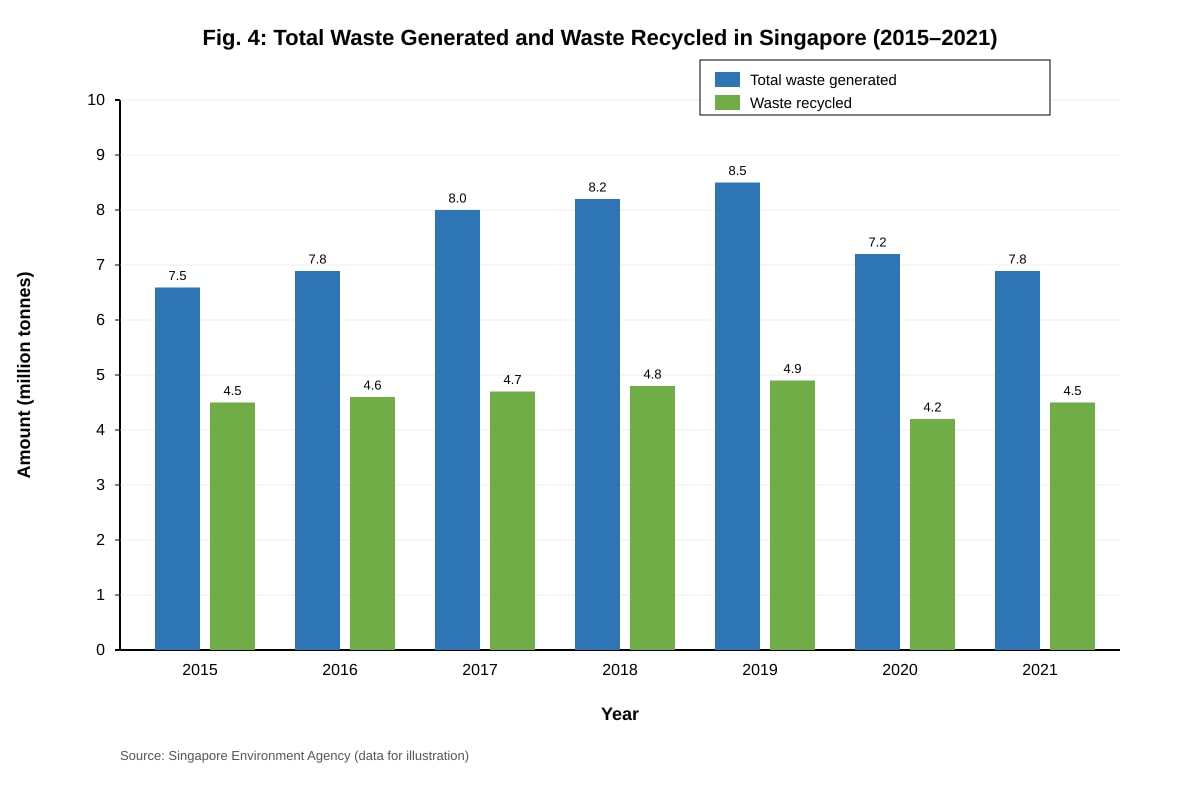
12. Study Fig. 5, which shows the amount of waste generated and recycled in Singapore from 2015 to 2021.
(a) Calculate the percentage of waste that was recycled in 2021. Show your working.
[2]
Answer:
Percentage recycled = (Amount recycled / Total waste generated) × 100
= (4.5 million tonnes / 7.8 million tonnes) × 100
= 0.5769... × 100
= 57.7% (rounded to one decimal place)
Marking Notes:
- 1 mark for correct formula and substitution.
- 1 mark for correct final answer (accept 57.7% or 58%).
- If working is shown but answer is incorrect due to calculation error, award 1 mark.
Teaching Note: Percentage calculations are common in Geography data questions. Always show your working to get method marks even if the final answer is wrong. Remember: (part / whole) × 100.
(b) Suggest one reason why the amount of waste generated decreased in 2020.
[1]
Answer: The COVID-19 pandemic led to reduced economic activity, with many businesses and factories temporarily closing or operating at reduced capacity. This resulted in less industrial and commercial waste being generated.
Marking Notes:
- 1 mark for a valid reason linked to the 2020 decrease.
- Accept other valid reasons: reduced tourism, work-from-home arrangements, increased awareness of waste.
Teaching Note: 2020 was an unusual year due to the global pandemic. The decrease in waste generation was primarily due to the economic slowdown and changes in consumption patterns.
13. Explain two strategies that can be used to reduce the amount of waste sent to landfills.
[4]
Answer:
Strategy 1: Reduce. This involves using fewer resources in the first place. For example, using reusable shopping bags instead of plastic bags, or buying products with less packaging. By reducing consumption, less waste is generated that needs to be disposed of.
Strategy 2: Recycle. This involves processing used materials into new products. For example, recycling paper, plastic, glass, and metal. Recycling reduces the amount of waste sent to landfills and also conserves raw materials and energy.
Marking Notes:
- 2 marks for each strategy (1 mark for naming the strategy, 1 mark for explaining how it works).
- Accept other valid strategies: reuse, composting, waste-to-energy incineration.
- The 3Rs (Reduce, Reuse, Recycle) are the most commonly tested.
Teaching Note: The waste hierarchy places "reduce" as the most effective strategy, followed by "reuse," then "recycle." Landfills are the least desirable option because they take up space and can cause environmental pollution.
14. Evaluate whether recycling is the most effective way to achieve sustainable resource use. Justify your answer.
[3]
Answer: Recycling is an important strategy, but it may not be the most effective way to achieve sustainable resource use.
Arguments that recycling is effective: Recycling conserves natural resources by reducing the need to extract raw materials. It also saves energy compared to producing new products from virgin materials, and it reduces the amount of waste sent to landfills.
Arguments that recycling is not the most effective: The most effective strategy is actually reducing consumption in the first place, as this prevents waste from being created. Recycling still requires energy for collection, sorting, and processing. Some materials can only be recycled a limited number of times before they degrade in quality.
Conclusion: While recycling is a valuable part of sustainable resource management, it should be combined with reduction and reuse strategies for the best results.
Marking Notes:
- 1 mark for stating a clear position (can be balanced or one-sided).
- 1 mark for providing a valid reason supporting the position.
- 1 mark for providing a counter-argument or showing evaluation (e.g., comparing recycling to other strategies).
Teaching Note: "Evaluate" questions require you to make a judgement. A strong answer considers both sides of the argument before reaching a conclusion. The waste hierarchy clearly places "reduce" above "recycle" in terms of effectiveness.
15. Suggest one way in which the Singapore government encourages sustainable resource use among its citizens.
[1]
Answer: Any one of the following:
- The National Environment Agency (NEA) runs public education campaigns (e.g., "Say YES to Waste Less").
- Providing recycling bins (blue bins) in every HDB block.
- Implementing the Mandatory Packaging Reporting scheme.
- Introducing the Deposit Refund Scheme for beverage containers.
- Subsidising energy-efficient appliances under the Climate Friendly Households Programme.
Marking Notes:
- 1 mark for a valid suggestion.
- Accept any specific government initiative or policy.
Teaching Note: Singapore uses a combination of legislation, incentives, and education to encourage sustainable behaviour. Students should be familiar with at least one specific government initiative.
Section D: Case Study Application (Questions 16–20)
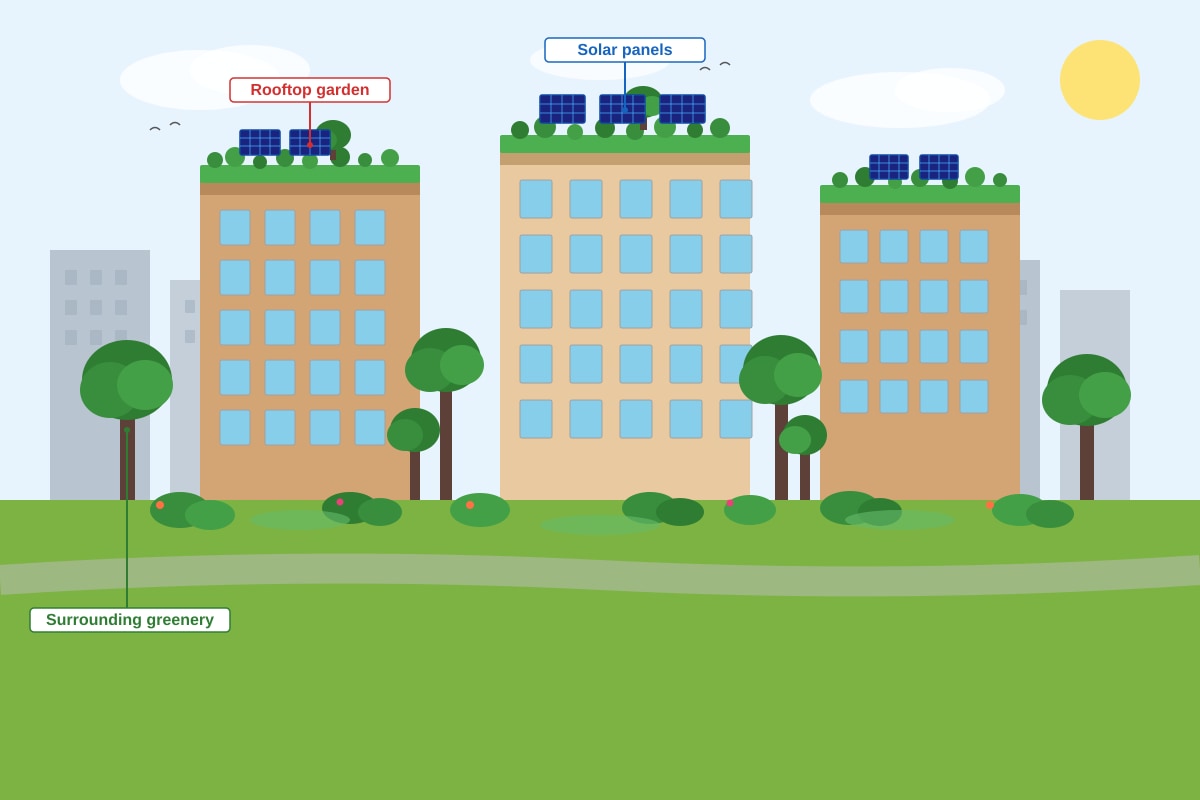
16. Study Fig. 6, which shows a photograph of a housing estate in Singapore with rooftop gardens and solar panels.
(a) Identify two sustainable features visible in the photograph.
[2]
Answer: Rooftop gardens and solar panels.
Marking Notes:
- 1 mark for each feature correctly identified (max 2).
- Accept "green roofs" for rooftop gardens.
Teaching Note: Sustainable features are those that reduce environmental impact or conserve resources. Rooftop gardens provide insulation and reduce the urban heat island effect, while solar panels generate renewable energy.
(b) Explain how rooftop gardens contribute to a more sustainable city.
[2]
Answer: Rooftop gardens help to reduce the urban heat island effect by absorbing less heat than traditional concrete roofs. The plants on the rooftop also absorb carbon dioxide and release oxygen, improving air quality. Additionally, rooftop gardens provide insulation, reducing the energy needed for cooling buildings, which lowers electricity consumption and greenhouse gas emissions.
Marking Notes:
- 1 mark for identifying a benefit (e.g., reduces heat, improves air quality, saves energy).
- 1 mark for explaining how the benefit contributes to sustainability.
Teaching Note: Urban sustainability means making cities more environmentally friendly, socially inclusive, and economically viable. Rooftop gardens address multiple sustainability goals simultaneously.
17. Describe one challenge faced by cities in managing their water resources.
[2]
Answer: Water pollution. Urban areas generate large amounts of wastewater from households, industries, and agriculture. This wastewater can contain pollutants such as chemicals, sewage, and microplastics. If not properly treated, these pollutants can contaminate rivers, lakes, and groundwater, making the water unsafe for human consumption and harming aquatic ecosystems.
Marking Notes:
- 1 mark for identifying a valid challenge (e.g., water pollution, water scarcity, aging infrastructure, flooding).
- 1 mark for explaining the challenge in detail.
Teaching Note: Common urban water challenges include: water scarcity (not enough water), water pollution (poor quality), flooding (too much water), and aging infrastructure (leaking pipes). Each challenge requires different management strategies.
18. Explain how deforestation contributes to the enhanced greenhouse effect.
[3]
Answer: Deforestation contributes to the enhanced greenhouse effect in two main ways:
-
Release of stored carbon: Trees store large amounts of carbon in their biomass. When forests are cut down and burned, this stored carbon is released into the atmosphere as carbon dioxide (), a greenhouse gas. This increases the concentration of greenhouse gases in the atmosphere.
-
Reduced carbon absorption: Forests act as carbon sinks, absorbing from the atmosphere through photosynthesis. When forests are removed, this natural carbon absorption capacity is lost, meaning more remains in the atmosphere.
The combination of increased emissions and reduced absorption leads to a net increase in atmospheric greenhouse gases, which traps more heat and enhances the natural greenhouse effect, causing global warming.
Marking Notes:
- 1 mark for explaining the release of stored carbon.
- 1 mark for explaining the loss of carbon absorption capacity.
- 1 mark for linking these to the enhanced greenhouse effect.
Teaching Note: The enhanced greenhouse effect is the additional warming caused by human activities that increase greenhouse gas concentrations. Deforestation is a major contributor because it both releases carbon and reduces the Earth's capacity to absorb it.
19. Suggest two reasons why conserving mangroves is important for local communities.
[2]
Answer: Any two of the following:
- Mangroves provide a habitat for fish and shellfish, which are important sources of food and income for local fishing communities.
- Mangroves protect coastal communities from storm surges and tsunamis by absorbing wave energy.
- Mangroves provide timber and other resources that local communities use for building and fuel.
- Mangroves support ecotourism, providing income for local communities through guided tours and wildlife watching.
Marking Notes:
- 1 mark for each valid reason (max 2).
- Accept any reason that clearly links mangrove conservation to community well-being.
Teaching Note: Mangrove conservation is important not just for environmental reasons, but also for the livelihoods and safety of local communities. This is an example of the link between environmental sustainability and social sustainability.
20. Evaluate the effectiveness of using solar energy as a sustainable energy source in Singapore. Support your answer with reasons.
[3]
Answer: Solar energy has both advantages and limitations in Singapore.
Arguments that solar energy is effective: Singapore receives abundant sunlight throughout the year, making solar energy a viable renewable energy source. Solar panels can be installed on rooftops of HDB flats, schools, and industrial buildings, using space that would otherwise be unused. Solar energy produces no greenhouse gas emissions during operation, helping Singapore reduce its carbon footprint.
Arguments that solar energy has limitations: Singapore's small land area limits the space available for large-scale solar farms. Cloud cover and the urban heat island effect can reduce the efficiency of solar panels. Solar energy is also intermittent – it only generates electricity during daylight hours and is affected by weather conditions. Currently, solar energy only contributes about 1% of Singapore's total electricity generation.
Conclusion: While solar energy is a promising sustainable energy source for Singapore, it is not yet effective enough to replace fossil fuels entirely. It should be used as part of a mix of renewable energy sources and energy efficiency measures.
Marking Notes:
- 1 mark for stating a clear position (can be balanced).
- 1 mark for providing a valid reason supporting the position.
- 1 mark for providing a counter-argument or showing evaluation.
Teaching Note: "Evaluate" questions require a balanced judgement. A strong answer acknowledges both the strengths and weaknesses of solar energy in the Singapore context. The key is to show that you understand the complexity of the issue.
END OF ANSWER KEY