From Real Exams Quiz
Secondary 2 Geography Physical Geography Quiz
Free Sec 2 Geography Physical Geography quiz, Exam version, with questions, answers, and syllabus-aligned practice for Singapore students.
These static practice materials are generated from the site's syllabus and paper-generation workflow, with source and model context shown so students and parents can evaluate the material before use.
Questions
Free quiz and exam paper access
Enter your details to view this paper
Your access is remembered on this device.
Answers
Secondary 2 Geography Quiz - Physical Geography: Answer Key
Total Marks: 40
Section A: Multiple-Choice Questions (5 Questions)
1. B) The solid outer layer of the Earth, including the crust and upper mantle [1]
- Explanation: The lithosphere is the rigid, solid outer layer of the Earth. It includes the Earth's crust and the uppermost part of the mantle. Option A describes the atmosphere, C describes the hydrosphere, and D describes the biosphere.
- Common mistake: Students often confuse the lithosphere with the crust alone. The lithosphere includes both the crust and the uppermost mantle.
2. C) Sun [1]
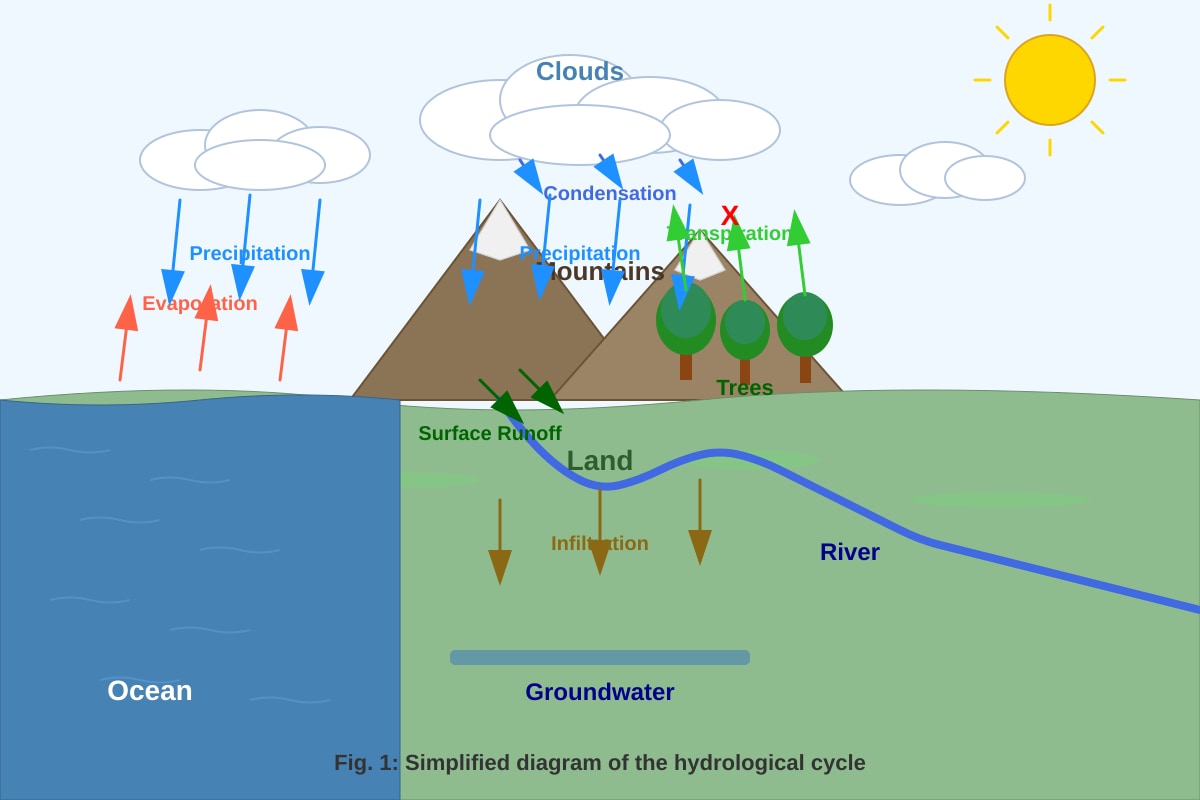
- Explanation: The Sun's energy drives the hydrological cycle. Solar radiation provides the heat energy needed for evaporation from oceans, lakes, and rivers, and for transpiration from plants. This water vapour then rises, cools, and condenses to form clouds, leading to precipitation.
- Common mistake: Students may think the wind drives the cycle. While wind moves clouds, the primary energy source is the Sun.
3. C) Groundwater [1]
- Explanation: A store is a place where water is held or stored. Groundwater is water stored underground in aquifers (porous rock layers). Evaporation, precipitation, and transpiration are all processes (flows), not stores.
- Common mistake: Confusing processes (flows) with stores. Evaporation is a process that moves water, not a place where water is stored.
4. D) Deposition [1]
- Explanation: Deposition is the process where water vapour changes directly into ice (solid) without becoming liquid first. Sublimation is the reverse process (ice to vapour). Condensation is gas to liquid. Evaporation is liquid to gas.
- Common mistake: Students may confuse deposition with sublimation. Remember: deposition = gas to solid; sublimation = solid to gas.
5. C) Constructing buildings and roads on floodplains [1]
- Explanation: Building on floodplains replaces permeable surfaces (soil/vegetation) with impermeable surfaces (concrete/asphalt). This reduces infiltration and increases surface runoff, leading to a higher risk of flooding. Planting trees (A) increases interception and infiltration, reducing flood risk. Building reservoirs (B) stores water and can reduce flood peaks. Reducing fertiliser use (D) does not directly affect flood risk.
- Common mistake: Students may think that any human activity near a river increases flood risk. The key is whether the activity reduces the land's ability to absorb water.
Section B: Short-Answer Questions (10 Questions)
6. The four main spheres of the Earth are: lithosphere, hydrosphere, atmosphere, biosphere. [2]
- Marking: Award 1 mark for every two correct spheres named. Award 2 marks for all four correct.
- Explanation:
- Lithosphere: The solid, rocky outer layer of the Earth.
- Hydrosphere: All the water on Earth (oceans, rivers, lakes, groundwater, ice).
- Atmosphere: The layer of gases surrounding the Earth.
- Biosphere: The regions of the Earth where living organisms are found.
- Common mistake: Students may forget the biosphere or list sub-spheres (e.g., cryosphere) instead of the main four.
7. Water budget is the balance between the inputs (precipitation) and outputs (evapotranspiration and runoff) of water in a given area over a period of time. [2]
- Marking: Award 1 mark for mentioning the balance between inputs and outputs. Award 1 mark for naming at least one input (precipitation) and one output (evapotranspiration or runoff).
- Explanation: Think of it like a bank account. Precipitation is money coming in (income). Evapotranspiration and runoff are money going out (expenses). If income > expenses, there is a water surplus. If expenses > income, there is a water deficit.
- Common mistake: Students may define only one side of the budget (e.g., only inputs) or confuse it with the hydrological cycle.
8. Evaporation and transpiration (or evapotranspiration). [2]
- Marking: Award 1 mark for each correct process named. Accept "evapotranspiration" as a combined term for 1 mark if only one is given, but two separate processes are expected for full marks.
- Explanation:
- Evaporation: The process where liquid water changes into water vapour from open water surfaces (oceans, lakes, rivers).
- Transpiration: The process where water vapour is released from plants through their leaves.
- Common mistake: Students may name precipitation or condensation, which are processes that move water towards the surface, not away from it.
9. Deforestation reduces interception and transpiration. [3]
- Marking: Award 1 mark for identifying a correct impact. Award 1 mark for explaining the mechanism. Award 1 mark for linking to the hydrological cycle.
- Model answer: Deforestation removes trees that intercept rainfall. This means more water reaches the ground directly, increasing surface runoff and reducing the amount of water that infiltrates into the soil. This can lead to a decrease in groundwater storage and an increase in flood risk. Additionally, with fewer trees, transpiration is reduced, which means less water vapour is returned to the atmosphere, potentially affecting local rainfall patterns.
- Explanation: Trees act like umbrellas (interception) and like pumps (transpiration). Removing them changes how water moves through the cycle.
- Common mistake: Students may only state that deforestation "causes less rain" without explaining the mechanism (reduced transpiration).
10. Transpiration (or evaporation from the soil/surface). [1]
- Explanation: The diagram shows water moving from the land surface (specifically from trees and the ground) to the atmosphere. This process is transpiration (from plants) or evaporation (from soil and water bodies).
- Common mistake: Students may write "evapotranspiration" which is acceptable, but "transpiration" is more specific to the land surface shown.
11. The atmosphere is a layer of gases surrounding the Earth. It contains gases such as nitrogen, oxygen, and carbon dioxide, and it protects the Earth from harmful solar radiation. [1]
- Marking: Award 1 mark for any one correct characteristic (e.g., composition, function, structure).
- Explanation: The atmosphere is essential for life. It provides the air we breathe, protects us from UV radiation, and helps regulate the Earth's temperature.
- Common mistake: Students may describe a weather phenomenon (e.g., "it rains") rather than a characteristic of the atmosphere itself.
12. Groundwater is an important store of fresh water because it is a reliable source of water during dry periods when surface water (rivers and lakes) may be depleted. It also naturally filters water as it passes through rock layers, making it relatively clean. [2]
- Marking: Award 1 mark for each valid reason explained.
- Explanation: Groundwater is stored in aquifers (porous rock layers). It is recharged slowly by infiltration, but it can be extracted for human use. It is a crucial source of drinking water for many communities, especially in arid regions.
- Common mistake: Students may say groundwater is "unlimited" or "infinite." It is a finite resource that can be depleted if overused.
13. Factors affecting surface runoff include: rainfall intensity (heavy rain leads to more runoff), soil permeability (impermeable surfaces like concrete increase runoff), vegetation cover (more vegetation increases interception and reduces runoff), slope gradient (steeper slopes increase runoff speed), and saturation of the ground (saturated ground cannot absorb more water). [2]
- Marking: Award 1 mark for each correct factor stated. Accept any two of the above or other valid factors.
- Explanation: Surface runoff is the water that flows over the land surface. It is influenced by how much and how fast water falls, and how easily the ground can absorb it.
- Common mistake: Students may list factors that affect infiltration instead of runoff. The two are inversely related: high infiltration = low runoff, and vice versa.
14. Evaporation is the process where liquid water changes into water vapour from open water surfaces (oceans, lakes, rivers). Transpiration is the process where water vapour is released from plants through their leaves. [2]
- Marking: Award 1 mark for a correct definition of evaporation. Award 1 mark for a correct definition of transpiration.
- Explanation: Both processes move water into the atmosphere, but from different sources. Evaporation is from non-living water surfaces; transpiration is from living plants.
- Common mistake: Students may think transpiration is the same as evaporation. The key difference is the source: plants vs. open water.
15. The biosphere (living organisms) interacts with the hydrosphere (water) when animals drink water from rivers or lakes, or when plants absorb water from the soil through their roots. [2]
- Marking: Award 1 mark for identifying a specific interaction. Award 1 mark for explaining how the interaction occurs.
- Explanation: The spheres are interconnected. The biosphere depends on the hydrosphere for survival. Water is essential for all life processes.
- Common mistake: Students may give a very general answer like "animals need water" without describing the specific interaction.
Section C: Structured-Response Questions (5 Questions)
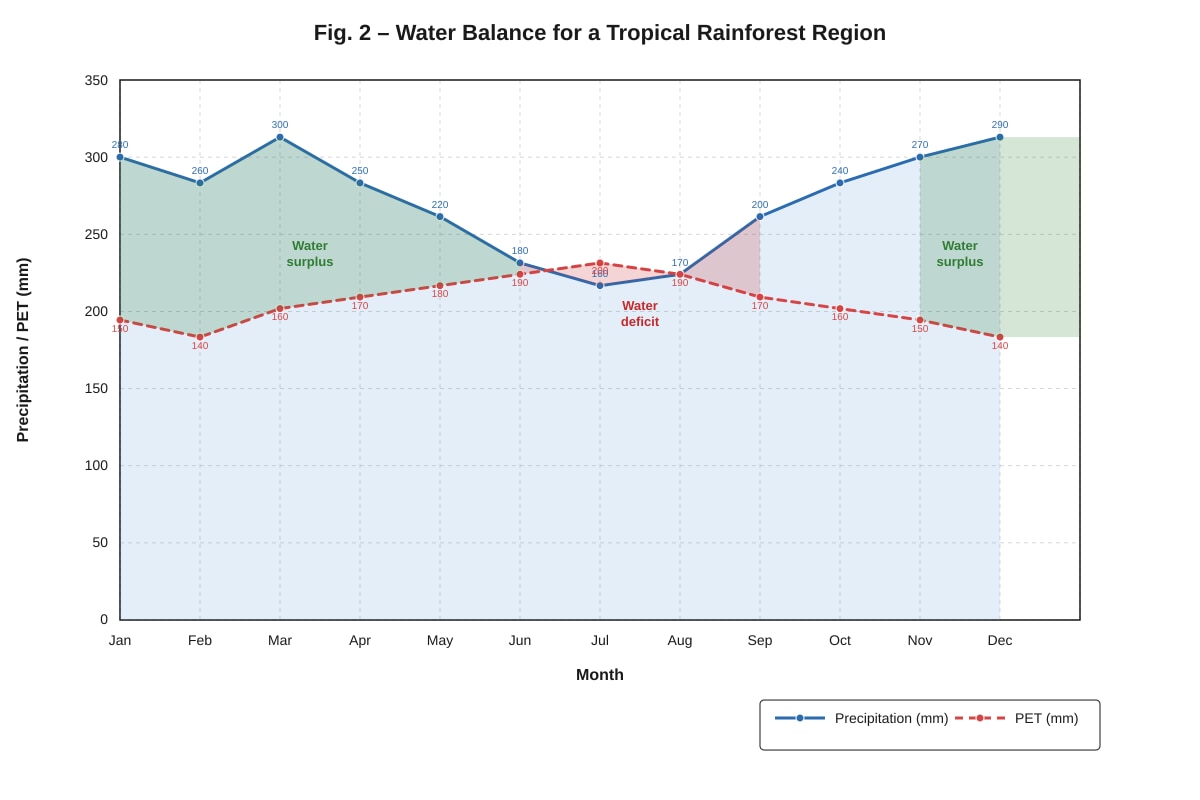
16. (a) The months with a water surplus are November to May (or November, December, January, February, March, April, May). [1]
- Marking: Award 1 mark for correctly identifying the surplus period. Accept any clear indication of the months.
- Explanation: A water surplus occurs when precipitation (income) is greater than potential evapotranspiration (expenses). In the graph, the precipitation line is above the PET line during these months.
(b) A water deficit could be caused by a decrease in precipitation (e.g., a dry spell or drought) or an increase in temperature leading to higher evapotranspiration rates. [2]
- Marking: Award 1 mark for identifying a valid factor. Award 1 mark for explaining how it leads to a deficit.
- Model answer: A decrease in precipitation, such as during a drought, would mean less water input into the system. If evapotranspiration remains the same or increases, the water output would exceed the input, creating a water deficit.
- Explanation: A water deficit is when potential evapotranspiration exceeds precipitation. This can happen if there is less rain or if it is hotter and more water evaporates.
- Common mistake: Students may only state the factor without explaining the link to the deficit.
17. The hydrosphere supports life in the following ways: [4]
- Marking: Award 2 marks for each well-described way (1 mark for identifying the way, 1 mark for explaining how it supports life).
- Model answer:
- Provides drinking water: All living organisms need water to survive. The hydrosphere stores and supplies fresh water through rivers, lakes, and groundwater, which is essential for hydration, digestion, and other bodily functions.
- Provides habitat: Many organisms live in water. Oceans, rivers, and lakes are habitats for fish, plants, and other aquatic life. These ecosystems are a major source of food and biodiversity.
- Explanation: Water is essential for all known forms of life. It is a solvent for biochemical reactions, a transport medium for nutrients, and a habitat for countless species.
- Common mistake: Students may list multiple ways but not explain how each way supports life.
18. Human activities can lead to water pollution through industrial discharge. Factories may release untreated chemical waste directly into rivers. This can contaminate the water with toxic substances, killing aquatic life and making the water unsafe for human consumption. [3]
- Marking: Award 1 mark for identifying a human activity that causes pollution. Award 1 mark for explaining the process. Award 1 mark for providing a specific example.
- Model answer: Agricultural activities can cause water pollution. Farmers use fertilisers and pesticides on their crops. When it rains, these chemicals are washed into nearby rivers and lakes (a process called agricultural runoff). This can cause eutrophication, where excess nutrients cause algal blooms that deplete oxygen in the water, killing fish.
- Explanation: Water pollution is the contamination of water bodies by harmful substances. Common sources include industrial waste, agricultural runoff, sewage, and oil spills.
- Common mistake: Students may identify a general activity (e.g., "factories") without explaining the specific mechanism of pollution.
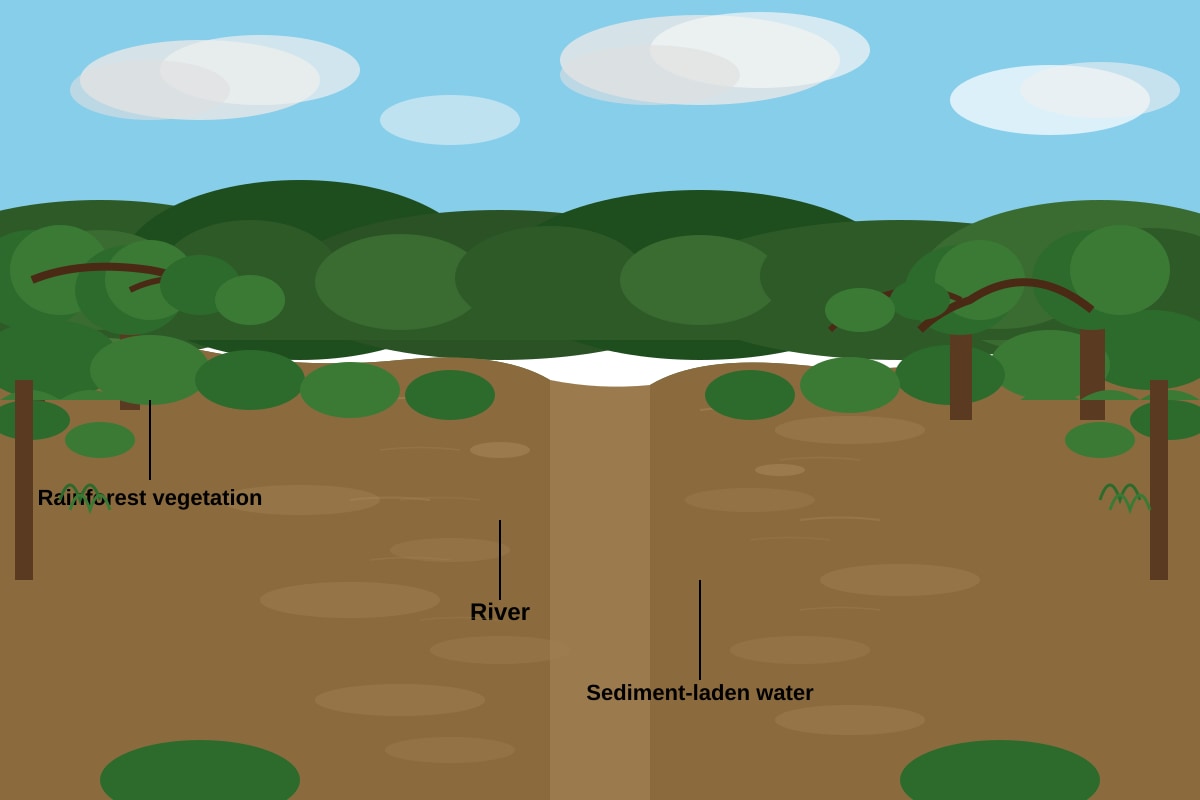
19. (a) The river is wide and appears to be flowing slowly. The water is brownish in colour, suggesting it carries a lot of sediment. [1]
- Marking: Award 1 mark for any one visible characteristic described.
- Explanation: The photograph shows a large, slow-moving river with sediment-laden water.
- Common mistake: Students may infer characteristics not visible (e.g., "the river is deep") without describing what they can actually see.
(b) The river water appears brownish because it carries a high load of sediment (suspended particles of soil and rock). This could be due to erosion of the riverbanks or deforestation in the catchment area, which increases soil erosion and runoff into the river. [2]
- Marking: Award 1 mark for identifying the sediment load. Award 1 mark for suggesting a reason for the high sediment load.
- Explanation: Rivers in tropical rainforests often appear brown or muddy because they carry large amounts of sediment eroded from the land. Deforestation can worsen this by exposing soil to rain.
- Common mistake: Students may say the water is "dirty" without explaining what makes it dirty (sediment) or why there is so much sediment.
20. Two strategies to sustainably manage water resources in Singapore are: [4]
- Marking: Award 2 marks for each well-explained strategy (1 mark for naming the strategy, 1 mark for explaining how it works).
- Model answer:
- NEWater: Singapore treats used water (sewage) using advanced membrane technologies (microfiltration, reverse osmosis, and ultraviolet disinfection) to produce high-grade reclaimed water. This water is used for industrial and air-con cooling purposes, reducing the demand for fresh water.
- Desalination: Singapore desalinates seawater to produce fresh water. This involves removing salt and minerals from seawater using reverse osmosis. This provides a climate-independent source of water, though it is energy-intensive.
- Explanation: Singapore has limited natural water resources. The "Four National Taps" strategy (local catchment, imported water, NEWater, desalination) aims to diversify and secure water supply sustainably.
- Common mistake: Students may name a strategy but not explain how it works or why it is sustainable. Simply saying "recycling water" is not enough; they need to explain the process (e.g., NEWater technology).
END OF ANSWER KEY