From Real Exams Quiz
Secondary 2 Geography Map Graph Data Skills Quiz
Free Exam-Derived NVIDIA Nemotron 3 Ultra 550B A55B Free Secondary 2 Geography Map Graph Data Skills quiz with questions and answers for Singapore students. This page is rendered as a direct URL so the questions and answers can be discovered without pressing in-page buttons.
These static practice materials are generated from the site's syllabus and paper-generation workflow, with source and model context shown so students and parents can evaluate the material before use.
Questions
Secondary 2 Geography Quiz - Map Graph Data Skills
Name: ___________________________
Class: ___________________________
Date: ___________________________
Score: _____ / 40
Duration: 45 minutes
Total Marks: 40
Instructions:
- Answer all questions.
- Write your answers in the spaces provided.
- For questions requiring grid references, state the easting first, then the northing.
- Where calculations are required, show your working clearly.
- The number of marks is given in brackets [ ] at the end of each question or part question.
Section A: Map Skills (15 marks)
Refer to the topographic map extract of Kampung Bahru provided in Figure 1 to answer Questions 1–5.
<image_placeholder> id: Q1-fig1 type: map linked_question: Q1 description: Topographic map extract of Kampung Bahru at 1:25,000 scale. Shows grid lines numbered 10–19 (eastings) and 20–29 (northings). Key features: Hospital at grid square 1425, School at 1623, River flowing NW to SE crossing grid lines 12/24 and 18/28, Contour lines at 10m intervals with spot heights 45m (1324), 62m (1526), 38m (1722). Main road runs NE-SW through grid squares 1325, 1425, 1525. Secondary road runs N-S along easting 16. Land use: residential (pink shading) in NW, commercial (red) along main road, vegetation (green) in SE. labels: Grid lines (eastings 10–19, northings 20–29), Hospital, School, River, Contour lines (10m interval), Spot heights (45, 62, 38), Main road, Secondary road, Residential area, Commercial area, Vegetation area, Scale 1:25,000, North arrow values: Scale 1:25,000; Contour interval 10m; Spot heights: 45m, 62m, 38m must_show: All grid lines clearly labelled; Features positioned accurately in stated grid squares; Contour lines with index contours every 50m; Legend with conventional symbols </image_placeholder>
1. State the four-figure grid reference of the Hospital.
[1]
Answer: ___________________________
2. State the six-figure grid reference of the School.
[1]
Answer: ___________________________
3. The river flows across the map. Using evidence from the map, state the general direction of flow of the river.
[1]
Answer: ___________________________
4. Calculate the straight-line distance in kilometres between the Hospital and the School.
[2]
Working:
Answer: _______________ km
5. Describe the relief of the area shown in the southeast portion of the map (eastings 16–19, northings 20–23). Support your answer with map evidence.
[3]
Answer:
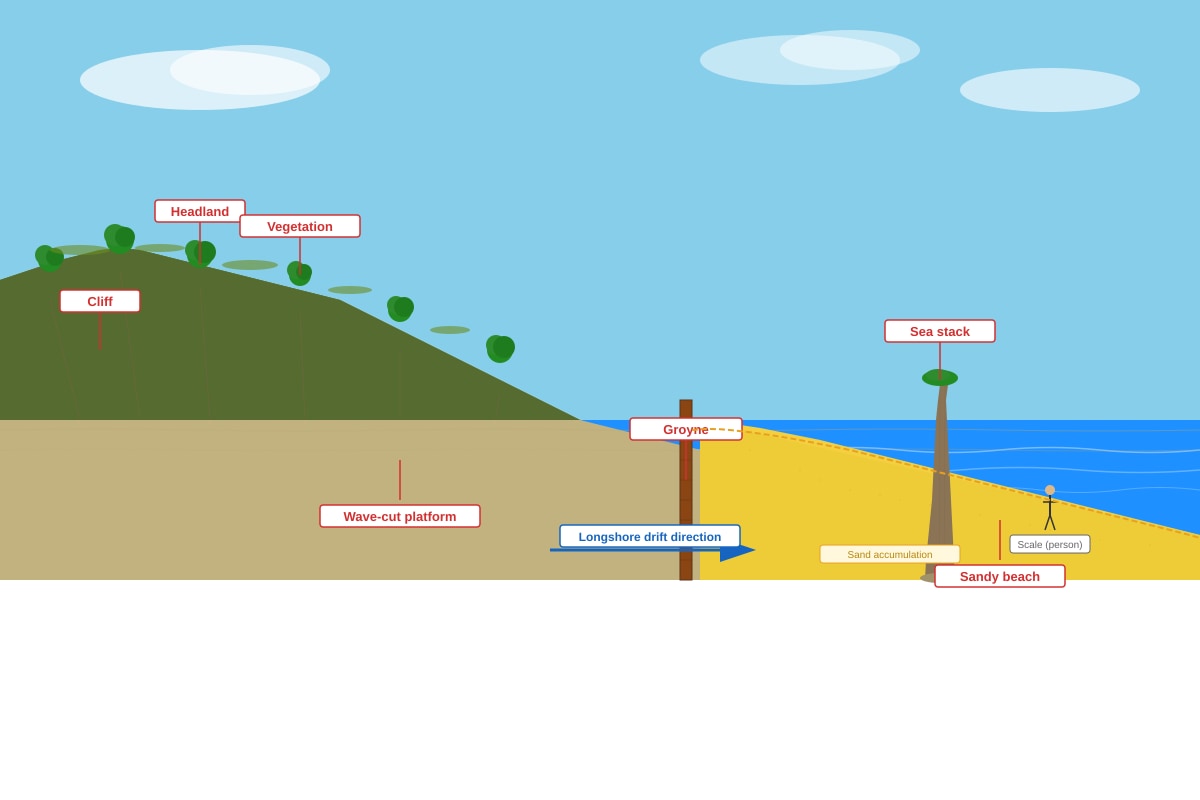
Refer to the photograph in Figure 2 to answer Questions 6–7.
<image_placeholder> id: Q6-fig2 type: source_image linked_question: Q6 description: Oblique aerial photograph of a river valley showing a meandering river with floodplain, steep valley sides with terraced farming, and a settlement on higher ground. River shows clear meanders with point bars on inside bends. Vegetation varies: dense forest on upper slopes, agricultural terraces on mid-slopes, grassland on floodplain. labels: River, Meanders, Point bars, Floodplain, Valley sides, Terraced farming, Settlement, Forest, Grassland, Direction of flow arrow values: None required must_show: Clear meander pattern; Distinct land use zones; Visible relief contrast between valley floor and sides </image_placeholder>
6. Identify two fluvial landforms visible in Figure 2.
[2]
Answer:
(i) ___________________________
(ii) ___________________________
7. Explain one reason why the settlement is located on higher ground rather than on the floodplain.
[2]
Answer:
Refer to the cross-section diagram in Figure 3 to answer Questions 8–9.
<image_placeholder> id: Q8-fig3 type: diagram linked_question: Q8 description: Cross-section along a transect from grid reference 1320 to 1920 across the Kampung Bahru map. Horizontal axis: distance (km) from 0 to 6 km at 1 km intervals. Vertical axis: elevation (m) from 0 to 80 m at 10 m intervals. Profile shows: gentle rise from 10m at 0km to 30m at 2km; steep rise to 65m at 3.5km; gentle decline to 40m at 5km; flat at 38m to 6km. Vertical exaggeration: 25 times. labels: Distance (km), Elevation (m), Vertical exaggeration (25x), Transect line 1320–1920 values: Horizontal scale: 1 cm = 1 km; Vertical scale: 1 cm = 40 m; Vertical exaggeration = 25x must_show: Accurate profile matching map contours; Labelled axes with units; Vertical exaggeration stated </image_placeholder>
8. Calculate the average gradient of the slope between 2 km and 3.5 km along the transect. Express your answer as a ratio in the form 1:x.
[2]
Working:
Answer: 1 : _______________
9. State the vertical exaggeration of the cross-section and explain why vertical exaggeration is used in cross-sections.
[2]
Answer:
Section B: Graph and Data Skills (15 marks)
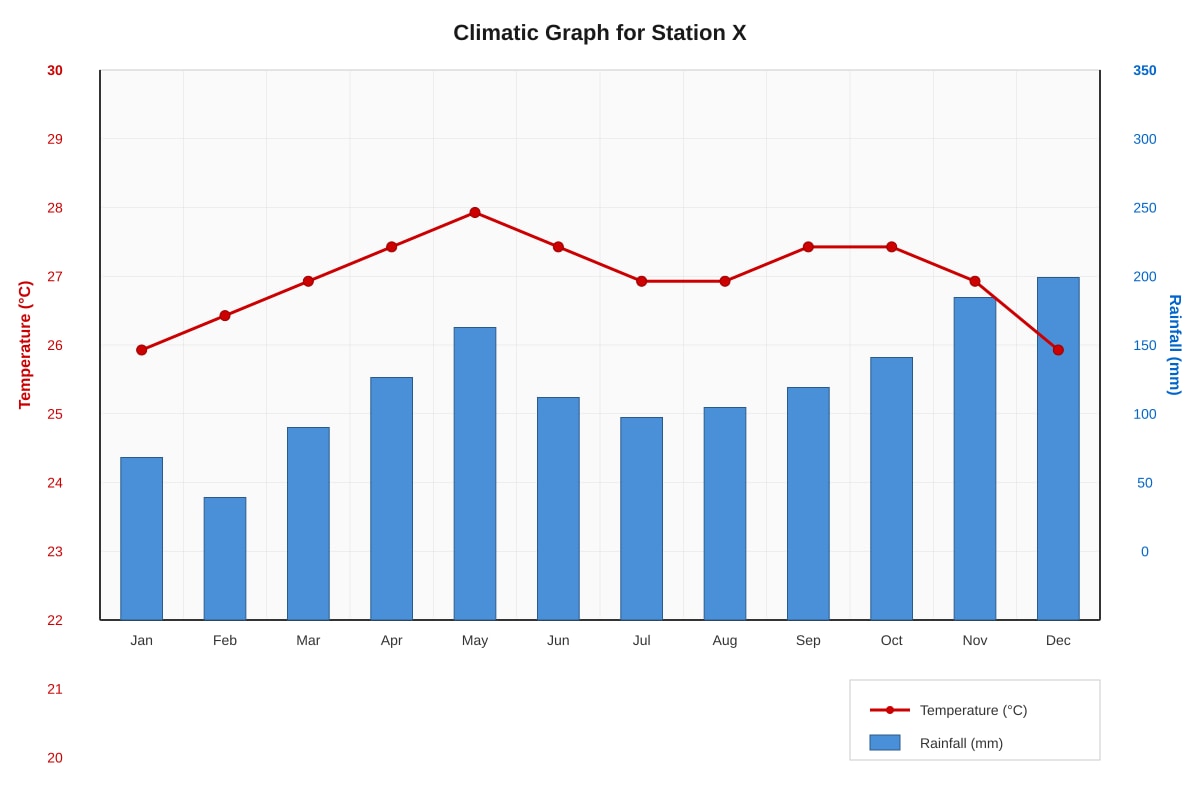
Refer to the climate graph for Station X in Figure 4 to answer Questions 10–12.
<image_placeholder> id: Q10-fig4 type: graph linked_question: Q10 description: Climate graph for Station X (tropical location). X-axis: Months (Jan–Dec). Left Y-axis: Temperature (°C) scale 20–30°C. Right Y-axis: Rainfall (mm) scale 0–300mm. Red line graph: monthly mean temperature (26–28°C range). Blue bars: monthly rainfall (50–280mm). Highest rainfall: Nov (280mm), Dec (260mm). Lowest rainfall: Feb (50mm), Mar (60mm). Temperature peaks: May (28°C), Oct (27.5°C). Temperature lowest: Jan (26°C), Dec (26°C). labels: Months (Jan–Dec), Temperature (°C), Rainfall (mm), Temperature line, Rainfall bars values: Temp range 26–28°C; Rainfall range 50–280mm; Annual rainfall ~1800mm; Annual temp range 2°C must_show: Dual-axis climate graph format; Clear distinction between temp line and rainfall bars; All 12 months labelled </image_placeholder>
10. State the month with the highest rainfall and the month with the lowest temperature.
[2]
Answer:
Highest rainfall: ___________________________
Lowest temperature: ___________________________
11. Calculate the annual temperature range for Station X.
[1]
Working:
Answer: _______________ °C
12. Describe the rainfall pattern shown in Figure 4 and suggest the likely climate type of Station X.
[3]
Answer:
Refer to the population pyramid for Country Y in Figure 5 to answer Questions 13–14.
<image_placeholder> id: Q13-fig5 type: graph linked_question: Q13 description: Population pyramid for Country Y (2023). X-axis: Percentage of total population (-6% to +6% each side). Y-axis: Age groups (0–4, 5–9, ..., 80+). Male bars on left (blue), female on right (red). Broad base: 0–4 (5.2% M, 5.0% F), 5–9 (4.8% M, 4.6% F). Narrowing steadily: 20–24 (3.5% M, 3.4% F), 40–44 (2.1% M, 2.2% F). Very narrow top: 80+ (0.3% M, 0.6% F). Distinct bulge at 25–29 (3.8% M, 3.6% F). Total population ~4.5 million. labels: Age groups (0–4 to 80+), Percentage (%), Male, Female, Year 2023 values: 0–4: 5.2% M, 5.0% F; 25–29: 3.8% M, 3.6% F; 80+: 0.3% M, 0.6% F; Total ~4.5M must_show: Classic expansive pyramid shape; Male/female distinction; Percentage scale; Age cohorts labelled </image_placeholder>
13. Calculate the percentage of the population aged 0–14 (dependent young) in Country Y.
[2]
Working:
Answer: _______________ %
14. Based on the shape of the population pyramid, identify the stage of the Demographic Transition Model (DTM) that Country Y is likely in. Explain your reasoning.
[3]
Answer:
Refer to the scatter graph in Figure 6 to answer Question 15.
<image_placeholder> id: Q15-fig6 type: graph linked_question: Q15 description: Scatter graph showing relationship between GDP per capita (US, log scale), Life Expectancy (years), Country A (outlier), Trend line values: GDP range: 1,000–100,000 (log); Life expectancy range: 50–85; Country A: 25,000 GDP, 68 LE must_show: Log scale on X-axis; Positive correlation trend; Clear outlier labelled; Axes with units </image_placeholder>
15. Describe the relationship between GDP per capita and life expectancy shown in Figure 6. Identify the outlier and suggest one possible reason for its position.
[3]
Answer:
Section C: Data Interpretation and Application (10 marks)
Refer to the data table in Figure 7 to answer Questions 16–18.
<image_placeholder> id: Q16-fig7 type: table linked_question: Q16 description: Table showing Urban Population (%) and Access to Improved Sanitation (%) for 6 countries in 2020. Country | Urban Population (%) | Access to Improved Sanitation (%) A | 15 | 28 B | 42 | 65 C | 78 | 94 D | 92 | 99 E | 55 | 73 F | 30 | 48 labels: Country, Urban Population (%), Access to Improved Sanitation (%) values: As per table above must_show: Complete table with 6 countries; Clear column headers; Units in % </image_placeholder>
16. Plot the data for Countries A, C, and E on the scatter graph axes provided in the answer space below. The first three points (B, D, F) have been plotted for you.
[3]
<image_placeholder> id: Q16-ans-fig type: graph linked_question: Q16 description: Scatter graph axes for student plotting. X-axis: Urban Population (%) 0–100. Y-axis: Access to Improved Sanitation (%) 0–100. Points for B (42,65), D (92,99), F (30,48) pre-plotted. Empty grid for student to plot A (15,28), C (78,94), E (55,73). labels: Urban Population (%), Access to Improved Sanitation (%), Pre-plotted points B, D, F values: X: 0–100%; Y: 0–100%; Pre-plotted: B(42,65), D(92,99), F(30,48) must_show: Labelled axes with scales; Pre-plotted points clearly marked; Grid for plotting </image_placeholder>
Answer space:
(Graph provided above)
17. Describe the relationship between urban population percentage and access to improved sanitation.
[2]
Answer:
18. Country G has an urban population of 68%. Use the graph to estimate the likely access to improved sanitation for Country G.
[1]
Answer: _______________ %
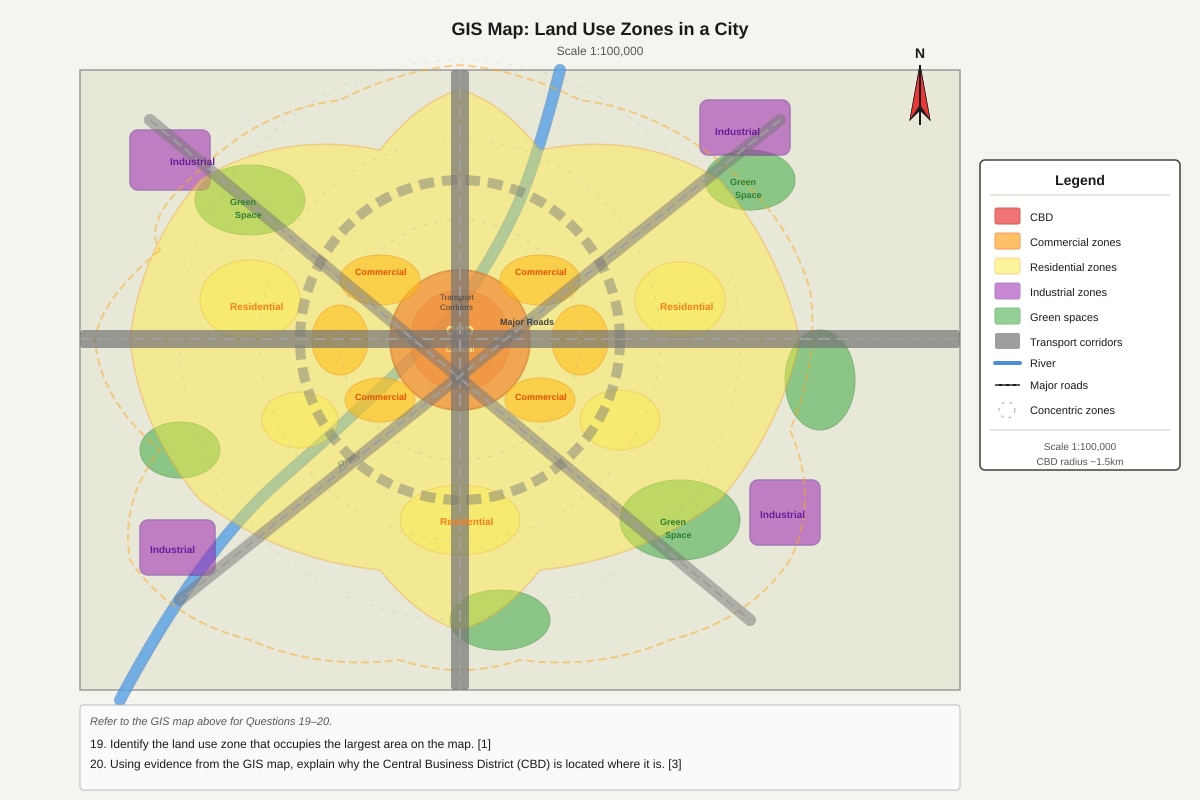
Refer to the GIS map layers description in Figure 8 to answer Questions 19–20.
<image_placeholder> id: Q19-fig8 type: diagram linked_question: Q19 description: Diagram showing 4 GIS map layers for a flood risk assessment: Layer 1: Elevation (DEM) - low lying areas in blue, high areas in red. Layer 2: River network - major rivers in dark blue. Layer 3: Land use - residential (pink), industrial (purple), agricultural (yellow), forest (green). Layer 4: Population density - high (dark red) to low (light yellow). All layers aligned to same grid. Overlay analysis concept illustrated. labels: Layer 1: Elevation (DEM), Layer 2: River Network, Layer 3: Land Use, Layer 4: Population Density, Overlay analysis arrow values: None required must_show: Four distinct layers with legends; Overlay concept visualised; Same spatial extent/grid </image_placeholder>
19. Explain how overlay analysis using these four GIS layers can help identify areas at highest flood risk.
[3]
Answer:
20. Suggest one limitation of using GIS overlay analysis for flood risk assessment.
[2]
Answer:
END OF QUIZ
Answers
Secondary 2 Geography Quiz - Map Graph Data Skills (Answer Key)
Total Marks: 40
Section A: Map Skills (15 marks)
Question 1 [1 mark]
Answer: 1425
Explanation: Four-figure grid references are read by stating the easting (vertical grid line to the left of the feature) first, then the northing (horizontal grid line below the feature). The Hospital is located in the grid square bounded by easting 14 and northing 25.
Common mistake: Reversing the order (writing 2514) or giving a six-figure reference when only four-figure is asked.
Question 2 [1 mark]
Answer: 162233 (or 162234 depending on exact position within the square)
Explanation: Six-figure grid references divide each grid square into 10 tenths horizontally and vertically. The School is at easting 16, northing 23. Estimating its position within the square: approximately 2/10 from the left (easting 162) and 3/10 from the bottom (northing 233), giving 162233.
Marking note: Accept reasonable estimates (e.g., 162234, 163233) if justified by map position.
Question 3 [1 mark]
Answer: Northwest to Southeast (or NW to SE)
Explanation: Rivers flow from higher ground to lower ground. On the map, the river crosses grid lines at 12/24 (higher elevation, spot height 45m nearby) and 18/28 (lower elevation). Contour lines show decreasing elevation toward the southeast. The river's V-shaped contour crossings point upstream (toward NW), confirming flow toward SE.
Key concept: Contour lines bend upstream when crossing rivers (V-shape points to higher ground).
Question 4 [2 marks]
Working:
- Hospital at 1425 → approximate centre: 14.5, 25.5
- School at 1623 → approximate centre: 16.5, 23.5
- Difference in eastings: 16.5 – 14.5 = 2.0 km (since 1 grid square = 1 km at 1:25,000)
- Difference in northings: 25.5 – 23.5 = 2.0 km
- Straight-line distance = √(2.0² + 2.0²) = √8 = 2.828 km ≈ 2.8 km (or 2.83 km)
Answer: 2.8 km (accept 2.8–2.9 km)
Mark breakdown: 1 mark for correct grid-to-distance conversion (1 grid square = 1 km), 1 mark for correct Pythagoras calculation and answer with units.
Common mistake: Forgetting to use Pythagoras theorem (adding 2+2=4 km), or incorrect scale conversion.
Question 5 [3 marks]
Answer:
The southeast portion (eastings 16–19, northings 20–23) is generally low-lying and flat with gentle undulations.
Evidence:
- Spot height at 1722 is only 38 m, indicating low elevation.
- Contour lines are widely spaced (or absent), showing gentle slopes.
- The area is covered by vegetation (green shading), typical of lowland areas.
- No steep slopes or high relief features (e.g., hills, valleys) are shown.
Mark breakdown: 1 mark for overall description (low-lying/flat/gentle), 1 mark for specific map evidence (spot height 38m, wide contour spacing), 1 mark for linking to land use (vegetation).
Key concept: Contour spacing indicates gradient — wide spacing = gentle slope; close spacing = steep slope.
Question 6 [2 marks]
Answer:
(i) Meander(s) / Meandering river channel
(ii) Floodplain / Point bar(s) / River cliff (bluff) / Slip-off slope (any two)
Explanation: The photograph shows a winding river course (meanders) with depositional features on inside bends (point bars/slip-off slopes) and a flat valley floor (floodplain). Terraced farming on valley sides is a human land use, not a fluvial landform.
Marking: 1 mark per correct fluvial landform identified.
Question 7 [2 marks]
Answer:
The settlement is on higher ground to avoid flooding. Floodplains are low-lying areas adjacent to rivers that are inundated during high discharge events. Building on higher ground (e.g., valley sides or terraces) reduces flood risk to lives and property.
Alternative acceptable reasons: Better drainage, healthier environment (less waterborne disease), historical defensive advantage.
Mark breakdown: 1 mark for identifying flood risk/flooding, 1 mark for explaining why higher ground reduces this risk.
Question 8 [2 marks]
Working:
- At 2 km: elevation ≈ 30 m
- At 3.5 km: elevation ≈ 65 m
- Vertical rise (Δh) = 65 – 30 = 35 m
- Horizontal distance (Δd) = 3.5 – 2.0 = 1.5 km = 1500 m
- Gradient = Δh / Δd = 35 / 1500 = 1 / 42.86 ≈ 1 : 43
Answer: 1 : 43 (accept 1 : 42 to 1 : 44)
Mark breakdown: 1 mark for correct reading of elevations and horizontal distance, 1 mark for correct gradient calculation and ratio format.
Note: Vertical exaggeration (25×) does not affect gradient calculation — use actual horizontal and vertical scales.
Question 9 [2 marks]
Answer:
The vertical exaggeration is 25 times (stated on the diagram).
Vertical exaggeration is used because the actual relief variation is very small compared to the horizontal distance, so a true-scale profile would appear almost flat and show no detail. Exaggerating the vertical scale makes slope changes and landform shapes visible for analysis.
Mark breakdown: 1 mark for stating VE = 25×, 1 mark for correct explanation.
Section B: Graph and Data Skills (15 marks)
Question 10 [2 marks]
Answer:
Highest rainfall: November (280 mm)
Lowest temperature: January (26°C) — December also 26°C, accept either
Explanation: Read the highest blue bar (rainfall) and lowest point on the red temperature line.
Marking: 1 mark each.
Question 11 [1 mark]
Working:
Annual temperature range = Highest monthly mean temp – Lowest monthly mean temp
= 28°C (May) – 26°C (Jan/Dec) = 2°C
Answer: 2°C
Key concept: Annual temperature range uses monthly mean temperatures, not absolute daily max/min.
Question 12 [3 marks]
Answer:
Rainfall pattern: High rainfall throughout the year with a distinct peak in November–December (280 mm, 260 mm) and a drier period in February–March (50 mm, 60 mm). No month is completely dry (lowest 50 mm).
Climate type: Tropical Rainforest (Af) or Tropical Monsoon (Am) climate.
Reasoning: Consistently high temperatures (26–28°C, range only 2°C) and high annual rainfall (~1800 mm) with no distinct dry month indicate a tropical climate. The double peak / late-year maximum suggests monsoon influence or equatorial convection.
Mark breakdown: 1 mark for describing rainfall pattern (high year-round, peak Nov–Dec, drier Feb–Mar), 1 mark for naming climate type, 1 mark for linking evidence (temp range, rainfall amount/distribution).
Question 13 [2 marks]
Working:
% aged 0–14 = Sum of % for age groups 0–4, 5–9, 10–14 (both sexes)
From pyramid (approximate values):
- 0–4: 5.2% (M) + 5.0% (F) = 10.2%
- 5–9: 4.8% (M) + 4.6% (F) = 9.4%
- 10–14: ~4.4% (M) + ~4.2% (F) = 8.6% (estimated from pyramid trend)
Total = 10.2 + 9.4 + 8.6 = 28.2%
Answer: 28% (accept 27–30%)
Mark breakdown: 1 mark for correct method (summing three age cohorts for both sexes), 1 mark for reasonable calculation.
Note: Exact values for 10–14 not given; estimation from pyramid shape is expected.
Question 14 [3 marks]
Answer:
DTM Stage: Stage 2 (Early Expanding)
Reasoning:
- Broad base (high 0–4, 5–9 cohorts) → High Birth Rate
- Rapidly narrowing pyramid → High Death Rate (especially infant/child mortality) but falling
- Very narrow top (tiny 80+ cohorts) → Low life expectancy
- Bulge at 25–29 → Possible echo effect or migration, but overall shape is classic Stage 2
- Population growing rapidly due to birth rate > death rate.
Mark breakdown: 1 mark for correct stage (Stage 2), 1 mark for identifying high birth rate evidence (broad base), 1 mark for identifying falling death rate / high mortality evidence (steep narrowing, narrow top).
Common mistake: Confusing Stage 2 (high BR, falling DR) with Stage 1 (high BR, high DR, stable population) — Stage 1 pyramid is more columnar/less tapered.
Question 15 [3 marks]
Answer:
Relationship: Positive correlation — as GDP per capita increases, life expectancy generally increases. The trend is non-linear (logarithmic): large gains in life expectancy at low GDP levels (e.g., 1,000 → 10,000 adds ~15 years), but diminishing returns at high GDP (e.g., 20,000 → 50,000 adds only ~5 years).
Outlier: Country A (GDP ~$25,000, Life Expectancy ~68 years) — lies below the trend line.
Possible reason: High income inequality, poor healthcare access despite wealth, impact of HIV/AIDS or conflict, data error, or specific lifestyle factors (e.g., high obesity, substance abuse).
Mark breakdown: 1 mark for describing positive + non-linear relationship, 1 mark for identifying Country A as outlier, 1 mark for plausible reason.
Section C: Data Interpretation and Application (10 marks)
Question 16 [3 marks]
Answer:
Points to plot:
- Country A: (15, 28)
- Country C: (78, 94)
- Country E: (55, 73)
Marking: 1 mark per correctly plotted point (accurate to ±2% on each axis). Points must be clearly marked (dot with label or cross).
Note: Pre-plotted points: B(42,65), D(92,99), F(30,48).
Question 17 [2 marks]
Answer:
There is a strong positive correlation between urban population percentage and access to improved sanitation. As urban population increases, access to improved sanitation also increases. The relationship appears non-linear: steepest rise at low–medium urbanisation (15% → 55% urban: sanitation 28% → 73%), flattening at high urbanisation (78% → 92% urban: sanitation 94% → 99%).
Mark breakdown: 1 mark for "positive correlation/relationship", 1 mark for noting non-linear pattern or describing trend with data references.
Question 18 [1 mark]
Answer: 82–86% (accept 80–88%)
Explanation: At 68% urban population (between E at 55%/73% and C at 78%/94%), interpolate on the trend. Visual estimation from graph: ~84%.
Marking: 1 mark for reasonable estimate based on graph trend.
Question 19 [3 marks]
Answer:
Overlay analysis combines the four layers to identify spatial coincidence of flood risk factors:
- Layer 1 (Elevation/DEM): Identifies low-lying areas (blue) where water naturally accumulates.
- Layer 2 (River Network): Shows proximity to rivers — areas near major rivers (dark blue) face higher fluvial flood risk.
- Layer 3 (Land Use): Highlights vulnerable land uses — residential (pink) and industrial (purple) areas have high asset value and population exposure; impermeable surfaces increase runoff.
- Layer 4 (Population Density): Shows human exposure — high density (dark red) means more people affected per flood event.
Highest risk areas = where low elevation + near river + urban land use + high population density overlap. GIS allows querying this intersection (e.g., "select areas where elevation < 10m AND distance to river < 500m AND land use = residential AND pop density > 5000/km²").
Mark breakdown: 1 mark for explaining overlay concept (combining layers), 1 mark for linking at least 2 specific layers to flood risk factors, 1 mark for describing how the combination identifies highest risk (intersection of multiple hazards/vulnerabilities).
Question 20 [2 marks]
Answer (any one well-explained):
- Static data / lack of temporal dimension: Layers represent a snapshot; flood risk changes with season, rainfall events, land use change, and infrastructure (e.g., new dams, drainage). GIS overlay alone doesn't model dynamic hydrological processes.
- Data quality/resolution issues: DEM accuracy, outdated land use maps, or coarse population data (e.g., census tracts) can misrepresent actual risk at local scale.
- Ignores flood defences: Levees, dams, drainage systems, and flood walls are not typically in these basic layers but drastically alter actual risk.
- Assumes equal weighting: Simple overlay treats all factors equally; in reality, proximity to river may matter more than population density for hazard, while density matters more for impact.
Mark breakdown: 1 mark for identifying a valid limitation, 1 mark for explaining why it matters for flood risk assessment.
END OF ANSWER KEY