From Real Exams Quiz
Secondary 2 Geography Human Geography Quiz
Free Sec 2 Geography Human Geography quiz, Exam version, with questions, answers, and syllabus-aligned practice for Singapore students.
These static practice materials are generated from the site's syllabus and paper-generation workflow, with source and model context shown so students and parents can evaluate the material before use.
Questions
Free quiz and exam paper access
Enter your details to view this paper
Your access is remembered on this device.
Answers
Secondary 2 Geography Quiz - Human Geography: Answer Key
Total Marks: 40
Section A: Multiple-Choice Questions (5 Questions)
1. Answer: C) The percentage of people living in cities has increased significantly. [1]
Explanation: Urbanisation refers to the increasing proportion of people living in urban areas. Since 1950, most developing countries have experienced rapid urbanisation due to rural-to-urban migration and natural population increase. This is a well-documented global trend.
Common Mistake: Students might choose D if they think of fluctuations in specific countries, but the overall global trend for developing countries is a clear increase.
2. Answer: C) Self-built housing using scrap materials [1]
Explanation: Squatter settlements (also called informal settlements) are characterised by housing that residents build themselves using whatever materials are available, such as corrugated metal, wood, plastic sheets, and cardboard. These settlements are unplanned and lack official approval.
Common Mistake: Students might choose A or D, which describe formal housing characteristics. Squatter settlements are the opposite of planned, formal housing.
3. Answer: B) Rapid rural-to-urban migration exceeding the supply of affordable formal housing [1]
Explanation: When large numbers of people move to cities faster than the city can build affordable housing, they have no choice but to build their own shelter on vacant land. This is the primary cause of squatter settlement growth.
Common Mistake: Students might choose A, but governments do not promote squatter settlements. They are a result of a lack of affordable housing, not a policy.
4. Answer: C) Better access to education and healthcare in the city [1]
Explanation: Pull factors are positive attractions that draw people to a new location. Cities typically offer better schools, hospitals, and other services compared to rural areas, which attracts migrants.
Common Mistake: Students might confuse push and pull factors. A and B are push factors (negative conditions that drive people away from rural areas). D is also a push factor.
5. Answer: B) Providing basic services like water, sanitation, and electricity while allowing residents to stay [1]
Explanation: This is an example of "in-situ upgrading," a sustainable approach that improves living conditions without displacing residents. It is more humane and practical than forced eviction.
Common Mistake: Students might think A (forced eviction) is a solution, but it is often unsustainable and creates new problems for displaced people. C and D do nothing to improve conditions.
Section B: Data-Response Questions (10 Questions)
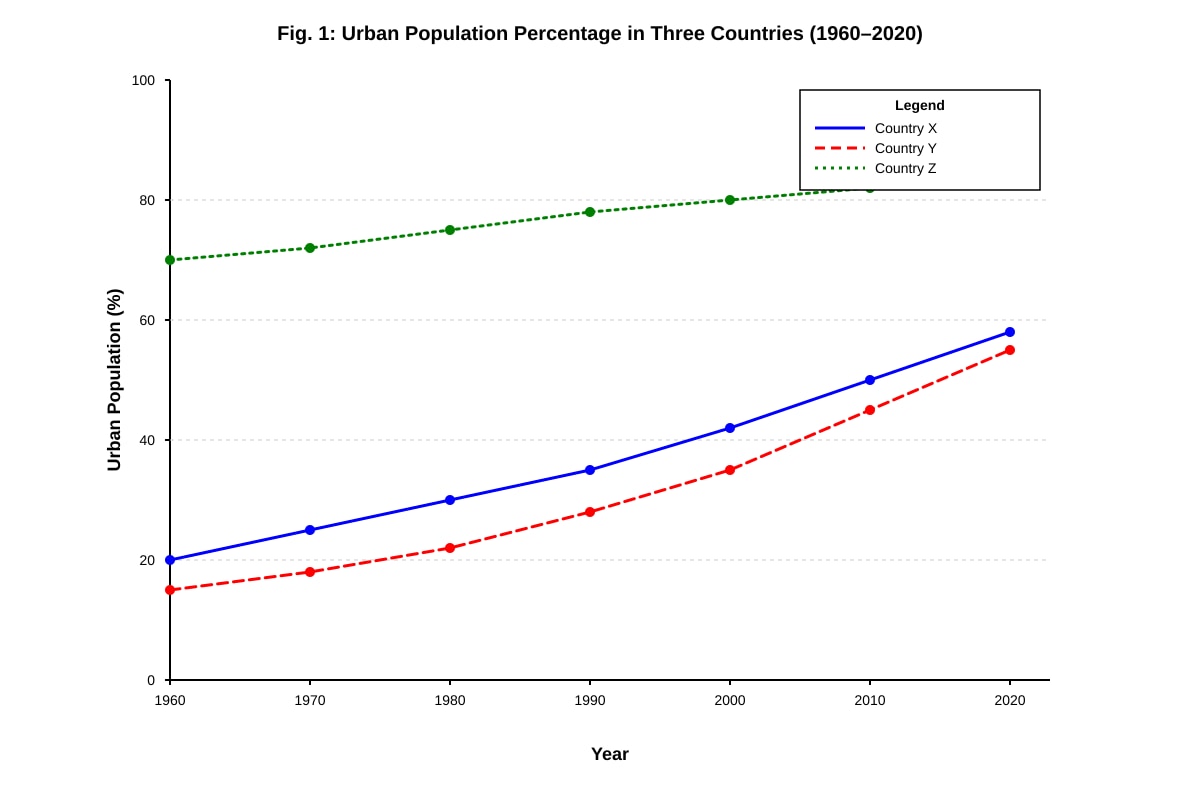
6. Answer: The overall trend for Country X is a steady increase in the percentage of urban population from 1960 to 2020. [1] It rose from 20% in 1960 to 58% in 2020. [1] [Total: 2]
Explanation: The graph shows a clear upward-sloping line for Country X. Students must state the direction of the trend (increase) and support it with specific data points from the graph. The mark scheme awards 1 mark for identifying the trend and 1 mark for using data.
Common Mistake: Describing the trend without using any numbers from the graph.
7. Answer: Both countries experienced an increase in urban population, but Country X urbanised at a faster rate than Country Y. [1] Country X's urban population grew from 20% to 58% (an increase of 38 percentage points), while Country Y's grew from 15% to 55% (an increase of 40 percentage points). However, Country X's growth was more consistent and steeper in the later decades. [1] [Total: 2]
Explanation: Students need to compare the two lines. The key is to note that both increased, but to describe the difference in their rates or patterns. Accept any reasonable comparison supported by data. Note: The actual percentage point increase is similar, but the shape of the curves differs. Accept either a comparison of overall change or a description of the different patterns.
Common Mistake: Simply stating that both increased without comparing them.
8. Answer: Country Z was the most urbanised in 1960. [1] Its urban population percentage was 70% in 1960. [1] [Total: 2]
Explanation: This is a direct data retrieval question. Students must read the graph carefully at the 1960 point. Country Z's line starts at 70%, which is higher than Country X (20%) and Country Y (15%).
Common Mistake: Misreading the graph and giving the value for Country X or Y.
9. Answer: Country Z was likely a more developed country (or had already undergone industrialisation) by 1960, meaning a larger proportion of its population already lived in cities working in factories and services rather than in agriculture. [2]
Explanation: This question requires inference. A high level of urbanisation in 1960 suggests that Country Z's industrial and economic transformation happened earlier. Students should link urbanisation to economic development.
Acceptable alternatives:
- Country Z may have had a smaller agricultural sector.
- Country Z may have had a longer history of urban development.
- Country Z may have been a more industrialised nation.
Common Mistake: Giving a vague answer like "it was more developed" without explaining the link to urbanisation.
10. Answer: One challenge Country X might face is increased pressure on housing and the growth of squatter settlements. [1] As more people move to cities, the demand for affordable housing will increase. If the supply of formal housing cannot keep up, new migrants may be forced to build informal housing on vacant land, leading to the expansion of squatter settlements. [1] [Total: 2]
Explanation: This question asks students to apply their knowledge of urban challenges to the data. The key is to link the increasing urban population to a specific problem and explain the causal mechanism.
Acceptable alternatives:
- Strain on infrastructure (water, electricity, transport).
- Increased traffic congestion.
- Higher levels of pollution.
- Pressure on healthcare and education services.
Common Mistake: Naming a challenge without explaining how it is caused by population increase.
11. Answer: Two characteristics: [1 mark each, max 2]
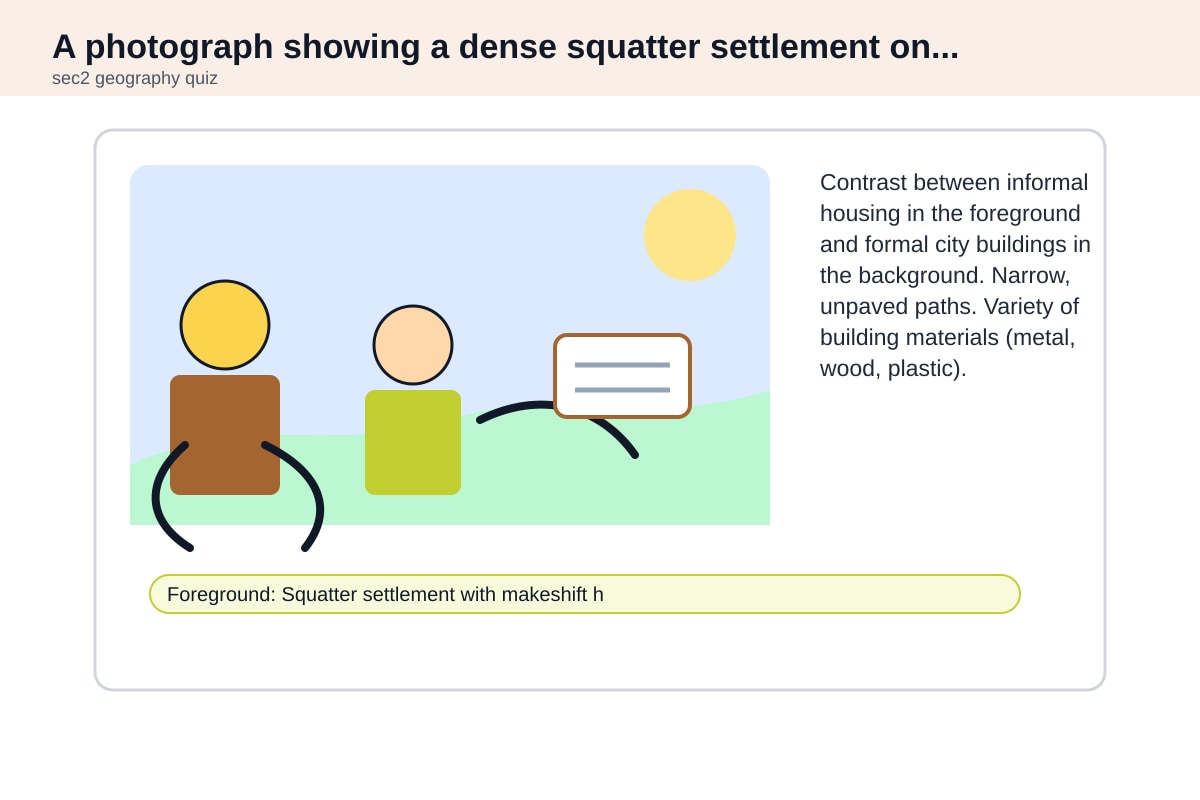
- The houses are made of makeshift materials such as corrugated metal sheets and wood.
- The houses are built very close together with narrow, unpaved paths between them.
- The settlement is located on a hillside, suggesting it is on unsuitable or marginal land.
- There is no evidence of planned layout or proper infrastructure.
Explanation: This is a direct observation question. Students must describe what they can see in the photograph. The mark scheme awards 1 mark for each valid characteristic described.
Common Mistake: Describing what the photograph implies (e.g., "people are poor") rather than what is visible.
12. Answer: Squatter settlements are unplanned and illegal, so the government does not provide them with official services like sewage systems or piped water. [1] The residents do not have legal ownership of the land, so they cannot apply for utility connections. The narrow, unpaved paths also make it difficult to install underground pipes. [1] [Total: 2]
Explanation: Students need to explain the cause-and-effect relationship between the informal nature of the settlement and the lack of sanitation. The key point is that because the settlement is not officially recognised, the government does not extend services to it.
Common Mistake: Simply stating that there is no sanitation without explaining why.
13. Answer: Land on the edge of the city is likely to be cheaper or vacant because it is less desirable for formal development. [1] The residents, who are poor, cannot afford land in the city centre, so they occupy marginal land on the outskirts where they are less likely to be evicted immediately. [1] [Total: 2]
Explanation: This question tests understanding of land value and affordability. The edge of the city often has undeveloped land that is not yet wanted by developers.
Acceptable alternatives:
- There is more available space on the edge of the city.
- The city centre is already built up and has no vacant land.
- The residents want to be close to the city for jobs but cannot afford to live inside it.
Common Mistake: Saying the settlement is on the edge because it is "better" without explaining the economic reason.
14. Answer: Seeing the modern, high-rise buildings in the city centre while living in poor conditions in the squatter settlement can lead to feelings of inequality, frustration, and social exclusion. [1] This contrast highlights the gap between the rich and the poor, which can lower the self-esteem and well-being of squatter settlement residents. [1] [Total: 2]
Explanation: This question requires students to think about the social and psychological impact of visible inequality. The contrast is not just physical but also social.
Common Mistake: Describing only physical differences without linking to social well-being or feelings.
15. Answer: The government could implement an "in-situ upgrading" programme. [1] This involves providing basic services such as piped water, electricity, proper drainage, and paved roads directly to the existing settlement without relocating the residents. The government could also help residents improve their houses by providing loans or building materials. [1] [Total: 2]
Explanation: This question tests knowledge of sustainable solutions to squatter settlements. In-situ upgrading is a key strategy taught in the syllabus.
Acceptable alternatives:
- Providing land titles to give residents security of tenure.
- Building a community centre or school within the settlement.
- Installing street lighting and improving waste collection.
Common Mistake: Suggesting forced eviction, which is not a sustainable or humane solution.
Section C: Structured Response Questions (5 Questions)
16. Answer: [2 marks per push factor, total 4]
Push Factor 1: Lack of job opportunities in rural areas. [1] In many rural areas, there are few jobs outside of agriculture. When harvests are poor or farms are too small to support a family, people have no way to earn a living. This pushes them to move to cities where they hope to find work. [1]
Push Factor 2: Poor access to services in rural areas. [1] Rural areas often lack basic services such as good schools, hospitals, clean water, and electricity. Families may move to cities so that their children can get a better education or so they can access proper healthcare. [1]
Explanation: Push factors are negative conditions in a person's current location that drive them to leave. Students must explain two distinct push factors clearly, describing both the condition and why it causes migration.
Marking Scheme:
- 1 mark for naming a valid push factor.
- 1 mark for explaining how it pushes people to migrate.
- Repeat for the second factor.
Common Mistake: Confusing push factors with pull factors. For example, "better jobs in the city" is a pull factor, not a push factor.
17. Answer: [2 marks per pull factor, total 4]
Pull Factor 1: More job opportunities and higher wages in cities. [1] Cities have a wider range of jobs in factories, construction, and services. These jobs often pay more than farming in rural areas, which attracts people seeking a better income. [1]
Pull Factor 2: Better access to education and healthcare. [1] Cities have more schools, including secondary schools and universities, as well as hospitals and clinics. Families are attracted to cities because they want better opportunities for their children and better healthcare for themselves. [1]
Explanation: Pull factors are positive attractions of a destination. Students must explain two distinct pull factors.
Marking Scheme:
- 1 mark for naming a valid pull factor.
- 1 mark for explaining how it attracts people to the city.
- Repeat for the second factor.
Common Mistake: Giving vague answers like "cities are better" without specifying what is better or why it attracts people.
18. Answer: [2 marks per problem, total 4]
Environmental Problem 1: Lack of proper waste disposal leading to pollution. [1] In squatter settlements, there is often no regular rubbish collection service. Residents may dump garbage in open spaces or into nearby rivers, causing land and water pollution. This creates an unhealthy environment and can spread diseases. [1]
Environmental Problem 2: Poor sanitation and lack of clean water. [1] Without proper sewage systems, human waste may be disposed of in open drains or on the ground. This contaminates the soil and water sources, leading to the spread of waterborne diseases like cholera and diarrhoea. [1]
Explanation: Environmental problems are physical issues in the settlement's surroundings caused by the lack of infrastructure and planning.
Marking Scheme:
- 1 mark for naming a valid environmental problem.
- 1 mark for explaining the problem and its impact.
- Repeat for the second problem.
Acceptable alternatives:
- Air pollution from burning waste or cooking fires.
- Flooding due to lack of drainage.
- Deforestation or soil erosion on hillsides.
Common Mistake: Describing social problems (e.g., crime, poverty) instead of environmental problems.
19. Answer: [4 marks]
In-situ upgrading is an approach where the government improves the existing squatter settlement rather than demolishing it and moving residents elsewhere. [1]
First, the government provides basic services such as piped water, electricity, proper drainage, and paved roads. [1] This directly improves the health and quality of life of residents by giving them access to clean water and sanitation, reducing the spread of diseases. [1]
Second, the government may provide land titles to residents, giving them legal ownership of their land. This gives them security and encourages them to invest in improving their own homes, as they no longer fear eviction. [1]
Explanation: This question requires a clear explanation of the in-situ upgrading strategy. Students should describe what it is and explain at least two ways it helps residents.
Marking Scheme:
- 1 mark for defining in-situ upgrading.
- 1 mark for describing a specific action (e.g., providing services).
- 1 mark for explaining the benefit of that action.
- 1 mark for a second action and its benefit.
Common Mistake: Describing relocation or resettlement instead of in-situ upgrading.
20. Answer: [4 marks]
Award marks for a balanced evaluation with a clear conclusion.
Arguments for providing basic services (in-situ upgrading):
- It is cheaper and faster than building new housing estates. [1]
- It allows residents to stay in their current location, close to their jobs and social networks. [1]
- It is less disruptive to people's lives than forced relocation. [1]
Arguments for relocation to new public housing:
- New housing estates are properly planned with better infrastructure and facilities. [1]
- Relocation can provide residents with legal ownership of a proper home. [1]
- It allows the land occupied by the squatter settlement to be redeveloped for other uses. [1]
Conclusion: [1 mark for a reasoned conclusion]
Sample Answer: Providing basic services to squatter settlements is generally a better solution than relocation because it is more practical and less disruptive. [1] In-situ upgrading is cheaper and faster, allowing governments to help more people with limited resources. [1] It also keeps communities together and allows residents to stay near their jobs. [1] However, relocation may be necessary if the squatter settlement is on dangerous land, such as a flood-prone area. In such cases, safety must come first. [1] Overall, in-situ upgrading is usually the better option because it is more sustainable and respects the needs of the residents. [1]
Marking Scheme:
- 1-2 marks: Describes only one side of the argument without evaluation.
- 3 marks: Discusses both sides but does not reach a clear conclusion.
- 4 marks: Discusses both sides and provides a reasoned conclusion.
Common Mistake: Giving only one-sided arguments without considering the alternative.
End of Answer Key