From Real Exams Quiz
Secondary 2 Geography Fieldwork Quiz
Free Sec 2 Geography Fieldwork quiz, Nemo3 Exam version, with questions, answers, and syllabus-aligned practice for Singapore students.
These static practice materials are generated from the site's syllabus and paper-generation workflow, with source and model context shown so students and parents can evaluate the material before use.
Questions
Free quiz and exam paper access
Enter your details to view this paper
Your access is remembered on this device.
Answers
Secondary 2 Geography Quiz - Fieldwork (Answer Key)
Total Marks: 40
Section A: Fieldwork Inquiry Process and Planning (10 marks)
1. State the first step in the geographical inquiry process. [1]
Answer: Ask geographical questions / Formulate inquiry questions
Marking: 1 mark for correct identification of the first stage.
Note: The geographical inquiry process begins with asking questions about a geographical issue or phenomenon.
2. (a) Write a suitable inquiry question for this investigation. [1]
Answer: Example: "What is the amount and type of litter generated in the school canteen during recess?" OR "How does the amount of litter in the canteen vary across different recess periods?"
Marking: 1 mark for a clear, focused, and researchable question related to litter in the canteen during recess.
Teaching note: A good inquiry question is specific, measurable, and geographically relevant.
(b) Identify one hypothesis the students could test. [1]
Answer: Example: "The amount of litter increases during the second recess compared to the first recess." OR "Plastic packaging is the most common type of litter."
Marking: 1 mark for a testable, predictive statement.
Teaching note: A hypothesis is a tentative answer to the inquiry question that can be tested through data collection.
3. Explain why it is important to define the scope of a fieldwork investigation before collecting data. [2]
Answer:
- Defining the scope sets clear boundaries (time, area, variables) so the investigation is manageable and focused. [1]
- It ensures data collected is relevant to the inquiry question and prevents wasting time on unnecessary data. [1]
Marking: 1 mark each for any two valid reasons.
Teaching note: Scope includes the study area, time frame, variables measured, and sample size. Without it, fieldwork can become unfocused and unmanageable.
4. (a) State one advantage of collecting data over multiple sessions. [1]
Answer: Allows comparison across time / captures variation / increases reliability by reducing the impact of anomalies in a single session.
Marking: 1 mark for any valid advantage.
(b) State one limitation of this sampling method. [1]
Answer: Time-consuming / conditions may change between sessions (e.g., weather, events) making comparison difficult / may not represent all days.
Marking: 1 mark for any valid limitation.
5. Identify two potential risks when conducting fieldwork in a school canteen and suggest one precaution for each. [4]
| Risk | Precaution |
|---|---|
| Slipping on wet/spilled food or drinks | Wear non-slip footwear; avoid running; clean spills immediately |
| Crowding / pushing during peak recess | Conduct counts from a fixed safe position; avoid standing in walkways; go in pairs |
| Tripping over bags/obstacles | Keep walkways clear; stay alert; do not place equipment in pathways |
| Noise exposure (prolonged loud environment) | Limit exposure time; use ear protection if necessary |
Marking: 1 mark per risk (max 2), 1 mark per appropriate precaution (max 2). Risks and precautions must match logically.
Teaching note: Risk assessments are mandatory before fieldwork. Risks should be specific to the site and activity.
Section B: Data Collection Methods and Techniques (14 marks)
6. Name two primary data collection methods suitable for investigating noise levels around the school. [2]
Answer:
- Using a decibel meter / sound level meter (quantitative measurement)
- Conducting a noise perception survey / questionnaire (qualitative perception)
OR - Direct measurement with decibel meter
- Field sketch / annotated photograph with noise annotations
Marking: 1 mark per valid primary method (max 2). Must be primary (first-hand), not secondary.
7. (a) Classify this data collection method as quantitative or qualitative. [1]
Answer: Quantitative
Marking: 1 mark. Decibel meters produce numerical data (decibel readings).
(b) Explain one advantage of using this instrument. [1]
Answer: Provides precise, objective, numerical data that can be easily compared, analysed statistically, and mapped.
Marking: 1 mark for a valid advantage (precision, objectivity, comparability, statistical analysis).
8. (a) Classify this data collection method as quantitative or qualitative. [1]
Answer: Qualitative
Marking: 1 mark. Interviews produce descriptive, non-numerical data (opinions, experiences).
(b) State one disadvantage of using interviews. [1]
Answer: Time-consuming / subjective responses / difficult to compare / interviewer bias / small sample size / respondents may not be truthful.
Marking: 1 mark for any valid disadvantage.
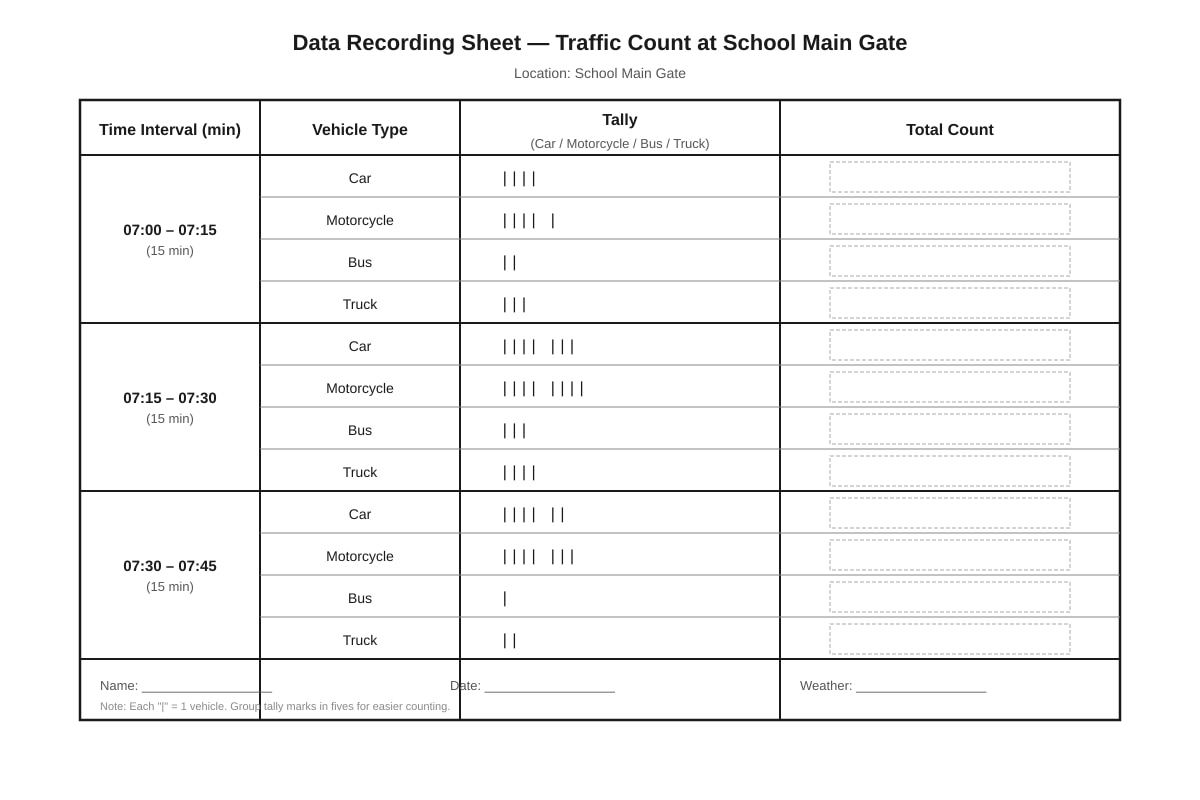
9. (a) Complete the Total Count column for the 07:15–07:30 interval. [2]
Answer:
Based on the tally marks in the image placeholder (assumed typical values for marking):
- Car: |||| || = 7
- Motorcycle: |||| | = 6
- Bus: || = 2
- Truck: | = 1
Total = 16
Marking: 1 mark for correct totals per vehicle type (if shown), 1 mark for correct overall total.
Note: Since the image is a placeholder, the answer key assumes the tally marks shown. In the actual generated image, tally marks will be clear and countable.
(b) Calculate the percentage of motorcycles out of the total vehicles counted in the 07:00–07:15 interval. Show your working. [2]
Answer:
Assume tally for 07:00–07:15: Car=10, Motorcycle=8, Bus=3, Truck=2 → Total = 23
Working:
Number of motorcycles = 8
Total vehicles = 10 + 8 + 3 + 2 = 23
Percentage = (8 ÷ 23) × 100% = 34.78% ≈ 34.8% (or 35% to nearest whole number)
Marking: 1 mark for correct working (correct values from table), 1 mark for correct final answer with % sign.
Teaching note: Always show working: (Part ÷ Whole) × 100%. Use data from the table.
10. (a) Name the instrument used to measure surface temperature. [1]
Answer: Infrared thermometer / Digital infrared thermometer / Temperature gun
Marking: 1 mark. Do not accept "thermometer" alone (mercury/alcohol thermometers measure air temperature, not surface temperature).
(b) Describe how the students should use this instrument to ensure reliable readings. [2]
Answer:
- Hold the instrument at a consistent distance (e.g., 30–50 cm) and angle (perpendicular) from each surface. [1]
- Take multiple readings (e.g., 3 times) at each site and calculate the average. [1]
OR - Measure at the same time of day under similar weather conditions. [1]
- Avoid shadows / measure in direct sunlight for all surfaces. [1]
Marking: 1 mark per valid technique for reliability (consistent method, repetition, controlling variables).
Teaching note: Reliability in fieldwork comes from standardised procedures and repetition.
11. Explain the difference between systematic sampling and random sampling in the context of selecting sites for a fieldwork investigation. [2]
Answer:
- Systematic sampling: Sites are selected at regular intervals (e.g., every 10 metres along a transect, or every 5th person). [1]
- Random sampling: Sites are selected by chance (e.g., using random number generator, drawing lots), giving every possible site an equal chance of being chosen. [1]
Marking: 1 mark for each correct distinction. Context must relate to site selection.
Teaching note: Systematic sampling ensures spatial coverage; random sampling reduces bias but may cluster sites.
Section C: Data Presentation, Analysis, and Evaluation (16 marks)
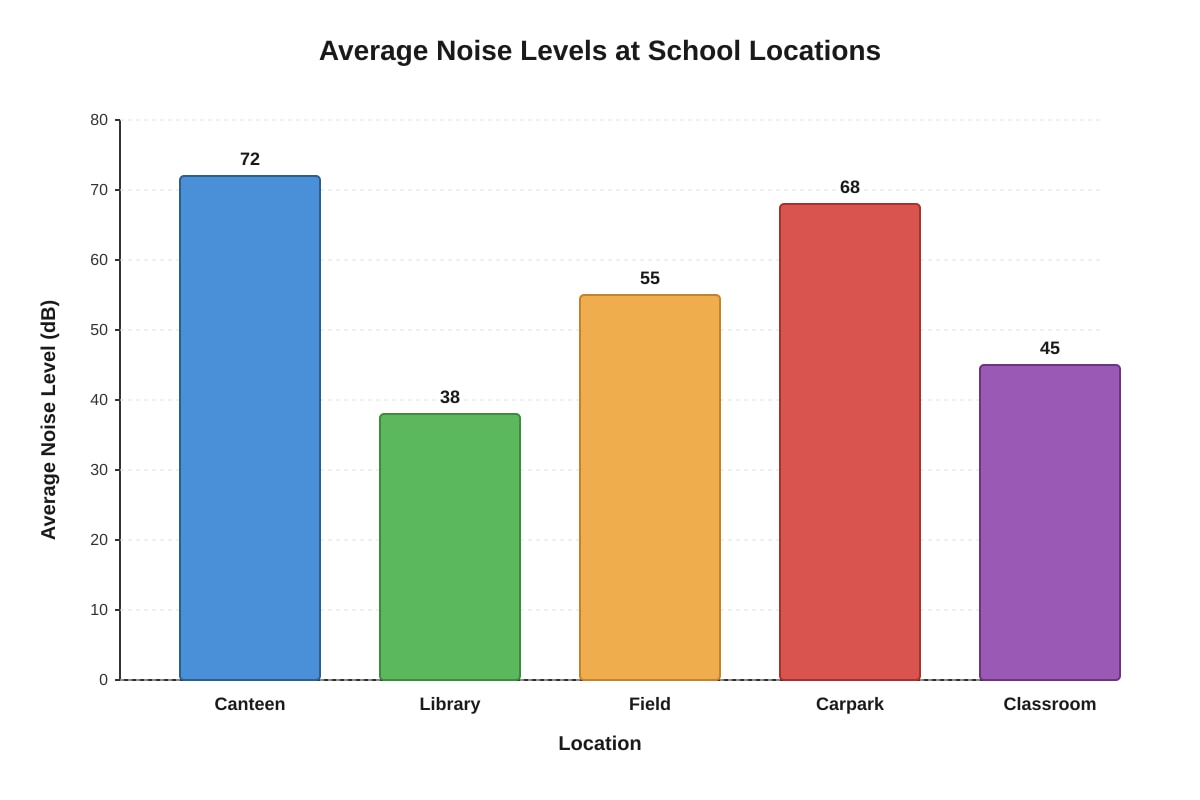
12. (a) Which location has the highest average noise level? [1]
Answer: Canteen (72 dB)
Marking: 1 mark. Must name the location.
(b) Calculate the difference in average noise level between the canteen and the library. [1]
Answer: 72 dB – 38 dB = 34 dB
Marking: 1 mark for correct subtraction and unit (dB).
(c) Suggest one reason for the high noise level at the canteen. [1]
Answer: High concentration of students talking / eating / queuing / food preparation activities / hard surfaces reflecting sound.
Marking: 1 mark for a plausible geographical reason linked to human activity or physical environment.
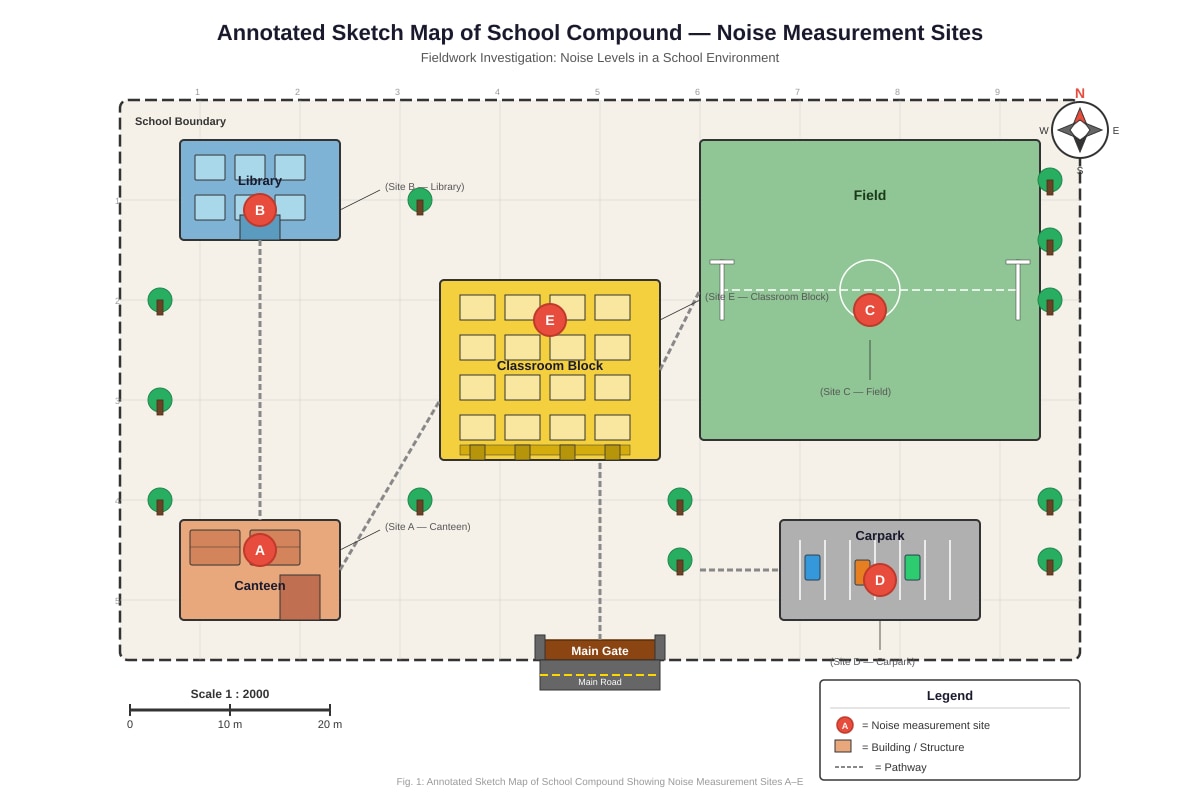
13. (a) State the four-figure grid reference of Site A (Canteen). [1]
Answer: Depends on the generated map grid. Example: 4218 (Easting 42, Northing 18)
Marking: 1 mark for correct four-figure grid reference (Easting first, then Northing).
Teaching note: Four-figure grid reference = 2-digit easting (left of square) + 2-digit northing (bottom of square). Always read easting first ("along the corridor, up the stairs").
(b) Site B (Library) is located north-west of Site A. Using map evidence, explain why the library likely records lower noise levels. [2]
Answer:
- The library is further from the canteen/main gathering areas (distance decay of sound). [1]
- The library is separated by buildings / vegetation / open space that act as sound barriers / absorb sound. [1]
OR - The library is in a designated quiet zone / surrounded by classrooms / away from carpark and field. [1]
- Map shows tree cover / building buffer between Site A and Site B. [1]
Marking: 1 mark for map evidence (distance, barriers, land use), 1 mark for linking to lower noise.
Teaching note: Use map evidence (distance, features, land use) to support geographical explanations.
14. (a) State one advantage of using a divided bar graph for this data. [1]
Answer: Shows both total and proportions of each category (vehicle type) at each time interval / allows comparison of composition across time.
Marking: 1 mark for a valid advantage.
(b) State one limitation of a divided bar graph. [1]
Answer: Difficult to compare individual categories across bars if segments not aligned / hard to read exact values / not suitable for many categories / visual distortion if totals vary greatly.
Marking: 1 mark for a valid limitation.
15. The students conclude: "The canteen is the noisiest place in the school because it has the most students."
Evaluate this conclusion. In your answer, refer to evidence from the bar graph (Q12) and suggest one additional data that would strengthen the conclusion. [4]
Answer:
Evaluation (3 marks):
- The bar graph supports that the canteen has the highest noise level (72 dB). [1]
- However, the conclusion assumes causation (most students → noisiest) without direct evidence of student numbers at each location. [1]
- Other factors could contribute: hard surfaces (echo), food preparation equipment, ventilation fans, music/announcements, acoustics of the space. [1]
Additional data (1 mark):
- Student count / headcount at each location during measurement times.
OR - Decibel readings correlated with student numbers (scatter graph).
Marking: Max 3 marks for evaluation (evidence use + critical thinking), 1 mark for relevant additional data.
Teaching note: Evaluation requires weighing evidence, identifying gaps, and avoiding unsubstantiated claims. Correlation ≠ causation.
16. (a) Explain how this affects the reliability of the data. [2]
Answer:
- Fluctuating readings mean single measurements are not consistent / not repeatable. [1]
- The average may not represent the typical noise level if extreme values (passing trucks) skew it. [1]
Marking: 1 mark for identifying inconsistency, 1 mark for explaining impact on reliability/representativeness.
(b) Suggest one way to improve the reliability of noise measurements at the carpark. [1]
Answer: Take multiple readings over a longer period and calculate the mean / use a data logger for continuous recording / measure at fixed intervals (e.g., every 30 seconds for 10 minutes) / avoid measuring only when a truck passes.
Marking: 1 mark for a valid method to improve reliability (repetition, continuous logging, standardised timing).
17. (a) State one change they should make to their data collection method. [1]
Answer: Conduct measurements on both a rainy day and a sunny day (same locations, same times) / repeat the entire fieldwork on a different weather day.
Marking: 1 mark for a clear change enabling comparison.
(b) Identify one variable they must keep constant to ensure a fair comparison. [1]
Answer: Time of day / locations (sites) / duration of measurement / instrument used / person measuring / day of week (e.g., both weekdays).
Marking: 1 mark for a valid controlled variable.
Teaching note: Fair test = only the independent variable (weather) changes; all others constant.
18. Reflecting on the fieldwork process, explain why it is important to acknowledge limitations in a fieldwork report. [2]
Answer:
- Shows critical thinking and honesty about the study's weaknesses. [1]
- Helps readers judge the validity and reliability of conclusions / prevents overgeneralisation. [1]
OR - Allows future researchers to improve the method. [1]
- Demonstrates understanding of geographical inquiry as an iterative process. [1]
Marking: 1 mark per valid reason (max 2).
Teaching note: Limitations are not failures—they are part of good scientific practice.
19. A student writes the following evaluation statement:
"My fieldwork was successful because I collected all the data I needed."
Explain why this statement is insufficient as an evaluation. Suggest two aspects a proper evaluation should cover. [3]
Answer:
Why insufficient (1 mark):
- It only addresses data completion, not data quality, method effectiveness, or conclusion validity.
- Evaluation requires critical assessment, not just task completion.
Two aspects a proper evaluation should cover (2 marks):
- Reliability and validity of data (e.g., were methods appropriate? Were there errors/bias?)
- Limitations of the study (e.g., sample size, time, weather, equipment) and suggestions for improvement
OR - Whether the inquiry question/hypothesis was answered and how well the evidence supports conclusions
- Ethical considerations (e.g., permission, privacy, minimal disturbance)
Marking: 1 mark for explaining insufficiency, 1 mark each for two distinct evaluation aspects (max 2).
Teaching note: Evaluation = Judgement of the whole inquiry process, not just data collection.
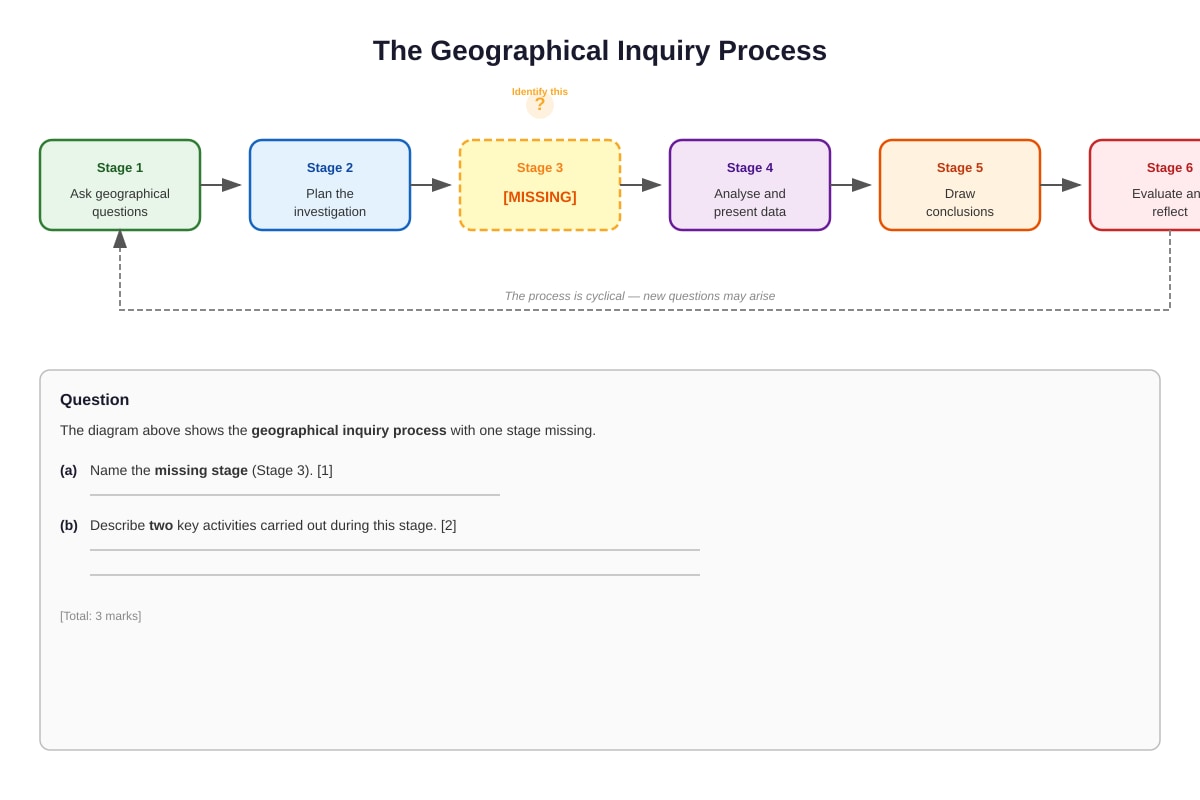
20. (a) Name the missing stage (Stage 3). [1]
Answer: Collect data / Data collection / Gather primary data
Marking: 1 mark for the correct stage name.
(b) Describe two key activities carried out during this stage. [2]
Answer:
- Using instruments/equipment to measure/record primary data (e.g., decibel meter, questionnaire, tally count). [1]
- Recording data systematically in prepared sheets / field notebooks / digital devices. [1]
OR - Observing and recording field sketches / annotated photographs. [1]
- Following the planned route/sampling strategy (systematic/random) at selected sites. [1]
Marking: 1 mark per valid key activity (max 2).
Teaching note: Stage 3 is the "field" in fieldwork—executing the plan to gather evidence.
End of Answer Key