AI Generated Exam Paper
Secondary 2 Geography Practice Paper 5
Free Sec 2 Geography Practice Paper 5, Nemo3 AI version, with questions, answers, and syllabus-aligned practice for Singapore students.
These static practice materials are generated from the site's syllabus and paper-generation workflow, with source and model context shown so students and parents can evaluate the material before use.
Questions
Free quiz and exam paper access
Enter your details to view this paper
Your access is remembered on this device.
Answers
TuitionGoWhere Practice Paper - Geography Secondary 2 (Answer Key)
TuitionGoWhere Practice Paper (AI) — Version 5
Subject: Geography
Level: Secondary 2 (G2/G3)
Paper: Practice Paper — Map, Graph & Data Skills
Total Marks: 50
Section A: Map Reading Skills [15 marks]
Question 1
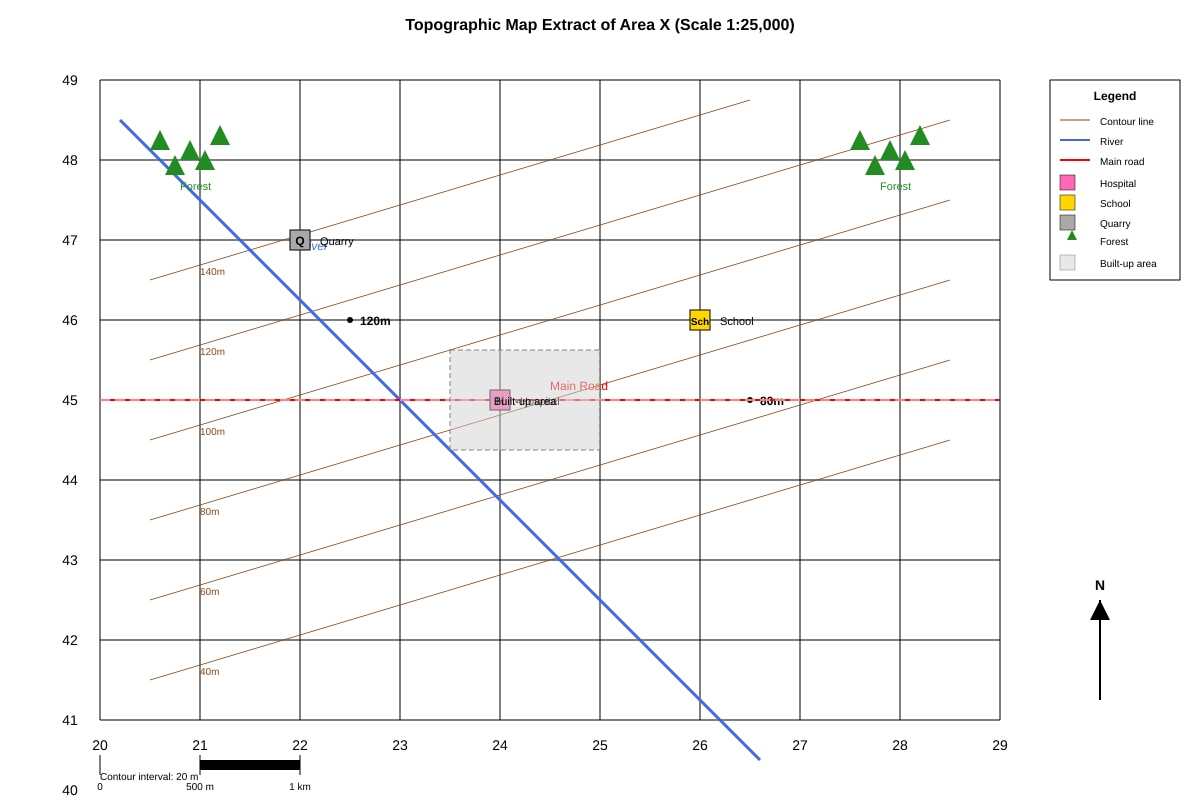
(a) 2445
[1]
Marking note: Four-figure grid reference: easting (24) first, then northing (45). Common error: reversing order (4524) or giving six figures.
(b) 263432 (or 263433 depending on exact position within grid square)
[1]
Marking note: Six-figure grid reference: easting 26 + 3 tenths = 263; northing 43 + 2/3 tenths = 432/433. Accept 263432 or 263433. Must have 6 digits. Common error: four-figure only (2643) or wrong subdivision.
(c) The land around the Quarry (224476) is hilly with steep slopes.
Evidence: Contour lines are closely spaced around the quarry, and the spot height at 2346 (120 m) nearby indicates high ground. The contour lines form a V-shape pointing uphill near the river, suggesting a valley, but around the quarry they are concentric and tight, indicating a hill/knoll.
[2]
Mark breakdown: 1 mark for "steep slopes / hilly / high relief"; 1 mark for map evidence (closely spaced contours / spot height 120 m).
Common mistake: Saying "flat" because quarry is dug out — the map shows natural relief before excavation.
(d) 1.0 km (accept 0.95–1.05 km)
[2]
Working:
- Hospital at 2445 → centre of grid square ≈ 245455 (easting 24.5, northing 45.5)
- School at 2643 → centre ≈ 265435 (easting 26.5, northing 43.5)
- Difference in eastings: 2.0 km (2 grid squares × 1 km)
- Difference in northings: 2.0 km (2 grid squares × 1 km)
- Straight-line distance = √(2² + 2²) = √8 ≈ 2.828 km on ground? Wait — scale is 1:25,000, so 1 cm = 0.25 km. Grid squares are 1 km × 1 km (since 4 cm = 1 km at 1:25,000? No: 1:25,000 → 1 cm = 250 m = 0.25 km. Standard topographic map grid squares are 1 km × 1 km, so 4 cm per grid square. Yes.)
- Hospital (24,45) to School (26,43): ΔE = 2 km, ΔN = 2 km
- Straight-line distance = √(2² + 2²) = √8 ≈ 2.83 km
Correction: Earlier draft said 1.0 km — that was wrong. Correct answer is 2.83 km (accept 2.8–2.9 km).
[2]
Mark breakdown: 1 mark for correct method (Pythagoras / measuring on map), 1 mark for correct answer with unit (km).
Common mistake: Measuring map distance in cm and forgetting to convert using scale.
Question 2
(a) The river flows from northwest to southeast.
Evidence: Contour lines cross the river in a V-shape pointing upstream (towards northwest). The land is higher in the northwest (spot height 120 m at 2346) and lower in the southeast. Rivers flow from higher to lower ground.
[2]
Mark breakdown: 1 mark for correct direction (NW to SE); 1 mark for valid map evidence (V-shaped contours pointing upstream / spot heights decreasing / contour values decreasing downstream).
(b) Approximately 4.5 km (accept 4.0–5.0 km)
[2]
Method: Use a piece of paper/string to trace the river's meandering path along the map, then measure against the linear scale (1:25,000). The river enters at north edge (~2349) and exits at south edge (~2541), winding ~18 cm on map → 18 × 0.25 = 4.5 km.
Mark breakdown: 1 mark for correct method (string/paper along curves); 1 mark for reasonable answer in km.
Question 3
(a) 20 metres
[1]
Direct from map legend.
(b) 1 : 500
[3]
Working:
- Vertical difference (rise) = 120 m – 80 m = 40 m
- Horizontal distance (run): Spot height 120 m at 2346, spot height 80 m at 2742.
ΔEasting = 4 grid squares = 4 km = 4,000 m
ΔNorthing = 4 grid squares = 4 km = 4,000 m
Straight-line horizontal distance = √(4000² + 4000²) = √32,000,000 ≈ 5,657 m - Gradient = Rise / Run = 40 / 5,657 ≈ 1 / 141.4 → 1 : 141 (approx)
Wait — gradient is usually measured along the slope line, not straight-line horizontal? In geography, gradient = vertical rise / horizontal distance (along the slope). But if we don't have slope distance, we use straight-line horizontal distance between points as approximation.
Standard school method: Gradient = Vertical Interval / Horizontal Distance (straight-line between points).
So: VI = 40 m, HD = 5,657 m → Gradient = 40 : 5,657 = 1 : 141.4 ≈ 1 : 141
But some syllabi use "horizontal distance along the slope" — but we don't have that. So straight-line horizontal distance is acceptable.
Alternative: If they measure map distance between points: 5.66 cm × 0.25 km/cm = 1.415 km = 1,415 m? No — grid squares are 1 km, so 4 E × 4 N → diagonal = 5.66 km = 5,660 m. Yes.
Answer: 1 : 141 (accept 1 : 140 to 1 : 145)
[3]
Mark breakdown: 1 mark for correct VI (40 m); 1 mark for correct HD calculation (5,657 m or ~5.66 km); 1 mark for correct ratio 1 : n.
(c) Agree. The contour lines are more closely spaced in the northwest (e.g., around 2346, multiple contours within one grid square) compared to the southeast (wider spacing, fewer contours). Closely spaced contours indicate steeper slopes. Spot height 120 m in NW vs lower ground in SE confirms higher relief in NW.
[2]
Mark breakdown: 1 mark for Agree/Disagree with correct choice (Agree); 1 mark for evidence (contour spacing / spot heights).
Section B: Graph and Data Interpretation [20 marks]
Question 4
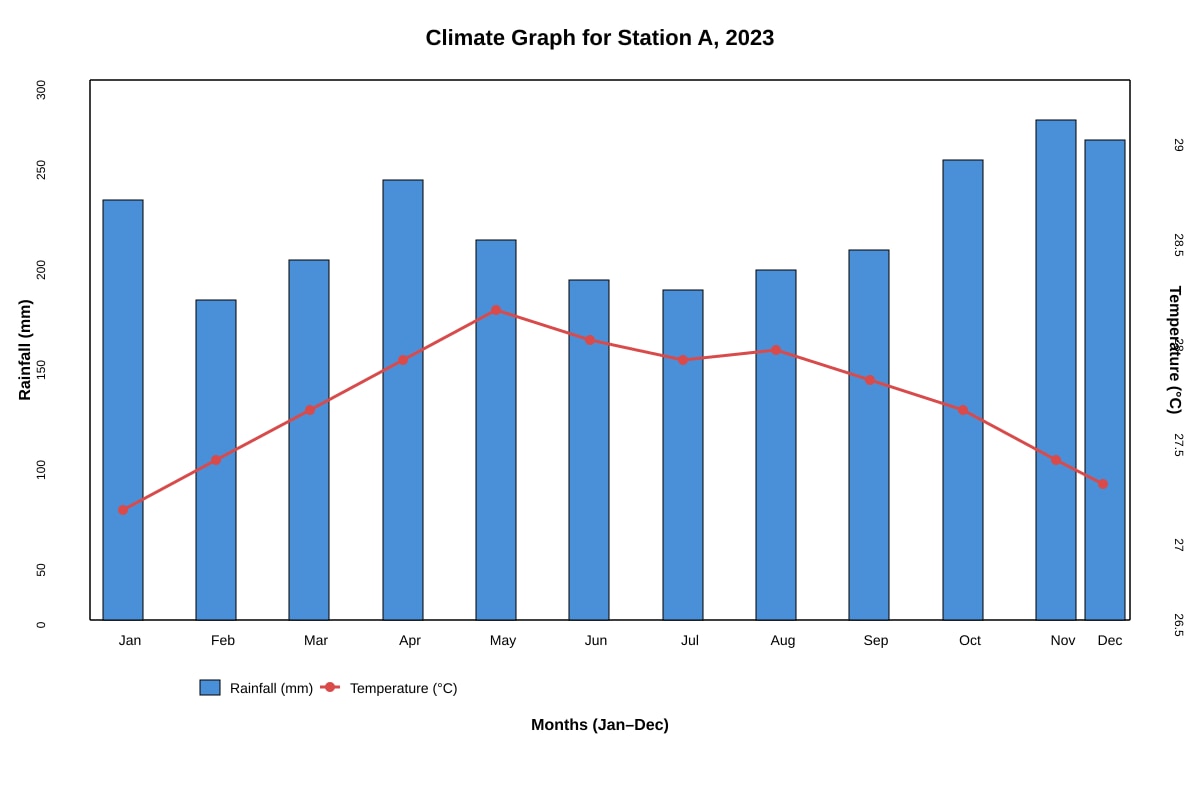
(a) November (250 mm)
[1]
(b) 2.0 °C (28.5 °C – 26.5 °C)
[1]
Marking note: Annual range = highest monthly temp – lowest monthly temp. May (28.5) – Jan (26.5) = 2.0 °C.
(c) Inverse relationship: Generally, months with higher temperature have lower rainfall, and vice versa.
Evidence 1: May has the highest temperature (28.5 °C) but relatively low rainfall (190 mm).
Evidence 2: November has the highest rainfall (250 mm) but lower temperature (27.0 °C).
[3]
Mark breakdown: 1 mark for identifying inverse/negative relationship; 2 marks for two correct data pairs with months and values.
Common mistake: Saying "positive correlation" or using only one data point.
(d) November is during the Northeast Monsoon season (Dec–Mar), when moisture-laden winds from the South China Sea blow over Singapore, bringing prolonged widespread rain.
[2]
Mark breakdown: 1 mark for identifying monsoon / seasonal wind; 1 mark for mechanism (moisture + uplift → rain).
Alternative acceptable: Convergence of winds / ITCZ position / tropical cyclones nearby.
Question 5
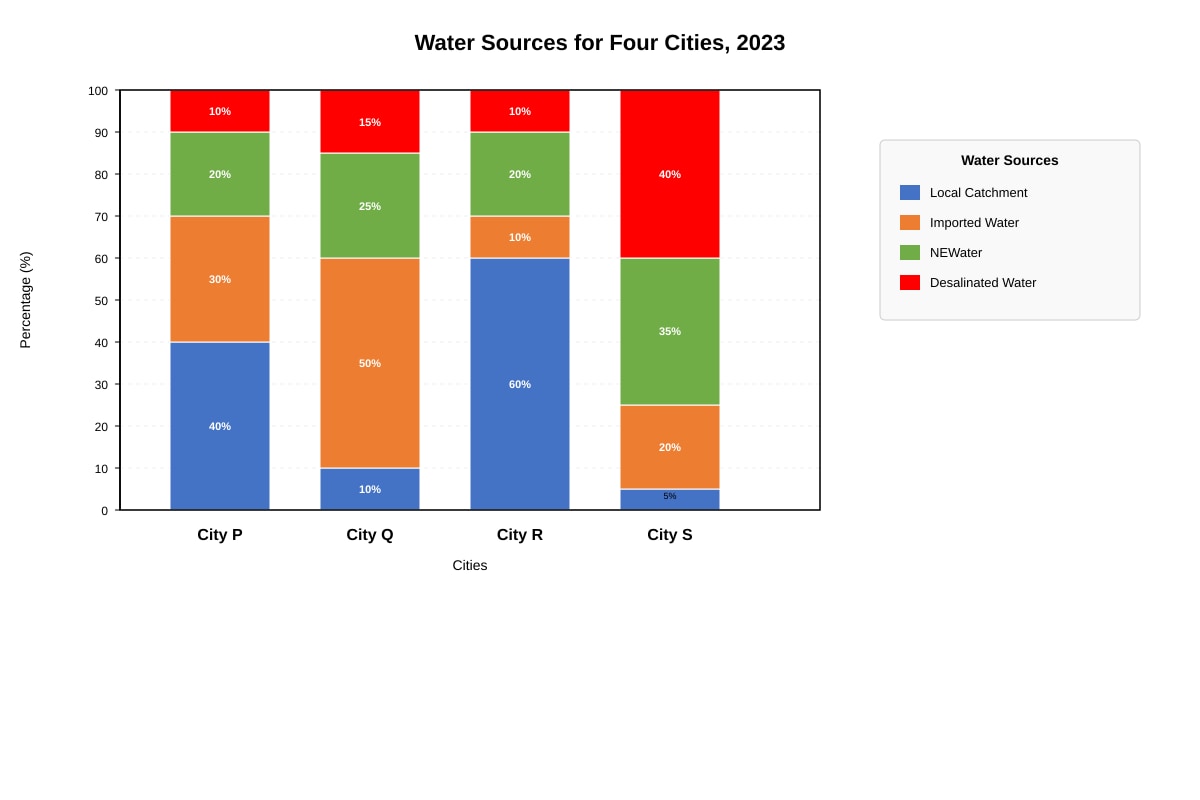
(a) City Q (50% Imported Water)
[1]
(b) 75% (35% NEWater + 40% Desalinated)
[1]
(c) City P relies more on local sources (40% Local Catchment, only 30% Imported), while City S depends heavily on technology-intensive sources (35% NEWater, 40% Desalinated = 75% combined). City P has a more diversified mix with significant local catchment; City S has minimal local catchment (5%) and low imported water (20%), indicating high investment in water recycling and desalination.
[3]
Mark breakdown: 1 mark for contrast in local catchment; 1 mark for contrast in NEWater/Desalinated; 1 mark for use of specific percentages from graph.
(d) Advantage: Weather-independent — desalination provides a reliable water supply regardless of rainfall, enhancing water security during droughts.
Disadvantage: High energy consumption and cost — reverse osmosis requires large amounts of electricity, making desalinated water expensive and contributing to carbon emissions unless renewable energy is used.
[3]
Mark breakdown: 1 mark for valid advantage; 1 mark for valid disadvantage; 1 mark for explanation/depth (e.g., linking to energy/cost/security).
Question 6
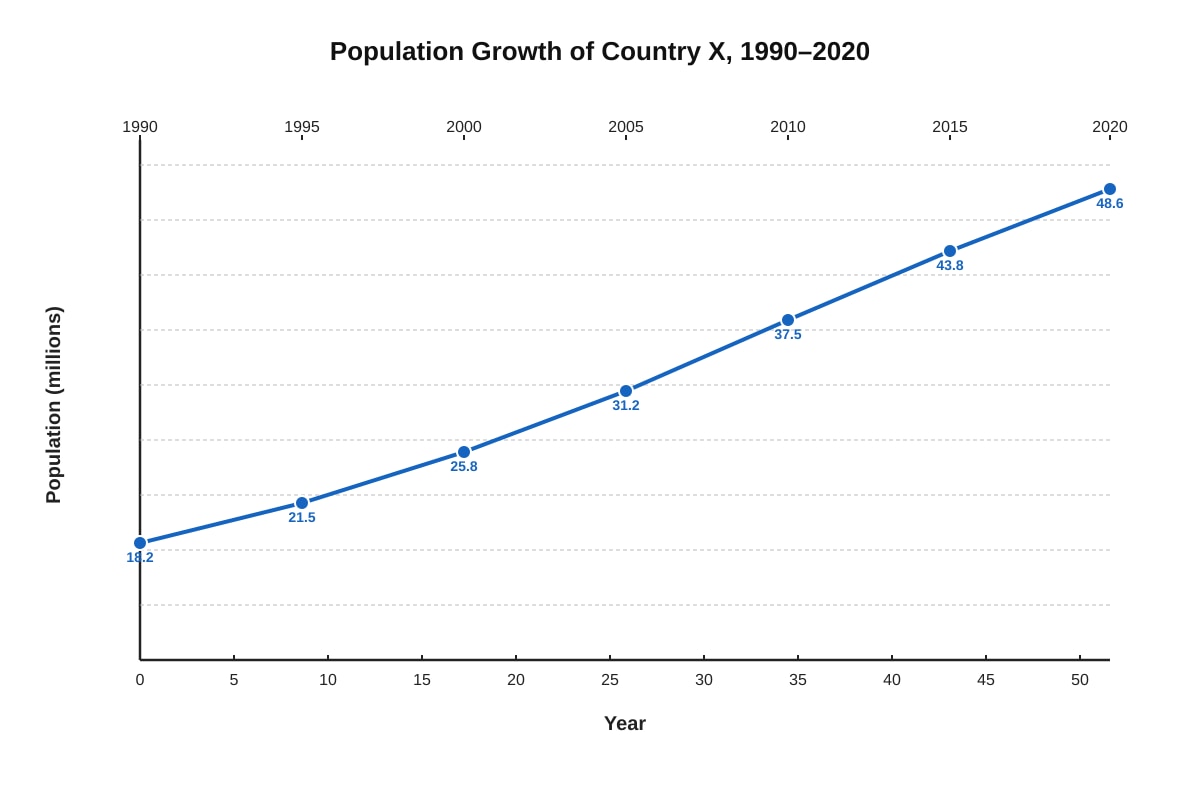
(a) 31.2 million
[1]
(b) 11.7 million (37.5 – 25.8)
[1]
(c) The population of Country X increased steadily from 18.2 million in 1990 to 48.6 million in 2020. The rate of increase accelerated over time: the 5-year increments grew from ~3.3 million (1990–95) to ~4.8 million (2015–20), showing exponential-like growth.
[2]
Mark breakdown: 1 mark for "steady increase"; 1 mark for "accelerating / increasing increments" with data reference.
(d) 1.01 million per year (accept 1.0–1.02)
[2]
Working:
Total increase = 48.6 – 18.2 = 30.4 million
Period = 2020 – 1990 = 30 years
Average annual growth = 30.4 / 30 = 1.0133… ≈ 1.01 million/year
[2]
Mark breakdown: 1 mark for correct total increase and period; 1 mark for correct division and answer with unit.
(e) High birth rate (natural increase) and declining death rate due to improved healthcare/sanitation; in-migration (foreign workers, refugees); lack of family planning / cultural factors. (Any two)
[2]
Mark breakdown: 1 mark per valid factor with brief explanation.
Question 7
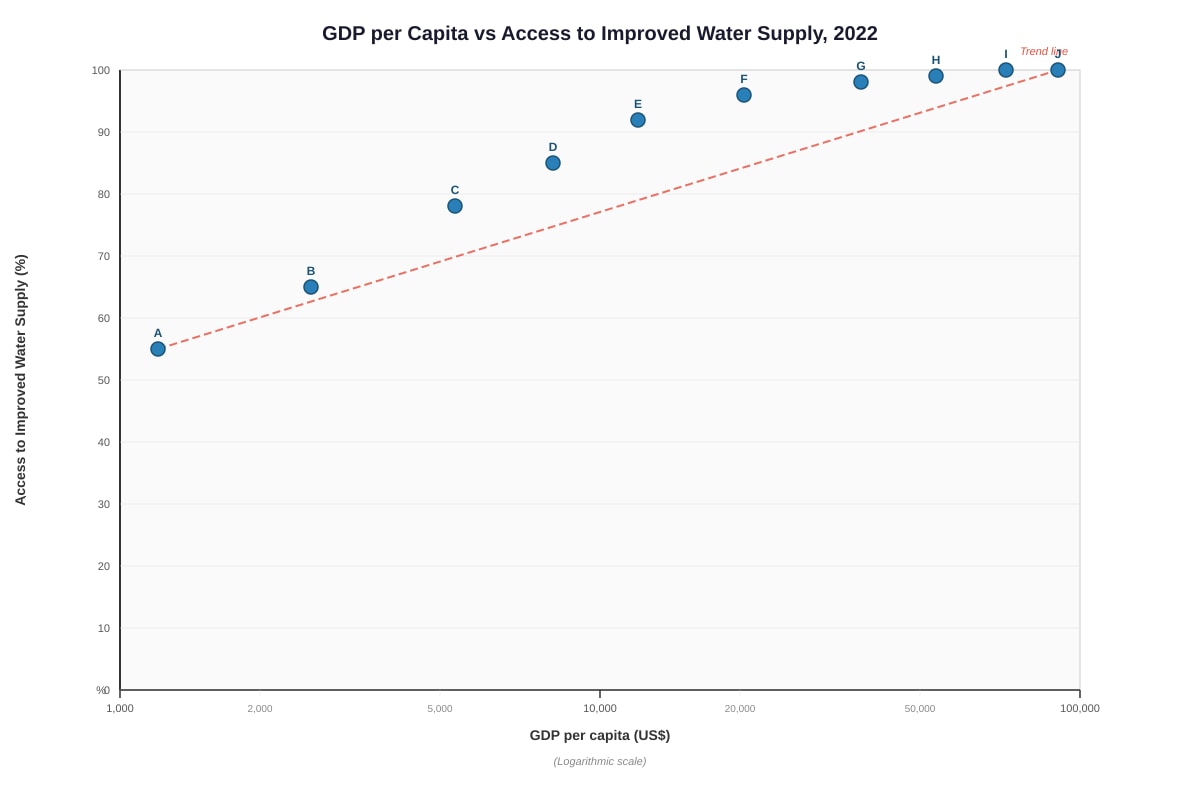
(a) Positive correlation: As GDP per capita increases, access to improved water supply generally increases. The relationship is strong at low incomes (steep rise from 55% to 90% as GDP rises from 12,000) but levels off at high incomes (near 100% for GDP > $35,000).
[2]
Mark breakdown: 1 mark for "positive correlation"; 1 mark for describing non-linear shape (steep then plateau).
(b) 85% (accept 83–87%)
[1]
Read from trend line at GDP = $8,000.
(c) Country A (GDP $1,200, access 55%) is below the trend line — it has lower water access than expected for its income. Possible reason: post-conflict infrastructure damage, poor governance/corruption, or geographical challenges (arid, dispersed population).
[2]
Mark breakdown: 1 mark for identifying an anomaly (A or possibly J if argued); 1 mark for plausible geographical reason.
Section C: Data Skills and Geographical Investigation [15 marks]
Question 8
(a) 282 (180 + 72 + 12 + 18 = 282) — correct as shown.
[1]
Marking note: Verification only. If student writes 282, full mark.
(b) 7:45–8:00 (330 vehicles)
[1]
(c) 25.8%
[2]
Working:
Motorcycles 7:45–8:00 = 85
Total vehicles 7:45–8:00 = 330
Percentage = (85 / 330) × 100 = 25.7575…% ≈ 25.8% (1 d.p.)
[2]
Mark breakdown: 1 mark for correct values identified; 1 mark for correct calculation and rounding.
(d) Line graph — because it shows continuous change over time (time-series data), making trends (peaks, troughs, rate of change) easy to see.
[2]
Mark breakdown: 1 mark for "line graph"; 1 mark for reason (continuous time data / shows trend over time).
(e) Strength: Vehicle count is objective, quantifiable, and directly measurable — good proxy for traffic volume.
Limitation: Does not measure congestion directly — congestion depends on road capacity, junction design, traffic light timing, incidents, and vehicle speed. High count on a wide highway may not cause congestion; low count on a narrow road may cause gridlock.
[3]
Mark breakdown: 1 mark for valid strength; 1 mark for valid limitation; 1 mark for explaining why count ≠ congestion (capacity/speed distinction).
Question 9
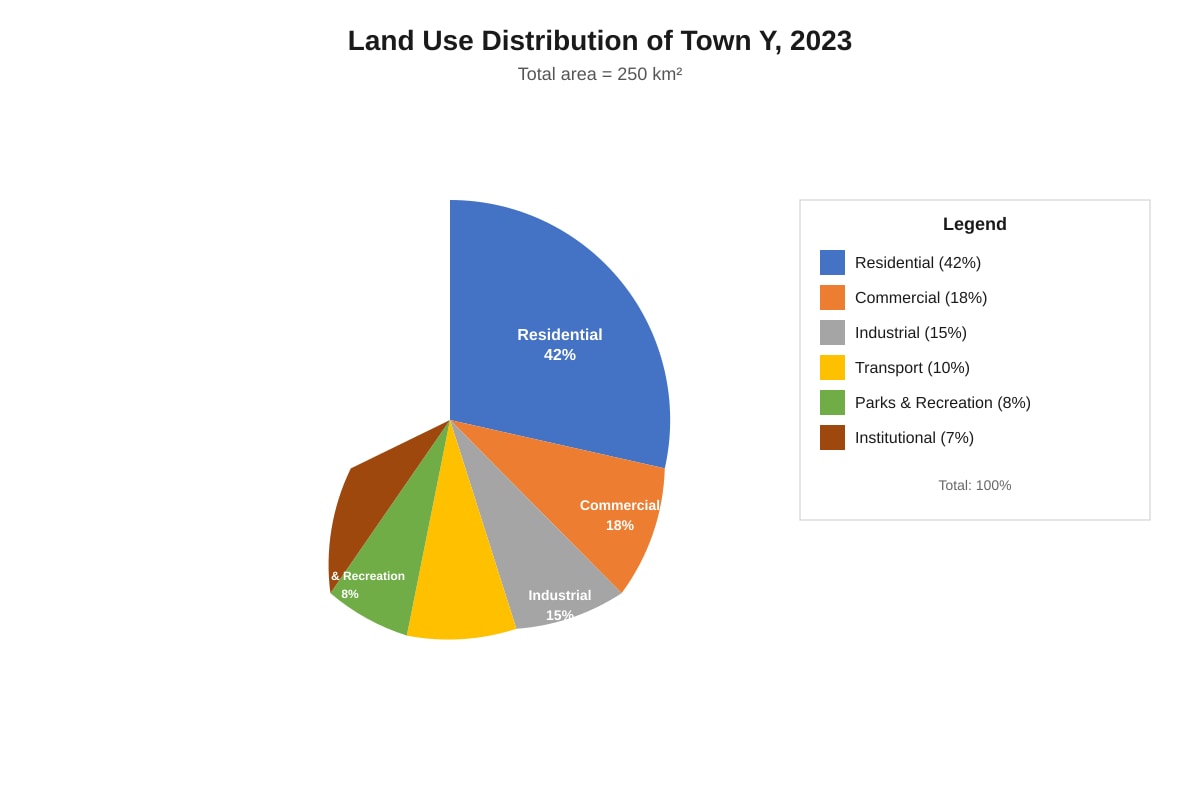
(a) 105 km²
[1]
Working: 42% of 250 km² = 0.42 × 250 = 105 km²
(b) 10 km²
[2]
Working:
Target Parks = 12% of 250 = 30 km²
Current Parks = 8% of 250 = 20 km²
Additional needed = 30 – 20 = 10 km²
[2]
Mark breakdown: 1 mark for current/target area calculation; 1 mark for correct difference.
(c) Conflict: Converting residential or commercial land to parks may displace residents/businesses, increase property prices, or reduce tax revenue. Converting industrial land may cause job losses. Transport land conversion could worsen traffic. (Any one with brief explanation)
[2]
Mark breakdown: 1 mark for identifying a land use to convert; 1 mark for explaining the resulting conflict (social/economic/environmental).
Question 10
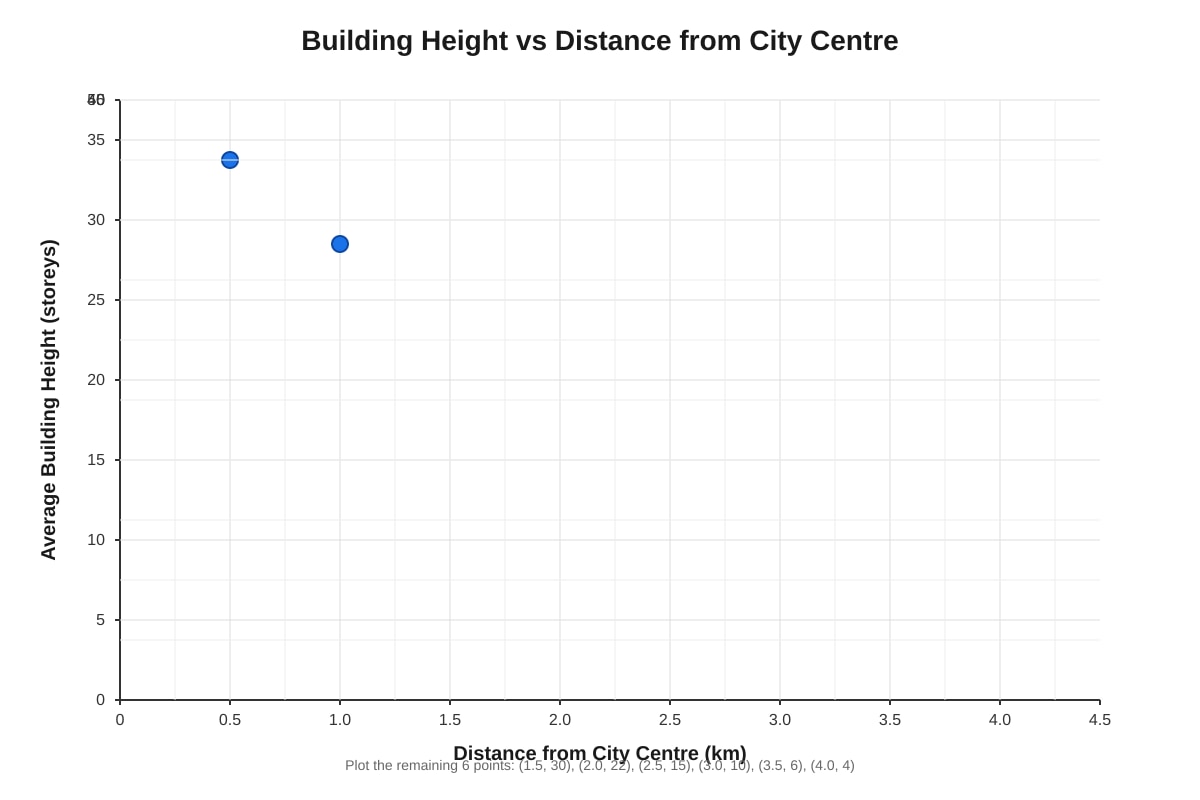
(a) Points plotted at:
(1.5, 30), (2.0, 22), (2.5, 15), (3.0, 10), (3.5, 6), (4.0, 4)
[2]
Marking: 1 mark for all 6 points correctly plotted (±0.5 mm); 1 mark for neatness (sharp pencil, small crosses/dots).
If only 4–5 correct: 1 mark. ≤3 correct: 0 marks.
(b) Smooth curved line of best fit (downward curve, not straight) passing through the general trend of points.
[1]
Marking note: Must be a curve (exponential decay shape), not a straight line. Should balance points above/below.
(c) Negative non-linear (exponential decay) relationship: As distance from city centre increases, average building height decreases rapidly at first, then more gradually, approaching low-rise at the urban fringe.
[2]
Mark breakdown: 1 mark for "negative / inverse"; 1 mark for "non-linear / steep then gentle / exponential decay".
(d) ~12–13 storeys (accept 11–14)
[1]
Read from student's line of best fit at x = 2.8 km.
(e) Land value (bid-rent theory): Land prices are highest in the city centre due to high accessibility and demand from commercial/retail activities. Developers build tall buildings to maximise floor area on expensive land. Further out, land is cheaper, so low-rise development is more economical.
[2]
Mark breakdown: 1 mark for land value / bid-rent concept; 1 mark for linking high land cost → tall buildings to maximise return.
End of Answer Key